
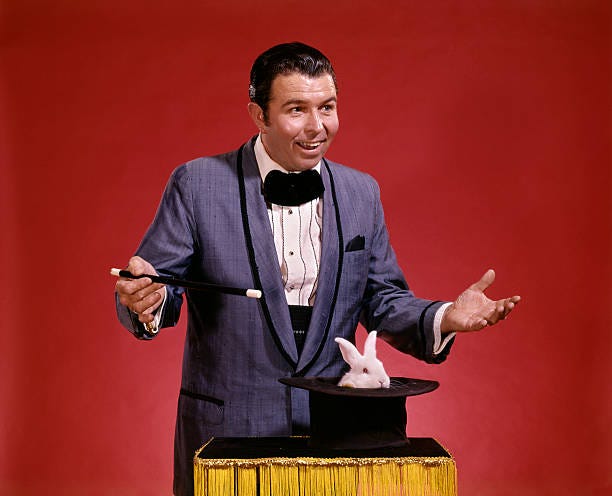
My first reaction was not concern. I want to be upfront about that. What I felt, watching my manager work on Pat Kowalski over the course of a year, was the thing you feel at a magic show — the certainty that something dishonest has occurred at the exact center of your attention, and the desire to see it again.
A weekly stand-up, a Tuesday in January. Nine of us in a semicircle taking turns saying “no blockers.” Priya was going on leave, her Tuesday reporting had to land somewhere, and the whole room had spent the morning perfecting a posture that said not it. I’d prepared the sentence “I’m at capacity through the foreseeable.” Practiced it twice in the car to ensure I landed the word foreseeable with sincerity.
Dana didn’t assign it. She didn’t ask. She looked at a point just over our heads — the middle distance, a place I would come to know well — and said:
“There’s probably a smarter way to run the Tuesday reports than how Priya’s been doing it. That’s a real opportunity for somebody.”
Then she moved to the next agenda item.
Priya was still in the room. Due in three weeks, standing slightly outside the semicircle, one hand on her back. She nodded along while her job was complimented in the past tense. Nobody looked at her. I didn’t look at her.
Forty seconds. That’s roughly how long it took Pat. He waited until we were on the topic of the spring offsite, then circled back — his phrase — and said he’d been thinking, and he’d like a crack at the Tuesday reports. He suspected there was some fat to trim.
“Only if you have the capacity,” Dana said, in the tone of someone protecting him from himself.
He assured her he did. Then he thanked her.
He thanked her. She had handed a man a second job, and the transaction was built so that he walked away grateful, the rest of us walked away relieved, and she walked away having asked no one for anything. I turned it over at my desk all afternoon like a card that had somehow gotten into my own pocket.
Everyone liked Pat. When anyone left the company — anyone, including people Pat had known for six weeks — it was Pat who bought the card, Pat who circulated it in a manila envelope with a sticky note reading sign & pass, Pat who tracked down the one holdout in Logistics on the last morning. Nobody assigned him this. There is no card budget. He kept a drawer of them, pre-purchased, blank inside, ready for departures no one had announced yet, which sounds ominous now but at the time was just Pat: a man quietly prepared for everyone else’s goodbye.
I tried sharing the stand-up story with my wife that night, and it died in the retelling. This kept happening with Dana material — the stories required you to have been standing in the semicircle. What I had, out loud, at the dinner table, was: a manager mentioned an opportunity and a coworker took it.
“So he volunteered,” my wife said.
“Yes,” I said. “Technically.” The way a rabbit technically volunteers to be in the hat.
She looked at me for a second and went back to her plate, and I sat there with the feeling of a man who has seen something real and returned with no evidence. This, I’d learn, was also part of the design. The trick doesn’t just work on the person it’s performed on. It works on the witnesses, retroactively, at their dinner tables.
Things flowed toward Dana constantly, and she never asked for any of them. Water is technically never asked for by a drain. And what I’d seen at stand-up turned out to be one instrument in a case of several, played in rotation, tuned to the room.
Here is what I could tell you about Dana after four years. She has two kids — I know this because she references “the kids” in the plural, scheduling around them, though I’ve never learned their names or ages. She’s “not a big birthday person,” which we found out when we tried to celebrate hers, once. She had a husband at some point who stopped coming up. She eats the same desk salad at 11:40 every day, and she owns a mug that says ONE DAY AT A TIME, and in four years I have never seen her drink from it.
I want you to notice what kind of list that is. Four years of daily proximity, and every item on it is either a boundary or a prop. I have coworkers I’ve known four months and I could tell you their opinions on air fryers, their sisters’ custody arrangements, the exact wrong thing they said at a wedding. Dana I could describe to a sketch artist and to no one else. It took that January stand-up for me to understand that this wasn’t privacy. Privacy is when the door is closed. With Dana there was a door, and it was open, and behind it was another door.
The coffee I only understood in hindsight, which is where I understand most things.
Pat came in late one Wednesday. Genuinely late — forty minutes, a situation involving his mother-in-law and a car. Before his bag hit the floor, Dana was at his desk with a coffee. Not a pointed coffee. A warm, correct coffee, with the amount of cream he enjoys, which meant she knew the amount of cream he enjoys.
“Rough morning? I moved your nine o’clock. Don’t even worry about it.”
She walked away before he could respond. That was the load-bearing part. You have to leave before the thank-you.
Here’s what I’ve worked out about unrequested favors. A favor you ask for has a size — you set the price yourself, going in. A favor that arrives unasked has no figure on it, so it can never be fully paid off. You just make installments, indefinitely, at a rate the other person gets to feel out. Pat stayed until eight that night. I’m not claiming the coffee did that. I’m telling you he stared at her empty office multiple times, and he stayed anyway. Ask Pat and he’d have said, that it was his own idea.
My mother in law does this exact thing, but with casserole.
The offsite happened in April, at one of those paint-your-own-ceramics studios that survive entirely on birthday parties and corporate team-building. You know the kind of thing. Blank mugs, rows of paint pots with names like Intentional Blue, a facilitator in heritage linen who told us she wasn’t leading the session, she was holding space for it. We were asked to paint what growth looked like to us and to set an intention. I set the intention of not making eye contact.
Dana didn’t come. She’d booked the offsite, championed the offsite, sent the calendar invite with a note that said you’ve all earned this — and then a conflict materialized, the way her conflicts did, at the last minute, apologetically, leaving eight people to bond in her honor while she stayed behind at the office doing whatever it is drains do when the water’s away.
I ended up sitting next to Pat. He was painting his mug with tiny, methodical hatch marks, and for a while we worked in the comfortable silence of two people who have chosen an activity over a conversation. Then, without looking up from his mug, he said:
“Can I tell you something? It stays here.”
I said sure. At our company, ‘it stays here’ is a thing people say, not a thing that happens — a relay, not a vault. But you say sure, because why wouldn’t you?
He lowered his voice, glanced at the facilitator, and told me Dana was under real pressure from above. That there were conversations happening about the team — his air quotes, her phrasing — and she was shielding all of us from them. That she’d told him she probably shouldn’t be saying anything, but he was the one person she didn’t have to manage, and some days that was the only thing getting her through.
He painted while he said it. Little hatch marks, very even. He’d been chosen, and it was clear that being-chosen had settled somewhere into his identity. When the facilitator drifted past and murmured that his piece was really landing, he didn’t look up.
Here is what I knew that Pat didn’t. A friend in Finance had told me, weeks earlier, that nobody upstairs was having conversations about the team. There was no pressure from above. The team was fine. Nobody upstairs could name the team. So perhaps Pat was guarding a secret with no contents, as I sat there beside him with a mug I’d painted three uneven lines on, holding my account of the secret, deciding whether to hand it over.
I didn’t. I told myself it was kindness. But the truth is I wasn’t sure it was false, entirely, and saying it out loud would commit me to knowing things about Dana that I preferred to keep at the level of noticing. And somewhere in the not-telling, the worse thought arrived on its own: it didn’t matter whether the pressure was real. Real or invented, it had converted Pat from an employee into a bodyguard, and she hadn’t even needed to be in the room. She was extracting loyalty from an offsite she’d skipped. We painted mugs about growth in her honor, and Pat painted his in her defense, and somewhere across town Dana ate her desk salad at 11:40.
We left our pieces to be fired overnight. Mine came back smudged as expected and Pat’s mug came back perfect. He kept it on his desk. I never saw him drink from it.
After the offsite Dana barely needed to employ the opportunity speak with Pat. She’d just look tired near him, and things would get done.
The raise conversation happened in May. I heard all of it. BrandCo has conversation-booths with the sound insulation of a cereal box, I was in the next one over, and leaving would have been more awkward than staying. That’s my whole defense.
“I wanted to talk about my compensation,” Pat said — the tone of a man who has practiced in the car, which I recognized, being an adult who also practices in the car.
What followed was thirty seconds of nothing. No throat-clearing. No “mm.” Just silence.
Pat filled it. Of course he filled it; that’s what the silence was for. And by the time he finished filling it, he had somehow argued the other side. The timing was tricky, he acknowledged. He knew what she was dealing with from above. He was thinking about it long-term anyway. He used the word compounding — his word, from his feature in the April newsletter, “1% Better: How Pat Kowalski Is Living Continuous Improvement,” including a photo of him at his standing desk smiling, his hatched mug placed behind him. I sat one booth over and listened to a man get robbed with his own crowbar.
When Dana finally spoke, she said: “I love that you’re thinking about it that way. Most people can’t.”
He was pleased. I could hear it — the specific acoustics of a man walking in for money and walking out with an adjective. And I understood, sitting there with my egg salad, three things in descending order of comfort. The compliment had cost her nothing. That was the point. And there was no one to tell, because there was no version of telling anyone that didn’t sound like a supportive manager and a motivated employee having a normal conversation. It comes with its own alibi, and I guess that’s the genius of it.
June. The BrandCo department gathering. Ninety people, catered fajitas, and Dana at the mic wanting to “brag on someone for a second.”
Pat, she announced, had set himself a personal mission: a full day of recovered efficiency across our function by Q4. A whole day, people. She led the applause herself.
I was watching Pat when she said it, because I had gotten into the habit of watching Pat, and I can tell you he heard about his personal mission at the same moment the rest of us did. There was a flicker — nothing anyone could point to. It was like watching someone step onto a moving walkway they didn’t know was there. His feet caught up. He stood, did his wave, the wave of a man being introduced at a golf tournament he isn’t sure he qualified for, and by the time the fajitas were cleared he could be heard describing the mission in the first person.
All year she had inadvertently asked. The middle distance, the opportunity for somebody, only if you have the capacity. In June, in front of ninety people, she didn’t.
Pat Kowalski hit the full day by December, right on schedule. What it cost him showed up in small administrative ways. Fridays, first. Then most of a vacation, which he took as four separate long weekends and spent, per Marcus, on the dashboards.
Nearing the holiday break I needed someone to take my slot at the quarterly business review, which is forty minutes of being asked why graphs and numbers are shaped the way they are shaped. The normal path: ask Marcus, hear no, move on with our lives. Instead I stood at his desk. I said the QBR could use a fresh voice. Somebody with actual presence. And then I looked at the middle distance.
I didn’t decide to. That’s the part I’d want on the record. The middle distance was just there, and I looked at it, the way Dana does, like the opportunity was a bird that had landed nearby and any sudden movement would scare it off.
Marcus volunteered within the hour. Came to my desk. Thanked me — “thanks for thinking of me,” those were his words. I said, “Only if you have the capacity.”
It worked. It felt like absolutely nothing. Not power, not guilt. A door you’d assumed was heavy, swinging open at a touch, and you standing there recalibrating everything you know about doors.
Pat Kowalski’s last day was a Friday, which is the day we do our goodbyes. Sheet cake in the George Pemberton room. And a card — circulating since Tuesday in a manila envelope, sticky note reading sign & pass, in handwriting that wasn’t his. Someone had gone through his drawer. Or bought their own, I don’t know.
The envelope reached me Tuesday afternoon and I held onto it too long, trying to find something true that could survive being read aloud at a cake reception. I drafted “You deserved better.” Crossed it out. Drafted “Watch out for quiet coffees.” Crossed that out too. What I finally wrote was, “You’ll be missed — you always found the smarter way.”
I never learned the exact mechanics of his leaving, and I’ve decided to keep it that way. The official language: he was pursuing an exciting efficiency consulting opportunity. The unofficial language, which reached me through Marcus: the opportunity did not, in the strictest sense, exist yet, and the whole thing had originated in a proposal Pat himself wrote — role redundancy, marginal gains — submitted through the BrandCo Kaizen intake form. A real form. It has a dropdown for Category of Improvement, and “Personnel” is somehow an option, and there’s a five-hundred-character limit that Pat, describing the elimination of his own job, reportedly came in under. There are magic tricks where knowing is better and magic tricks where knowing is worse. I believe I have learned to tell them apart.
Dana gave a small speech at the cake portion. Pat was the kind of person who made everyone around him better, she said. His impact would compound long after he was gone. The room made the warm sound rooms make. Pat was visibly moved — he got the recognition at the end, all of it, at once — and I stood at the back with my paper plate and understood that even this was on schedule.
Monday, stand-up, the semicircle. Dana looked into the middle distance and said Pat’s old dashboards were probably heavier than they needed to be. A real opportunity there for somebody.
Eight of us, holding very still. Somewhere in the pause, a throat cleared. I didn’t look to see whose. I already knew what it would look like — a hand going up, in its own voice, grateful.
Know someone standing in a semicircle? Click and pass along PSA!

Comments
Nothing yet. Say the first thing.
Sign in to join the conversation.