
Welcome to "Donut Break the Internet", Donutz Digital’s weekly newsletter dedicated to digital marketing news. Here, you'll find a roundup of must-know updates, practical tips, and in-depth analyses on marketing.
This week's Donutz:
Microsoft Clarity Unveils AI Bot Tracking 🤖
Instagram Tests ‘Friends’ Over ‘Following’ 🤝
OpenAI Sets Premium Pricing for ChatGPT Ads 💸
Meta’s Record Holiday Season: Three Numbers That Matter 🎄
If you haven’t already, make sure to subscribe! Until then, enjoy your read. 🚀
Remember when your analytics only showed you what humans did on your site? Those days are officially over. Microsoft Clarity just launched AI Bot Activity, and it’s revealing a whole new layer of traffic you’ve been blind to.
Here’s what’s happening: AI systems and crawlers are accessing your content at massive scale: reading pages, fetching resources, revisiting your site continuously. But unlike traditional search engine crawlers preparing content for indexing, today’s AI bots are doing something more interesting. They’re the first signal of how your content might be summarized, cited, or surfaced in AI-powered experiences later.
The new dashboard shows you which AI platforms are hitting your site, how often they’re crawling, and which pages they’re obsessed with. This isn’t guesswork or modeling, it’s built on real server-side logs from CDN integrations, giving you data that client-side analytics simply can’t capture.
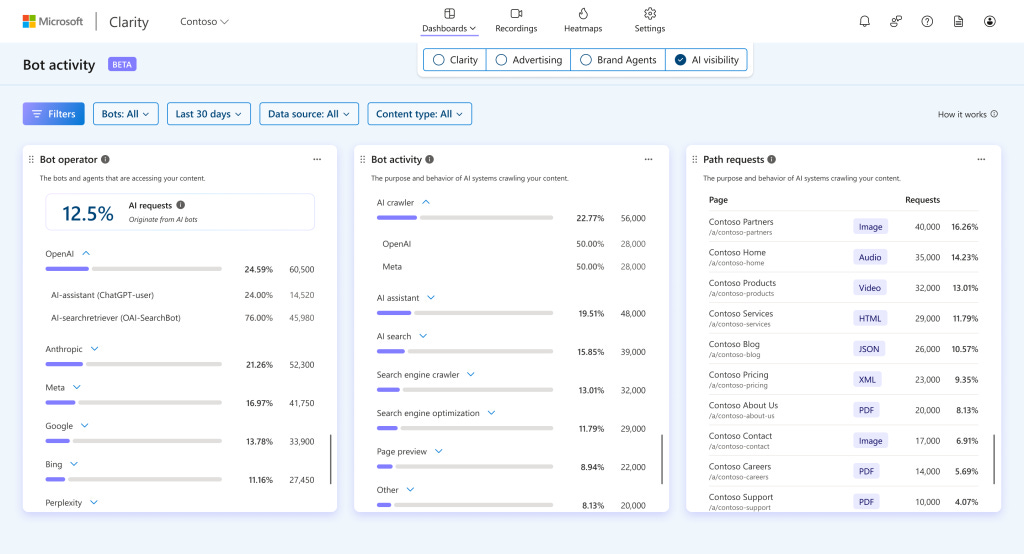
What makes this particularly valuable is what you can do with the intelligence. You’re not just watching bots crawl anymore, you’re making informed decisions about infrastructure planning, content prioritization, and whether that automated traffic is actually productive or just expensive.
The feature works through supported CDNs including Fastly, Amazon CloudFront, and Cloudflare. WordPress users running the latest Clarity plugin get automatic access. The dashboard breaks down bot activity by purpose, shows crawler requests by operator, and highlights your most frequently accessed paths.
Microsoft is positioning this as just the beginning of a broader AI Visibility suite. The move recognizes a fundamental shift: AI traffic isn’t background noise anymore. It’s an audience that deserves measurement just like your human visitors.

Instagram is experimenting with something that could fundamentally change how we perceive popularity on the platform. Instead of showing your “Following” count, some users are seeing “Friends”, the number of people who mutually follow you.
The test was spotted by users back in November and confirmed by Instagram as a small-scale experiment. According to IG, they’re exploring ways to make friend connections more visible and meaningful, which tracks with how people actually use the app now. Most interaction happens in DMs rather than public feeds, so mutual follows might be a more accurate indicator of real engagement.
But here’s where it gets interesting for marketers: this could completely reshape the follower/following ratio dynamics that brands have relied on for years. Right now, having more followers than people you follow back signals influence. It’s a shorthand for authority and reach. Switch that to mutual follows, and you’re measuring something different entirely, community relevance rather than broadcast power.
Instagram hasn’t committed to rolling this out broadly. They’re testing, watching reactions, and presumably analyzing whether users engage differently with the metric. The move reflects Instagram chief Adam Mosseri’s repeated emphasis on private sharing over public posting as the platform’s core activity now.
For brands and influencers who’ve built strategies around follower counts and ratios, this is worth monitoring. The metric you’ve optimized for might not be the metric that matters in six months.
OpenAI is asking advertisers to pay roughly $60 per thousand impressions for ChatGPT ads, pricing that puts the platform closer to premium TV inventory than social media.
Even at the high end, Meta rarely approaches what OpenAI is charging. The Information reports that ChatGPT ad pricing is comparable to live NFL games and highly targeted streaming placements.
But here’s the catch: advertisers will receive extremely limited reporting. You’ll get impressions and clicks. That’s it. No conversion data, no attribution, no visibility into what happens after someone sees or clicks your ad. This is fundamentally different from the detailed reporting available on Google and Meta.
Early campaigns will function more like reach and awareness plays than performance-driven placements. Advertisers pay per impression regardless of engagement, and OpenAI is initially targeting large established brands working through agencies rather than small advertisers.
Users under eighteen won’t see ads, and ads won’t appear in conversations involving sensitive topics like mental health or politics.
The premium pricing reflects OpenAI’s bet that ChatGPT represents a new kind of advertising environment, one where context and user intent might justify costs that would be prohibitive on traditional digital platforms. Whether advertisers agree that the audience quality justifies three times Meta’s pricing without conversion tracking remains to be seen.
Meta just posted advertising revenue of $58.1 billion for Q4, a 24% jump year-over-year that CEO Mark Zuckerberg is calling a “major AI acceleration.” But beyond the headline number, three specific stats tell you where Meta’s advertising business is actually headed.
First, ad impressions climbed 18% while the average price per ad increased 6%. That pricing bump reflects genuine demand rather than Meta forcing higher rates. Advertisers are competing harder for inventory, which means they’re seeing returns that justify the spend.
Second, Meta’s AI video generation tools hit a combined revenue run rate of $10 billion in Q4. That’s significant not because of the absolute number, but because the quarter-over-quarter growth rate was nearly three times faster than overall ad revenue growth. Advertisers are actually using these generative tools at scale, not just testing them.
Third, the efficiency gains from AI are measurable: Meta doubled the GPUs dedicated to training its ad recommendation model and made other backend improvements. The result was a three percent lift in Facebook clicks and a one percent boost to Instagram conversions. Those might sound small, but at Meta’s scale, they represent billions in additional value for advertisers.
The company is betting even bigger on AI infrastructure, projecting capital expenditures between $115 billion and $135 billion for the year, most of it dedicated to AI development. That’s an enormous increase from last year’s $72 billion total.
Zuckerberg is also talking about AI enabling leaner operations, with projects that previously required large teams now accomplished by single talented individuals. This comes amid reports of internal friction between Meta’s AI divisions and the rest of the company, and the departure of some key AI leaders.
The takeaway for marketers: Meta’s AI investments are delivering measurable performance improvements right now, not just theoretical future benefits. The platform is actively improving at converting your ad spend into results, which matters more than any individual feature announcement.
Thanks for reading! If you enjoyed this newsletter, share it with your network.
Make sure to subscribe to stay updated on our next editions. Have questions, topic suggestions, or insights to share? Reach out, we value your feedback!
Carla from Donutz Digital 🍩
No posts
Comments
Nothing yet. Say the first thing.
Sign in to join the conversation.