
[Note: This article is truncated in some emails, so you’ll want to read the whole thing on a browser or in the Substack app.]
Choices Matter Fest has one day left for its sale, though its broadcast has ended. You can still find the sale here: https://store.steampowered.com/sale/choices-matter-festival
This will be my final CMF 2026 article. It’s been fun to keep up with, and even more fun to play a few demos. Chants of Sennaar next, then a newsletter announcement, then more industry and thematic stuff. Hoping to get all this out within a month.
[You can also pledge a subscription. Sometime before the end of the year, I’m going to create a Discord community and offer online seminars and classes to anyone with a subscription, or who gets a “Buy Me a Coffee” membership, or becomes a patron on Patreon. I have not set up the Discord or the Patreon yet, so don’t give me any money. I will announce when it’s ready. All posts here will remain free. Leading some online courses seems like something you all want. Let me know if this is in error. Or let me know if you’d be interested, and what questions you have.]
Today, I’m reviewing my five favorite upcoming games that were featured in the festival; some had demos, but not all. As you know from me by now, my reviews are partially about my own enjoyment and partially trying to tease out the main themes. Enough intro!
Putting this at #5 may be surprising. I’ve made my enjoyment of the original game known a few times. Bigby is my prototypical case study in a character with firm attributes, virtues, and flaws but whose journey is malleable. That is, he’s a perfect example of our ability to change, as people, while remaining largely the same person.
Bigby’s relationships with Toad, Colin (the pig), Snow White, et al are written in wet concrete, slowly solidifying throughout a playthrough but unable to alter much from the initial state. Though Bigby may change, the others around him change as well.
Critics and academics most frequently bring up The Walking Dead’s first two seasons in order to discuss Telltale’s habit of allowing choice and then bringing the two branches back together. This is usually a negative for critics and some fans. If Lee dies either way, then why does the game agonize so much on whether I cut his arm off? If Clem gets taken and Lee gets captured while looking for her either way, why include the different possible pathways for getting there? The beginning of season two seems to go blank-slate from your ending state of season one. Do the choices matter, or don’t they?
I’ve said my piece on and made my peace with meaningful choice in games. Telltale is the master of choices mattering in the moment you decide, not in the consequences. I tend to enjoy this as a gameplay experience at least as much as I enjoy studying the underlying concept: other people beside the main character have their own agencies and decisions to make. If anything, Telltale’s The Walking Dead is a game about the fate we all create for ourselves.
But The Wolf Among Us avoids this issue almost entirely. It’s just done better than TWD. And they do it by making it clear from the start that the player’s decisions as Bigby affect Bigby’s emotional and moral vectors more than they affect the world beyond him. Emphasis on the more than: the player’s decisions absolutely still affect the world beyond him. There are also immediate consequences for Bigby’s actions in the first two episodes; the biggest of these, the branching only discovered after a second playthrough, is whether Prince Lawrence survives.1
So the pathways and essential plots of each TWAU playthrough are the same, with a few minor changes every time. Those minor changes are beautiful to watch (this is why I’ve enjoyed assigning it in class, where we get to talk about our decisions together and the minute disturbances of fate we fashion), and we understand Bigby and company better with each successive run.
So it’s no shock that it’s on my Top 5. See my first CMF post in which I discuss the remaster:
Why is it only #5? It’s nothing against this remaster; it’s everything for the others I’m about to get to. I’ve decided not to include The Wolf Among Us 2 on this list because (1) too obvious and (2) while it’s listed under “upcoming” in the festival, no new information came out concerning it this week. The sequel will come out in 2027, after the remaster. I’ll follow both of their releases.
Ithaca is in playtest mode right now. I played it for a little under 10 minutes before I knew I’d be in for the ride (literally: it’s about a road trip). It’s an indie narrative RPG with simplistic animations, an excellent color palette, and more than enough mystery to intrigue me.
The playtest is limited for now, so hopefully their being featured in CMF will give them an attention boost. Hey, Pixel Hunt Studios!2 If you’re reading this, I’m an English professor, and I’d love to talk about narrative structure, dialogue, characters, and how gameplay and aesthetics reinforce the game’s themes. I’m really interested in what’s here and am very excited to see the game as it progresses and eventually comes out.
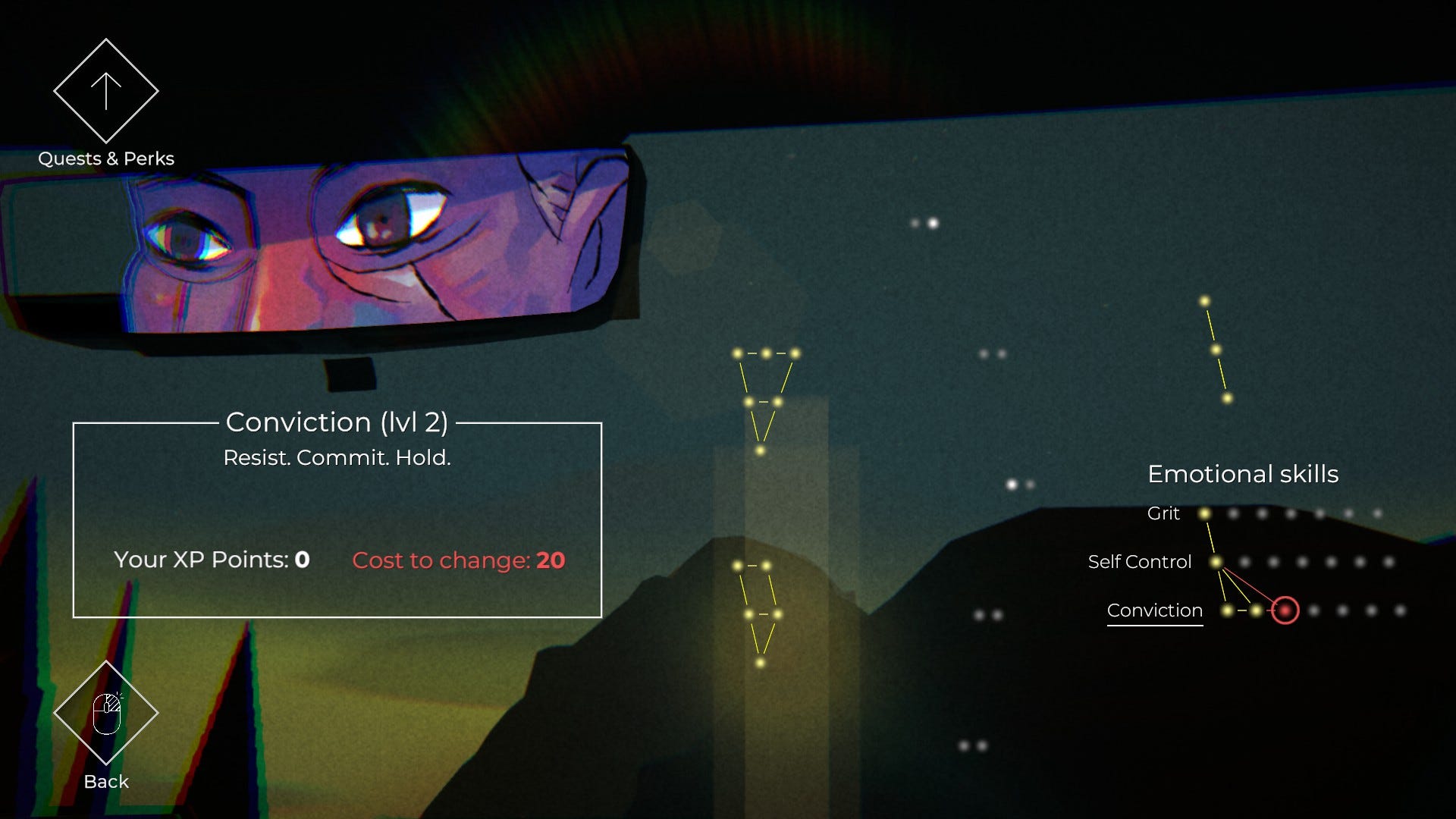
You play as Penelope, an environmental rights lawyer who gets caught up in the “largest eco-terrorist act of the 21st century.” Sounds great. The game starts off well: a body in a trunk and the opening line, “The gods are probably long dead by now.” The gods’ death and the people’s freedom is then linked. Dig.
Within the playtest, you can learn how to control some basic aspects of the game, including skills-based dialogue trees, how to interact with the car’s internal computer screen, Penelope’s inner monologue (which is directed at the player explicitly, as a replacement for prayer, since the gods are dead), and choosing diverging roads.
The aesthetic and gravity (earned or not, we’ll see) borrow from several of the major adventures and RPGs of the last 15 years, from Kentucky Route Zero to Disco Elysium. As I’ve been saying, this is fairly standard for adventure-RPGs. There’s some lovingly-called ‘indie game bullshit’ happening, too: whether the images on screen (like a bunch of Athena statues appearing ex nihilo) are visually true to the space around Penelope, imaginations from her psyche, or just representations for the player is not yet clear—I am a fan of such ambiguity and visual unreality.
The dialogue itself, as it is exists now, is on the more “how real people talk” side of things, rather than the “hyper-stylized” or “artistic” side. The individual words are not held back by too-quickly-outdated slang, nor is it timeless: the patterns and tone of each character I’ve heard from so far definitely put this game into a 2013-present umbrella for the ways in which modern English-speakers tend to communicate.3
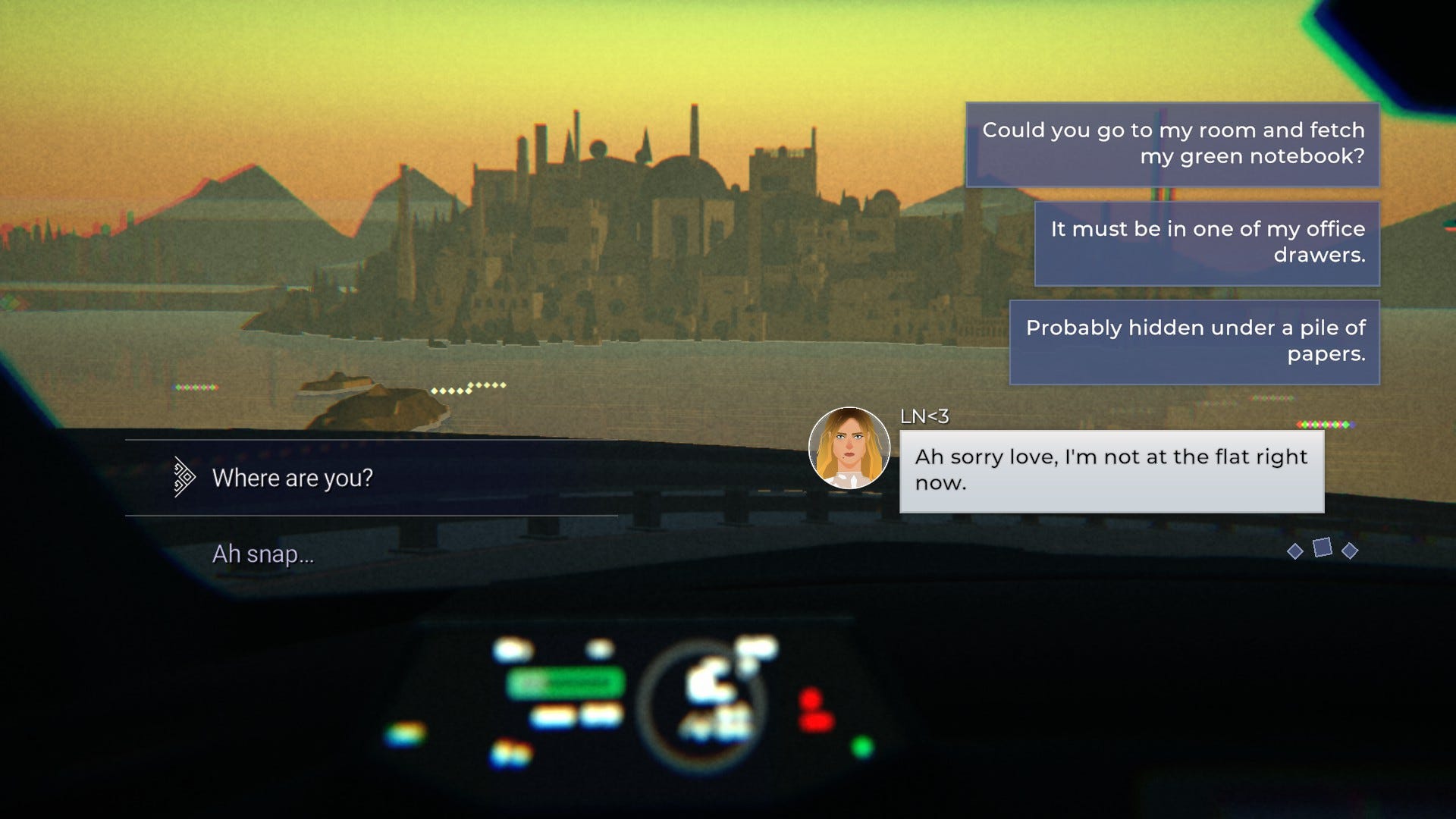
My biggest question right now is why, even with a car on “autopilot” (so it’s a near-future sci-fi), Penelope is texting so much and so quickly.4 It saves on voice acting cost, but the texting animation specifically comes across like those Hooked text message stories, usually called “chat fiction.” The writing here is much better, of course, but I do feel like there’s something missing—a common thing to say about a playtest. My first idea is to limit or remove the amount of multi-texting: if the characters say one thing at a time (though text size increase), and if the player gets to pick what Penelope says (even if there is only one option, or both options lead to the same response), then it will feel more like interactive fiction and real conversations.
What does the car add to the game? I’m not sure yet. There’s more to find here, and I’m on board for it. Next!
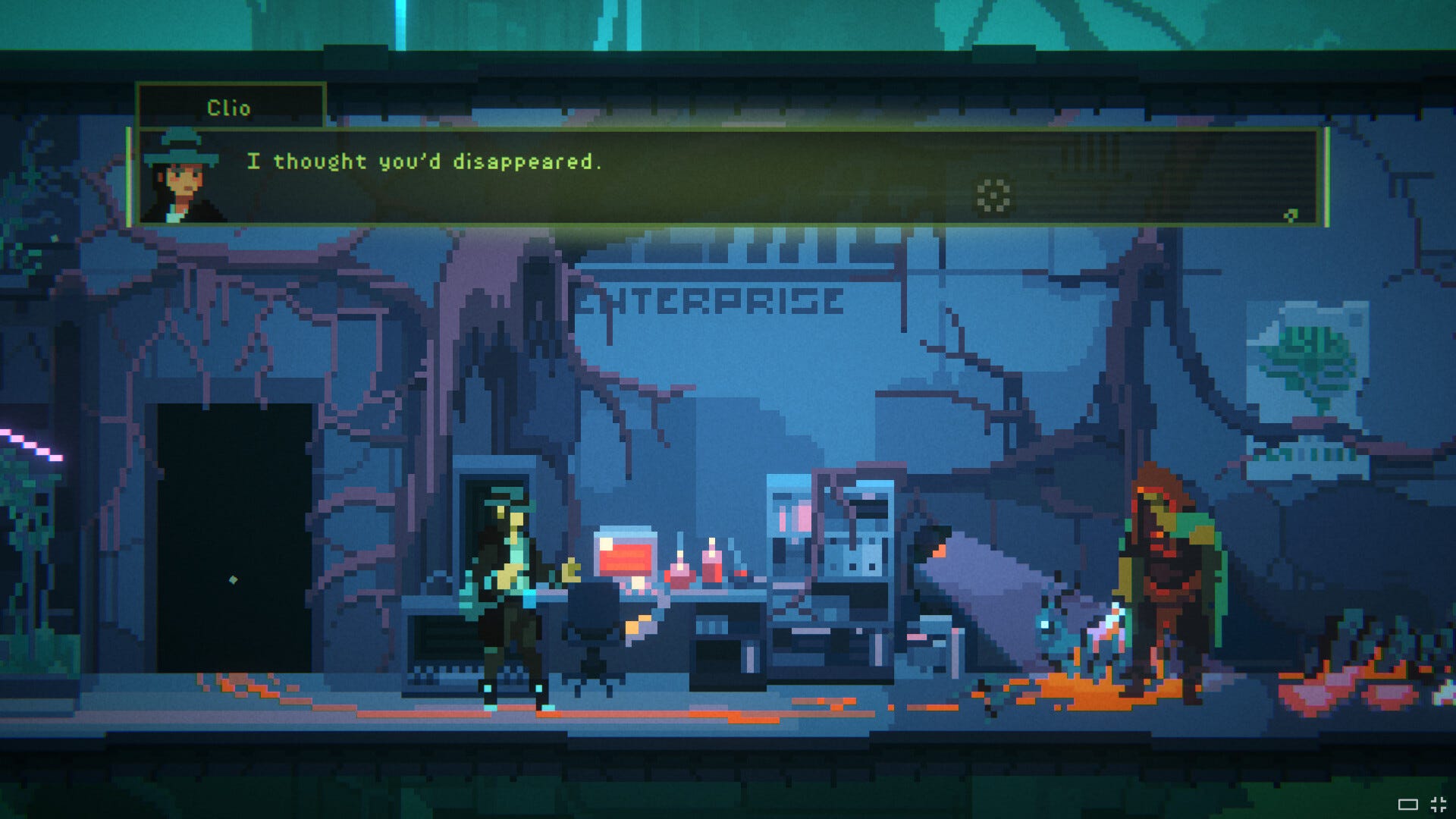
DigiTales Interactive’s next game is From Ruins: a detective adventure at the end of the world, so the trailer tells me. There is no demo or playtest for this one, but without hands-on experience I can still say my excitement is quite high.
DigiTales previously released Lacuna and Between Horizons, also detective storygames from what I can tell. I have not played them yet, but I grabbed them for about $5 total because of the Choices Matter sale.
The puzzle-setting and detective framework for From Ruins should remind us of the very serious and incredible Case of the Golden Idol and the stupid and silly Duck Detective (which you can read my review of here, alongside a couple others:
I love this style of mystery-solving: a list of words that populate as you discover things about the scene, the people involved, and the ideas surrounding everyone. Placing words into their correct slots (filling in the originally-unknown situation about a crime scene, or a thing that’s like a crime scene) solves the puzzles, progresses the story, and creates for a great moot of mental trial and literary joy. How they weave the story and the puzzles together will be what makes or breaks this one for me, since its mechanics are firmly set on filling in words rather than traditional or modern adventure puzzles (such as in Lamplight City or The Drifter).
The pixel art looks fantastic; I’ve become a big fan of modern pixelated games recently (The Drifter from last year being my favorite), so seeing it here was a nice surprise. DigiTales’s other games are in my short list to be played in the next few months; I’ll be keeping a close eye on From Ruins as I catch up with this developer.
I wrote about Vale’s Echo a few days ago, toward the end of that first CMF post. It really works for me, though obviously from just a demo I can’t guarantee that the themes, narrative tension, pacing, puzzle intricacy, or excellent use of the grotesque will hold up for the entire game.
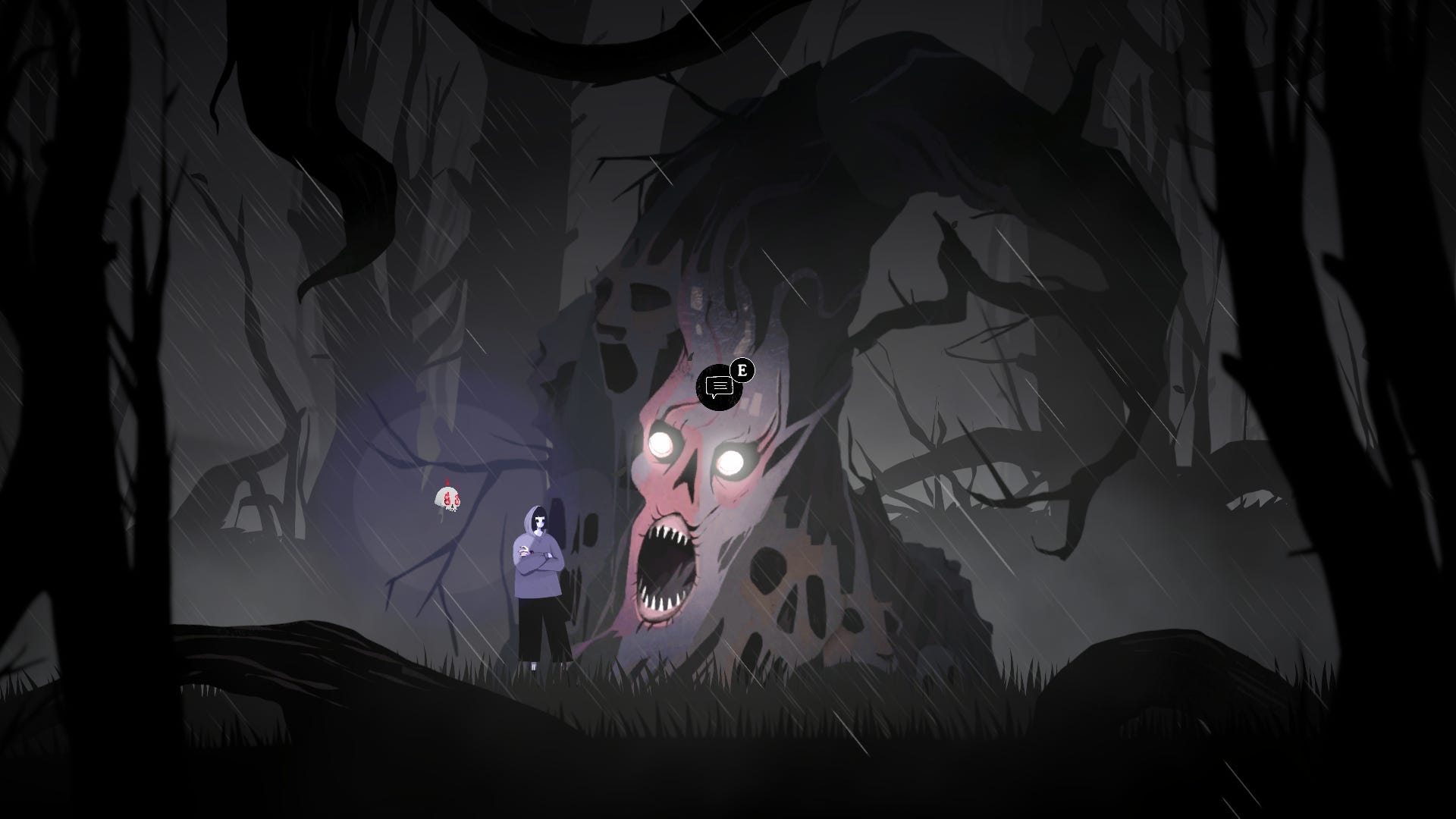
I can tell you that all of that and more thrilled me within the scope of the demo. The dialogue and the protagonist (Vale)’s general attitude will come off a little too “millennial” for some players, no doubt—I’ll admit her resting animation seems a bit too disinterested and post-irony pilled, if that means anything—but she has so far been compelling to follow.
I enjoy a sidekick, especially if they aren’t overly sarcastic (kind of a been-there-done-that for the past 20 years, kind of a it-needs-to-be-done-as-well-as-Mimir-from-God-of-War-2018-if-you’re-going-to-do-it). Echo seems to fit well so far. The banter is nice. Discovering what Echo’s deal is will be nice to unravel.
The aesthetic is what sold me at first: how they crafted a grim and unpleasant underworld and yet made sure that each neutral color stands out, how they emphasized the disgust and the awe at once, how they fit natural puzzles within the dark and the dank without them feeling overly difficult (to complement the horror) or simple (to complement the narrative pacing).
Vale helps the NPCs she encounters, in dialogue and/or in puzzles, even if they’re rude about it. Adventure games are notorious for encouraging players to treat other human characters as objects and manipulate them to progress the story. While gross, pulling an infected tooth from the face-tree (who is not rude, I must add) eased his suffering, and his offering to help was not previously agreed upon. That is, Vale was not necessarily pulling teeth in order to achieve a goal—it just seemed like a good thing to do (also, it’s a fun reversal of that “it’s like pulling teeth” phrase). What I’ve played so far is masterful, and I genuinely cannot wait to play more.5
The Expanse: Osiris Reborn “is a third-person Action RPG set in The Expanse universe. You’re no hero — just a merc caught in the wrong place at the wrong time, trying to hold your crew together and keep the ship up and running. Your choices will shape your story” (Steam page description).
I was such a massive fan of the Expanse television show 9 years ago that I stopped watching halfway through season two, bought all the books, and have allowed these nine tomes to gather wisdom in their long eon of chillin on a bookshelf. I promise I’ll read them soon.
Anyway, the show really is excellent. I played the Telltale game earlier this summer and had a fantastic time (would need to play it another time or two in order to consider writing a review—it’s probably in my cards, if I’m making myself an adventure/Telltale guy). I’d love the ability to jump into this world again with a story-driven choices-matter action RPG, especially if I can line it up with when I finally read the series.
Mandrake looks both fun and cute. Here is its Steam page description: “You are the last of the Mandrakes, a sorcerous line of gardeners. At long last, you’ve returned to your family's abandoned home. Make friends, tend your gardens, and put down roots. Fish, gather and delve in the wilds. Make a place for yourself, and uncover the mysteries your family left behind.”
It’s a farming sim with 3D assets, an isometric camera, and a heavy emphasis on NPC interactions through Discotian dialogue/text scrolling on the right side of the screen. There are some dialogue moments without major decisions that appear like a visual novel. The magic-soaked medievalist fantasy aesthetic will probably wear on me, and farming/life sims are rarely my cup of tea. It will depend entirely on the execution of these NPC interactions and how much like spreading room temperature butter on firm sourdough the mechanics come to me.
Travelling at Night has a demo, which a couple friends and I have gotten the chance to play. It just blew me away, y’all. I mean, we got isometric camera, we got ruins of WWII, we got tons of characters to play as. The writing alone grabbed me so well that every other game from this developer, Weather Factory, is now in my library or on my wishlist. I will get to the ones I haven’t played alongside the games from DigiTales mentioned above.
Anyway, the demo.
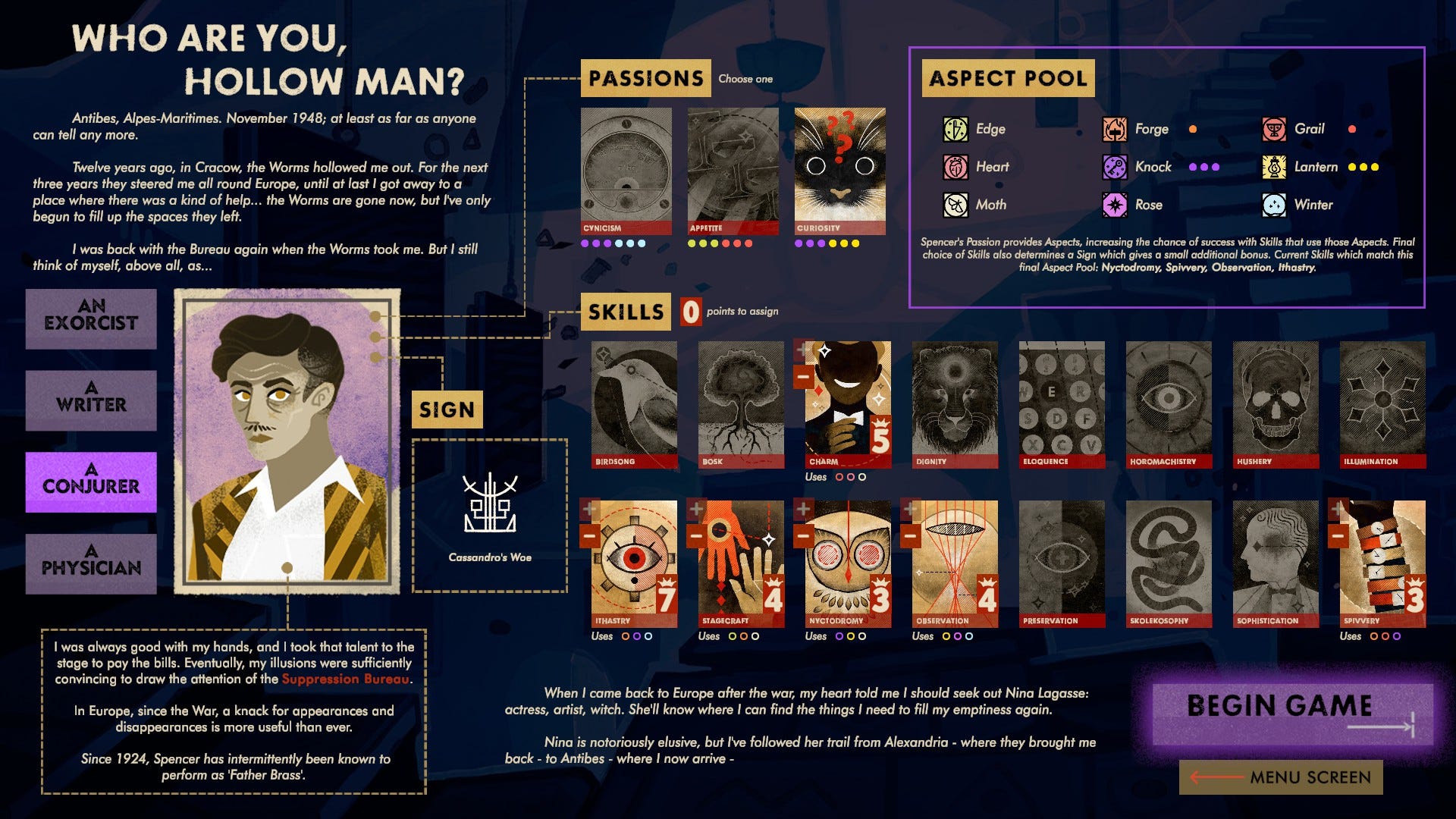
The art style is gorgeous, and the animations are fluid but simple. The way text appears on the screen is clunkier than other larger-budget games of this RPG style have been (Disco, Esoteric Ebb), but its UI is intuitive, and the options load easily. I saw no issues with pacing or delivery of responses to dialogue options or skill checks (which games of this size can have). The sound design is also really great so far—nothing like the soundtrack to Disco, obviously, but what’s here fits the game well.
The mechanics are post-Disco adventure-RPG: you walk, click on what interests you when it lights up, and choose dialogue and skill checks to discovery and roleplay. This includes items and NPCs. Text scrolls on the right half of the screen, one line at a time, and your specific character determines what extra options you have and what skills you might be better at. This is not a game for generalists; I get the sense, within 10 minutes of walking around, that you will need to place points into certain skills consistently and roleplay your character consistently in order to do well. As the tutorial puts it, choose the options that feel right to you in that moment. So far, they’re doing a great job rewarding you immediately while promising important consequences for strategic skill improvement further into the story.
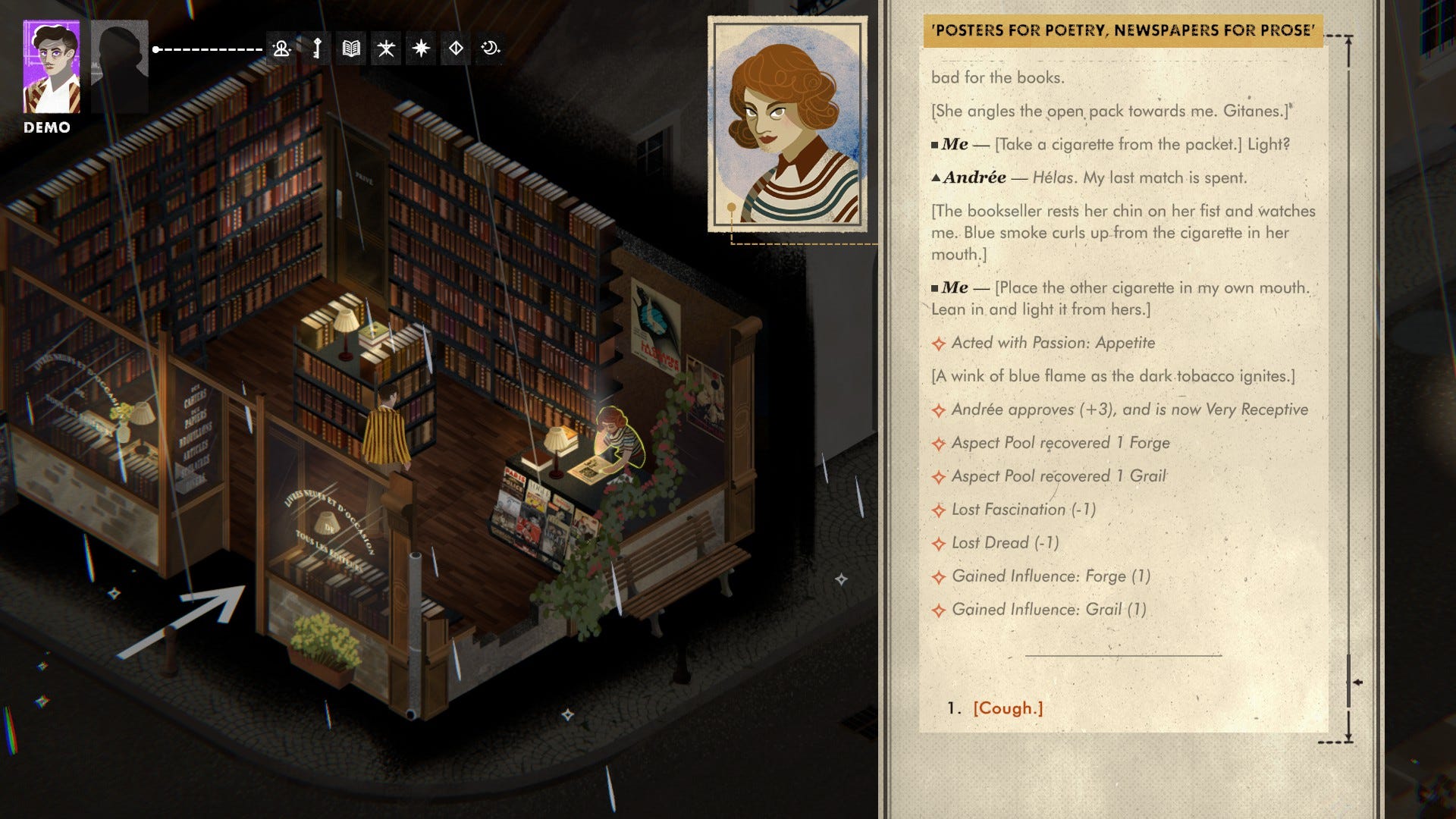
Two mechanics set this game apart from its ilk, as far as I can tell.6 First, the skill checks do not simulate die rolls, but cards in a deck—or, to use their metaphor, tokens in a bag. They have reintroduced fate into chance. For each time you use a skill, a token is removed from the bag to determine the number that gets added to your skill check. For example, later in the conversation above, you can use Sophistication to impress the bookseller with an erudite quote; I had to pull at least a 3 from the “bag” to succeed, and I pulled a 5. That 5 is no longer in the bag. The bag resets when it empties or when you reload a save. As their tutorial says, “your luck will always turn.” I’m impressed with the gall to add this in: they are guaranteeing that you’ll have to miss a few 90% chances throughout the game, in direct conflict with what most players want. But this will invariably create more interesting stories, and save-scumming will be a constant temptation (though I hope no more than it already exists in D&D-based luckgames).
The second is a crafting system. You gain memories and items, and you can combine them together in order to gain more specific memories. I think. It uses words like “use” and “craft” but the “things” you’re using are memories and concepts. Within the crafting menu, if you hover over the first Forge Memory (Forge is one of your Aspects, which are different from skills), it says: “Use a Forge Influence to subvert two Lantern Influences into a Forge Memory.” You can only craft this recipe if you are in a Hearth or a Holy Place. I don’t understand what any of those words mean yet, but I’m 100% game for the complexity and indie game bullshit.
It’s a rare feeling, staring into something that you can’t make sense of, knowing that you can make sense of it if you give it the time it deserves and the patience it asks for. This is something worth studying.
There are the top 5. I’m far from an expert on new games coming out, but this week has made sure I’m paying closer attention. Chants of Sennaar and alchemy is next. Until then, try to reap some vengeance on the games industry as you can.
Spoilers for a 13-year-old game, by the way. I’m not worried about you; the remaster is just as much for old fans as new ones, it seems, so spoilers are part of the territory. You should probably also know that Achilles dies sometime between The Iliad and The Odyssey. If you haven’t played TWAU and this interests you, you’re fine to wait for the remaster, but you should buy the original (half off right now) if you might be able to play in the next few months.
If I yell, maybe they’ll hear me.
It’s a fun mash-up. Many spelling and word choice options are British (bollocks, mum), but the voice actors are American (Tallie Medel plays Penelope); distances are in kilometers, and all names are Greek (Helen, Nyx, Melanippus).
Her eyes stay on the road; the texting happens without her hands moving and without her speaking.
I did it! I said the name of the thing! That’s the name of the newsletter!
This is an admission that I have not played every game. In fact, I’d say I’ve played a tiny minority of them! If you know of a game that does either of these, please let me know!
Comments
Nothing yet. Say the first thing.
Sign in to join the conversation.