
This happens once every few lifetimes
These chemicals hit me like white wine
…
Honestly, who are we to fight the alchemy?
Taylor Swift, “The Alchemy”
Swift does an interesting thing with alchemy in that song, from 2024’s The Tortured Poets Department. Using “alchemy” instead of the more usual “chemistry” to describe an innate romantic connection is cool. She used to associate love with the color red (“Red,” Red [2012]), but calls it “golden” in the song “Daylight” from Lover (2019). While the original use of red didn’t have an alchemical meaning at the time, she turned it into a possible alchemical symbol when she turned love into gold. In the traditional alchemical process, the Philosophers’ Stone (a powder that you’d cast onto the thing you want to turn to gold) should look reddish, and it becomes gold upon the casting.
Kinda neat.1
I moved pretty fast in the first Alchemy Games introduction. There are more things for me to explain more clearly that I did not think I could fit into last week’s post. Read that one first if you haven’t yet, or don’t! That’s okay!
This week, I’m going to go a little slower with extra context that I think is both useful and fascinating. Then I’ll talk about demons, as promised.
Games next time.
With newly found vigor
With copper flowing within
Let the new process begin
To unveil this masterpiece
And Oceans, “Towards the Absence of Light”
Let me begin today with an acknowledgement that learning anything to do with alchemy is notoriously dense and nonsensical. This is because, from the Arabic writers around the year 800 to the European mystical and occult texts of the 1400s, alchemists wrote their treatises with incredible metaphor and symbolism.
Today, scientists want their material to be repeatable, reproduceable. Lab reports contain “methods” sections (as do surveys, psychological studies, sociological analyses, and humanities papers) so that everyone reading it can transparently see exactly how the scholar went about their experiment. We consider this a necessary part of good scholarship. I should be able to copy everything you say you did and find the same result; otherwise, your findings are put into question. I can trust that you (evidently “you” and “I” are both scientists now) do not mean to deceive me, but I can’t trust that you didn’t make any mistakes. We’re human.
But in the Middle Ages, even after the development of the scientific method and the importance of experiments, such methods sections were not considered as important. In fact, medieval alchemists thought about it the other way around: if I tell you how I tried to make the Philosophers’ Stone, then you might be able to make it better and more efficiently than I can, and then I’ll be out of business. Lab work was intellectual property before there were good intellectual property laws.
In order to hide their experiments, they disguised them in allegory so that only certain readers with the gift of “alchemical hermeneutics”2 could uncover the way to the Sun, to gold. The most important alchemical book from the Islamic Golden Age was literally called The Secret Book of Secrets because alchemy was already shooping itself into shrouds of esotericism (Compare: “I shoop me into shroudes as I a shepe were” [I put myself into shrouds as though I were a sheep]).3
Colors and celestial bodies are two of the codes that were best learned by outsiders by the end of the Middle Ages. In the alchemical process, the substance being turned into the Stone was supposed to go from black to white to yellow to red. These four colors start showing up in metaphors in order to refer to certain steps of the process, to certain metals, or to other four-part concepts, like the humors.4
Spondent quas non exhibent divitias, pauperes Alchimistae; pariter qui se sapientes existimant in foveam incident quam fecerunt.
[Alchemists promise riches which they cannot show, for they are poor; just the same, though they think themselves wise, they fall into the holes which they have dug.]
This is from Pope John XXII, the beginning of his 1317 denouncement of alchemists.5
Last time, I mentioned that I wrote my dissertation about alchemical fraud (those are the first two words of the title!) and that, by the 1300s, alchemy and fraud were very closely associated. This is one of my favorite topics, so I’ll spend a few paragraphs on this.
Geoffrey Chaucer (the Canterbury Tales guy, c. 1340-1400) lived through the Black Plague.6 So did William Langland (c. 1330-1385?), a lay clergyman7 who wrote the expansive dream vision allegory The Vision of Piers Plowman. For a long time, scholars argued that Chaucer and Langland believed alchemy was black magic (some argued that Chaucer was a secret alchemist, but this was never a majority view). Both Chaucer and Langland seem to denounce alchemy in their poetry. Chaucer says that the “fiend” (Satan) is in the alchemy lab during the experiments, and Langland compares it to necromancy.
However, more recent scholarship has argued that Chaucer simply believed that alchemy didn’t work. He said that the devil was in the lab for rhetorical effect: Satan is a liar, and so are the alchemists. They didn’t literally summon the king of demons to hang out with them. I followed this line of reasoning in my chapter on Chaucer.
Remember that last time I included a long quote from Chaucer’s The Canon’s Yeoman’s Tale. That tale, which comes close to the end of The Canterbury Tales, is Chaucer’s discussion of alchemy (The CT is several stories being told by different members of a group of pilgrims all walking to Canterbury together, an oft-trod pilgrimage at the time). A canon is a clerk,8 in this case a learned alchemist, and a yeoman is an assistant. At the beginning of the tale, a canon and his assistant come up to the pilgrims, interrupting the tales. The alchemists look disheveled and tired; they are on the run. Chaucer includes some alchemical symbolism for them right from the start: dressed in black (the color that begins the alchemical process), they disrupt the pilgrims’ travel. In other words: alchemy prevents our approach to God.
Some more interesting symbolism is how the canon appears; Chaucer dresses them in poor clothing, and the yeoman says that their experiments will leave them destitute. Remember that Pope John XXII specifically calls alchemists poor. They spend all their money on foolish endeavors, and the second they’re able to scam a lord into funding them, they blow the money on yet more useless experiments.
When the yeoman says that they “doon illusioun” [do delusion/illusion] to many people by promising to multiply their riches, the canon becomes upset. He cries out that the yeoman is giving away their secrets, and he believes everything that other people say about him (thus my reference to The Wiz).9 The secret of alchemy, according to Chaucer, is that alchemy is fundamentally fraudulent. It doesn’t work.
I also argued that Langland was using moral/religious language in his denunciation of alchemy. Here’s the relevant passage, from Passus X, lines 209-215:
Ac Astronomye is a hard thing, and yvel for to knowe;
Geometry and Geomesie is gynful of speche;
Whoso thynketh werche with tho two thryveth ful late—
For sorcerie is the soveryn book that to the science longeth.
Yet ar ther fibicches in forceres of fele mennes makynge,
Experiments of Alkenamye the peple to decyve;
If thow thynke to dowel, deel therwith nevere![But Astronomy is a difficult matter, and evil to know;
Geometry and Geomancy are full of treacherous speech;
They who seem to work with those two will prosper afterward
Because sorcery is the primary teacher of those sciences.
Yet there are tricks in chests of many men’s making,
Experiments of Alchemy that deceive people;
If you want to do well, never deal with it!]10
Langland probably means what we call “astrology” by Astronomye. Feel free to check out that chapter in my diss for more. I’m working on editing it for separate publication, but we’ll see how that goes. The word “fibicches” is one of my scholarly hot takes. I think it’s the Middle English equivalent of “fibbage,” as “fib” + “-age.” In context, it definitely means “trick.”
In short: these writers didn’t think that alchemy was magical and powered by malevolent forces (unless you think lying for profit is a malevolent force, which is fair). They thought it was a scam, and they used religiously-charged language to condemn the scammers.
Under the spell
Of alchemists who failed
To clench the menstrual grail
Cradle of Filth, “Shat out of Hell”
No.
At least, not in the way that we think of magic today.11 There were no codified spells, no conjurations or wands. Cauldrons, sure, but that’s just boiling stuff. I’m happy with D&D’s new Artificer class (alchemists referred to their work as a craft or an art).
But alchemy was mystical and theological. Mystical, insofar as their physical effects had an impact on metaphysical reality simultaneously and they believed spirit and body weren’t really separable. Theological, insofar as they wanted to understand God’s creation as they thought it. They lived inside the Firmament, and God’s handiwork was evident all around them. Mystical does not mean witchy. Their world was a world of miracles, visions, saints, and salvation.
Their world was also a world of connections between all things, logical or not. The lyric from Cradle of Filth above refers to the Stone as the “menstrual grail,” a reference to a several-lines-of-logic-deep association in a medieval worldview, which definitely feels pseudo-scientific and insensitive to us today. I’ll illustrate it here as convolutedly as possible:
women take on the receptive role during ‘normal’ sex → vessels/cups are filled → grail, like those stories of Arthur, from which Jesus drank wine → communion wine is Christ’s blood → bloody cup is a menstrual grail → menstruation! back to women
//
separately, moon → silver and moon → menstruation and moon → feminine in Latin
//
grail → a thing to seek, even unto death → elixir or Stone
//
silver → an important step along the path to alchemical gold.
Isn’t that fun? Cradle of Filth are hitting right on the ridiculous ways that alchemists used to hide the real meaning of their writings. Notably, the alchemists fail to find the grail. They just can’t make seem to make real gold!
So, to mysticism and magic they turned. What physical experiments deny, power and allegory can grant.
Here sat Babylon
Fattened by the purses of the worst and wrong
Where the decadent tastes of Hell grew strong
Like a curse upon this tragic kingdom
Cradle of Filth, “Tragic Kingdom”
Alchemy was pretty devout at first. Theologians were the ones who took up the mercurial call in the 12th to 14th centuries. But, unfortunately, yes, eventually some alchemists started looking more and more demonic. We do know of a few medieval examples of demonic alchemy. I’ll share one here.
- real life horror story incoming -
The Cradle of Filth epigraphs come from their 2008 album Godspeed on the Devil’s Thunder. There’s a reason the intro song is called “Shat out of Hell,” and later they refer to the main character as a Babylon addicted to greed and infernal desire (the “decadent tastes of Hell”). The album is a narrative of the life of Gilles de Rais, the 15th century French serial killer—according to legend, he was in love with Joan of Arc and started worshiping Satan after she was burned; no contemporary source corroborates the love story.
Gilles12 was a low-level noble who got himself a castle at Tiffauges, in southern Brittany (northwestern France). He had a standard arranged marriage, but the love was cold, if ever it had been there.
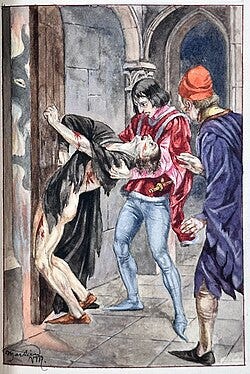
We do know that Gilles, as part of his dive into the occult, hired the alchemist Francois Prelati to regain his previous wealth. The two worked together for some time in the 1430s. Prelati was never able to create the gold that Gilles desired, but he was helpful in many other ways, namely by helping his patron murder children.
While on trial, Prelati claimed to have summoned a demon named Barron, but when Gilles saw no proof of the conjuration, Prelati said that Barron required a child sacrifice. This almost certainly happened after the start of Gilles’s unimaginable cruelty and grotesque debauchery. Over the 1430s, according to the findings of the ecclesiastical trial, Gilles killed at least 140 children. Sick shit. As Cradle of Filth call him: darkness incarnate.
Behold the bold inauguration of the dark side
Demonic passions climbing
Ill-fated stars aligning
Tonight these sights are guaranteed to feed the master
The tide of blood is rising
His gifts will be providing
Cradle of Filth, “Midnight Shadows Crawl to Darken Counsel with Life”
I will not quote from the most heinous or disgusting descriptions that fill the lyric book of Godspeed. This one I find interesting: it’s got astrology, fear of demons, and child sacrifice. Later in the song (again, not quoting the whole thing, because gross), blood is called a “red secret.” Medievalisms plaster the screams all throughout the album, alchemy squarely among them.13
The demon Barron, supposedly, came for and because of Prelati’s alchemy. Conjuration was a constitutive part of the alchemical process. However, note that Barron’s appearance was determined by blood sacrifice. Prelati seems to have been both an alchemists and a conjurer.
Prelati was arrested as an accomplice and placed in prison. Gilles himself was put to death rather quickly. Prelati escaped his prison and was later put to death for torturing the Treasurer of France (out of revenge for the former’s involvement in arresting Gilles). His actual death sentence was unrelated to his whole helped-a-guy-kill-a-ton-of-kids thing.
- the horrors cease, but I do not -
Alchemists didn’t do themselves any favors in the 1400s or 1500s. This is the same time (the emergence of the so-called Renaissance) when the witch hunts, inquisitions, and anti-science rhetoric that we all have heard about became popular in the Church. Alchemists became increasingly associated not just with fraud but also with mystical and occult secrets, even with demonic magic. We went from metaphorical religious condemnation to actual accusations of demon-conjuring. There are jokes about this subtle and secretive fraud in Ben Jonson’s 1610 play The Alchemist (whose main character is an alchemist named Subtle). (Great play).
By the time of Jonson’s satirical play, there was a resurgence of alchemists, like Isaac Newton and John Dee, who wanted to reform and rescue the study. They still thought the whole lead-to-gold thing would work, but they abandoned most of the unnecessary secrecy and focused on physical experiments. They did a pretty good job. Their experiments paved the path to chemistry.
Now that I’m good with the amount of yapping I’ve done, we’ll get back to games. Come back for Chants of Sennaar’s use of alchemy: all metal, some mystique, maybe demons.
Same bat time, same bat channel.
There, I did it. I talked about Swift. Can I go back to referencing obscure death metal?
Alchemical hermeneutics is a modern term that we use to describe what alchemists did when they read allegory-dense texts. A hermeneutic (yes, it comes from “Hermes,” just as the term “hermetic,” which is often used to describe mystical and occult texts—alchemy is one of the hermetic studies) is a process or method of analysis. It’s more or less synonymous with “interpretation” but usually with religious, mystical, or dense literary texts. Alchemical hermeneutics is the process of interpreting works as alchemists did: find alchemy wherever you can, no matter how convoluted the association or symbol. Assume the reader hid some coded messages in the text. Dig them out. We would not consider this a worthwhile or responsible scholarly method today in literary analysis, but alchemists really did hide coded messages in their art and words.
The Vision of Piers Plowman, Prologue, line 2.
Humor theory was our best guess at why people get sick and why people behave differently until the 1700s. There are four humors, or liquids, in your body: blood (red), phlegm (white), yellow bile, and black bile. Your mood depends on the proportion of these four humors inside you. Too much blood makes you sanguine. Too much black bile makes you melancholic (black-bile-ish). The disease cholera was named for that yellow bile, or choler. We still use these humoral words for moods and dispositions today, just as you might come across “mercurial” and “jovial” to describe someone. The intersection of alchemy, medicine, and astrology—and the impact of these three on our words for psychological concepts and personalities—is difficult to overstate.
Latin text from James J Walsh’s The Popes and Science: The History of the Papal Relations to Science During the Middle Ages and Down to Our Own Time, New York: Fordham University Press, 1908; p. 414. My translation. This is the beginning of the main text of a minor papal bull that banned fraudulent alchemy. Walsh argues that we should call it a “decree,” not a “bull,” because it was a relatively unimportant pronouncement. Most other sources call it a bull. Alternate translation: Poor alchemists promise riches which they do not show; just the same, those who judge themselves [to be] wise fall into the traps which they have set.
My favorite Middle English authors lived at this time. For reference: the Black Death or the Bubonic Plague was in the 1340s, with occasional recurrences. The Death killed about 1/3 of Europe in under 20 years. Every medieval author writing in the 1370s-90s lost friends and family to it. For more reference: Dante died in 1321. For more more reference: In 1381, there was a massive Peasants’ Revolt in England, during which peasants (who were banned from leaving their birthplace in search of better pay) killed their lords, some priests, and some high-up government officials.
“Lay clergy” means he had some education and was respected by church leaders but held no official church office (thus, “lay”). He did not come from a lot of money. He may have been a “clerk,” which could mean any administrative or managerial position in the church or government. We know very little about Langland’s life—even calling him “lay clergy” is an interpretation based on his knowledge of Latin, his having attended the equivalent of an elementary school (and so could read Latin from a young age), and his writing several scathing disses against the church and high-ranking officials in his poetry (which indicate he probably was not in danger of losing a job or livelihood, as a priest might have for saying these things). The logic is flimsy, but it’s the best we can do with so few records. Some scholars have argued pretty rigorously that he was a low-level priest, others that he was never involved in the church. Lay clergy is the most likely interpretation, in my opinion. Regardless, Piers Plowman was the second most-copied text of 14th century England (Canterbury was first).
Readers by 1390 knew to be wary of clerks. There was a long tradition of satires and comedies that present clerks as tricksters. In the 1381 Rising, the mayor-led mob who burned documents from Cambridge University in the center of town chanted, led by Margery Starre: “Away with the learning of clerks! Away with it!” Starre may have also influenced Chaucer’s Wife of Bath character.
And therefrom a reference also to the Kendrick-Drake beef of 2024. Kendrick quotes that line at the beginning of “Euphoria,” the best song from the battle. I can imagine Pope John XXII calling alchemists “pathetic master manipulators and habitual liars, too.”
Other variations of this text include references to necromancy and pyromancy (fire-divination). Geomancy is to geology what astrology is to astronomy and what alchemy is to chemistry; Greek for earth-magic.
There are several things that, because medieval people talked about them alongside curses, divine favor, and spiritualism, we think were magical. Runes (like, the futharc alphabets from Scandinavia) are probably the most rampant example of this. Speakers of Old Norse did not think runes were magic. The power was in being able to etch ephemeral and transitory concepts (like speech) into stone, thus turning them permanent. The other half of that power was the interpretation of runes (i.e., reading). This seems like a mystic power in a world where only 5% of people could read. And let’s be honest: it is. This is getting long enough, so I’ll stop here.
I refer to him by his first name throughout. It was probably pronounced something like “zhill,” with ‘zh’ meaning the ‘s’ in ‘pleasure’ or maybe your ‘g’ in ‘genre,’ which is still the modern French pronunciation of the name. His name probably did not have the ‘s’ sound at the end (most final -s were dropped by a hundred or so years before Gilles was born). Dani Filth (vocalist for the band) pronounces it like the English named Gil+s pretty consistently in the album.
The record, along with most Cradle of Filth projects, features medievalist music as well, usually characterized by renaissance and baroque instrumentation in a gothic mood.
Comments
Nothing yet. Say the first thing.
Sign in to join the conversation.