
Welcome to PLAY DATES Episode 05, a series of conversations with creators, founders, movers, shakers, and people who prioritise PLAY to make their work and processes feel more alive.
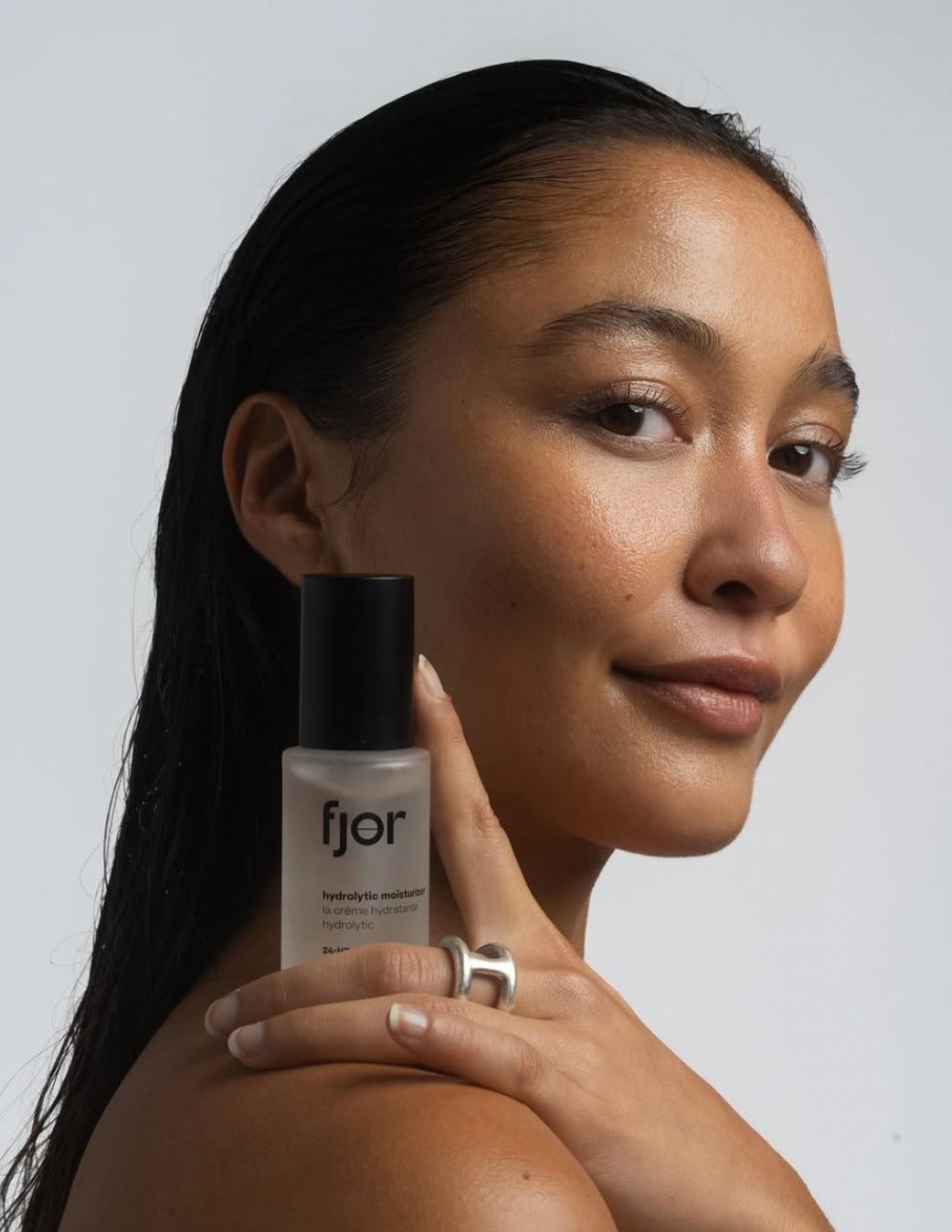
I’m India, founder of PLAY Collective, and this play date is with Natalie Enslöw, founder of fjör, founder of fjör, an advanced microbiome skincare brand focused on simplifying routines and supporting long-term skin health.
Some friendships begin with intention, whilst others arrive through shared language before you realise you’re speaking it.
Natalie and I met through a mutual friend, the way you often do in London when everyone has three jobs and one shared WhatsApp group. We properly crossed paths at a Proven launch lunch not long after, one of those introductions where you realise quite quickly that you’ve been circling similar ideas from different directions.
A few months later, we collaborated on what would become the fjör x PLAY run club. What started as a one-off has quietly become one of our more creatively consistent collectives. Less about performance, more about practice. A shared interest in how people feel in their own skin, rather than how they are perceived in it.
Watch the full PLAY DATE below for a glimpse into what it looks like when you trade “prestige” for purpose, and learn to keep going after your fiftieth rejection email:
Natalie launched fjör in 2022 after what she describes as an emotional but very necessary exit from her role in marketing at Rolex.
“I quit my job on a whim, on an emotional whim. I was just like, I can’t do this for one more second.”
She didn’t have kids, a mortgage, or anything that made risk feel structurally impossible. What she did have was a growing sense that she wanted to be in the business of helping people in a meaningful way.
“Watches is an amazing industry to be in. But in terms of my personality, I want to see everyone I know thrive.”
That instinct eventually became fjör, a skincare brand built not around endless steps or surface-level optimisation, but around supporting the skin barrier and microbiome to function properly over time.
Her motivation was also deeply personal.
Growing up, both of Natalie’s parents struggled with their skin in very different ways. Her mother through doing too much, dealing with allergies, irritation, and sensitivity from overuse of products. Her father through doing too little, experiencing severe sun damage later in life.
“When you watch someone you love feel uncomfortable in their own skin, or worry about being judged, you think if I can support someone so they don’t have to feel like that, I’ve done something good in my life.”
That why has carried her through what she describes as the far less glamorous side of building something from scratch.
“Being a founder is going to show you your deepest fears, your biggest insecurities. It’s going to challenge you in every single way.”
Online, entrepreneurship is often framed as aesthetically pleasing. A laptop. A coffee. A moodboard. In reality, it’s a lot more weekends at 2am, negotiating with yourself about whether you’re actually capable of what you said you wanted to build.
“You see the milestones, but wow, to get here I have faced a lot.”
The biggest shift, she says, has been moving from external to internal validation.
“In corporate, I was very driven by external validation. When you’re a founder, you’re forced to understand what it means to have internal validation.”
When there is no promotion cycle, no performance review, no one telling you that you’re doing well, the question becomes whether you can build enough self-trust to continue anyway.
“I am so much more resilient than I thought.”
A lot of that resilience, she notes, comes from what she jokingly calls rejection therapy.
“You have to be prepared to find the people that will see your vision and want to support you. But most of the time you’re faced with a lot of no’s.”
The skill then becomes less about avoiding rejection and more about surviving it.
“No, I will become it.”
For anyone thinking about starting something themselves, her advice is refreshingly practical.
Rather than imagining a perfect linear path between idea and outcome, she recommends thinking in terms of acceptable loss.
“What’s the acceptable loss that you’re able to digest that will still be not so bad that you can keep going?”
Time. Money. Energy.
Creating frameworks around how much of each you’re willing to spend before reassessing can make risk-taking less existential, and more experimental.
Because, as she puts it:
“It’s not going to be perfect. Plan A, Plan B, Plan C… I think I’m already on Plan X at this point.”
Outside of building fjör, play for Natalie looks less like productivity and more like permission.
Dancing features heavily as part of her morning routine.
“I will break it down. If you put me on a dance floor, I will go.”
Sometimes that looks like a ten minute dance break between meetings. Sometimes it’s brushing her teeth to “Small Change” by Don West and calling it a win.
Music, she says, has become a kind of emotional archive.
“You can really see the red thread of what I was going through based on what I was listening to at the time.”
When asked to paint her ideal day in London, the answer is slow mornings, movement, time with loved ones, a good skincare routine, and yes, occasionally a sauna or cold plunge. Not as a business model, but as a reminder that how you feel matters as much as what you produce.
Because in building something of your own, the relationship you’re forging is ultimately with yourself.
If Natalie’s approach resonates, try this:
Instead of asking whether your plan is perfect, ask what you’re willing to lose in pursuit of it.
Time.
Money.
Comfort.
Certainty.
And decide in advance what enough looks like to keep going.
And if you’d like to try our PLAY experiences IRL, click here.
No posts
Comments
Nothing yet. Say the first thing.
Sign in to join the conversation.