
Last November, I stood in a parking lot in Mississauga — asphalt, shopping carts, a drainage ditch full of Phragmites — and someone asked me: “Could this ever be restored?”
My honest answer was yes. And also no. And the difference between those two answers is the most useful idea in this entire field.
What separates a piece of land that can recover from one that can’t?
Ecosystem restoration is the process of halting or reversing the degradation of an ecosystem so that its biodiversity recovers and its services improve. That definition comes from the United Nations, which declared 2021–2030 the Decade on Ecosystem Restoration. It matters because it sets a bar: you are not restoring an ecosystem unless biodiversity is actually increasing and the system is functioning better than when you started. Planting ten thousand trees of one species is not restoration. It is landscaping with ambition.
There is a distinction I didn’t understand until a few years ago. Ecosystem restoration is the big umbrella — it covers everything from greening a city block to returning a clear-cut watershed to a closed-canopy forest. Ecological restoration is a specific discipline within that umbrella, focused on assisting the recovery of degraded, damaged, or destroyed ecosystems. The UN Decade widened the tent. Ecological restoration stayed closer to its scientific roots.
For the work we’re doing at Planet Healers, you need both.
A contaminated industrial site in Hamilton needs remediation before anything else can happen. A degraded pasture in Yucatán needs ecological restoration — removing cattle, planting native species, and letting succession work. A stormwater pond in Mississauga needs rehabilitation to function as an actual habitat instead of a concrete basin. These are all different points on something called the ecosystem restoration continuum.
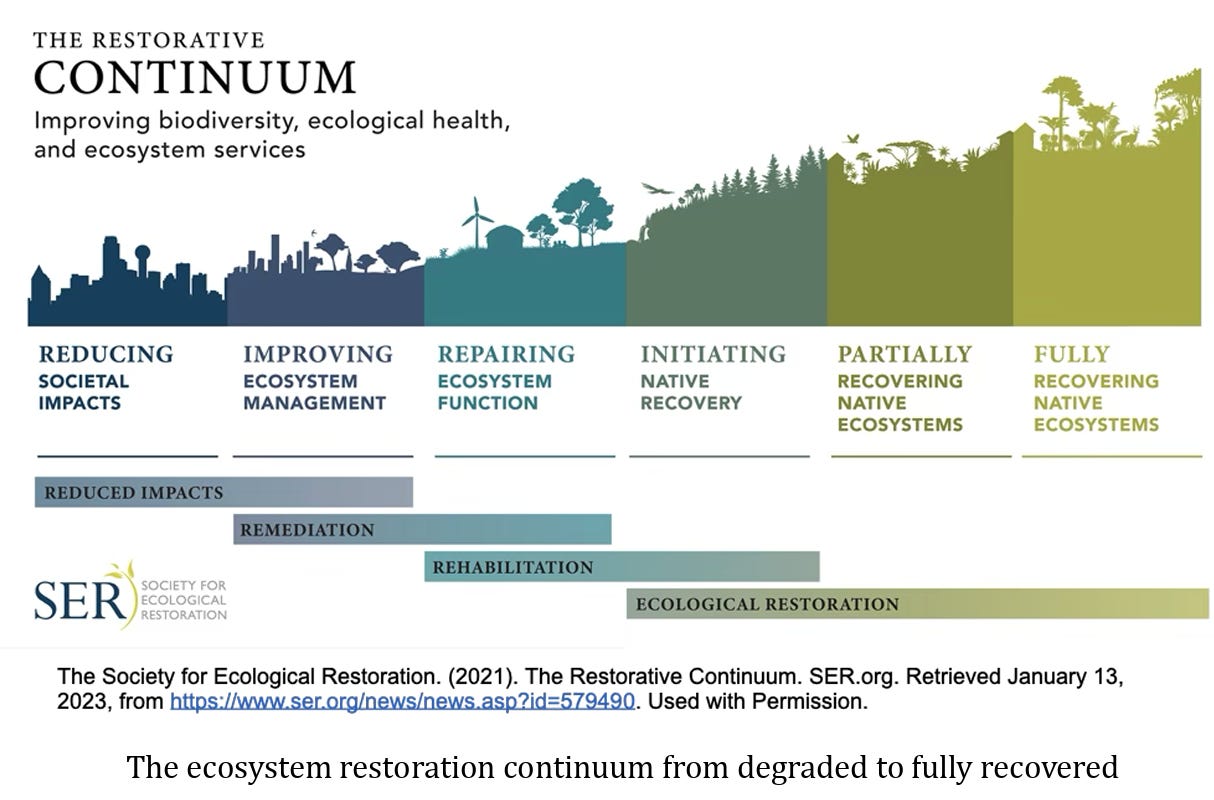
The continuum is the single most useful concept in this field. Picture a spectrum. On one end: the most degraded condition imaginable — a paved parking lot, a strip mine, a monoculture cornfield drenched in glyphosate. On the other end: a fully recovered, self-sustaining ecosystem with its original biodiversity intact. Everything we do in restoration is about moving a site from wherever it sits on that spectrum toward the recovered end.
The stages break out like this: reducing impacts comes first — stop doing the thing that’s causing the damage. Then remediation — clean up contamination. Then rehabilitation — get basic ecological functions working again. Then ecological restoration — assist the ecosystem toward full recovery. And the target you’re always aiming for is the reference ecosystem: the intact or least-disturbed version of what your site should look like if it were healthy.
Not every project reaches full recovery. That parking lot in Mississauga is never going to become old-growth forest. But it could become a functioning prairie meadow with native grasses, wildflowers, deep root systems, and pollinators — and that’s a different world from what it is now.
At Tsunul, we started at a specific point on the continuum: compacted cattle pasture, depleted seed bank, bare karst limestone. Ten years later — 514 documented species and a closing canopy. We didn’t design that. We removed obstacles and the land did the rest.
That parking lot in Mississauga? The answer is yes — it can be restored. But not to what it was before. What can it become next? That’s a different question, and a more honest one.
Next week: a field observation about something I’ve been watching at the reserve that most people walk right past — and what it tells us about why migratory birds need restored habitat more than most of us realize.
Paul
El noviembre pasado estaba en un estacionamiento en Mississauga —asfalto, carritos de compra, una zanja de drenaje llena de Phragmites— cuando alguien me preguntó: “¿Alguna vez se podría restaurar esto?”
Mi respuesta honesta fue sí. Y también no. Y la diferencia entre esas dos respuestas es la idea más útil en todo este campo.
¿Qué separa una porción de tierra que puede recuperarse de una que no puede?
La restauración de ecosistemas es el proceso de detener o revertir la degradación de un ecosistema para que su biodiversidad se recupere y sus funciones mejoren. Esa definición viene de las Naciones Unidas, que declaró 2021–2030 la Década sobre la Restauración de Ecosistemas. Importa porque marca una meta: no estás restaurando un ecosistema a menos que la biodiversidad esté realmente aumentando y el sistema funcione mejor de lo que comenzó. Plantar diez mil árboles de una sola especie no es restauración. Es jardinería ambiciosa.
Hay una distinción que no entendí hasta hace unos años. La restauración de ecosistemas es el paraguas grande —cubre todo desde reverdecimiento de una manzana urbana hasta devolver un bosque talado a forestal cerrado. La restauración ecológica es una disciplina específica dentro de ese paraguas, enfocada en asistir la recuperación de ecosistemas que han sido degradados, dañados o destruidos. La Década de la ONU amplió la carpa. La restauración ecológica se mantuvo más cerca de sus raíces científicas.
Para el trabajo que hacemos en Planet Healers, necesitas ambas.
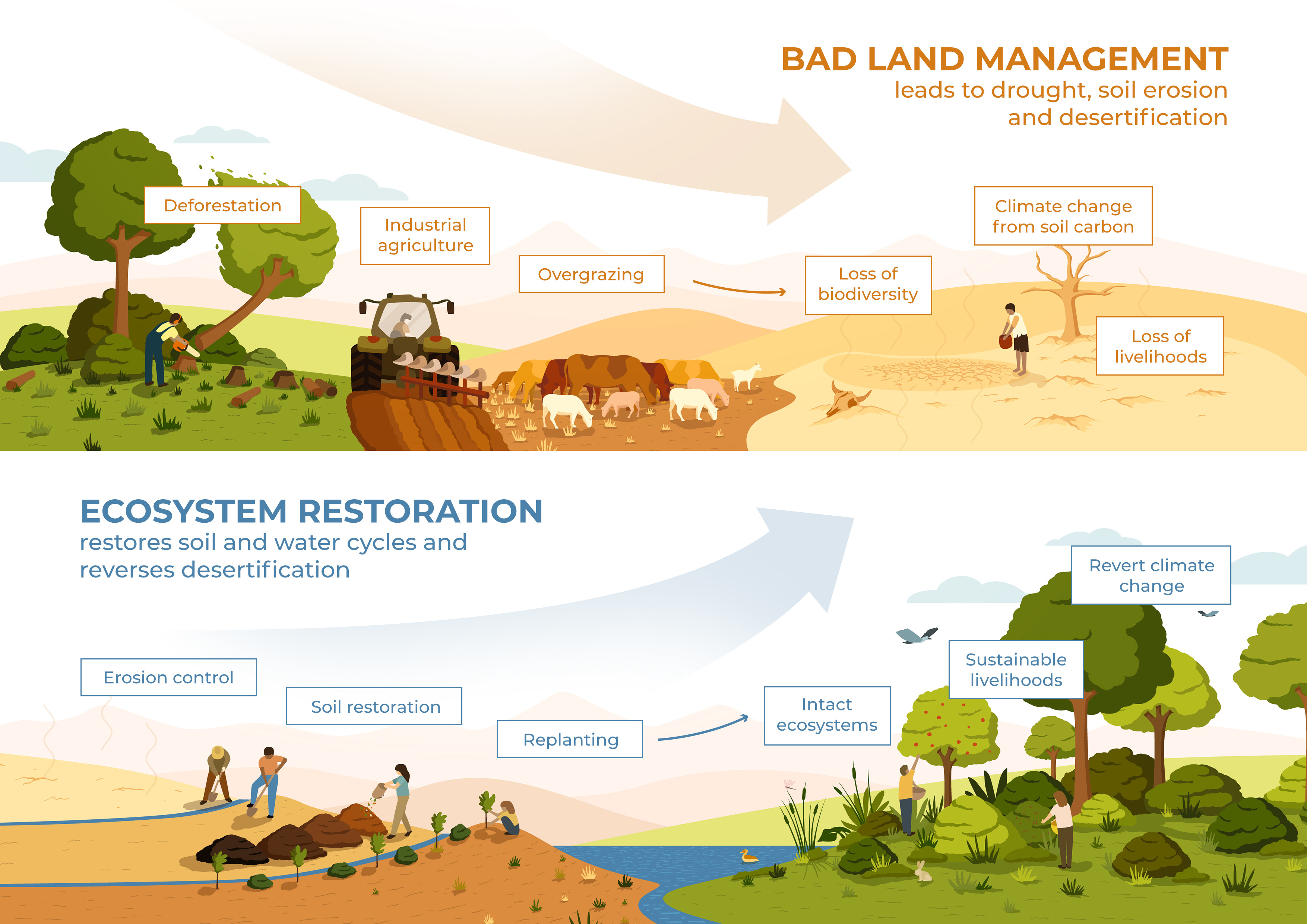
Un sitio industrial contaminado en Hamilton necesita remediación antes de que cualquier otra cosa suceda. Un pastizal degradado en Yucatán necesita restauración ecológica — sacar el ganado, plantar especies nativas, dejar que la sucesión funcione. Un estanque de agua de tormenta en Mississauga necesita rehabilitación para funcionar como hábitat real en lugar de una cuenca de concreto. Estos son todos diferentes puntos en algo llamado el continuo de restauración de ecosistemas.
El continuo es el concepto más útil en este campo. Imagina un espectro. En un extremo: la condición más degradada imaginable — un estacionamiento pavimentado, una mina a cielo abierto, un campo de maíz de monocultivo empapado en glifosato. En el otro extremo: un ecosistema completamente recuperado, autosostenible con su biodiversidad original intacta. Todo lo que hacemos en restauración se trata de mover un sitio desde donde esté en ese espectro hacia el extremo recuperado.
Las etapas se dividen así: reducir impactos viene primero — detener lo que causa el daño. Luego remediación — limpiar la contaminación. Luego rehabilitación — conseguir que las funciones ecológicas básicas funcionen nuevamente. Luego restauración ecológica — asistir el ecosistema hacia recuperación completa. Y el objetivo que siempre buscas es el ecosistema de referencia: la versión intacta o menos perturbada de cómo debería verse tu sitio si fuera sano.
No todos los proyectos alcanzan recuperación completa. Ese estacionamiento en Mississauga nunca va a ser bosque viejo. Pero podría convertirse en un prado funcional con pastos nativos, flores silvestres, sistemas de raíces profundas, y polinizadores — y eso es un mundo diferente de lo que es ahora.
En Tsunul, comenzamos en un punto específico del continuo: pastizal compactado por ganado, banco de semillas agotado, piedra caliza de karst desnuda. Diez años después — 514 especies documentadas y dosel cerrándose. No diseñamos eso. Removimos obstáculos y la tierra hizo el resto.
¿Ese estacionamiento en Mississauga? La respuesta es sí — puede ser restaurado. Pero no a lo que era antes. A lo que puede convertirse después. Esa es una pregunta diferente, y más honesta.
La próxima semana: una observación de campo sobre algo que he estado observando en la reserva que la mayoría de las personas pasan por alto — y qué nos dice sobre por qué las aves migratorias necesitan más el hábitat restaurado de lo que la mayoría realizamos.
Paul
Comments
Nothing yet. Say the first thing.
Sign in to join the conversation.