
Most of what goes wrong in native plant propagation goes wrong in the first ten minutes, standing in a field with a bag in your hand. Collect a week early and you have a bag of immature seed that will never germinate. Leave a full bag in the sun in the back of the truck and it cooks. Get home and stack the bags in a corner overnight and the microbes heat them up and kill everything in them.
None of that is difficult to avoid. It just has to be known before you go out, which is the point of this piece.
I call the whole business seed scouting, and I have been doing it for thirty years.
There is no calendar that will tell you. Timing shifts with the species, the weather, the site, and the year. What you get instead is a set of signals, and once you have watched a few seasons they become obvious.
Seeds starting to fall on their own. Fruit softening or changing colour. Cones beginning to open. Acorns and nuts turning brown and letting go of the cap easily. Dry pods splitting. And the one most people miss: wildlife feeding on something heavily. The birds and the squirrels know before you do. When they start working a tree, pay attention.
If you are unsure, wait. It is better to collect late and lose some to the wildlife than to collect early and end up with a bag of seed that was never viable. Immature seed looks fine. It just does nothing, and you will not find out for eight months.
Bloom time is when you do the real work, though. Plants are easiest to identify and easiest to find when they are flowering, so that is when I mark locations and come back later. In a good year I know where I am going in September because I walked the same ground in June.
Early summer: willow, poplar, serviceberry.
Late summer: elderberry, dogwood. This is where we are now.
Early fall: hawthorn, viburnum, sumac, maple.
Mid fall: oak, hazelnut, walnut, birch.
Late fall: conifers, rosehips, witch hazel.
Species run in groups. When one is ready, the others around it usually are too, and after a few seasons you stop thinking in dates and start thinking in waves.
There is a thing that happens after enough years of this that I have never seen written down properly, so I gave it a name. A search image.
It is a combination of what you remember about where a species likes to grow, what grows alongside it, the colour of its leaves, the way it holds itself. Water sedge has blue-green leaves and stands erect. Fringed sedge droops, and the leaves run yellow-green. You are not consciously running through a key. You have a felt sense of the plant and your eye finds it in a marsh from ten metres away.
You cannot be taught this in an afternoon. You get it by going out repeatedly and paying attention, which is the same way you get everything else worth having in this work.
Less than ten percent of what is available in any population. That is the number I work to and I would rather people erred under it.
Collect from a lot of plants rather than a lot of seed from a few, because you are collecting genetics as much as seed. A tray grown from one mother plant is a tray of siblings, and it will not have what it needs when conditions change.
Leave rare and endangered species alone unless you are part of a recognized conservation effort. Their populations are small enough that removing seed does real damage, their habitat requirements are narrow, and they take skill to grow.
Get permission. From the landowner, from the conservation authority, from whoever holds the permit for that ground. This is not a formality and people do get in trouble over it.
When I have worked with Indigenous communities, the teaching I have been given is to ask permission of the plants before beginning, to make a small offering in thanks, to leave the first plant you find and collect from the next, and to take only what you need. That is their teaching, not mine, and I pass it on as it was given to me. What I add is my own promise, which I make out loud and have kept for thirty years: I will look after your children and find them a good home. Very few of the thousands of seeds a tree drops ever become a tree. Collecting them and growing them on raises those odds enormously.
Nothing expensive. Cloth bags or buckets for dry seed. Plastic tubs or ziplocks for berries and fleshy fruit. Hand pruners for clusters, pole pruners for anything high. A tarp for shaking small trees and shrubs over. Gloves for the thorny ones. Paper or mesh bags for drying.
And labels. Label in the field, every time, with the species, the date and the location. I have thrown out good seed because I could not remember what it was, and by March one bag of small brown seed looks like any other.
This is where most of the losses happen and almost nobody talks about it.
Open the bags in the field to let moisture out. Never leave bags sitting in the sun, because a closed bag in sunlight turns into a small greenhouse and fries what is inside it. Get the seed laid out to dry as soon as you are back, in a shaded breezy place, and turn it. Left in the bag, microbial action heats it up fast and kills it.
Then it depends what you have got.
Willows, poplars, maples, ash and the spring ephemerals: process and sow within a few days, or into the fridge. Drying kills them.
Berries: cool them so they do not rot, and process quickly.
Fluffy seed like asters and goldenrods: shake into a feed bag if it is ready, or shear and lay it out on a tarp. Clean it before the leaves go brittle, because brittle leaves shatter into the seed and make the cleaning miserable.
Aquatics, arrowhead, wild celery, wild rice, pickerelweed: do not dry these at all. Wash them and store them in fresh water in a cooler.
Everything else that tolerates drying: air dry it properly, then into paper envelopes somewhere cool and protected from insects and rodents.
Tell someone where you are going. Gloves, long sleeves and long trousers, which handle the thorns and the mosquitoes at the same time. A bright vest during hunting season. Life jackets if you are collecting from a canoe, and people do drown doing this.
Know the plants that will hurt you. Water hemlock is lethal in every part. Pokeweed, mayapple and both baneberries are toxic. The arums, skunk cabbage and water arum, carry oxalic acid crystals that burn your hands. Wash before you eat anything. Crushed jewelweed rubbed on the skin takes the sting out of nettle and helps with poison ivy, and jewelweed usually grows within a few metres of both.
When I go out scouting I try to let go of the list. I know what I want to collect, and then I put it down and go where the ground pulls me. Curiosity, or something catching the light, or no reason I can name.
It works more often than it has any right to. I think it is because the list keeps you looking for what you already know is there, and the whole skill of this is noticing what you did not expect.
So that is seed scouting. Now the second species of the season.
Asclepias tuberosa
Nothing else in a dry meadow is that colour. Vivid orange, all through the summer, and the butterflies find it before the people do. Monarchs, viceroys, hummingbirds behind them.
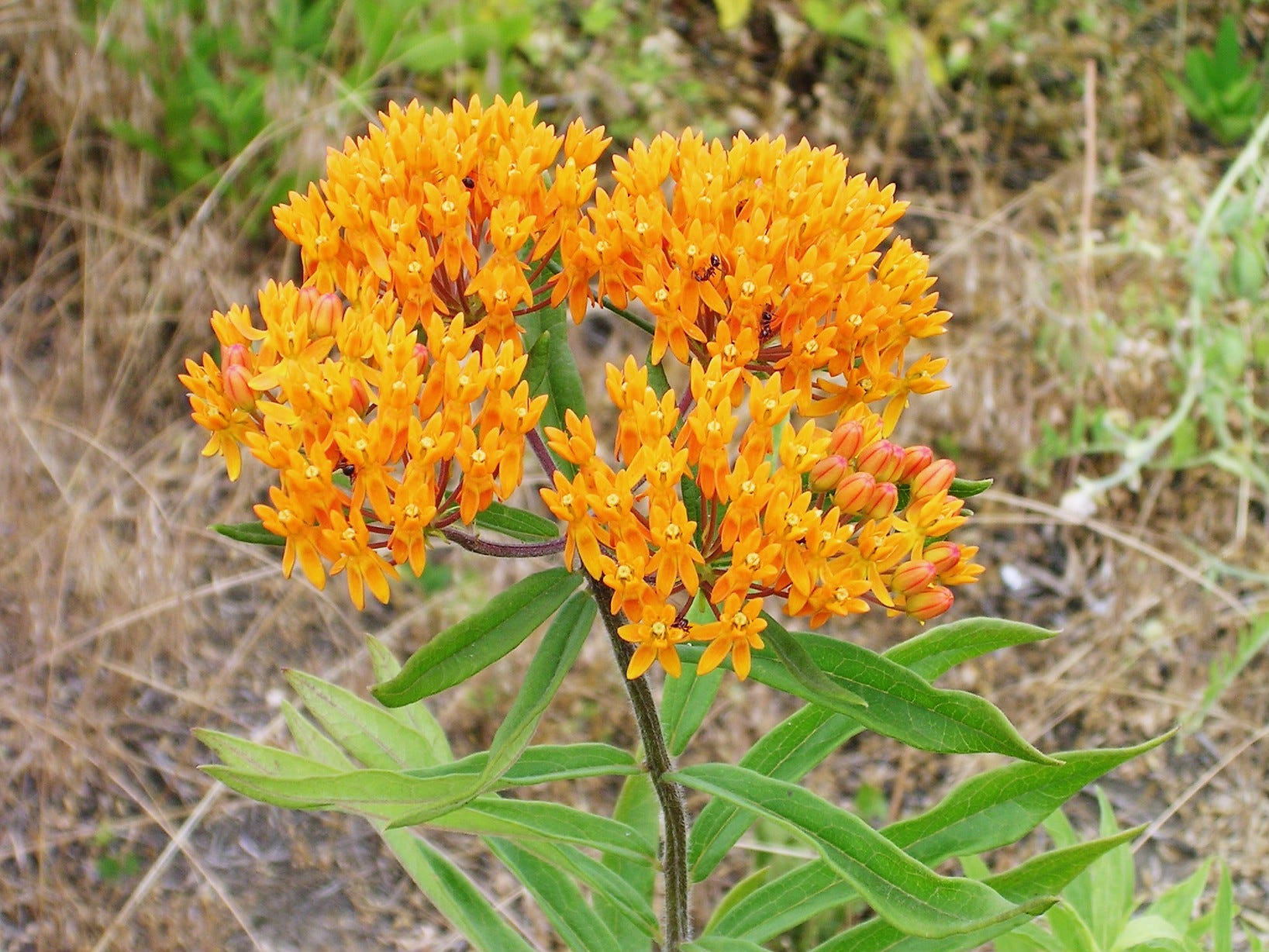
It goes by pleurisy root too, from when it was used for lung complaints, and the silky down out of the pods got used for stuffing pillows when there was nothing else. Treat the herbal history as history. The plant is toxic in quantity. But it tells you how long people have been paying attention to this one.
For a grower it is about as forgiving as a wildflower gets. Deer leave it alone. It breaks up clay. It wants sand and dry and full sun, and it shrugs off the droughts that flatten everything with shallow roots.
Collect around September 11, give or take a week, when the pods are just splitting and before the down flies. Three weeks from now, if you are reading this the day it goes out.
Clean it outside. My seed-cleaning chart for this species has one word written in capitals and that word is OUTSIDE. Open a bag of milkweed pods indoors once and you will understand. Screen off the down, finish on a finer screen and a sieve, store dry.
Thirty days wet to stratify, seeds in a container of water in the fridge. Then warm-season sowing into coarse vermiculite, 72-cell plug trays.
Full sun, sandy dry soil, 60 to 90 centimetres tall, 30 centimetre spacing, zones 3 to 9, perennial.
If you have a dry sandy corner where nothing performs, this is the plant that turns your worst soil into the brightest thing on the street, with a monarch on it.
Growing Wild is my three-book propagation series: Trees of Life, Prairie Wild and Wild Wetlands. Butterfly milkweed and 141 other wildflowers and grasses are in Prairie Wild, each with its collection date, cleaning method and stratification. The books are the one thing I charge for, because they are built around original photographs. ko-fi.com/planethealers/shop.
Comments
Nothing yet. Say the first thing.
Sign in to join the conversation.