
In Kenya’s highlands, when a sacred mugumo fig crashes to the ground, its death echoes through both ecology and society.
After hundreds of years of sustaining life all around it, providing shade for prayers and sacrifices, and standing as a sacred symbol for generations, the demise of such a giant is more than a local tragedy. In the Kikuyu culture of Kenya, it is a portentous event.
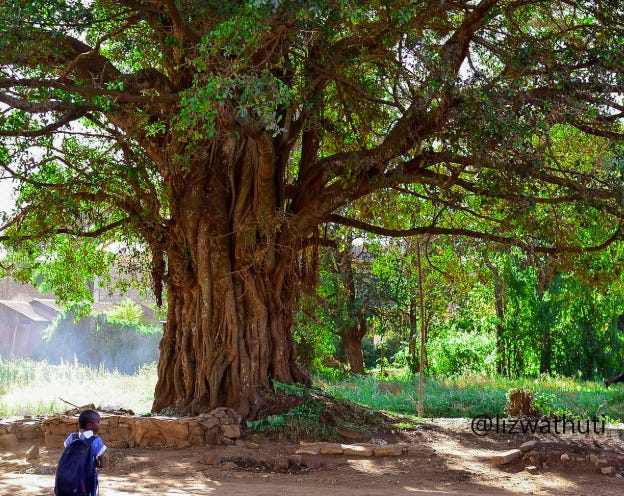
Mugumo trees (Ficus thonningii) are magnificent to behold. Some grow upwards from the soil, while others are strangler figs that grow from seeds that fall on other trees. Their branches send down aerial roots that envelop everything they touch. In time, these roots fuse into a solid mass that even an elephant would struggle to topple.
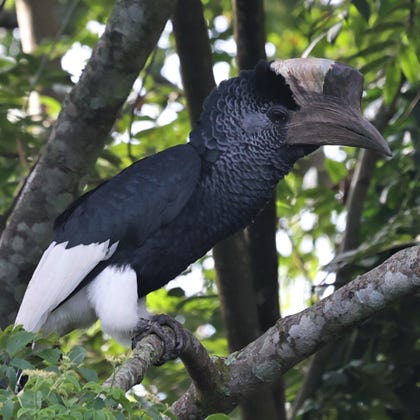
To birds, monkeys and fruit bats, mugumo trees offer a lifeline. Their figs feed these animals through times of fruit scarcity, sustaining the creatures that disperse the seeds of many more tree species.
To Kikuyu people, these trees symbolize strength, endurance and spiritual power. Once consecrated as shrines, they serve believers as conduits to their god, Ngai. As such, they must never be cut.
Taboos against felling fig trees are not unique to Kenya. Across Africa, Asia, the Pacific and the Americas, many cultures have developed similar prohibitions — often accompanied by stories of misfortune, or worse, befalling those who break them.
According to a 2017 media report, a Kenyan man’s brown skin turned white after he pruned a sacred fig tree in 1972. Contrast that with the fate of some Kikuyu converts to Christianity who — according to the missionary Costanzo Cagnolo, writing in 1933 — were killed for chopping down a mugumo for firewood.
With such protections in place, sacred mugumos could grow into giants. The very notion of one falling became wrapped up in faith.
Perhaps the most famous of Kenya’s fallen fig trees was one that grew in the town of Thika — until 1963, that is. Its downfall had been foretold more than a century earlier. In the late 1800s, a Kikuyu seer called Cege wa Kibiru prophesied the arrival of pale-skinned people carrying ‘fire sticks’ — their guns. He foresaw an iron snake that would swallow people and vomit them out again — the train. And he predicted that when the giant mugumo in Thika fell, his people would be free.
When representatives of the British colonial government heard this story, they reinforced the tree with a metal rail. It did not help. Part of the tree fell in May 1963. A month later Kenya gained internal self-rule.
The rest of the tree fell six months later. Within a month — on 12 December —Kenya became independent, with Jomo Kenyatta its first Prime Minister. One of Kenyatta’s first acts as leader of the new nation was to plant a mugumo fig tree where the British Union Flag had once flown.
The connection between falling fig trees and political change did not end there. People have linked the collapse of sacred mugumos with the assassination of politician JM Kariuki in 1975, the death of Kenyatta in 1978, and the election victories of Mwai Kibaki in 2002 and Kenyatta’s son Uhuru in 2013. Each fallen tree was read as a sign.
By 2017 — another election year — Kenya’s mugumos were under intense scrutiny. Dozens of media reports pondered the significance of an apparent increase in falling mugumos. When one sacred tree cracked and began leaning towards people’s houses in Kiambu County, a village elder warned that such things happen when society commits a sin: “God is angry and people need to seek forgiveness.”
Three days earlier, another giant mugumo had fallen in Nyeri County. Some people said it symbolized the death of the county governor. Others blamed a snake that had made its home among the tree’s roots and defiled the holy place.
Kikuyu elders gathered at the fallen tree. They chanted, sacrificed lambs and poured libations of traditional beer sweetened with honey to cleanse the shrine. When asked what the mugumo’s demise meant, an elder called Kariuki Kabue said there was nothing to fear and that the purpose of the ceremony was to “say goodbye to this tree”.
On this occasion, it was simply a matter of old age. Even sacred giants eventually fall.
Mugumo trees have played many other curious roles in Kenya — wartime lookout post, clandestine post office and symbol of resistance. In my book Gods, Wasps and Stranglers, they star alongside a queen, a Nobel laureate and the most wanted man in the British Empire. Their sacred status has a history of its own. Missionaries and their converts sometimes viewed these trees as obstacles to be overcome rather than shrines to be revered. I wrote about that story here.
No posts
Comments
Nothing yet. Say the first thing.
Sign in to join the conversation.