
When biologists Jeremy Quirós-Navarro and Tim Chamberlain hauled themselves by ropes into the canopy of a large strangler fig in the cloud forest of Costa Rica’s Tilarán Mountain Range, the only wildlife they saw was a hummingbird. But when they reached the point where the fig’s main branches formed a union with the trunk, they found something even more interesting.
“There was a big aggregation of animal droppings — different shapes, different sizes, different types,” says Chamberlain, a tree safety expert specialized in raptor and canopy research. “It clearly looked like a latrine and that there were different animals using it. It was super exciting.”
Exciting, because such latrines had never been reported in a forest canopy. Until now, scientists assumed that arboreal mammals simply defecated from branches, letting their waste fall to the forest floor. The new discovery suggests something very different: that certain fig trees function as shared hubs where multiple species exchange chemical information. In doing so, the strangler figs may act not only as keystone food resources but as nodes of communication — reshaping our understanding of how life in the canopy is organized.
A latrine isn’t just any place an animal goes to the toilet. It is a site animals visit repeatedly to defecate, urinate or rub scent glands, leaving chemical signals. On the ground, such sites are common. They play important roles in marking territory, signalling reproductive status and individual identities, and even limiting the spread of parasites. But until Quirós-Navarro, Chamberlain and their colleague Deiver Espinoza published their research in March 2026, no scientific study had documented latrines in the canopy.
For Quirós-Navarro, a pattern was beginning to emerge. As he told Chamberlain while they hung from the tree, it was the fourth time he had found a multi-species latrine in the same species of strangler fig, Ficus tuerckheimii.
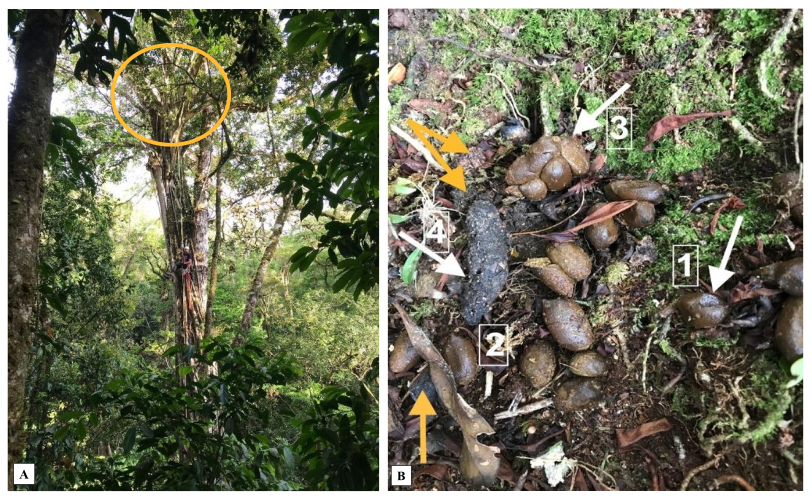
A couple of weeks later, Chamberlain was in Honduras, leading tree canopy access for an Operation Wallacea expedition in a remote area of forest. On a day off, he came across another large strangler fig of the same species and, on a hunch, he climbed it. Sure enough, he found another multi-species latrine.
“That was the moment we decided to actively look for more in other strangler figs,” says Quirós-Navarro.
Without any funding or institutional support, they set out to find more canopy latrines. To identify which species were using them, they installed two motion-triggered cameras near the latrine in the tree that Quirós-Navarro had climbed with Chamberlain.
The results were striking.
Over two months, the cameras recorded 181 independent visits by mammals. The animals came one by one — a mantled howler monkey, an opossum, a red-tailed squirrel and many more. In total, 17 mammal species visited the latrine.
“Working on other projects, the highest quantity of mammals I have detected in a single tree has been five species,” says Quirós-Navarro, now a doctoral student at the University of Connecticut. “But 17 in a single tree? It is almost all the canopy mammals of the cloud forest.”
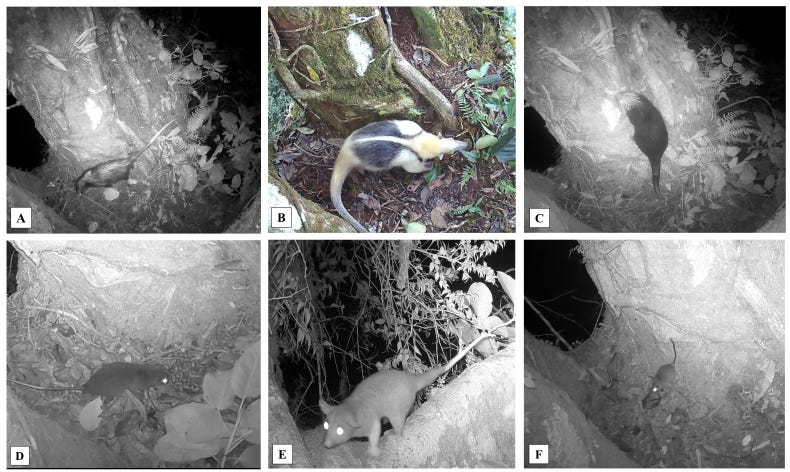
Some animals came to defecate or, in the case of the margay, to spray urine. Others appeared to rub scent glands at the site. Some may simply have passed through, or visited to gather information about nearby animals.
The cameras also captured never-before-recorded footage of Hoffmann’s two-toed sloths defecating in the canopy. Until now, it had been assumed that sloths always travel to the ground to defecate. The researchers suggest that using the latrine may be safer, as each of the sloths observed was a female carrying offspring.
The cameras also recorded four members of the raccoon family — the olingo, kinkajou, cacomixtle and white-nosed coati — alongside rodents, the long-tailed weasel, the tayra, and a type of anteater called a northern tamandua. The most frequent visitor was the Mexican hairy dwarf porcupine.
“We were hoping that we might see one or two species,” says Chamberlain. “It really blew our minds just seeing so much activity in this one site.”
The camera-trapping results were remarkable, but the researchers had more to share. By combining new fieldwork with data from previous climbs, they built a dataset covering 169 trees of 29 species in three of Costa Rica’s mountain ranges. They found latrines only in Ficus tuerckheimii — and in 11 of the 15 individuals they climbed.
The researchers think latrines are concentrated in these strangler figs in part because of the tree’s structure. Each latrine was located at the tree’s main bifurcation, which formed a flat, open platform covered with moss, soil, fallen leaves and other organic matter. Location matters too.
“It is more likely to find a latrine when the Ficus is next to a river,” Quirós-Navarro told me. “The massive horizontal branches that these trees exhibit form a bridge over the river, and they act as a key connector point in the forest.”
The researchers suggest that Ficus tuerckheimii “may serve as a keystone structure in the canopy, supporting interaction and communication among arboreal mammals”.
Andy Whitworth, a research associate at Wake Forest University in the United States, who has studied terrestrial latrines of spider monkeys, calls the new study “really neat”.
“What I really appreciate is that the authors utilized cameras in a novel way to ask a specific question,” he says. “Their effort in tree climbing and field work is admirable. And then the discovery of this specific strangler fig species as the only identified latrine site is impressive.”
Whitworth says the strangler figs “must be essential for safety and information transfer between both individuals of a species and between species”, adding that he and his colleagues have detected similar information transfer sites on fallen tropical logs over rivers.
“These types of studies show that animals don’t simply move randomly on the ground, or in the trees, but choose specific areas, likely to leave signs to other animals,” he told me.
The findings from Costa Rica resonate with research from Southeast Asia. Quentin Phillipps, an expert on figs in Borneo, suggests that the trees themselves may benefit.
“My guess is that the Costa Rican fig tree benefits from the dung as fertilizer and, if someone excavated a latrine, they would find that the fig tree had inserted adventitious feeding roots into the base of it,” he told me. “If my guess is correct, this means that the fig tree benefits from the latrine and presumably initially attracts mammals by some sort of smell.”
Phillipps also notes parallels in Borneo — where several civet species, including the binturong, have been recorded defecating on fig trees.
The first researcher to describe this was Miyabi Nakabayashi, in her doctoral thesis in 2015. In a 2019 paper, she and her colleagues described how binturongs defecated on relatively flat tree surfaces, such as tree forks, large epiphytes and large branches, often rubbing the faeces onto the surface of the defecation sites.
While the smaller civets are defecating in fig trees incidentally as they feed, the binturong appears to be more intentional.
“Regarding binturongs, they clearly formed latrines,” says Nakabayashi. “A binturong repeatedly defecated on the root masses of Cymbidium [an orchid species], and even several months later, when she returned to feed on Ficus punctata, she defecated on exactly the same Cymbidium individual.”
“Thick, stable, relatively flat branches of various fig and dipterocarp species, tree forks, and root masses of epiphytes all served as latrines,” she told me. “Small-toothed palm civets also clearly defecated in the canopy and, like binturongs, smeared faeces onto branches. However, I was not able to confirm the formation of latrines in this species.”
Quirós-Navarro was excited to learn of this research. “She has the same definition as I do: the animal is repeatedly coming to the same place to poop, regardless of if the tree is fruiting or not,” he says. “I would love to see if they consistently use fig trees more frequently than any other trees. That would be amazing.”
New questions in the canopy
The research in Costa Rica raises many new questions: Do the fig trees benefit from the nutrients? Do latrine visitors avoid each other, or interact indirectly through scent? How do insects, reptiles and amphibians use these sites? And why are latrines associated with fig trees in particular?
Quirós-Navarro and his colleagues are now monitoring other Ficus tuerckheimii trees to explore such questions. Their research adds to mounting evidence that Ficus species are central to the integrity of tropical forests, underpinning biodiversity and offering valuable opportunities for conservation and ecological restoration.
“The whole story is wonderful in many ways because it’s so revealing about what we don’t know, and how much mystery there is out there still,” says Chamberlain. “It’s very humbling.”
Learn more about the Tropical Forest Ecology Project.
Thanks for reading. For more astounding stories about the ecological and cultural importance of fig trees, see the Planet Ficus archive. To support my work please consider subscribing or sharing this post.
No posts
Comments
Nothing yet. Say the first thing.
Sign in to join the conversation.