
Each month, I’ll bring you stories from around the world that reveal just how extraordinary fig trees are — not just biologically, but culturally, spiritually and artistically.
In this roundup, featuring news from February 2026, you’ll find: figs saving howler monkeys in Mexico, sacred figs of Sudan and Egypt, figs protecting penguins in Australia, culturally important fig species in Myanmar and Nigeria, heritage figs in India, and more.
Let’s dive in.
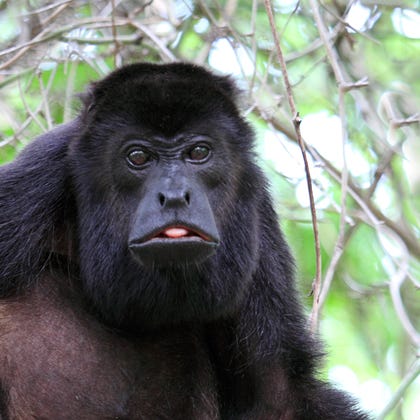
The year-round availability of figs is a boon to fruit eating animals. New research in Mexico explored why exactly it is that figs are so important to mantled howler monkeys. Researchers Pedro Dias and Ariadna Rangel-Negrín analyzed 20 years of data to test five possible explanations. Over this period, the monkeys allocated 77 percent of their feeding time to 11 fig species. The researchers showed that figs matter because their presence prevents the total amount of available food from falling below a critical threshold.
In other words, figs did not just supplement the monkeys’ diet — they prevented starvation. Overall, figs rescued the howler monkeys from food scarcity in 72 of the study’s 491 weeks of monitoring. The researchers say their findings show that fig trees should be explicitly protected in conservation planning, shielded from logging and used in forest restoration projects.
In Australia, the National Parks and Wildlife Service of New South Wales will plant native fig trees on an island nature reserve to improve habitat around little penguin burrows. The planting forms part of a wider project aimed at protecting species at risk from a potential bird flu outbreak.
The Times of India told the story of how Uttar Pradesh became the first state in India to institutionalize conservation of ‘living heritage’ when, in 2021, it identified 948 heritage trees aged at least one hundred years old. A remarkable 88 percent of the trees belong to just three fig species — a reflection of longstanding cultural reverence towards these trees.
Aye Mya Mon and colleagues published research on the significance of nine Ficus species to the Pa-O people in Myanmar, who use these ‘cultural keystone species’ in their diets and traditional medicines. The study also discusses the ecological importance of figs. It calls for traditional practices associated with socio-economically important species to be integrated with scientific knowledge and sustainable management strategies to enhance tropical forest restoration.
Nigerian health writer Olufunke described how Ficus exasperata leaves, bark, roots and figs are widely used across West and Central Africa to treat disorders including: inflammation, hypertension, infections, pain and burns. This species also has many practical uses — from processing palm oil to polishing wood and constructing canoes, furniture and drums.
The paperback edition of Olivia Sprinkel’s book To Hear the Trees Speak was published on 12 February. It features two fig species — the banyan (Ficus benghalensis) and the bodhi (Ficus religiosa) — among ten trees from which Sprinkel draws lessons for life in a fast-changing world.
British magazine Time Out included the ‘double decker’ living fig tree bridge in Meghalaya, India in its list of the world’s most beautiful bridges — see my story on the origins and persistence of these amazing structures: How Living Fig Tree Bridges Provide Lifelines in Extreme Weather
Figs also took three of the ten places in Discover Wildlife’s list of ‘epic photos of the most monumental trees on Earth’. Which do think is most iconic?
Julien Cooper and colleagues published a fascinating paper providing evidence that ancient Egyptians adopted traditions associated with sacred sycamore figs (Ficus sycomorus) from the Beja people of what is now Sudan.
Using a combination of biological, linguistic and cultural clues, the researchers were able to connect sacred-tree traditions of antiquity with present-day practices.
Together, these strands suggest a long-standing religious exchange between Egypt and the Beja, who today are Muslims but retain some pre-Islamic religious beliefs.

From Quentin Phillipps’s website Figs of Borneo come three examples of atypical reproduction by Ficus species. The first two cases are of figs that can reproduce asexually as well as through normal sexual reproduction:
Ficus grandiflora produces small roots that develop into structures called bulbils — see the photos. Heavy rain or floods can wash these bulbils off the plant and carry them to new sites, where they develop into clones of the parent tree.
Ficus carrii uses a different approach. It appears to reproduce partly by producing tiny clonal propagules on the outside of its figs, meaning animals that eat the fruit may disperse both seeds and ready‑made clones of the parent plant.
Ficus uncinulata reproduces sexually like most figs, but differs in how its seeds are dispersed. While most Ficus species rely on fruit-eating animals to provide this service, this one has another tactic. Its figs are covered with tiny hooked hairs that attach to the fur of passing animals — as seen in this photo of a cat at the Sabah Ficus Germplasm Centre, whose work I wrote about here: How Fig Trees Could Revolutionize Reforestation
Two stories I published here at Planet Ficus in February 2026:
Do you have a memory, photo, or observation involving fig trees? I’d love to hear from you. Send your story or image to planetficus@substack.com — I’ll feature selected entries in future editions.
Thanks for being part of Planet Ficus. If you liked what you read, consider sharing it with someone who might enjoy these stories too — and if you haven’t already, please subscribe for future editions. Together we can grow a forest of readers.
No posts
Comments
Nothing yet. Say the first thing.
Sign in to join the conversation.