
Paul Kingsnorth was a chain-yourself-to-trees environmentalist who has now grown older, converted to Christianity, and moved to rural Ireland to raise his family on the periphery of “the Machine”, the subject of this new book which is: “an attempt—a final attempt, I hope—to circumscribe this thing with words. To do my best to explain, to myself and to whoever is reading, the nature of this force that the poets have seen for so long. The nature of the Machine: where it comes from, how we built it, and what it is doing, finally, to our world and to our souls.”
I hadn’t read any of Kingsnorth’s past writing before picking it up, but I’d been reading around it in Byung-Chul Han and Simone Weil and Oswald Spengler. Against the Machine is a timely work with a cutting, deeply correct diagnosis, but it also falls short of what it could have been: some arguments are lazy, and the proposed solutions, while more nuanced than a pure degrowth tract, are left wanting. But hey, it also touches on Blue Origin and asteroid mining. Let’s dive in.
Kingsnorth starts with original sin, when humanity first left the garden (nature) then later tortured and killed the messenger who showed us the path back to it (the Christian way of life). He contends that whether we accept this story or not, its fading relevance and replacement with money as our sovereign is the underlying historical cause of the malaise in which we now find ourselves. Our crisis of meaning.
The West, in short, was Christendom. But Christendom died. What does that make us, its descendants, living amongst its beautiful ruins? It makes ours a culture with no sacred order. And this is a dangerous place to be.
A sacred order is something “solid, timeless, and lasting”, and in the form of Christianity it tied down the West: it gave it roots. Kingsnorth draws heavily on Weil’s work of rootedness to argue that modernity is really a centuries-long mass uprooting event that started in the West and was then spread globally in a self-reinforcing process.
He invokes Spengler’s theory of cultural cycles, starting with an organic birth, rising to a fulfilled potential, then ossifying into a “civilization” made up of a spiritually dead, sprawling cosmopolis. Kingsnorth pattern matches the machine’s values with those of Spengler’s Faustian age of history, with its “endless need for conquest, invention and exploration”.
This historical background does an effective job setting the stage to then define “the Machine” in more detail. Unfortunately, this is also where some of the weaker arguments start to crop up. Drawing on a recent trip to purchase a lawnmower, Kingsnorth uses robotic mowers to generalize that “[i]n my lifetime, all the labour- and time-saving technologies which have been pushed at us, from the microwave oven to the internet, have given us things we didn’t previously have, and taken plenty more away, but one thing none of them has done is to save either time or labour”. Other examples he gives to justify this? Email, smart fridges, instant boiling water taps, and Amazon’s Alexa.
Okay but here’s another, less frivolous list also within the author’s lifetime: computer-aided design, barcodes and scanners, electronic tolls, GPS, and laparoscopic surgery. If we dial back a few decades earlier we start to run into things like automatic washers and dryers. Imagine going back soon after they were introduced and telling housewives that these weren’t actually saving them labor and time, and were being pushed at them by “the Machine”. I’m not sure they would agree that “plenty more” was taken away from them than given. Also provided by the Machine in Kingsnorth’s lifetime: the MRI, monoclonal antibodies, antiretrovirals, IVF, reverse osmosis membranes, statins, and CAR T therapy.
Regardless, the collection of these “technics” as Kingsnorth calls them (borrowing from Lewis Mumford) is not the machine itself, but its output:
The Machine is, rather, a tendency within us, made concrete by power and circumstance, which coalesces in a huge agglomeration of power, control and ambition. The Machine manifests today as an intersection of money power, state power and increasingly coercive and manipulative technologies, which constitute an ongoing war against roots and against limits. Its momentum is always forward, and it will not stop until it has conquered and transformed the world. To do that, it must raze or transmute many older and less measurable things: rooted human communities, wild nature, human nature, human freedom, beauty, faith and the many deeper values which we all adhere to in some way or another but find difficult to describe or even to defend. Its modus operandi is the abolition of all borders, boundaries, categories, essences and truths: the uprooting of all previous ways of living in the name of pure individualism and perfect subjectivity. Its endgame is the replacement of nature with technology, in order to facilitate total human control over a totally human world.
How does this happen in a practical sense? Kingsnorth points to the Enclosure process in his native England as the original template, where local communities and cultures and commons were purposefully uprooted to create a desert from which the Machine could operate. He also introduces the first hints of a method for resisting the Machine in the form of the Fen Tigers and Ned Ludd, who while they “lost their war, their case was always correct”.
Then the author turns to Jeff Bezos. He takes Jeff to be a mouthpiece for the Machine, but curiously, instead of focusing on Amazon, Kingsnorth takes aim more at Blue Origin and its goals of expanding beyond Earth. He cherry-picks quotations to paint Blue’s goals as fleeing Earth to build “castles in the sky”. Of course, the name “Blue Origin” represents the ocean world we started on, and Jeff’s actual motivation is to move heavy industry off planet and “re-zone” Earth for humans to live free of it: “We need to preserve Earth as a residential and natural zone”. Perhaps Kingsnorth didn’t care to dig into these deeper motives, or they were too inconvenient for the narrative. In the book as a whole, he paints the Machine as inevitable and invincible. We might then imagine he would embrace Jeff’s ambition to divert the Machine off planet, allowing for a return to the garden. But alas.
The author suggests Jeff has fallen for a story of pure reason and rationality:
Reason is appealing, because it implies that humans can use their faculties to order the universe, and that the universe will respond in kind. We want desperately to believe this story; in a Godless age, it is perhaps the only story that can save us, because it tells us that we understand the world, or are capable of doing so, and that this understanding will allow us to control it. And because the story is at least partially true—we have modern medicine and the internet and sort-of democracies and space flight as demonstrations that empiricism and rational enquiry can deliver at least some goods—we are able to keep telling it.
This gets back to the same tension above. Kingsnorth must thread a needle to paint the Machine as an all-encompassing evil, while not fully ignoring the reality of all the wonders it has given us. His solution is to begrudgingly admit these but heavily downplay them: “at least some goods”, which comes across as a weaselly effort. You won’t find graphics like this within the book:
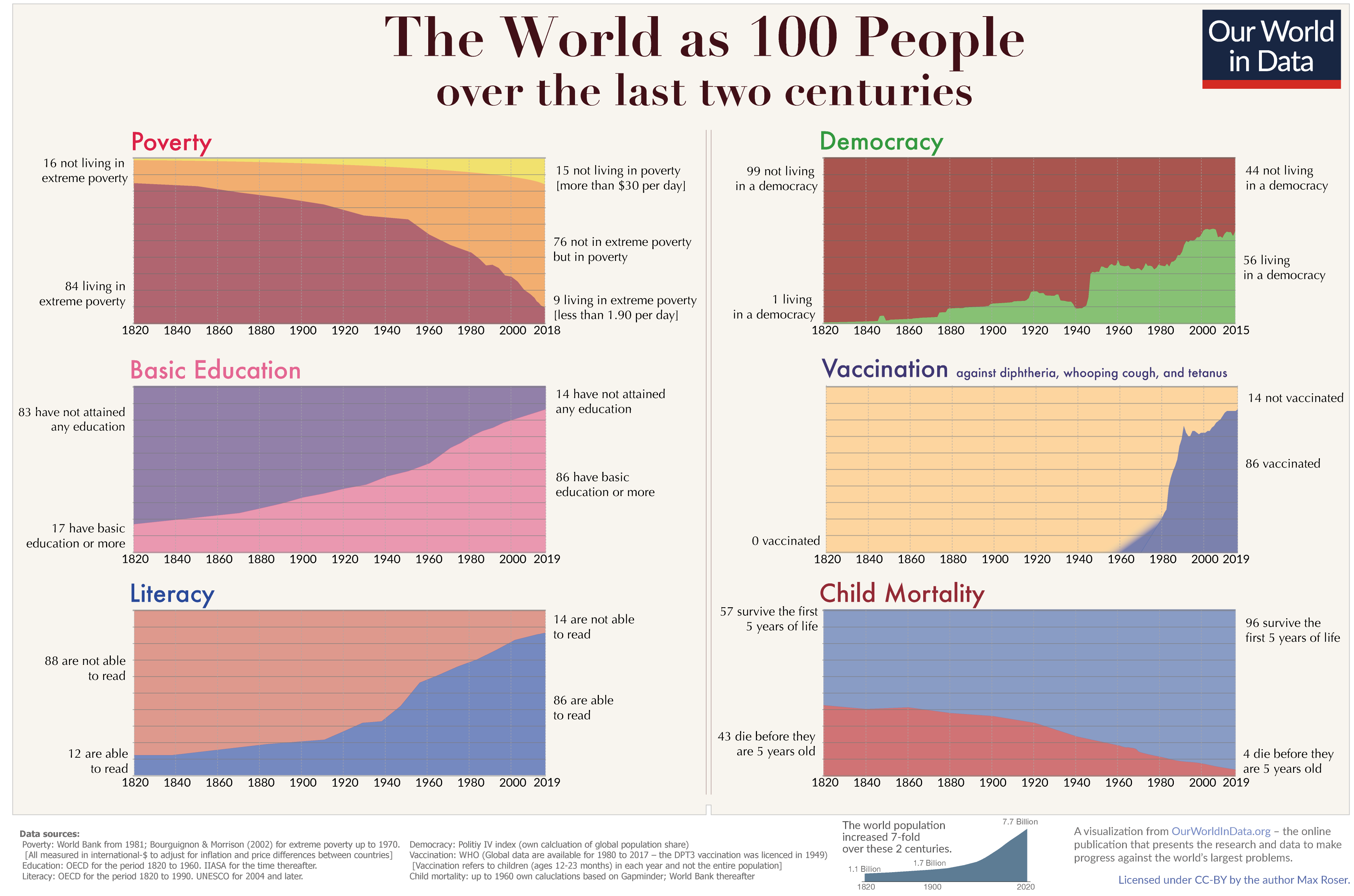
That’s not to say it’s a simple weighing exercise, where what’s been lost should be disregarded because on balance it comes up short. I’m not sure it’s possible to write a book which gives proper focus to that loss but also comes across as even-handed. Kingsnorth breathes life into every nook of the uprooting and its impact in a treatment that puts today’s “this is what they took from us” memes in their place. On cities:
This is the modern Machine city: global in scale and ambition, bland, homogenised and empty at its heart. Plato’s ideal city, and the real cities of the pre-modern period, were a combination, sometimes uneasy, sometimes harmonious, of ambition and aim. They were religious centres, cultural hubs, marketplaces, dwelling places, loci of power. The twenty-first century city exists mainly for one purpose: profit. Everything that exists there, from schools to art galleries to concert halls to government buildings, is pointed towards this end. You can judge a culture, I think, by its tallest buildings; what it chooses to reach towards is a reflection of its soul and purpose. The tallest buildings in a modern city are not cathedrals, temples, or even palaces: they are skyscrapers, which are homes to banks, finance houses and global corporations.
And on waste:
We can enjoy our little towns here in the richer bits of the world because the waste we generate through our excited purchases of big-screen tellies, Lego sets, foreign holidays, cheap clothes, cheap food and all the rest of it always ends up somewhere else. The dioxins and PCBs go into the water and soil, the plastic goes into the oceans, the carbon dioxide goes into the air. Fifty million tonnes of ‘e-waste’ is dumped every year, much of it shipped to the poorest countries on Earth, which are least equipped to deal with it. But then they’re not really supposed to deal with it: they’re supposed to keep it away from us.
By the end of this section Kingsnorth has done well to accomplish part of what he set out to do, to “circumscribe this thing with words”. He then sets his sights on the culture war. His contention is that both sides, left and right, are really part of the same Liberalism that has regressed to produce a “sovereign human person, dis-embedded from community, history, and nature”. The “Four Ps” of Past, People, Place, and Prayer have been superseded by the Four Ss of Science, The Self, Sex, and The Screen. I imagine Balaji’s “network states” are a good model for a future culmination of this trend.
Kingsnorth brandishes his antiwoke credentials: at first I was skeptical, then he laid it on thick enough to convince me, then kept going so much I was a bit skeptical again. He comes at the culture war mostly from the perspective of what the postmodernists are doing to tradition and culture, which is tearing them down in an indiscriminate rage. Destruction with no replacement. One of their targets is woodstoves in homes (i.e., the hearth; see The Ancient City for the best view on this in past times):
This new tilt against household fireplaces is not just an Irish phenomenon: it is suddenly popping up everywhere. Woodstoves are, curiously, becoming the number one air pollution villain. Never mind mass car use, accelerating air travel or industrial pollution. Never mind the emissions caused by the massive increase in internet server farms, which by 2030 could be using up an astonishing 70 percent of this country’s electricity.
Having dispensed with all of science in an earlier chapter, we aren’t given the benefit of data here, just a whataboutism. Data like a single old wood stove producing 8 diesel school buses worth of PM2.5 emissions. Alas, again. But maybe this is the problem, that what we gain from the Machine is more easily quantified than what has been lost. You can’t put numbers on the meaning attached to a family sitting around the hearth, or to children being in a classroom together instead of on Zoom.
AI discourse is scattered throughout the book, but the dedicated chunks are underdeveloped. Kingsnorth hasn’t engaged with AI himself, so plucks weird tidbits here and there from online news articles:
Just as I was writing this chapter, Kuwait debuted an entirely fake ‘AI newsreader’ that promises ‘new and innovative content’. Fedha looks, sounds, and behaves like a real person, and has been given an old Kuwaiti name meaning ‘metallic’—the traditional colour of a robot, according its creator.
Like, OK? That’s nice for Kuwait. Is this significant? He then quotes from transcripts of Bing’s Sydney, and from the failed AI “pause” moratorium. He’s unfamiliar with actual current capabilities because he has never used an LLM:
The currently available chatbots, unlike the crude algorithms that run a social media feed, can develop nuance and power autonomously, teaching themselves and others, and they can do so at exponential rates.
Chatbots trained to communicate in English have started speaking Persian, having quietly taught themselves.
“Quietly taught themselves” is a funny way of saying there were Persian texts in the pre-training data. I don’t know what “develop nuance and power autonomously” is supposed to mean, but it sounds scary! Kingsnorth defers heavily to Tristan Harris and later Eliezer Yudkowsky, both famous for giving reasonable takes on AI. The book’s slant here is predictable but unfortunate, because unlike all the other deterministic, inanimate Machine technics, AI is much closer to the cast-out mysticism and spiritual realm that Kingsnorth so wants to revive. From Andrej Karpathy: “we’re summoning ghosts, not building animals”. Could AI not be a way to usher magic back into the world, with its black boxes we can only start to poke at with interpretability methods? This seems like a missed opportunity to explore.
Having finished with a detailed diagnosis, we now come to the prescription. Kingsnorth says we should abandon “the West”, here taken to be the West’s way of seeing the world, drawing on the left-brain right-brain distinction put forward by Iain McGilchrist:
It would mean attending to the ways of seeing that were central to past cultures, but that Western modernity relentlessly dismisses or downplays as unprofitable, unrealistic, romantic and all the rest. Perhaps central to this is an effort to see the world as an organism rather than a mechanism, and then to express it that way, through art, through creativity, through writing, through our conversations.
Without reading the newer 1,500 page, 2-volume set from McGilchrist, the best I can make out is that he believes an anatomical asymmetry (which is real) was reinforced by cultural conditions in the West to amplify a certain way of seeing the world, which could be manifested in epigenetic or structural changes in the brain. Basically, “the West” as mental illness. His earlier book The Master and His Emissary has been called “a seductive fantasy masquerading as science”. But if you try to come at this rationally, I feel like Kingsnorth would counter with something like ‘Why are you doing that? The whole point of my book is that rationality and scientism are Machine values to be discarded’. But then what is he saying here? That if we put effort into seeing the world the other way, we can reverse those epigenetic changes somehow? I don’t think he’s saying that, I think he likes the just-so story from McGilchrist, isn’t worried about any actual mechanism, and so it doesn’t matter if the mechanism (which probably doesn’t exist anyway) can be reversed by just thinking a different way. Then why appeal to a science-like authority in the first place? A bit later, Kingsnorth says “these days I find it impossible to trust anything which comes to me with a seal of authority stamped upon it. In fact, the minute I am told that an ‘expert’, a state-sanctioned authority, a scientific body or a mainstream media organisation has ‘fact checked’ what I’ve just heard, I instinctively dismiss it.” Is McGilchrist OK because he’s outside the mainstream, or because his story fits the narrative? What about Yudkowsky, who the author tells us is “regarded as a leader in the field of artificial general intelligence”? Should we believe his prognostications that we’re all going to die, because as Kingsnorth says, “Let me remind you that this is Time magazine”?
To his credit, the book does lay out a coherent overarching if idealistic goal for fighting back against the Machine:
This, then, is my idea of an anti-Machine politics. A reactionary radicalism, its face set against Progress Theology, which aims to defend or build a moral economy at the human scale, which rejects the atomised individualism of the liberal era and understands that materialism as a worldview has failed us. A politics which embraces family and home and place, loving the particular without excluding the outsider, and which looks on all great agglomerations of power with suspicion.
But things get shaky down at the level of tactics. He invokes historical analogies to “shatter zones” at the edges of older states where people lived ungovernable in difficult terrain, and to “jellyfish tribes” that scattered and divided in response to organized pressure. I appreciate how honest Kingsnorth is about the power and popularity of the Machine: even he himself doesn’t advocate for attacking it head-on or starting a popular revolution against it. He sees its power is growing, and heading for the hills would only buy time. Those who flee off the grid are to be venerated, but a more realistic path for most (but because of the Machine’s popularity, it’s really the few) is to resist from within:
Like small furry mammals running unnoticed beneath the feet of tyrannosaurs, we build our own little worlds on the margins and wait for the coming of the meteor, which we can already see coming in the very unsustainability of Machine modernity. The mice don’t attack the dinosaurs, but neither do they just wait for them to die out: they avoid them as best they can, and get on with their work.
Kingsnorth has stared down the great maw of the Machine and concluded this is the best we can do. There’s an impasse here, where a wholesale new culture to replace the West can’t be built until the Machine is dead, but the Machine is so powerful we can’t hope to kill it, and probably can’t outlast it. So are the mice working away at building something new, or does “getting on with their work” just mean eating and shitting and reproducing? Is the age of mammals really coming after, just not within our lifetimes? If the Machine offers to extend our lifespans enough to reach it, should we accept? Probably Kingsnorth would say no, but in other areas he does accept gifts from the Machine, like his livelihood from writing on Substack and selling books.
For a commentator already on the margins, the book’s medicine is easy to take, but what about those actively building the Machine? I think the author would tell us to stop. Don’t work for the billionaire. Don’t invent new technology, unless it’s technology to oppose the Machine. Destroy the spaceships. But do we just pause here, on the cusp of curing cancer and every other disease, drawing down emissions, lifting those remaining in poverty out of it, and settling the solar system? There’s an arbitrariness of when to stop, or where to regress to:
Mark lives entirely off-grid. He has no electricity, he collects his water from a local spring, and he heats his small home with locally scavenged wood. He has no phone or computer, and never looks at the internet.
Many people look askance at me because I have no smartphone and can’t be included in their WhatsApp group, or because I won’t use social media or watch the TV, but I’m a beige normie compared to him.
I tend to think both of these are LARPing. That these lifestyles are only possible because the Machine has already cleared away most infectious diseases and predatory animals, and made safe food widely available. And it’s OK they’re a LARP. Kingsnorth basically admits as much. But I’d argue these ways of living become more possible for more people, and they get richer and deeper, the more powerful the Machine gets: this means not bombing the datacenters. The technics will fade into the background, screens will start to disappear, and magic will creep back in both by design and via Clarke’s third law. For me, ‘Against the Machine’ provides good guidance for where to steer the Machine, and some correctives, but I’m along for the ride.
Comments
Nothing yet. Say the first thing.
Sign in to join the conversation.