
Solar Geo-what?
One of the challenges of making a film about a topic like solar geoengineering in Plan C for Civilization is...what is “solar geoengineering,” aka, “solar radiation management,” “SRM” or, “chemtrails,” (depending on your willingness to dive down internet conspiracy rabbit holes).
The concept is foreign to most, and based on my encounters when many people hear that solar geoengineering could be a means to cool the planet their mind snaps to the somewhat more familiar term “geothermal”. As in, circulating liquids from the ground to the surface to cool a warm a building or to create electricity. It does have an oddly poetic connection and on some level it feels rude and a little wonky to correct the misunderstanding. So instead I just try to move as quickly as I can to the actual concept.
Perhaps because of this branding issue, some have recently begun to try to introduce the phrase “sunlight reflection.” It’s simple, to the point and certainly accurate. But to me it first conjures up images of vintage tanning techniques from a time before we knew much about the other effects of solar radiation.

So what is solar geoengineering?
According to an analysis from 2025, less than than 4% of Americans reported being “very familiar” with the concept of “solar geoengineering.” That feels right. The word “geoengineering” itself has a sorted, jumbled etymology. Until about 15 years ago it was a catchall phrase for just about any technology that could address the impacts of climate change from global heating to acidifying oceans and so forth. It included research designed to remove carbon dioxide from the atmosphere (carbon dioxide removal, or CDR) and ideas to reflect sunlight away from the earth (solar radiation management, SRM, or solar geoengineering).
CDR is an attempt to attack the problem itself - to draw down excess CO2 in the atmosphere, while solar geoengineering only addresses the most dangerous symptom - heat. The main intention of global scale carbon dioxide removal as a field is to reduce the warming effect that it creates as a greenhouse gas in the atmosphere. And in this way, it shares the goal of reducing heat with solar geoengineering. But the carbon dioxide, once removed, also has many potential co-benefits that are related to the many ways in which carbon moves through the earth system. It can be used to improve soil health and agricultural yields, reduce ocean acidity and even be “recycled” through converting it into liquid jet fuel, yoga mats and toothbrushes.
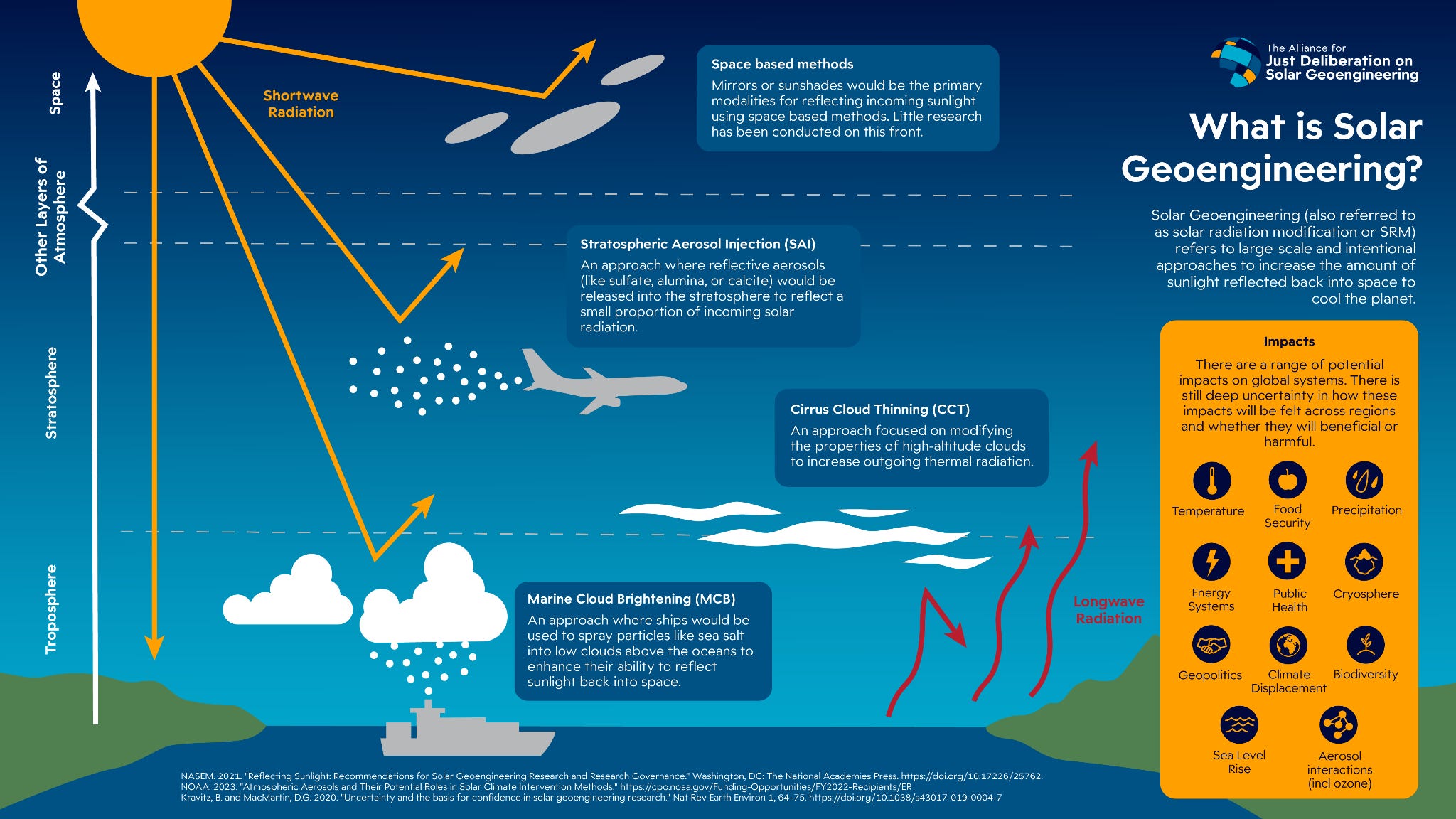
Reflecting sunlight away from the earth, on the other hand, is strictly designed to cool the planet. In theory, and in most model simulations, it would return the climate and associated patterns of weather to something more like what we experienced for millenia rather than what we’re seeing now and what is to come. But it doesn’t have any of the other co-benefits - if anything, it comes with lots of uncertainties.
It was convenient to lump these (CDR & SRM) together for many years, but frustrated researchers and communicators have been trying to pull them apart for more than a decade to avoid confusion. Unfortunately, it hasn’t quite worked out. If you want to see a scientist’s head explode...per Wikipedia the definition of geoengineering was and still is “deliberate large-scale interventions in the Earth’s climate system intended to counteract human-caused climate change.”
But in the end, who cares about the terminology? If I don’t have much time at all and I’m talking with someone under, say, 50, I’ll just ask “have you seen Snowpiercer?” If the answer is “yes,” then it’s easy to explain the premise of solar geoengineering because it’s the exact same concept as the experiment gone awry in the first minute of Bong Joon Ho’s sci-fi film from 2013. The scientists in Snowpiercer went a little far though, and accidentally and froze the planet.
*Bong Joon Ho also directed Parasite, the top film of the 21st century so far for many critics and viewers. He’s got chops.
And if the Snowpiercer reference doesn’t land, or if I have more than 10 seconds, I’ll use the natural analog, or the “Mt. Pinatubo” effect.
Certain volcanoes erupt and spew megatons of tiny, shiny particles into the atmosphere.
Small amount of sunlight is reflected.
Planet cools for a year or so.
Scientists want to know if we could do the same.
So there you have it. Solar geoengineering, mimicking an occasional but well-documented natural phenomenon, has been proposed as a way to cool a heating planet.
Could we do it? Should we do it? That’s a different conversation.
No posts
Comments
Nothing yet. Say the first thing.
Sign in to join the conversation.