
Welcome back. This week's edition is a heavy one, with Microsoft Build dominated the news cycle with a wave of model releases and a meaningful pricing shift in Copilot, and AWS quietly dropped one of the more architecturally interesting serverless updates in recent memory.
On the local AI front, Stanford's OpenJarvis is worth your attention if you're thinking seriously about on-device agent infrastructure. And NVIDIA's LocateAnything-3B is a compact but production-grade grounding model that's already embedded in their own VLM stack.
A lot to get through — let's dig in.
- Michael
Gemma 4 - 12B - Is Now Available on Ollama (link)
Microsoft Build Happend this week. Tom’s hardware has a summary of the announcements (link)
Microsoft Copilot has switched to a consumption model versus a per user model (link)
Microsoft releases 7 in house models (link)
OpenJarvis is a local-first personal AI framework out of Stanford SAIL (Hazy Research and the Scaling Intelligence Lab), built around the thesis that the software stack, not the hardware or models. It has been the missing piece for practical on-device AI. Their Intelligence Per Watt research found that local language models already handle 88.7% of single-turn chat and reasoning queries, with intelligence efficiency improving 5.3× from 2023 to 2025. The framework aims to be the PyTorch of local AI: a research platform and production foundation simultaneously.
Five-primitive architecture — Intelligence (model selection), Engine (inference runtime), Agents (multi-step reasoning), Tools & Memory, and Learning (trace-driven improvement) are each independently swappable, keeping the stack composable rather than monolithic.
Engine-agnostic inference — supports Ollama, vLLM, SGLang, llama.cpp, MLX, Exo, LiteLLM, and cloud APIs through a unified InferenceEngine interface, with auto-detection of GPU vendor, VRAM, and optimal backend for your hardware.
On-device learning loop — every interaction generates local traces that feed automatic improvements to model weights, prompts, and agent behavior via DSPy, GRPO training, and LoRA fine-tuning — an uncommon capability for a local-first framework.
Energy and cost as first-class eval metrics — built-in telemetry tracks GPU power draw, FLOPs, token costs, and latency, treating efficiency as a benchmark constraint rather than an afterthought — directly aligned with the Intelligence Per Watt research agenda.
Skills ecosystem with 13,700+ community entries — skills follow the agentskills.io open standard and can be imported from Hermes Agent (~150 skills), OpenClaw (~13,700 community skills), or any GitHub repo, then optimized against your own trace history
Read more at Github
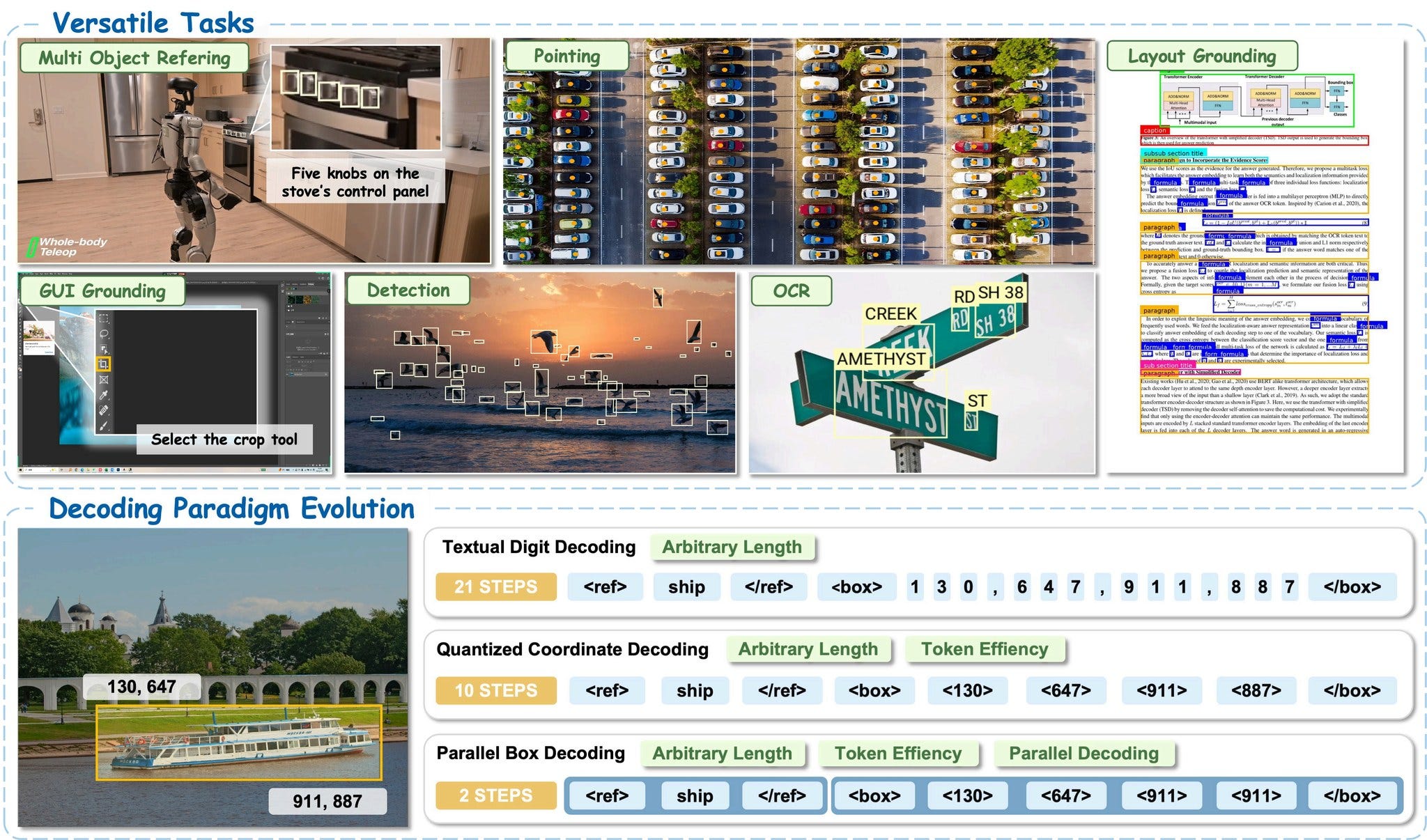
NVIDIA has released LocateAnything-3B, a 3B-parameter vision-language model purpose-built for spatial grounding tasks, under the Eagle VLM research umbrella. It’s a compact but capable model covering object detection, referring expression grounding, GUI element localization, OCR/layout, and robotics perception — all from natural language prompts.
Parallel Box Decoding (PBD) — instead of autoregressive coordinate generation token-by-token, the model predicts complete bounding boxes in a single parallel step, delivering up to 2.5× higher throughput without sacrificing geometric consistency.
Generalist grounding at scale — trained on 12M images, 138M+ queries, and 785M bounding boxes spanning natural scenes, robotics, driving, GUI interaction, and document understanding, making it one of the broader training sets for a model this size.
Already in production at NVIDIA — the model has been integrated into Nemotron 3 Nano Omni, supporting grounding, GUI understanding, and multimodal agentic capabilities, so this isn’t pure research — it’s the perception backbone behind NVIDIA’s own frontier VLMs.
Three inference modes — Fast (pure MTP, highest throughput), Slow (autoregressive, most robust), and Hybrid (default — MTP with AR fallback on ambiguous boxes), giving practitioners a practical knob to tune speed vs. accuracy per workload.
Non-commercial only — released under the NVIDIA License for academic and non-profit research only; commercial use is not permitted except by NVIDIA and its affiliates. Worth flagging for anyone looking to productionize it independently.
Read More At HuggingFace
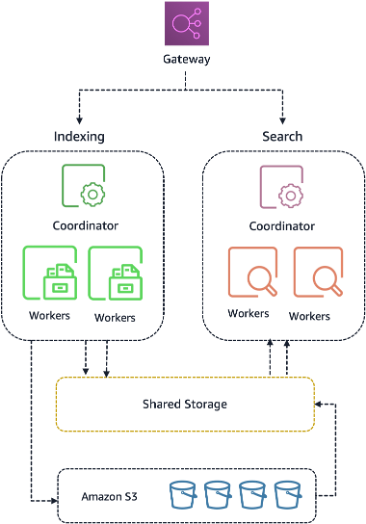
AWS has done a full ground-up re-architecture of OpenSearch Serverless, and the headline numbers are worth paying attention to.
The new “NextGen” architecture decouples compute from storage, delivers up to 20x faster autoscaling, true scale-to-zero, and up to 60% lower cost compared to provisioning clusters for peak load. It’s a meaningful shift in how the service is designed — less “managed cluster” and more “serverless-first.”
True scale-to-zero — after 10 minutes of inactivity, compute drops to 0 OCUs; when traffic resumes, capacity returns in ~10 seconds without dropping queued requests.
Compute/storage fully decoupled — stateless OCUs mount a distributed shared storage layer, which eliminates local disk bootstrapping and allows indexing and search to scale independently of each other.
GPU-accelerated HNSW by default — NextGen vector collections automatically use GPU-backed compute for HNSW index construction, with GPU usage billed as a separate line item — no opt-in required as with Classic.
Simplified multi-tenant networking — a new per-account regional endpoint serves all collections through a single hostname, eliminating per-collection TLS sessions and removing the need for custom Route 53 private hosted zones.
Migration is reindex-only — existing Classic collections don’t auto-migrate; you create a new NextGen collection group, reindex your data, and update the endpoint — index mappings and queries are unchanged. TIMESERIES collections are not supported at launch.
Read More On the AWS Blog
No posts
Comments
Nothing yet. Say the first thing.
Sign in to join the conversation.