
When I was a kid, I use to research cycling and follow the sport. Every month a new fad came out and every few months what we knew all along from the old French coaches was reaffirmed. This week’s reaffirmation is that “Professional Developer's Don’t Vibe. (link). In particular, “Experienced developers find agents suitable for accelerating straightforward, repetitive, and scaffolding tasks if prompted with well-defined plans”. Am I the only one who immediately becomes suspicious when someone talks about how amazing their Agentic AI Coding is going?
A topic I love to focus on got a reinforcer from this great article on The Search Results F-Heatmap, Frame by Frame (link). Those who design search interfaces can benefit from the research published by AdSERP and summerized by Andy Edmonds in that article. Tracking eye movments, or better, understanding eye movements allows you to design a better page layout. Happy Designing!
Lastly, something else that is near and dear to my heart is unsupervised document clustering which Elastic wrote about on their Search Labs with Jina (link).
-Michael
AWS announced S3 File Systems - (Link). Now you don’t have to choose between object storage and and file storage. S3 Files uses Amazon Elastic File System (Amazon EFS) and delivers ~1ms latencies for active data.
Nividia Launches Nemotron 3 Nano Omni Model - (Link) a 30B-A3B hybrid MoE open model that unifies vision, audio, and language into a single multimodal agent runtime — claiming 9x higher throughput than comparable open omni models — with day-one adoption from Palantir, Foxconn, and H Company.
Claude Code is included in Pro (Link) - Fake new has been falsely reporting that Claude Code is not included in the pro plan. Checking the source plan page, it is still included.
Local AI gets real - with Qwen 3.6 (Link), Gemma 4 (Link), and Kimi (Link) -

Got over your OpenClaw hang over? Hermes Agent (link), is an MIT-licensed autonomous agent built around a closed learning loop: it creates reusable skills from experience, improves them during use, and builds persistent memory across sessions. The pitch is an agent that compounds in capability the longer it runs, deployable on anything from a $5 VPS to serverless infrastructure. I’ll be trying it out on my home lab and laptops. It includes:
Self-improving skill system: Hermes auto-generates and refines procedural “skills” as it works, storing them in a cross-session memory index so solutions to past problems are recalled and reused — not re-derived on every invocation.
Runs anywhere, not just your laptop: Six terminal backends (local, Docker, SSH, Daytona, Singularity, Modal) with serverless options that hibernate when idle, decoupling the agent runtime from your development machine entirely.
15+ messaging platform gateway: A single agent instance surfaces across Telegram, Discord, Slack, WhatsApp, Signal, Matrix, and more — meaning the agent persists context while you switch interfaces, not the other way around.
Parallel subagent delegation: Isolated subagents with their own terminals and Python RPC scripts enable zero-context-cost parallel pipelines, with
execute_codecollapsing multi-step workflows into single inference calls.MCP and RL research hooks: Native MCP server integration extends tooling, while trajectory export and Atropos RL training support make it a credible platform for teams doing applied agent research, not just application development.
Read More On [GitHub]
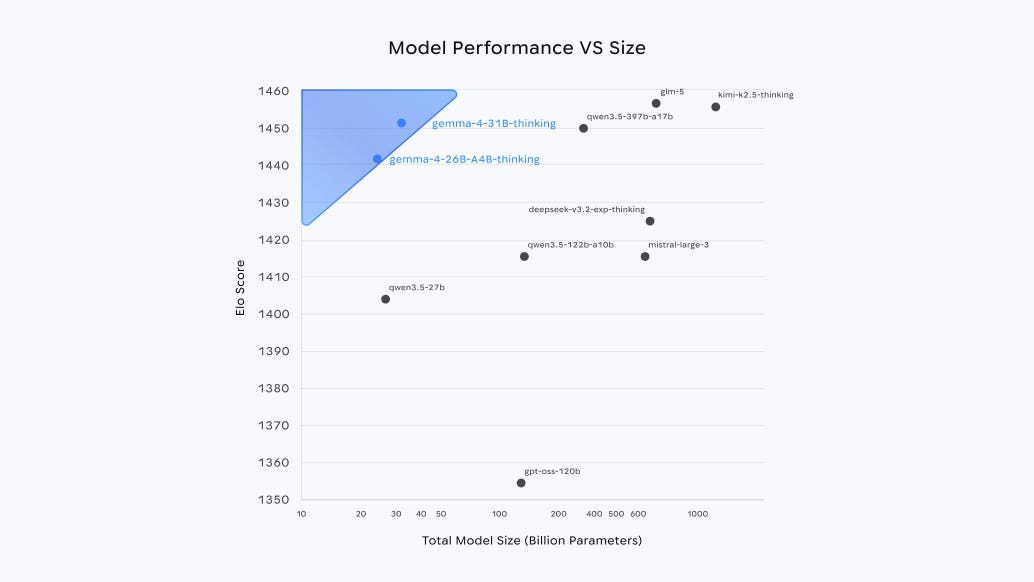
Google DeepMind’s Gemma 4 is the latest generation of its open-weight model family, distilled from Gemini 3 research and built across four size variants — E2B, E4B, 26B, and 31B — targeting everything from IoT devices to consumer workstations (even a Raspberry Pi). The headline claim is best-in-class intelligence-per-parameter for open models.
Benchmark numbers are serious: The 31B thinking variant scores 89.2% on AIME 2026 math and 80% on LiveCodeBench v6 — numbers that rival many closed models — while the E4B still hits 52% on LiveCodeBench, surprisingly strong for an edge-class model.
Native agentic support: Gemma 4 ships with built-in function calling and scores 86.4% on the τ2-bench agentic tool use benchmark, signaling this is designed as an agent runtime, not just a chat model.
140-language multimodal support: Audio and vision understanding across 140 languages is baked in, making it a credible option for localized enterprise deployments without additional fine-tuning overhead.
Broad ecosystem distribution: Weights are available via Hugging Face, Ollama, Kaggle, LM Studio, and Docker on day one, with training support across JAX, Keras, and Unsloth — lower friction to production than most open releases.
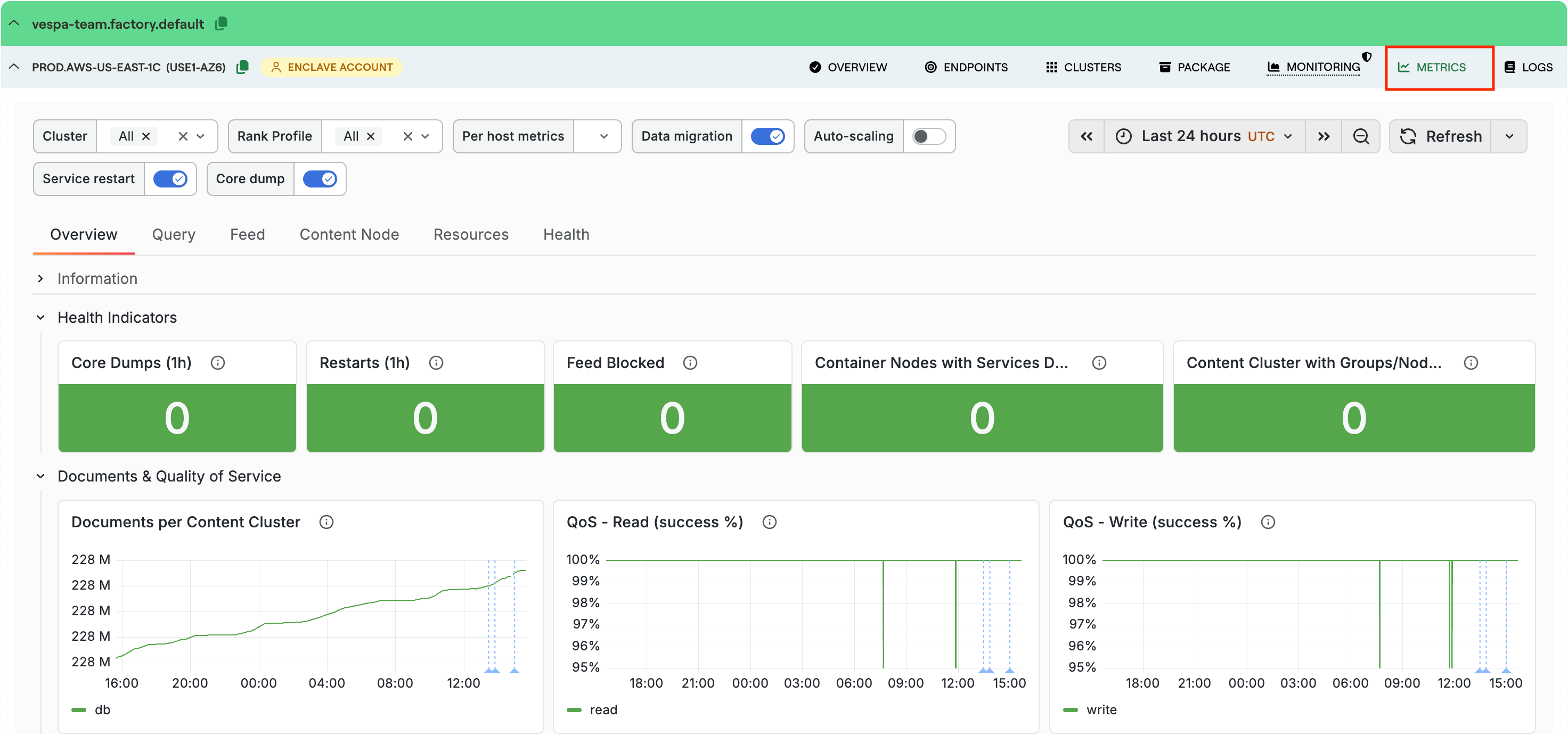
Vespa’s revamped Cloud metrics dashboard moves beyond raw graph-watching by structuring observability around a deliberate troubleshooting flow: health, latency path, resource saturation. Engineers then can get from symptom to root cause without hunting across disconnected panels.
Key Points
Structured triage workflow: The dashboard is organized around three sequential questions (healthy? where is latency? saturated?) mapping directly to Overview, Query/Feed, and Resources tabs rather than presenting an undifferentiated metrics wall.
New Health Indicators row: A dedicated five-panel health row surfaces core dumps, restarts, feed blocks, and downed nodes at a glance, giving on-call engineers a single starting point before diving deeper.
Annotations tie spikes to events: Vertical timeline markers for service restarts and core dumps now appear across every chart, directly correlating latency anomalies to operational events like upgrades, reindexing, or OOM crashes.
Smarter thread pool visibility: The Resources tab now auto-renders context-specific thread pool rows based on
services.xmlconfiguration, eliminating empty panels and surfacing only what’s relevant to a given deployment topology.JVM memory layering for AI workloads: Heap, direct, and native memory are broken out separately — particularly useful when running local embedders or LLM components where model weights and KV cache consume native memory that won’t show up in heap metrics.
No posts
Comments
Nothing yet. Say the first thing.
Sign in to join the conversation.