

We’ve spent the last few months digging a little deeper into the Categories of place-based change we identified in our Taxonomy for place-based change. We wanted to test our thinking and look more closely at how these ways of working actually drive change.
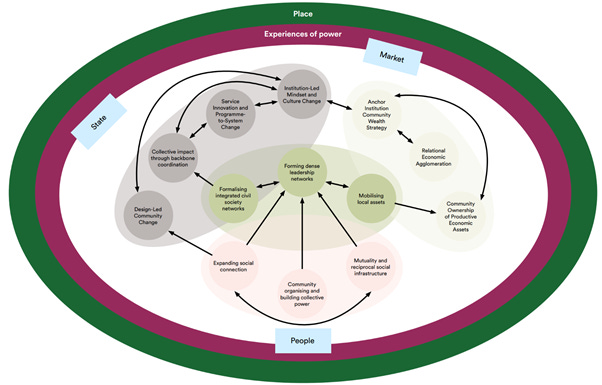
The result is our Pattern book. In that, we have identified 13 patterns that, from looking more thoroughly through the evidence, map onto the Categories we have outlined.
We think these patterns show up across places. They may use different language, and they will fit them to their conditions, and knit them with other patterns in their own ways, but the patterns seem to recur.
The below diagram from our provocations paper show how we seem them sitting within places and often interact.
As with everything we have done here, though, we know we might be wrong.
We have already identified some issues with this that we will be working on over the next few months as we look to move from this v1 to a v2.
Some of the things that we want to think about more deeply include:
We know the evidence we have drawn from is predominantly problem rather than asset oriented, is pertaining to white populations and gives preference to data that is easily measurable. We have shown that place-based working is a field of practice that can be understood through evidence, but it does not really engage with questions of whose evidence and why that is prioritised.
Linked to this - we know that place-based work is limited by the structural and economic forces shaping places, but we haven’t explored enough of how and where place-based approaches have the power to shift these forces and where the constraints are.
These first points both relate to Category 5 in our taxonomy, which we have not yet reviewed in detail. This is about power, and power is everywhere in place-based work. What we don’t have a clear idea of is: are there specific patterns of practice relating to that category of work, or is it more about how you do the other patterns?
Our theory is general about places, and we want to see how it holds up when we apply it to specific sectors – in particular those grappling with problems that tend to be framed as individual problems (e.g. homelessness, education, health and physical activity), rather than problems of places.
We also think that we can learn something by applying this thinking to place-adjacent topics that span multiple sectors – e.g. those like social cohesion, loneliness and isolation, social mobility, devolution, and more.
Finally, we want to see what we can learn by applying this thinking to actual places – does the theory hold up and what does this look like in real, complex systems?
The kinds of activities we’ll be doing to move our learnings on are:
Analysing what the evidence tells us about how exclusion and marginalisation may be showing up, e.g. along lines of class, race, ethnicity, gender, disability etc. This will include interrogating bias in the evidence, and drawing on a wider range of evidentiary types (e.g. lived experience, storytelling)
Review case studies from work that focusses on shifting power relationships, to learn more about Category 5 ways of working and the patterns that sit within this work.
Build on learnings from the sectors and topics identified above to learn more about where our theory applies well, where it needs adapting, and where this leads us
Conducting a deeper analysis of three case study places, alongside podcasts and blogs that showcase a specific example of place-based working, to check and challenge our theory and see how it holds up ‘in the real world’.
We’re completely open about how this might lead us to shift our thinking. It might be that what we find leads us to revisit and address issues in some of our previous work too (e.g. taxonomy and provocations).
As always, we are keen to work out in the open to think about these more deeply – if you are interested in collaborating please reach out. We’ll be moving on this across the autumn and winter and sharing learnings regularly.
We’d love to hear from your if you’re interested in any of the above.
No posts
Comments
Nothing yet. Say the first thing.
Sign in to join the conversation.