
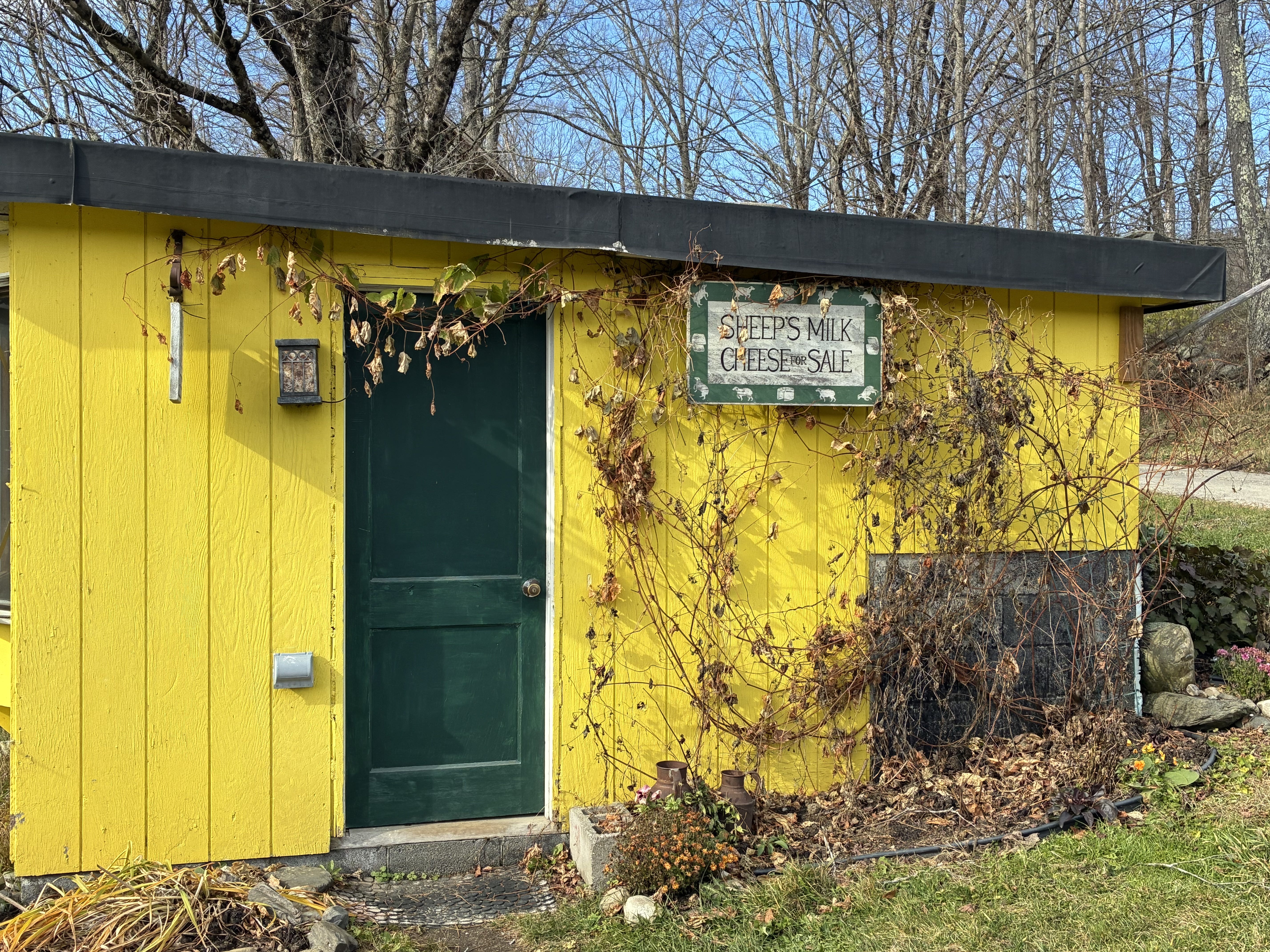
In November I spent a few days in Vermont. Vermont is known for a few things - skiing, maple syrup and cheese are among them. On the last day of my stay, I bought several locally made cheeses at two different shops. Both shops were tucked away on back roads about 20 minutes from the town where I was staying. Had the innkeeper at the bed and breakfast not told me about the shops, I would never have known about them. He also tipped me off that both shops took cash only, and maybe Zelle. So before I set off, I stopped at a bank ATM in the village.
Maybe I could have come across these cheeses in local shops, but finding these places turned out to be more fun than selecting one of them from a large refrigerator case filled with all kinds of other cheeses.
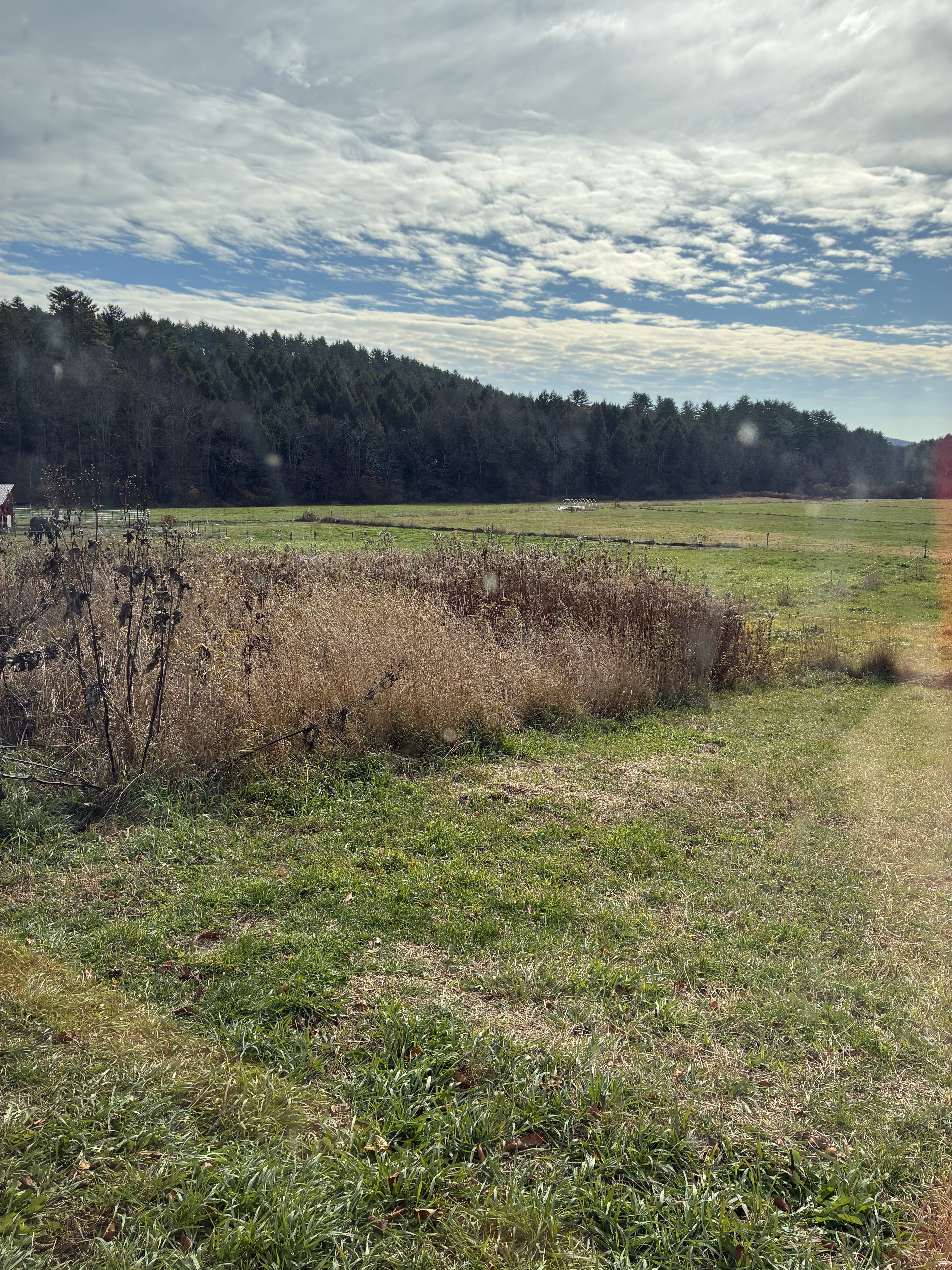
The first shop, a small wooden building with refrigerators and a small freezer, sold cheese made from sheep and cow’s milk as well as lamb, t-shirts, honey and local maple syrup. The late morning light streamed in through a window that ran the length of the building. I sat on the wide window sill and looked south at the fields and mountains. A couple of horses were in a pen closer to the barn. I was alone. No sales person to help me. A sheet explained the different cheeses, how and where they were aged, type of milk, flavors. I picked a cheese made from sheep’s milk. I’m not a cheese connoisseur, so I can’t claim any real reason other than it was neither the oldest cheese nor the most expensive.
At the table in the corner of the room, I found instructions about payment. The directions were simple and direct. I filled out a form that told the cheesemakers the name of the cheese I purchased, how much it cost, my name, email and how I found out about the shop. I dug out exactly $11.70 for the cheese, wrapped the slip around the money and pushed it all through a slit in a simple wood box on the table.
I lost any cell signal, so I found the second shop without the help of GPS. The second shop, housed in an even smaller but newer wood building with a ramp up to the door, sold only cheese stored in a large refrigerator. The cheesemaker was on the cover of a cheese trade publication set out next to the refrigerator. This fridge stored even more types of cheeses, so it took me a while to make a decision.
The directions to pay were similar as at the first shop. Here, though, I could make a payment via Venmo. The directions for sending a Venmo payment included the note that the buyer probably wouldn’t be able to make the payment at the shop. The cheesemakers advised buyers to pay when they got some distance from the shop. I wouldn’t get a cell signal again until I was a couple of miles from the shop. I had enough cash, so I filled out my information and tucked my money into a slot in the table.
Sounds like a quaint rustic experience from another time, right? Both buildings were in sight of farm houses, but I never saw anyone. Maybe that was because it was November, not June or July when there were tourists. Neither building required a security code or bar code scan of the cheeses I purchased. No one counted my money to make sure I paid enough or too much. No one was there to give me change. No one ever appeared at all, though at the first shop, two blonde dogs ambled up the lane and barked at me as I left the shop and took the 10 steps to my car. They were probably making cheese or doing fall farm chores, getting ready for winter.
I drove back to town, towards cell towers, contactless payments and coffee shops. As I went about the rest of my day, I began to think about these cheese transactions. While my cheese transactions appeared very different from those I make using my iPhone, both transactions actually had a lot in common.
Why does this system - writing down how much cheese you buy and pushing cash through a slot in a box - work? Because it’s based on the same foundations as modern payment methods: trust.
It seemed to me that buyers likely fall into 3 categories:
Locals who live on nearby farms or towns and villages. They may know the cheesemaker and his or her family. Their kids might go to school together. They probably run into each other at a local bar, bookstore, pharmacy, doctor’s office or coffee shop or community meetings.
Cheese aficionados who read cheese magazines and travel to places like Vermont to visit specific cheesemakers and to buy cheeses.
Visitors who hear about the shop from a local. I clearly fell into this category.
Left alone to choose and pay for their cheeses, wouldn’t buyers be tempted to pay less than the price on the list or not pay at all?
All three categories of buyers bring a level of trust to the transaction. They’ve found these shops because they know the cheesemakers personally, through reputation or through a trusted third party. Buyers in each category have an interest in maintaining this trust chain.
“Three can keep a secret, if two of them are dead.” - Benjamin Franklin
What for example, would be the big deal if a local failed to pay or didn’t pay the full price of the cheese? He or she’d be stealing from a friend or neighbor. From someone he relies on. Poems and novels have been written about this. This act would follow the thief and the maker would eventually find out. Relationships in rural areas are complex. You can live on your property acres away from anyone else, but after a heavy snowfall you might need a neighbor to help you plow your lane to the highway. That neighbor might be the cheesemaker. Maybe you sell him your vegetables and he pays you in cheese. The thief has to keep that secret forever because, otherwise, it will get back to the maker. In any case the cheese maker already knows about the theft. All he has to do is reconcile his inventory with actual money paid in the box or by Venmo and the receipts. The maker will know. The buyer will know. Which will lead, eventually to the exposure of the secret.
From the cheesemaker’s side, theft breaks his trust with both his existing and potential customers. The cheesemaker doesn’t know which of his buyers stole from him. Was it a tourist? Was it someone he met in a coffee shop he goes to or someone he buys eggs from? Maybe most of them pay for what they buy but unless the maker figures out who the thief was, he’s left to question the trustworthiness of his buyers - and the security of his purchasing and payment systems. His accountant may tell him the impact of the losses on his business. At some point, the loss of trust will drive the cheesemaker to change his payment process - employ someone to take money at the shop, set up devices to take card payments. With less trust, the cheesecake probably won’t keep his shop open 24 hours a day. Maybe he gives up on the shop and moves all purchases to his website. Most of these actions would mean he’d have to raise prices.
Trust goes hand-in-hand with security.
These new measures would impact local buyers too. They might not be able to afford the cheese. They would lose that sense of security and trust in their relationship with the cheese maker and maybe with their neighbors and larger community. When the relationships that keep rural communities going fail, other forces move in.
Cheese and digital identity.
Like the quaint payment methods in the Vermont cheese shops, trust and security are also the foundation of digital transactions. Both are increasingly broken by humans and non-humans. Fraud, it seems, enjoys new technologies, and uses AI & other tech to re-run old criminal activities and create new methods to steal. The prospect of identifying the thief in the digital ether is much more difficult and costly. And even if the buyer, or card company or bank, can pinpoint a thief, the thieves can likely live happily with the profit of their crimes.
Are you thinking I’m going to make a pitch for the return of cash?
Nope!
My cheese purchases led me to think again about David Birch and Victoria Richardson’s book Money In The Metaverse: Digital Assets, Online Identities, Spatial Computing and Why Virtual Worlds Mean Real Business. The Fintech Book Club discussed this book in 2024.
Like digital purchases everywhere, knowing who the buyer is crucial to maintaining trust in cheese purchases in quaint rustic Vermont shops. Knowing the buyer establishes a relationship, even if the seller and buyer never meet.
Birch & Richardson make good technical and business arguments for digital identity and assets in banking and payments. I would take their arguments even further. All the reasons for banks and other financial services organizations to implement digital identity also works for buying cheese in Vermont. Using digital identity even with a cash purchase at these small cheese shops would reinforce trust. Of course there are many technical issues to sort out especially with lack of cellular/internet access. Digital asset tracking of a cheesemaker’s most valuable cheeses would enable the maker to better manage his or her most valuable assets, brand and potential fraud. The wine industry already has begun to use technology to prevent fraud and to improve operations. (Interested in the wine industry and how it meets fintech? Follow FinVino.)
Think of digital identity tools and solutions as part of your FI’s banking and payments trust chain. Create use cases that Incorporate it for both buyers and sellers.
Add digital identity to your small business strategies. While cash purchases are increasingly niche, financial institutions still have small business customers who, for a variety of reasons, work with cash on a daily basis. Telling them to stop is not a relationship building tactic. Technologies that support multiple use cases enable your FI to support trust in those transactions. Doing so also creates opportunities for you to build trust with those customers so that you can start conversations about how the business owners can move away from cash.
Evaluate your bank’s infrastructure’s ability to incorporate digital identity technologies throughout the enterprise. Position your FI to use digital identity in multiple ways with business and consumer customers.
Thanks for reading PivotAssets. Please share it with your colleagues
I’m an independent analyst, strategic advisor & consultant (& a former Gartner analyst). I’ve worked in and covered the banking industry for over 2 decades.
My aim with this newsletter is not to confirm what you know (and you are plenty smart!) but to challenge you & give you a fresh perspective & analysis on the transformation that is —and isn’t happening - in the industry.
PivotAssets is my consultancy. I help FIs and software companies world-wide cut through the technology and other hype that can get in the way of your strategy and plans to increase profitability, innovation or transformation. What else can I help you with?
Ensure your financial institution can deliver small innovations, stop ghosting customers, uncover its hidden tribes and leverage your legacy. Should you start a new digital bank brand?
Help you tap into hidden customer segments that will unlock your FI’s innovation capabilities.
Position your solution(s) or fintech to meet the demands of today’s banking environment? I can:
Assist you in creating a narrative that reflects your mission, goals, market and product(s) - and isn’t a copy of what everyone else is doing.
Help you tap into capabilities to support hidden customer segments that will unlock your ability to support innovation.
Analyze your GTM strategy to help you address a new market.
Help you prepare for your first vendor briefing or your first funding pitch meeting.
Write thought leadership pieces relevant to your business, solutions or technology.
Organize and moderate webinars, podcasts, panels and other events.
Contact me at stessa@pivotassets.co or via LinkedIn.
Ivo Spigel and Nick Holland and I co-founded FinVino, a new banking/fintech retreat for CxOs coming to Hvar, Croatia in 2026. It’s an opportunity for senior banking executives to explore the intersection between banking and the wine industry - two legacy industries facing disruption and innovation in a beautiful location. Follow our LinkedIn page for details. Interested in sponsoring this event? Send me an email or direct message!
I’m an expert advisor at Third Eye Advisory. Check out my latest research there. Third Eye services include 1:1 discussions and strategy sessions.
Fintech Book Club - Jim Perry, Efi Pylarinou and I - discusses 1 fintech book every quarter. Our most recent discussion was about Theodora Lau’s new book Banking on (Artificial) Intelligence.
Join us on 12 December 2025 when we discuss Branch Tomorrow by Brett King & contributions from our own Efi Pylarinou, Paolo Sirioni, Jim Marous, Richard Turrin and Bruno Diniz.
Comments
Nothing yet. Say the first thing.
Sign in to join the conversation.