

BONUS NEWSLETTER
Back in the late nineties, when I first started to seriously write novels, I wanted to buy a laptop. At the time, I was a single mom teaching teenagers with behavior disorders at an inner-city school, and I’d come home limp with exhaustion.
After standing on my feet all day, the idea of sitting at my desktop to write when I got home wasn’t appealing. I wanted to write in bed, pillows propping up my back. But laptops were fairly new on the scene and thus expensive. The one I wanted cost $1600, an incredible indulgence at the time.
My thrifty side said, “Absolutely not.” But my artistic side said, “You have to show the universe and yourself that you’re serious about your writing.”
So, I bought it, and I never regretted it. I was thinking about my pricey laptop after I sent questions to Heather Garbo, the book coach whom I interviewed in this bonus newsletter. Sometimes we writers need the laptop, the coaching or the conference as a way of saying to our craft, “Yes. I support you. Yes. You matter.”
Every year I pay a good chunk of cash for writer education, knowing that even though it might be pricey, the benefits will be worth it.
I loved my interview with Heather for so many reasons, but I was so happy to have her delve into the author’s mindset, which separates the writers who persist and those who don’t. Also in this bonus issue, there’s an interview with debut author Mimi Montgomery who shares her publishing journey.
But before that, if you missed Pitch Tank, it’s still going on until Monday.

ADVICE FROM BOOK COACH HEATHER GARBO
I’m not sure all writers know what a book coach does. How does your role differ from a developmental editor?
I like to say I’m one part editor, one part project manager, one part industry guide, and one part cheerleader. I’ve been both a freelance editor and a small press acquiring editor, and while developmental editing is still a huge part of what I do, as a book coach I go beyond that.
As an editor, I either start with a manuscript evaluation so we get clarity on what’s working and what’s not, or with story planning to ensure you’re clear on the story and don’t overlook foundational steps to avoid a painful revision later. And I share editorial feedback as you plan, write and revise.
As a project manager, I provide accountability to help you tackle achievable milestones and create an action plan for how, so you’re not left paralyzed by overwhelm. And we brainstorm when you’re stuck and need to talk through tricky issues.
As an industry guide, I provide insights on genre conventions and what’s happening in the marketplace. I often advise writers even once they’re pitching.
And then there’s the mindset piece, which I jokingly call cheerleading but it’s much more important than that. Writing is emotional work. It’s important that my writing clients feel safe and supported in our time together. There’s a great deal of trust involved in editorial feedback, but also in holding space for talking about being vulnerable on the page or imposter syndrome or all the other worries that come up with writing.
What kind of writer most benefits from book coaching?
The writers who benefit most are ready to commit to the work and stay open to feedback and growing. They dedicate time to writing. If we’re working on a manuscript eval, they jump right into revision to build on the momentum we’ve created. If we’re doing monthly coaching with planning, drafting or revising, they prioritize that work time, and show up fully to get the most out of our collaboration.
You’ll also benefit most if you stay open to editorial feedback…to learning and growing as a writer. If you’re just hoping I say your story is already excellent, and not open to feedback, then book coaching isn’t worth your time or investment. A good book coach is committed to being candid with writers.
We’re not doing you any favors if we send you out into the querying trenches with a half-baked manuscript. You only get one chance with an agent and sometimes an entire agency, so it’s cruel to not be forthright with our feedback.
I know one of your favorite genres is women’s fiction. Who are three of your favorite authors and why do you admire them?
This has to be the hardest question to answer. I can only answer by qualifying this as three of my favorite authors right now.
I love Katherine Heiny’s characters and the wry humor she injects onto the page. I’ve reread Early Morning Riser many times, and I often think of the protagonist’s mother who was so fantastic in her absurdity. I still laugh out loud about things she said just from memory.
Annabel Monaghan’s books are always a delight. They’re fun and light-hearted but there’s often an unexpected depth—like having a conversation with your best friends. I read Nora Goes Off-Script when I was in the throes of a debilitating health crisis, and it got me out of my head and became a comfort read. It’s one of the reasons I often say you never know who needs to read your book right now. It’s not only the literary or upmarket books that save lives. And I’ve enjoyed all of her books since.
Curtis Sittenfeld is a fantastic storyteller whose books always suck me in. I love how she uses engaging stories to explore important social issues that impact women.
What are some characteristics of success writers when it comes to mindset?
This is the broken record statement I will never stop repeating: your mindset matters as much as your writing skills. I’ve actually identified 5 mindset shifts essential for writers. (I’ve even created a downloadable guide to delve deeper into 14 limiting beliefs and the mindset shifts needed to move past these.) But I’ll distill these to three main points.
First you have to believe in the value of your story. My first step with new writers is always to address why this story is so meaningful to them. Clarity on why this story matters to you and who you will reach with it can carry you through the difficult parts of writing, revising, querying, and even publishing. You need to believe in the value of your voice and what you’re sharing.
Second is about permission. There are so many permissions writers need to give themselves: permission to invest your time, money and excitement in the pursuit of writing, permission to dedicate regular time in your schedule, and permission to dig in and explore the story even when it’s messy or hard or makes you feel vulnerable.
Third, you need to stay open to learning. The writers who experience the most growth in their writing stay open to feedback and growth, which is pretty much how you have success with anything, right? One important skill related to this is learning how to evaluate and process editorial feedback so you can use it to grow as a writer.
What are the top three mistakes that you see authors making in their manuscripts?
The biggest mistake I see writers making overall is to skip story planning. I know this will upset a lot of people who like to identify as pantsers, but story planning doesn’t mean you need to do a big, detailed outline. It’s about making considered, intentional choices. If you’re not intentional in your planning and writing, you’ll have a LOT more work to do in revision. Some writers are okay with that, but the problem comes when the story structure is flimsy, yet writers become so attached to the words they’ve already written that they struggle to see clearly or be open to needed revision. Then they get stuck.
When I evaluate a manuscript the mistakes I see most often are either starting the story in the wrong place, usually too early with far too much set-up, or a lack of cause-and-effect sequencing in the narrative trajectory. In other words, a lot of different things happen, but the plot points are not linked in a way that feels inevitable so the story seems much more contrived and the plot points feel convenient.
I know you asked for three, but I have to mention revising too. So many new writers approach revision the wrong way by starting with micro, page-level edits before they strengthen the global structure of the story. They spend a ton of time basically doing busy work—moving words around on the page but never addressing the story’s structural issues. Then they often give up before they’ve made any real revision progress.
What is the most satisfying part of your job?
Ooh, there are so many good parts! The breakthroughs a writer experiences when we’ve been working together and they finally see how all their ideas tie together with a solid throughline is always an amazing feeling.
But my absolute favorite part is helping a writer to discover (or rediscover) their voice, to speak up and claim space through writing. This is especially gratifying when I work with a writer who is new to novel-writing, who is putting themselves out there for the first time, and I’m able to reflect back all they’re doing so well, and that I get what they’re trying to say on the page.
When I meet with someone who has been anxious about sharing, and the feedback has not only given them clarity about what to do next, but also feel supported and seen, it can feel very emotional for both of us. Because writing is ultimately about connection, right?
And not only do I share what’s working and what’s not, but I also create an action plan, so what’s felt tenuous becomes concrete. It might be the first time they’re realizing they can maybe do this thing they’ve been dreaming about for so long and they’re so excited to keep going. And that energy is contagious.
What do you say to someone who starts getting discouraged about publishing?
First I validate that. This IS hard. There is no doubt about it. It actually makes me really mad when I see writers who have had success talk about writing and/or publishing as easy. This makes writers who are struggling feel like a failure, but the struggle is a more typical experience.
For example, I’ve seen more online threads saying self-publishing is easy. And while it’s certainly doable, it’s not easy—it’s a lot of hard work. Although I haven’t self-published, when I ran a small press I guided books through editorial, production, distribution and marketing, so I know there’s nothing easy about that. Struggle isn’t a personal failing—it’s part of the process.
Then we revisit why this story is so meaningful to them, why they connect to it on a deeper level, and who they want to reach with this story. Drawing on that can give them strength to keep going.
Finally I remind writers we have to celebrate the milestones along the way. Because completing a first draft? That’s cause to celebrate! Finally nailing a tricky scene? Celebrate! Beta reader says they got choked up at the end? Celebrate!
And once a writer remembers all the difficult things they’ve already accomplished, it becomes easier to know they can tackle more hard things. This is a long process, and (as my own coach says), we need to acknowledge success to build on it. I like to remind writers the tenacity that took them through the hard, long work of writing and revising will carry them through the querying or self-publishing process too.
Is there anything I didn’t ask that you’d like to address?
Two more things I’d love to share…first is a question that comes up with writers when they’re first learning about book coaching, and that is…why haven’t I heard about book coaching before?
It’s true that book coaching is a relatively new niche in the industry. It emerged to fill a role that was previously occupied by acquisitions editors and even agents. The industry has become so much more competitive and there’s a very high standard for manuscripts yet many editors and agents no longer have the time they once did to help a writer refine their story. Yes, you will find agents that provide more editorial feedback than others, but even those agents can often only deliver high-level feedback. (Devon Halliday has a helpful recent post that goes into more detail on this.) I sometimes even receive client referrals from agents, even those who provide their own editorial feedback.
And even though you’ll usually go through a developmental edit with an acquiring editor, they want to acquire a book that’s already really solid because they’re already juggling so much. Most agents and editors simply don’t have extensive time to work through it with you even if they want to.
Another reason book coaching has emerged is, of course, self-publishing, which has exploded and no longer carries the stigma it once did. A self-published author who treats their book publication as the business it is knows it’s wise to hire professionals, including editors and/or a book coach.
The second thing I’d love to share is what a writer should look for in a book coach. I’d recommend keeping three things in mind. First, the coach’s background. A certified book coach has gone through hundreds of hours of education and practicum training, and must pass an evaluation to become certified. It’s not simply a completion certification. You also want to work with someone who has a strong editorial background. Authoring a book isn’t qualification enough, in my opinion, because writing, editing and coaching are entirely different skills. That’s not to say an author can’t be a good book coach—many are—but ask about their editorial background too.
Second, you want to work with someone who is knowledgeable in the genre you’re writing in as well as the industry overall. Most book coaches focus on certain genres, and they should know what the genre conventions are and what’s happening in that market right now. A coach who is focused, say on fantasy, may struggle with upmarket, or vice versa.
Finally, you want to be sure you have a good rapport. As I said in the beginning, writing is emotional work. You want to know you can trust how your coach guides you, and you want it to feel like a safe space to ask questions and be vulnerable, especially when the work has personal emotional resonance for you.
This safe space is something that’s really important to me to create with my clients. And I continue to cheer on my clients even after our work together. They often email or text me their successes, and I’m always thrilled. There’s a real bond when you help someone to get their voice and story out into the world…when you believe in them and want them to succeed. And it’s a journey I’m always honored to be a part of.
Heather Garbo is a certified book coach who works with women’s fiction, upmarket and book club fiction writers (re)discovering their writing voices in midlife or later. She has nearly three decades as a communications professional, is the former director of a regional small press, and an active member of the Women’s Fiction Writer’s Association. Learn more at www.garbobookcoaching.com or follow her Substack at Write Your Next Chapter for helpful writing and industry guidance.
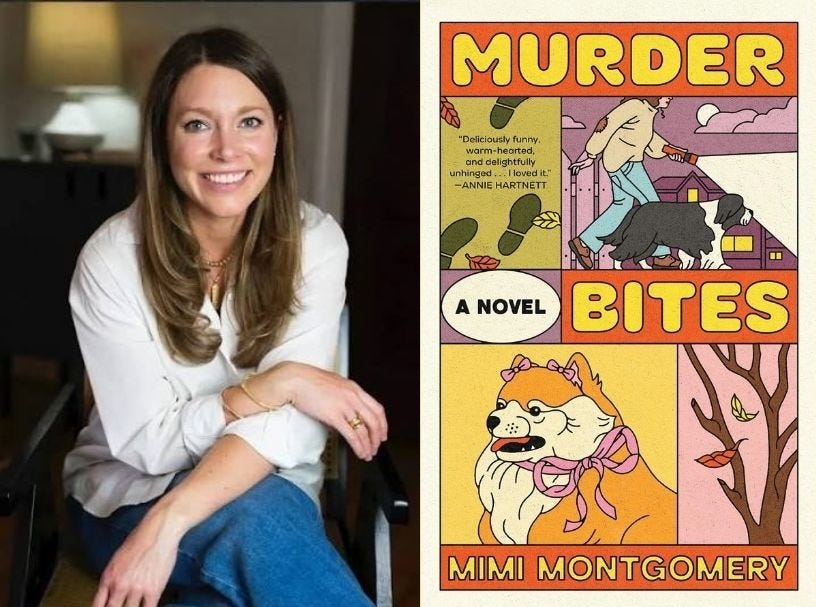
DEBUT SPOTLIGHT: Interview with Mimi Montgomery author Murder Bites
Small Southern town? Dogs? Culture clashes? I’m on board. Mimi Montgomery, author of Murder Bites is a journalist and author who’s written for outlets like Axios, The Washington Post, Washingtonian, Garden & Gun, and Outside Magazine, and her reporting has been featured on Jimmy Kimmel Live, Inside Edition, and CNN, among others. She shares her publication journey, best writing advice, and more
What is your pitch for Murder Bites?
“Murder Bites” follows a city transplant named Margot who finds herself ostracized when she’s forced to relocate to a small Southern town where everyone’s obsessed with their dogs. So obsessed, in fact, that it’s the filming location for “Pawsh,” an “America’s Next Top Model”-style show for purebred dogs. When the local dog walker is killed in an over-the-top incident involving several Home Depot skeletons, Margot finds herself framed as the killer — meaning she has to forge unlikely friendships with the very same townspeople she’s written off to clear her name. Hijinks, jokes, and lots of pop culture references ensue!
What is the novel’s origin story? Do you remember how the idea came to you?
It’s a bit of a Frankenstein origin story: I’m originally from a small town in the South, but I’ve lived in D.C. for over a decade, and I always experience a little bit of culture shock when going back and forth between the two. I knew I wanted to write something that touched on the tension that can come with navigating two very different environments — one more conservative and rural, the other more liberal and urban — but also ultimately made the point that, at the end of the day, we humans are far weirder and more nuanced than we initially give each other credit for.
On the other hand, when my then-boyfriend-now-husband and I got our French bulldog, Ziggy, we found ourselves firmly entrenched in the “fur baby” movement — aka joining all the other professional, late 20s/early 30s couples who were delaying having kids and therefore spending all their money and parental energy on their dogs. We started doing ridiculous stuff like joining a members-only dog bar and paying $20 for “bark-uterie” boards. I knew the entire thing was ripe for satire, and so I decided to meld these two origin stories together and create a weird, satirical mystery novel of my own.
What was the most difficult craft issue you faced when writing the novel?
I initially found it difficult to balance the humor and satirical elements of the novel with the deeper emotional aspects you need to create a satisfying, layered story for readers. I naturally have a biting sense of humor, which can be jarring for readers if it isn’t evened out with some heart. So I had to work really hard to drill down on the characters’ emotional arcs and backstories. And writing big, emotional scenes can feel — for lack of a better word — very cringe when you’re staring at the page all by yourself! But I had to force myself to step back and remember that it will land differently for the reader, and that I myself love a book that has a lot of big emotions.
What was your querying and sub journey like?
Roundabout, to say the least! TLDR: I queried my now-agent, Claire Friedman at Ink Well, and she said she liked the writing and was interested in working with me — if I submitted her an outline showing how I’d change the plot to meet her notes. I did, and luckily she signed me.
And then I sold my book off an R&R. We had two requests for R&Rs, and we could have continued to take the book out on sub, but the notes I’d received so far were resonating enough that I knew I needed to make some tweaks. So I squirreled myself away for the summer and reworked the novel — and then sold it that fall to my editor, Sydney Collins, at Bantam, who was one of my original R&R requests. It’s the little book that could!
You have a book tour! So many authors dream of one. How did that come about?
I organized the whole thing myself! It’s my understanding that authors don’t really get big, splashy tours anymore unless you’re the Yesteryear author or, like, Ann Patchett. But so much of the lead-up to publication can get lost in trying to score publicity and overanalyzing reviews that I knew I wanted to do something to remind myself of the actual point of it all: Writing for readers and being part of a literary community.
I was careful to only pick cities where I knew people and felt confident I could get bodies out, though, as bookstores put time and money into hosting authors. And I picked places that were a simple drive away where I could stay with friends or family. I’m using it as a way to do a series of mini reunions with people I love and haven’t seen in a while.
What novels made you want to be a writer?
So many — I’ve always been a huge reader — but the one that specifically inspired “Murder Bites” was “Squeeze Me” by Carl Hiaasen. It was the first novel I read by him — I thought he was so hilarious and smart, and I loved how he felt confident enough to take really big, zany swings. I also loved that he used his background as a journalist to write satire. I’m a journalist, too, and I frequently see the day’s headlines and think this is absolutely the plot of a satirical novel. Seeing his path really informed the kind of book I wanted to write.
What are your favorite craft books?
This is hardly a unique answer, but “Save the Cat Writes a Novel” by Jessica Brody was enormously helpful in learning about plot structure, stakes, and character development. And “Story Genius” by Lisa Cron really drilled in the importance of internal and external stakes, as well as your character’s emotional development. And this isn’t a craft book, but Courtney Maum’s publishing world Bible, “Before and After the Book Deal,” was the ultimate guide as I navigated this unpredictable, wild world.
What is the best writing advice you’ve ever gotten?
There are two pieces of advice I think about frequently. The first is probably more publishing industry-coded than writing, per se: “Other people’s opinions of you are none of your business.” Basically, this means not everybody is going to like your work, and that’s okay! It can be really tempting to get lost in the Goodreads sauce and go down a rabbit hole overanalyzing everyone’s thoughts on your writing, but at the end of the day — it’s none of your business! You have to nurture your own faith and confidence in yourself, and stay true to your own voice and creative impulses.
The other was from my pal the author Kate Myers — I was telling her about being worried that the reader would find some zany plot point unbelievable, and she told me that we have to believe we can land the plane in order for the readers to believe it, too. All kinds of truly wild things happen in real life, so why shouldn’t they happen in our fiction, too? If you believe in your talent and ability to tell a story, that will come across to the reader, and they’ll follow you through the wacky and wonderful maze you create for them.
BOUNUS Thursday posts will always be free and will come once or twice a month. They’ll include author success stories and, very soon, a query critique. If you want your query publicly critiqued for free, please email me your letter to karin.gillespie@gmail.com. Priority goes to paid subscribers, but it’s open to all. Please note: there’s no guarantee of being picked; I’ll choose the letters that will be the best teaching tools.
Also, if you want to share your success story as an author for the Thursday bonus posts, you can also email me. Priority goes to those who are willing to share the query letter that landed you an agent.
No posts
Comments
Nothing yet. Say the first thing.
Sign in to join the conversation.