
🗂️ Welcome to Pitch, Please: Office Hours, a mini series for paid pitches that’s dedicated to answering one frequently-asked PR-related question in one pint-sized, pithy response.
If you’re worried your pitch is too long, the least interesting Kardashian to look at it has your answer.
For no less than five years, my iCloud account profile picture—the one that would populate into everyone’s phone under my contact info—was a meme of Kourtney Kardashian. The oldest sister has a way with monotone words, and I’ve always found her to be the most relatable (although many would argue it’s a pre-divorce Khloe).
When she said “ABCDEFG, I have to go,” I understood. And when she told Kris Jenner “your conversations are too long, bye”—on a corded phone, no less—I felt that shit in my bones.
I’m guilty of doing this to my own mom (sorry, Jo), definitely the HuzZben, and probably every other member of my family.
If it’s not to the point, I don’t want it.
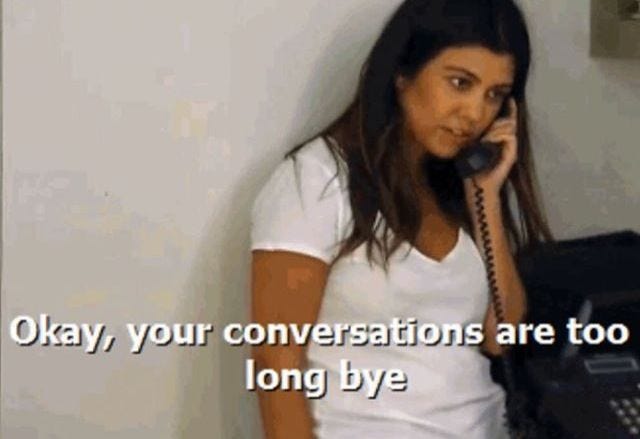
After half a decade, the HuzZben finally asked what the hell it was and I changed it. As a long-winded person myself, in both life and probably in email, I understand this hypocrisy, but gurl, I like my pitches snappy.
If you have to ask the question: Are my pitches too long? then you could probably cut back. Better yet: Would Kourtney K say my conversations are too long, bye? If the answer is yes, yew better kut back.

It’s tempting to provide as much information as possible. You want to be thorough, right? Nothing left on the proverbial table? Totally. These are valuable concerns and valiant efforts. But what you don’t want is to meander. Or ramble. Or just plain take too long to get to the point.
No one’s saying “don’t be thorough” or “leave things out.” Be thorough, yes, but only about what’s important. Pitches should, of course, provide all the information necessary for the writer to either pass or reply. There are some things that can be left on the proverbial table—but evaluate each piece of information before including or excluding. What story are you telling? Are you providing the info you need to tell it in full?
Let me introduce you to the inverted pyramid a la journalism 101: Pitch, Please edition. The logic is as follows: your most important information lives at the top of the story. As you travel further down the the pyramid, information decreases in importance.
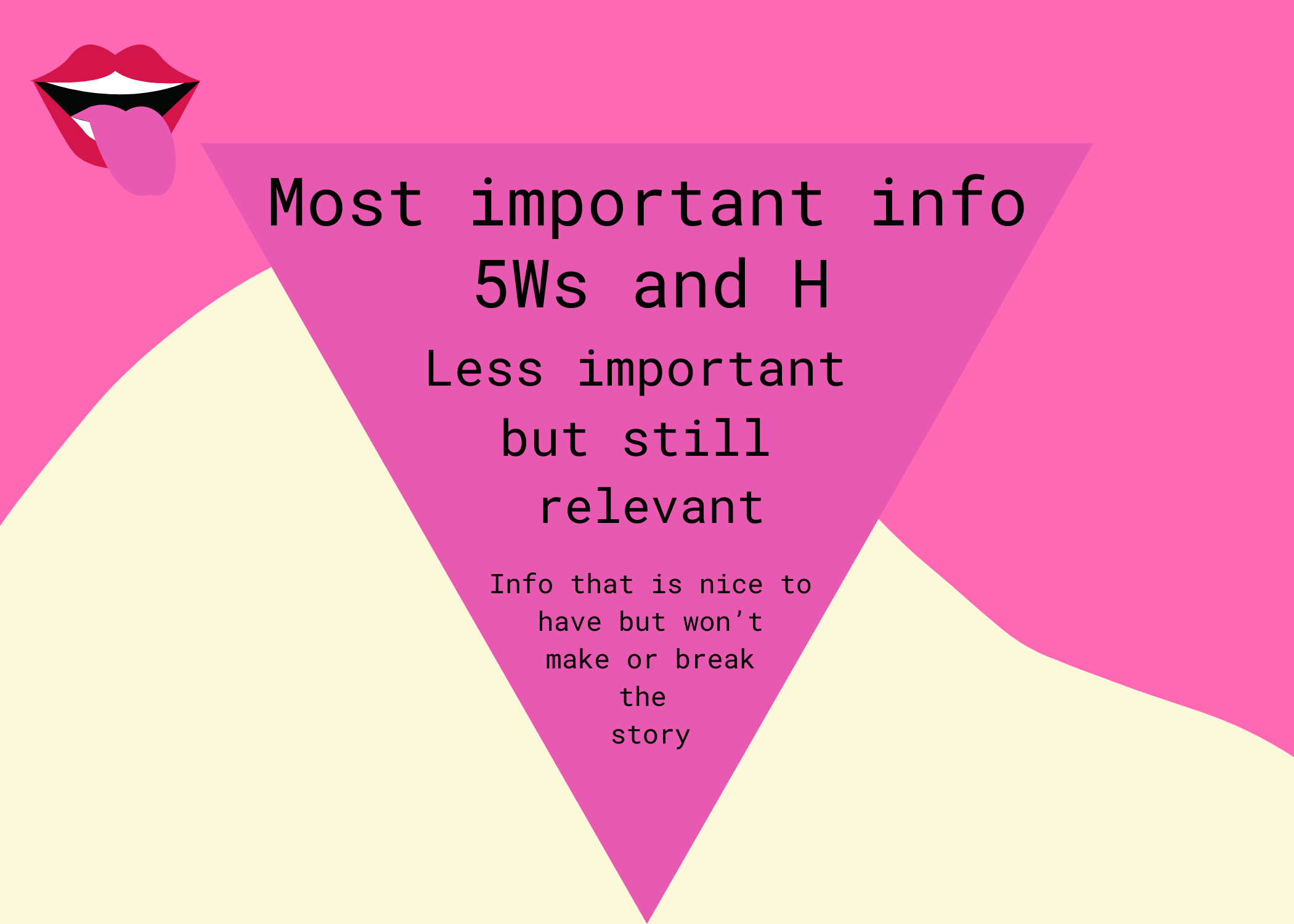
Intro: Your intro includes the most pertinent information that must be included in the story. It answers the 5Ws and one H—who, what, when, where, why, and how. It’s your story in a nutshell, if it was a tweet.
Body: Includes less important information that’s still relevant and worth the writer telling and the reader knowing. It adds color and often, context. In news stories, this is usually where sources are quoted. They liven up an otherwise flat, secondary source with a unique first-person perspective and pathos the cold-hard facts simply cannot.
Tail: The tail of the story, also known as the conclusion, completes the inverted pyramid and is markedly smaller than the top. It consists of info that’s nice to have but nowhere near pertinent. These inclusions don’t make or break the story, but can function as a neat lil bow or even contextualize what the viewer just read.
You might be thinking: now what? Why are you subjecting me to an intro to journalism class on this bright and early Tuesday???
Consulting the inverted pyramid could solve a lot of common pitch problems. If nothing more, it’s at least a jumping off point that could help you more efficiently pick and choose which details to include and which to kick to the kurb.
Because no one wants conversations that are too long, bye.
Publicists fear leaving something out; journalists fear digging through a pitch to find the story.
Give it a good ol’ gut check. Would you tolerate this email? At what point would your eyes gloss over? Does your pitch make a konscious effort to provide the most important info up front? Does the info decrease in importance as it progresses?
That’s the pitch you want to write.
Scary paragraph blocks that trigger college thesis PTSD
Wordiness
Convoluted storytelling
Burying the lede
If Mrs. Barker would say your conversations are too long, bye, then your pitch needs a kut. Make it shorter and tighter, front-load what’s important, and cut the fluff. The proof’s in the Health Nut salad. Just make sure to shake the shit out of it ;)

Know someone who’d LOVE Pitch, Pease? Feel free to share it with your work wife or even your office frenemy 💋
Comments
Nothing yet. Say the first thing.
Sign in to join the conversation.