
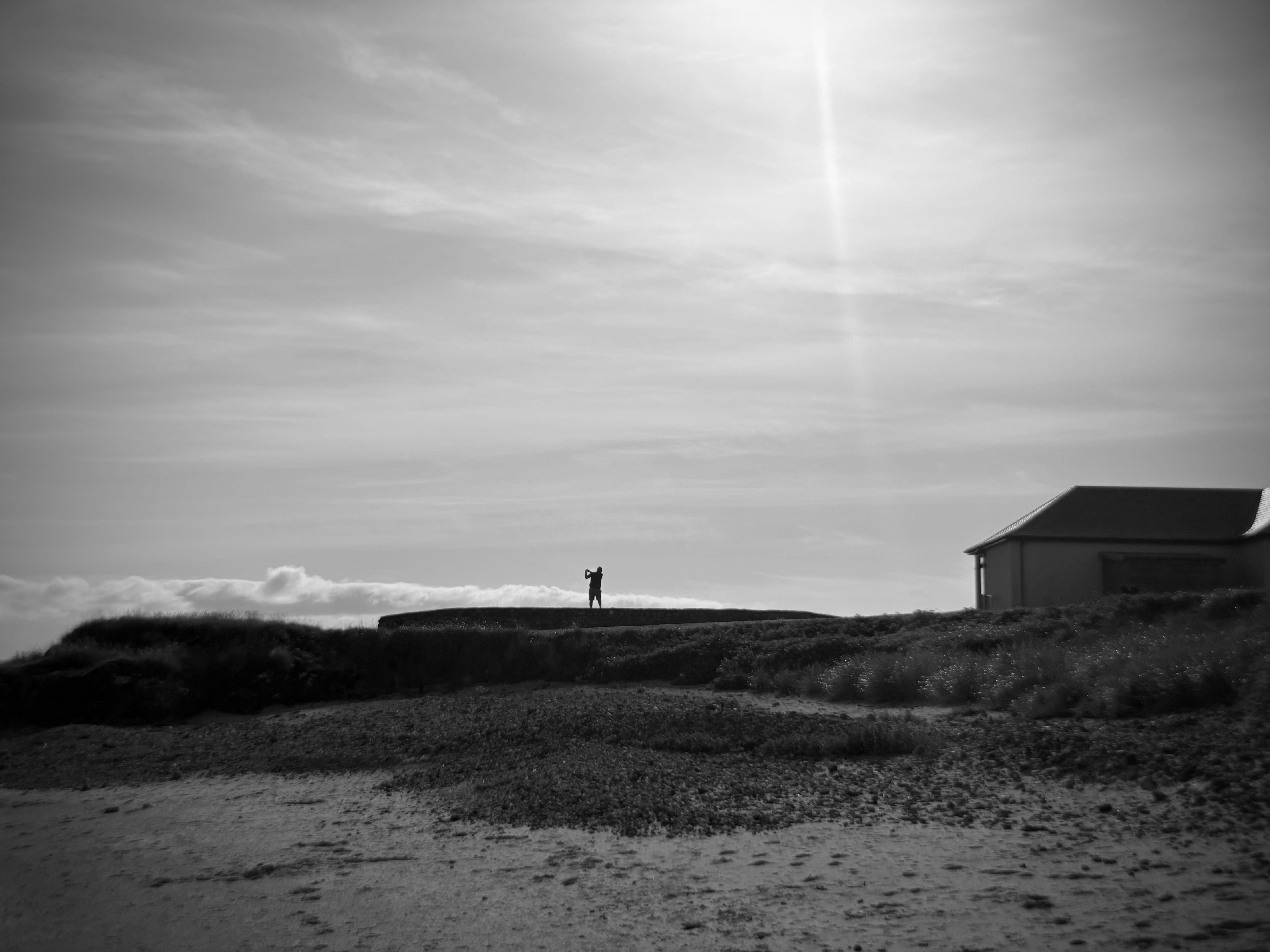
I doubt I’ve ever heard so much about a place before arriving as with Machrihanish.
Breathless whispers, tearful confessions, and at least three whole books I’ve read dedicated to and inspired by the place, including Michael Bamberger’s magnificent, timeless “To the Linksland”. That volume shifted the course from a bucket list item to an essential mission, a pilgrimage. A case of not “if”, but “when”.
“When” became “now” in July 2026. Waking like a child on Christmas morning, my alarm shifts me from dreaming of Kintyre to heading there in an instant, and the journey, a considerable one, seems to pass easily, entirely spent under the spell of anticipation.
From beside the first tee, very little is visible of the course, for the little ridge that the second smuggles you over hides most of the routing away, though the closing hole comes sliding past on the right, a welcome bailout zone for the famous opening tee shot. To me, all the fuss about the way the course starts — picking your line across a vast crescent of a beach to the promised land of bent and fescue beyond — seems a veil behind which Machrihanish’s treasures are hidden, and I think about how shallow we humans are, always looking for an angle through which to understand, a hook onto which we can attach meaning.
A hook is, of course, the last thing you need here, although the beach is in play, and as we await our turn, more than one golfer can be seen scurrying across the white sand to pitch back up to the links. The right hand side has danger, too, for a ribbon of pot bunkers that serve the eighteenth are obscured from view out that way, but we manage to survive this ordeal, and from there, a remarkable stretch of golf follows. For our approach to the second, we must fire over the inlet that dissects the course, and carry the large, diagonal bank on the far side, beyond which a punchbowl green with steep sides lies in wait, funnelling decent shots towards the hole.
A blind drive unsettles us at the third, though we trust the marker, and our subsequent prize is a nice line into the green, protected by half a dozen deep bunkers. Already, the simplicity of the design, of trusting the natural land to provide sufficient challenge, is clear, and the conditioning of the turf only enhances this. One must stare at the ground, and trust that the ball will follow faithfully the contours, though it often means playing away from the direct line.
A menacing bunker dominates the short fourth, with more sand waiting out right and further back, and the small plateau green requires accuracy, which is a good test ahead of the fifth, whose fairway swings hard left to leave an approach that must clear or trundle through a depression to find the target painted on the hill beyond. At the sixth, mystified as to the line, I resort to the course guide, and notice for the first time the hole names. This one — a short par four packed with thrilling ridges and swales — is called “Balaclava”, and I smile at this, for already it seems to me as if Machrihanish is to some degree masked, its secrets nestled in the pockets of this ancient landscape. And all along, our soundtrack is the steady rhythm of the Atlantic.
The stretch from the fifth is referred to on the flapping leaves of my guide as “the gauntlet”, — “a series of challenging and penal tee shots that demand precision”, but — perhaps helped by a dryish summer even in this coastal location — it is hard to agree with the term “penal”. There are some strange places awaiting your ball if you miss, certainly, and — as I slide my drive right and have the thrill of a true “hit-and-hope” from some virginal swale miles off Balaclava’s line — my sense is of a track that one can play and survive from all sorts of angles, as is the case at The Old Course, reserving its greatest riches for the accurate, patient, resilient golfer. It feels, a third of the way through this opening journey, like a very honest test.
Through the middle section, I lose my way a little, in terms of my golf and of my recollection of the holes, and almost tear my card up. The two par fives — the tenth and twelfth holes — are spliced by a long par three, and I am glad to find again the middle of the clubface on the charming thirteenth, a mischievous par four that slides along the course’s northern boundary, the green only clearly visible from an elusive plateau in the fairway. Somehow this hole sticks out to me in its playful nature — the thrilling, rollercoaster ride of the front nine now replaced by the simple, open elegance of the back.
At the fourteenth, we begin the journey home towards the little string of houses that run into town, and our reward for negotiating another tricky green site is back-to-back par threes that mug us for our shots and our confidence. The sixteenth, at over two hundred and thirty yards, is barely reachable today in a gentle breeze, and must be menacing in a gale, but I pause to reflect on how irrelevant “par” is out here. Machrihanish is a hundred and fifty years old, and its charms and challenges are far too subtle, far too important to waste time measuring against this notion of par.
The wind, and the turf, and the acres of hazards between our ears are what build it afresh every day, and what the course takes on one hole, it may give on another. To try and describe it is a fool’s errand, for Machrihanish seems to me as much a mysterious beast after playing it as I suspected it was before: a coy, beguiling teaser of a links. That it could be summed up by focusing on a single drive — that daunting first one, which now seems such a long time ago — or by the thinly veiled slight that “it ends softly” in the final two holes is to give ourselves away in our ignorance. Like The Old Course, it has layered depth, I suspect; it requires study.
The tight line of the out of bounds left at the seventeenth only seems out of character because the playing lines through the rest of the course are so open, so vague. A precise golfer might plot their steady way through the holes on a benign day, but the rest of us get to survive and occasionally flourish when a course is presented fairly, honestly. This hole reminds us of the freedom that lies behind us on the far side of The Burn, and if the last has been softened over time as the motor car reached Machrihanish, today’s finish is still charming, with the delicate ridge that guards the front right brought more into focus by the final few bunkers on the left.
We pause before putting out to watch the next group quietly plunge their pegs into that first tee box, and begin the latest edition of the voyage that folk have been taking for a century and a half, and what is for me the acid test of a great golf course — that upon finishing, you just want the time and the energy to “go again” — is in evidence, not least because I feel like I have barely skimmed the surface of Machrihanish’s depths. Some things in life are obvious, and accessible. Others require time, and dedication, and close attention, and this place feels to me like it sits at the far end of that spectrum. Tucked behind a marram grass balaclava, perhaps.
Old Tom Morris is reported to have said — when extending the original twelve holes to eighteen in the late 1870s — that “the Almighty had golf in his eye when he designed this place”. By the time Old Tom had finished, we assume golf was coursing through his veins…
Comments
Nothing yet. Say the first thing.
Sign in to join the conversation.