
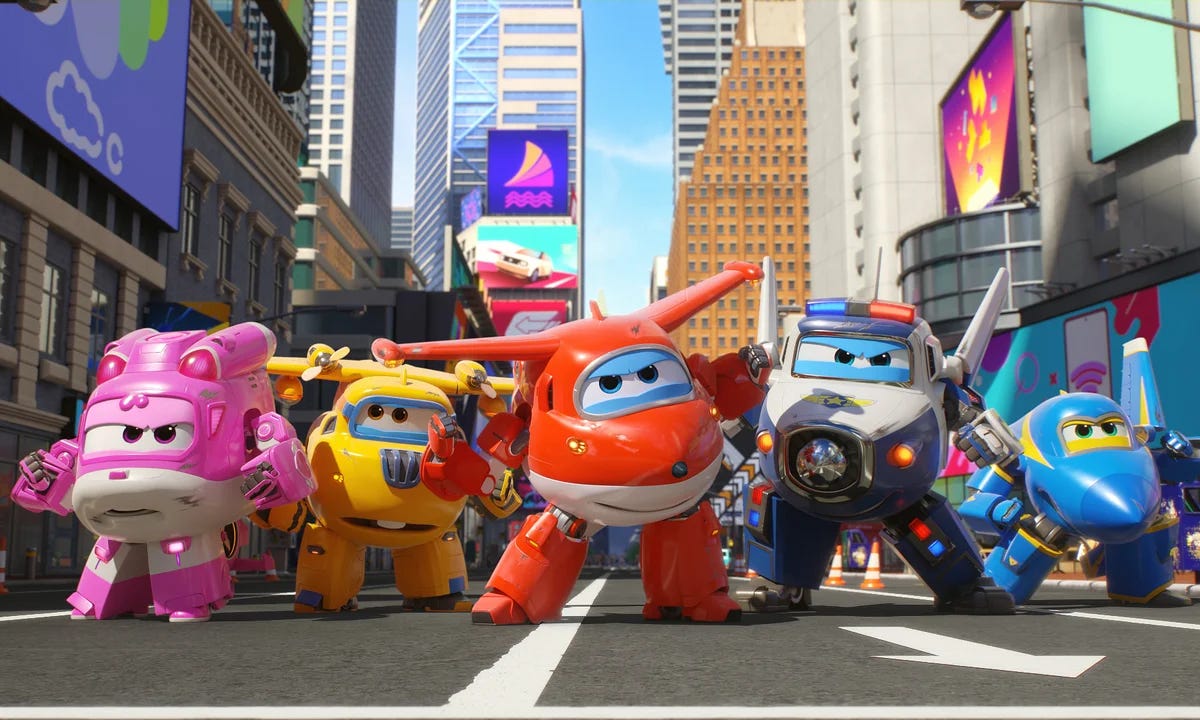
My kids are watching this show called Super Wings where a few friendly jets go across the globe to deliver packages in little suitcases and solve problemos. One time they dug a hole from China to Brazil underground through the earth’s mantle. I thought to myself “That’s impossible! How big is that drill!” When I imagine the solid bulk mantle, it’s The Thing (Ben Grimm) in my mind—his crater skin, but without the eyebrows and heart and things, obviously. I’ve been sitting here with my silent-headphones watching Jet and Jerome fly to Boryeong trying to think about what makes me feel alive. Flying makes me feel like I have an ear infection.
I can tell you what gives me a sense of peace: driving through a tree tunnel, what wallops me: running back into the house to grab something before school drop-off and hearing a toothbrush sound in the kitchen and immediately talking to my dad, “you didn’t brush your teeth? Why are you using the sound?” (he had fake teeth lest you think his hygiene wasn’t military grade); what fills me with awe; a horse laying down in the field at dawn. How can they possibly let the world go like that, right there in the dandelions? But what makes me feel alive is a much harder question to answer. I so rarely feel in my body, and I also fear the answer is pain, or pressure.
Last week I read this essay from children’s librarian Rachel Bachman’s newsletter Excuse My Whimsy on “What Children Actually Want From Picture Books.” And I have been thinking about it since. The exclamations are the exact right amount, per the recipe, thank you.
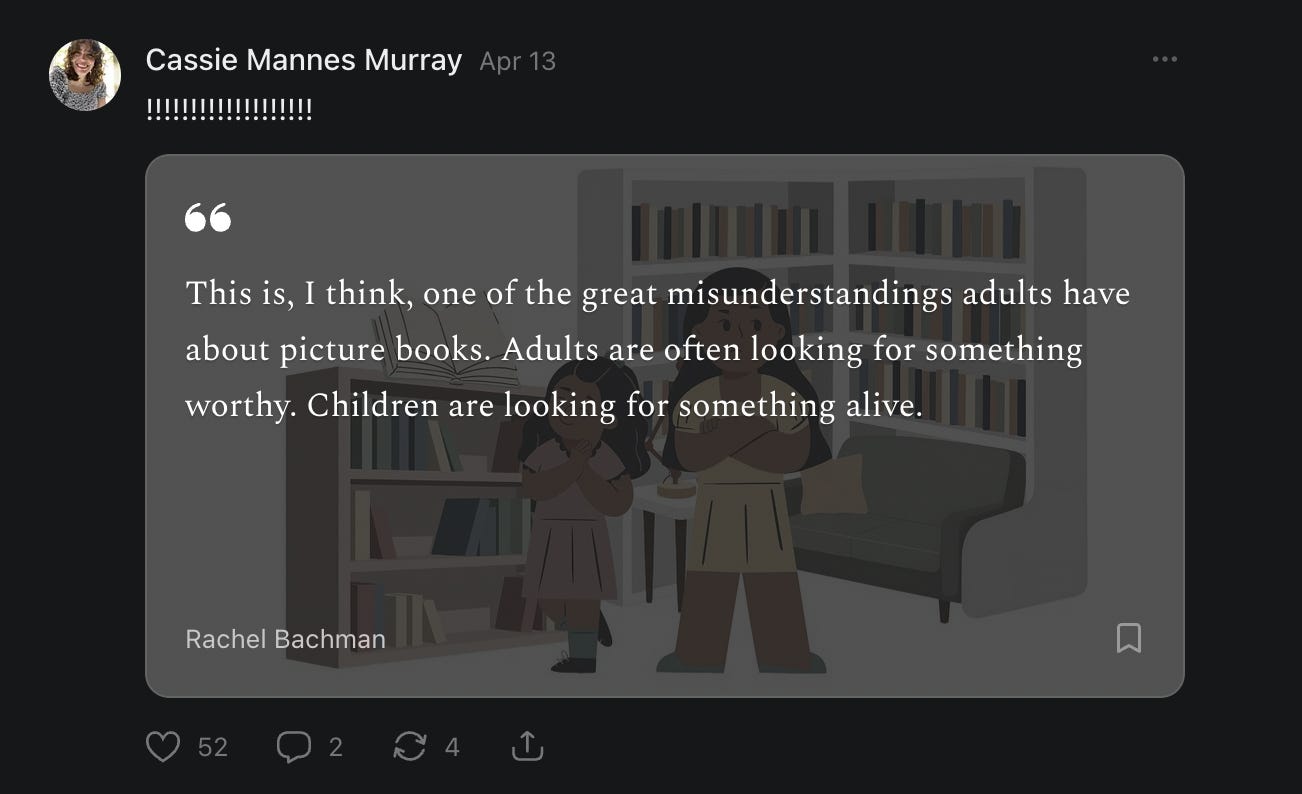
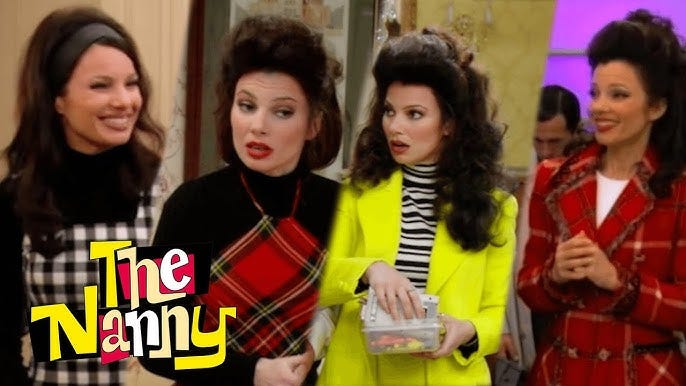
While this statement is truer than true to my experience, my boys want to read books with loudness, with food in the front flap they can pretend to chomp or guzzle depending (see: The Bear Ate Your Sandwich or Dozens of Donuts), with pick your favorite bird pages (see: Odd Bird), books that interact (see: all Sandra Boynton but especially right now Dinosaur Dance). We own several feminist books, books about differences and uniqueness, books about race and cultural traditions, heroes and history, but what they turn to again and again is the man with the hot dog shaped nose in Red Truck, or Nubby because of all the treasure in the dirt pile (pizza! A Dino tail! Diamonds!) and the map at the end, or Tad and Dad for the SPLOOOOSH!, or Go! Go! Go! Stop! because of the yelling and the excavator with a dirt wig. (I call it the Fran Fine excavator for those wondering—she’s the Flashy Girl from Fairfield’s Construction Site).
What strikes me here isn’t this learning curve I’ve been going through at bedtime every day for the last four-ish years, but that this statement fits my experience of the current publicity landscape. Media, awards, contests want books that are “worthy” and readers want books that are “alive.” Perhaps this is the primary problem (among others) of why book publicity and marketing are suffering avenues for book sales. There’s a mismatch between what the institutions want to promote and the books that make readers feel alive. It’s a mismatch that for a good while Booktok and Bookstagram had leveled, but both seem to have cooled off from my vantage point.
I get asked about social media all the time and I have two (current, but flexible) thoughts here: In order to have your book succeed on Bookstagram’s algorithm today, you have to already have a platform or very engaged and connected friends who will promote it on their platform, endless time to strategize and post (mostly your face), or your publisher has to be willing to send out hundreds (yes, hundreds) of physical arcs. The second: if someone has to see something seven times to buy it, social media counts as only one of those times. You can see a book fourteen times on Instagram—flat lay, bookshelf, portrait photo, but that still only amounts to one of the seven times to earn a sale. Woof, math.
But how do we cure this mismatch between worthy and alive? It’s a rhombus of a problem.
First, it seems a problem directly related to “platform,” that dirty word. The thought seems to go: if someone already has a platform, that must mean they’re worthy, right? We should cover them or their book because they’ve been legitimized by other people. Someone is worthy then because they have a lot of money (Strangers), a lot of fame (Famesick—I say this with love in my heart, I’m a Lena Dunham fan), a lot of clout (celebrity memoirs), a lot of scene-recognition (NYC darlings), a lot of followers (Does Anyone Else Feel This Way?), a lot of beauty (Dolly Alderton), a career in writing (Adult Braces), a lot of connections (The Tell), a history of attention (My First Book). Notice anything about all the books that came to mind straight away here? (hm.)
In these scenarios, the book is secondary to something much larger than the book. I’m not saying this can’t be built, but it happens well before any publicity meeting at a publisher, well before a publicity campaign even begins, likely before acquisition. (Somewhere down the line, I’d like to build an arm to Pine State that’s platform-building BEFORE submissions). If I know myself, I’ll just have to do it one day and then I’ll be doing it. In these scenarios, there’s no building from scratch, there’s reliance on an already-built yellow brick road.
Other things that make a book worthy? Access: big four publisher, big agent, big advance, big foreign sales, big film rights. Story: big hook, big angle, big plot (cinematic, crisis), big first. What then does the … good book … rely on? None of the bells and whistles, it’s a good book. When I have this thought I imagine trying to publicize A River Runs Through It in 2026. Get this: two brothers, sons of a preacher, love the same girl, one is a fly fisherman and the other is a future English professor. There’s war and speakeasies! Zoe is working on one of these “good books” right now, it’s gotten THREE starred reviews, Joe Bond’s Hope House.
I want to note here that none of the things above associated with platform determine career longevity, and good publicity can sometimes offset a bad sales track in a publisher’s eyes or in editorial meetings. But who gets all the publicity oxygen without much of a fight—the “worthy.” The rest of us are attempting a chance card. And don’t get me wrong, I love a chance card. You can’t know unless you try.
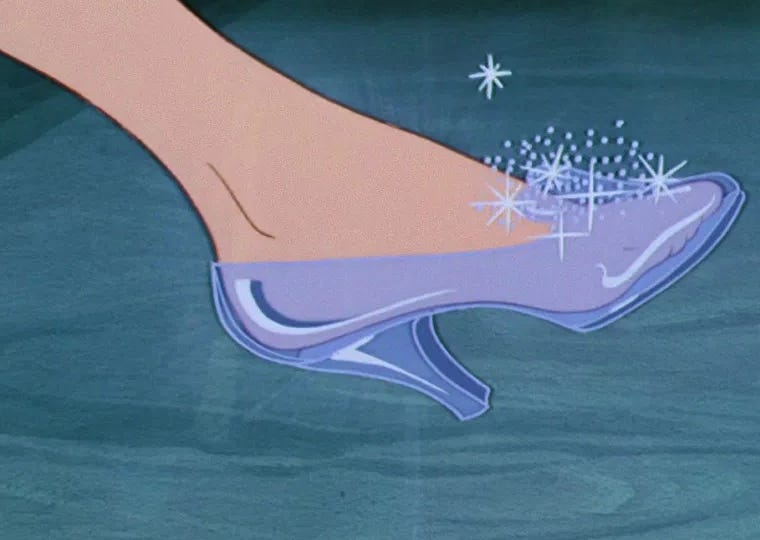
In this sense, worthy is something that must be deemed, like a knighting ceremony or a glass slipper. You are bestowed with worthy. A book cannot look itself in the mirror and offer affirmations.
And when I think alive, I think about all the girlies on Tiktok reading the same romance novel, inventing trends, choosing songs like we once did for away message lyrics, and creating a community of in-the-know readers who understand the running gag. I think of books that create community, that must be discussed. Some of the books that I mentioned above share this quality too.
Alive books keep you up at night. It could be plot, urgency, sentences, humor, lovable characters, edging, breakthroughs, so many factors. This could be any genre, I’ve cried over poems as often as anything else. I was riveted by The Weeds. The reading experience is like watching a silent film, it does not have a “riveting” plot, but the two alternating character voices are so defined, and so interesting. I never had to question who was speaking, only what would happen next in the eerie waiting (stalling?) periods they both are sort of damned to in different time periods. I looked forward to reading it. I feel that way right now about Forest Time by Jeremy Lloyd. Reading that book every morning for fifteen minutes after my workout, gets me up for my workout.
Alive are the books that I hug after closing, that come with sensations: chills, shudders, heart rapidity, tears, focus, irritability, disgust, fluttering, buzzing, warmth, clenching, heat, heavy breathing. Listening to author Kate Crane talk about a highway (of all things!) on a podcast recently made me feel alive. I couldn’t stop listening. She made an ssssssss sound to reenact if you were driving on it—the feel of the gravel. It got to me more than any craft question. A highway! A HIGHWAY!
When I read The Things They Carried, it’s the water buffalo that I’ll always remember, how sick I felt for that water buffalo. When I think about one of my favorite books Lark & Termite, I drift into that moment when you’re daydreaming and you realize you’re in another world altogether but you refuse to look away from the spot that brought you there. So, you’re staring and bickering with the you inside your head, while the dream glycerin fades.
It’s true that we rely on venues and institutions to get books into readers hands—from entity to person, when the real goal is always person to person. Nothing sells better than a hand sell. Book campaigns (from what I’m seeing at the minute) spend a lot of time in the art (craft questions, “narratives,” themes, universally large or mass stakes, the setting is always the brain) where readers seem to want something closer to the body (senses). Readers (or Redditers) might say, “I want to know the last book that destroyed you” pay attention to the comments. They require a body.
Destroyed! An action! A feeling! I can’t remember that last book that made me feel like crumpled tissue. Storygraph reviews too, often start with I (feeling) this book. I used to love to loathe a book, now I don’t have time for that and I DNF books all the time. I don’t think feelings are good places to have deep discussions about craft necessarily. I used to loathe! in workshop when someone was like “I really liked this…” when I wanted to know what was working—the machine of the thing. I do think a “feelings read” is helpful in an editing stage: what is the body doing? Regular folks, who do not think about writing and sentences all the time, read with their feelings and bodies, their limbs (ecstatic!), their heart (palpitating!), their eyes (bugging!). You’ll often see readers comment, “if I was X character, I would have done X,” they are body snatchers!
I’m not trying to A Little Life or Bridge to Terabithia anyone here. But I am trying to figure out a backwards way into the body for book publicity. If Mrs. Frizzle could do it while Ralphie was sick, I can do it. For now, I’m convinced it starts with sensation. Where are you when you read it. Who are you when you read it. How does it stick in your body? I remember how satisfied I felt reading the twist in Ministry of Time but really I spent the entire book wanting them to make out, how delighted I was at the video game chapter in Tomorrow, Tomorrow, Tomorrow, how anxious I was reading this excerpt of What We Try to Bury Grows Here that I immediately bought the book, but have been too scared to read it. I read the whole excerpt expecting to skim it, it was unskimmable.
Next time you’re convinced to buy a book, I want you to send me what got you. Was it marketing copy, a galley letter, a blurb, a sentence in a review somewhere by a normal person who read it, or something more suspiciously embodied like an itch?
As always, the Pine State calendar of events lives here (which I need to update), and you can buy our books here! You can also see what we’re working on and contact us through our website, Pinestatepublicity.com.
Tom Sleigh was interviewed for USA Today about ROSIE, Nour Rahal featured Hasan Dudar and CARRYOUT for Detroit Free Press, AETV interviewed Kate Crane about WHAT EVER HAPPENED TO EDDY CRANE?, you’ll see Nancy Lehman’s RITZ OF THE BAYOU everywhere including The New Yorker, Kate Crane wrote about “being furious for 38 years” for Slate, Monica Ferrell, author of THE FUTURE, is in conversation with Diana Whitney in the newest issue of Adroit, THE FUTURE also got this lovely review in Harvard Review this week, Erica Stern got a new review for FRONTIER: A MEMOIR AND A GHOST STORY in River Teeth, the last excerpt of ERASE GENESIS by Rebecca Gayle Howell just dropped in Oxford American, Jill Christman was on Pop of Culture last week, Toledo City Paper recommended Hasan Dudar’s CARRYOUT, The Daily Iowan called ULTRANATURAL by Candice Wuehle “intoxicating,” and Little Village Magazine said they were “consumed” by it, and so much more on Twitter, Bluesky, & Instagram.
Comments
Nothing yet. Say the first thing.
Sign in to join the conversation.