
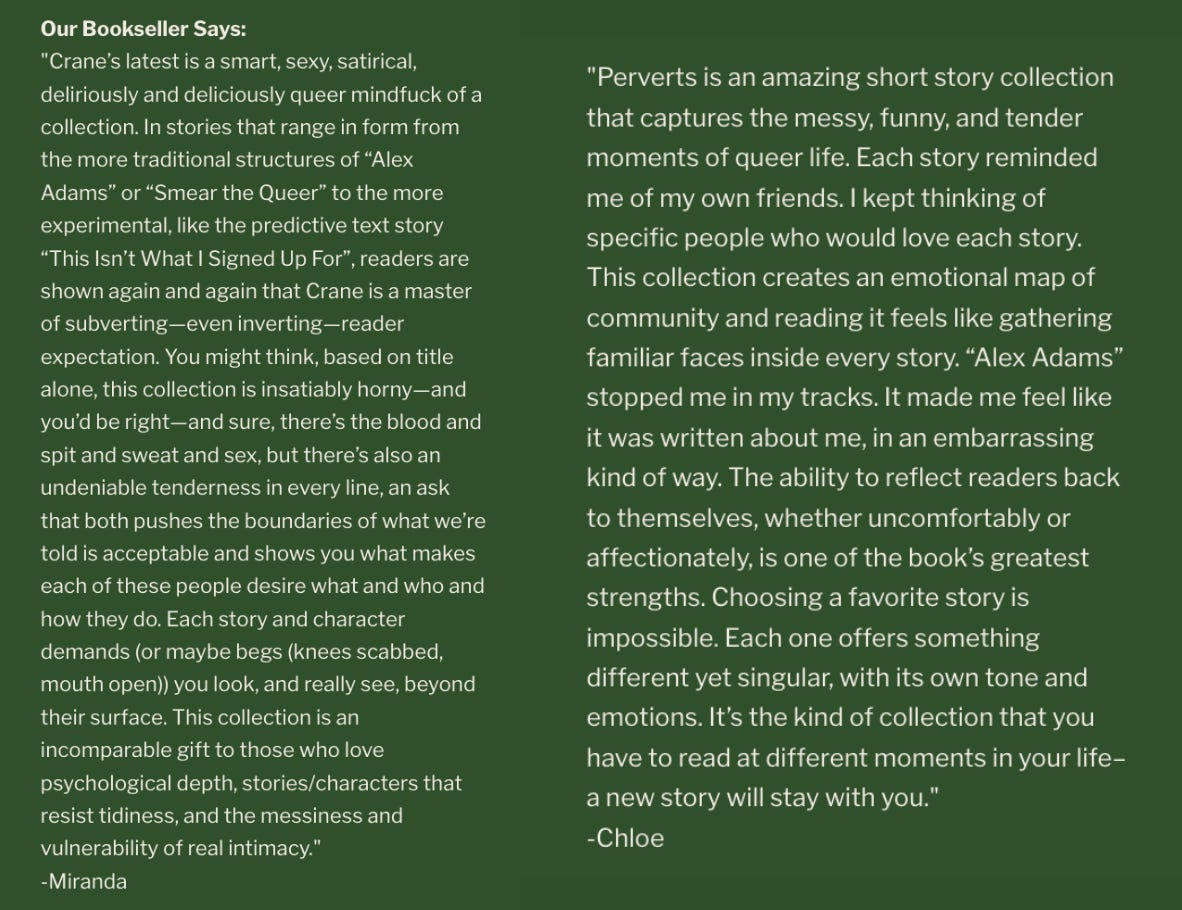
Been a fan of Mac Crane and their writing for a long time, and when I realized they were doing a bit of coaching work, I wanted to know more about their process, advice, and what it looks like to be a writing coach. Crane’s new book PERVERTS is a short story collection dropping in July and you should preorder a copy. My local booksellers highly recommend it.
Here, Crane discusses the role of the writing coach, drops some 🔥 writing tips & reads, and what the job of unearthing a story actually looks like. You can get in touch about manuscript consults & more here.
CMM:
Mac–you’ve written two stellar novels with a short story collection on the way (thrilling!), and you’ve moved from independent presses to the big four with Dial Press, plus your debut novel I Keep My Exoskeletons to Myself has one of the highest review rates on Goodreads that I’ve ever seen–in other words, you’re doing big things in publishing. And now, you’re moving all the success into consulting other writers on manuscripts and book coaching. Tell me about what writing looks like for you, and then how you translate that into book coaching?
MC:
For me, writing books looks like playing, experimenting, and delighting in my work—because if I don’t, first and foremost, then surely no one else will. It also looks like chasing down my obsessions, whatever idea or themes that won’t leave me alone. That obsessive energy comes through in my writing and, in my opinion, makes it infinitely more interesting and engaging. I’m obsessed with form, subtext, and experimentation. With punchy, strange dialogue and people who say anything but what they mean. When I’m brainstorming, instead of writing a list of themes I want to explore, I write a list of questions I want to interrogate. And the novel becomes the attempt at answering them. Of course, the catch is that most of these questions are inherently unanswerable. Things like “What are the limits of desire?” and “How does one control one’s legacy?” Or say, “What are the many languages of shame?” Maybe, then, my novels, in a way, are all failures. But what matters is the reaching for, the search, the hands dirtying of it all.
When it comes to book coaching—which involves mentoring, providing feedback, accountability, deadlines, brainstorming, relevant readings, and more—I bring the same energy, passion, and playfulness. I urge clients to lean into what delights them, what they can’t stop thinking and talking about. As a reader, it’s easy to see what writers enjoyed writing because those the moments or scenes are so full of heat, possibility, and complexity. Part of my job, among many, is to pick out those scenes/moments/ideas/narrative threads and tap into the potential of them. Another important part of that is empowerment. I want my clients to feel empowered to let go of antiquated writing “rules” and to learn to embrace and trust their own instincts and impulses. You want to write a novel in the form of a cookbook? Let’s do it. And let’s do it well. Let’s marry the narrative and the structure. Let’s make that marriage inevitable.
At the end of the day, it’s about meeting the writer where they are at and doing everything I can to help the book be what it wants to be, on its own terms, without imposing my tastes or desires onto the project. I was a basketball coach for many years, and so much of my experience in that world applies here: I help unlock talent and potential, develop craft and skills (if requested/welcomed), and celebrate wins both big and small, while also acknowledging the reality of life and stress under capitalism and adapting deadlines, schedules, etc. accordingly.

CMM:
I’m awed at you calling all your novels failures and had to take a beat at that, but I think it perfectly aligns with what you’re saying about coaching in general–having to acknowledge that you’ll fail in order to … fly (I wish I had a good Space Jam reference here). You get something out of the failure, a new door opens, all the euphemisms. And I’m someone who can get lost in the sauce (might as well make it a thing) of failure and I have trouble clawing my way back to something usable–an all or nothing mentality. I wish I was more adaptable, but I’m pretty neurotic. With my kids I use that “practice makes progress” phrasing, and that’s what it feels like you’re saying with play. That nothing is totally useless, and that you have that keen ability to tease the useful out of what a writer might think is slop. I can obviously see why writers might need this in their life, but what do you think a solid coach might offer at say the revising stage where so much feels malleable?
MC:
Well, I’m more or less setting myself up, you know? Pursuing the unanswerable. A bit of Rilke’s “live the questions now” type thing. But yes, a new door! Or, the door becomes a window, or a highway. Or…aliens who need your help to win a basketball game (Space Jam is forever a favorite!). Funnily enough, having my kids has helped so much with my own flexibility, adaptability, fluidity, and play. (The neurotic in me sees the neurotic in you.) If I’m going to tell them that it’s totally cool and fun to experiment and make a god awful drawing, then I better be able to back that shit up. But you’re totally right—nothing is useless. In the middle of drafting, I have found myself, time and time again, desiring a particular scene, moment, idea, paragraph, etc. and realize that I wrote that very thing years ago. That it was part of some “failed” experiment. But now it fits somewhere else. And it clicks right into place. Each piece isn’t its own thing—it’s a collaboration with time and our fluid selves.
I have a lot of exercises, prompts, and strategies for approaching revision, depending on the writer’s needs, revision style, and pain points. But first and foremost: what is the distance between what they want the narrative to be and what the narrative currently is? Can they feel that distance? Articulate it? Themes, questions, structure, character arcs, plot-level goals, all of it. Right away, we have several things to be writing and revising toward. That distance is important to determine: that’s where desire and hunger live, and that’s what propels us forward on this years-long book journey.
I do urge clients to begin a new document for draft two, though it’s ultimately up to them. Something about going into the original can feel overwhelming and also over-reliant on the original draft. Of course, they can reference the original, but each line, scene, and chapter needs to earn its place in draft two. It forces the writer to become both investigator and jury. Part of this investigation also involves finding the scenes that really sing, finding moments of heat, curiosity, and interest, finding what was joyful and compelling to write—these are moments of potential. They’re sparkplugs. How are they serving the story and characters? What are they trying to say and show? How can they be broken out? How can they expand and run wild? How can we inject other scenes with that same spark?
CMM:
Ou, ou, ou, tell me about “earn its place.” I’ve heard writers say this in interviews, but everything you’re saying here is so interesting (and liberatingly honest if I’m being transparent) I’m so curious to hear what it means to you? I think part of my curiosity stems from being someone who quite literally cannot plot (braided essays forever!), or maybe that’s just what I’ve told myself and I need a writing coach. And part of it is getting stuck in the “SO WHAT?” void–I have trouble deciphering what matters and then the overwhelm kicks in. Maybe this is different when you’re looking at a whole first draft, but in that first draft process, what do you tell yourself to stay above the thing enough that you can simply let it BE(come)?
MC:
First of all, I think plot is what you make it. The word can be scary but I often find myself reframing it, in the most basic sense, as “consequences.” And those can be story level, line level, thematic, psychological, and more. But also, I feel lucky to live in a time to learn from other writers who are expanding the idea of plot. Lincoln Michel had a great craft essay in Lit Hub a few years ago called “On the Many Different Engines That Power a Short Story.
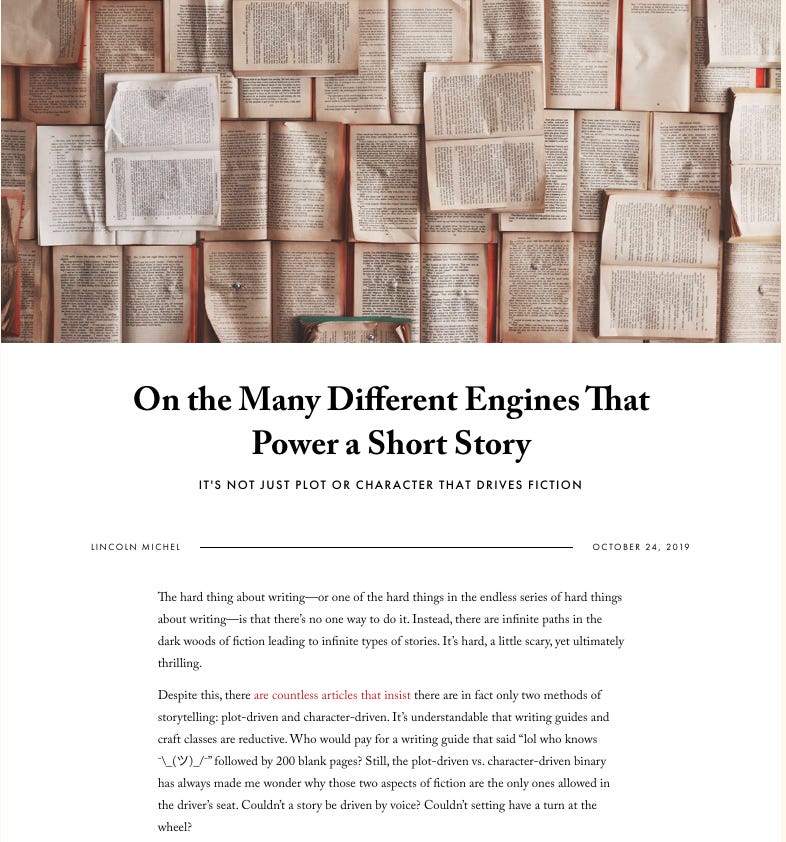
Things like form, language, and setting. (Braided essay as form as engine!) And I think that can be true of a novel as well—or rather, there are several engines working at once. Plot feels less intimidating to me if I think about the interplay of everything as all possible engines. This leads me to a line earning its place. A line, imo, should be working at least two engines at once. Sometimes a line can be necessary for one reason but more often than not, say, for me specifically, a line that earns its place is powering the voice engine as well as thematic, world-building, or psychological engine. Jo Ann Beard has a well-known “sentence test” she uses for each line:
Is it grammatical? (I would argue this means for the world and logic of that particular piece)
Is it true?
Is it new information?
Is there a surprise in it? (Could be as minor as a surprising use of punctuation or an unexpected word)
Surprise is one of my main guiding principles for drafting and revising. Big surprises, like reveals and twists of course, but mostly, the joy of surprise is character and line level surprise. Did someone say something strange or off-kilter? Did someone put mayonnaise in their coffee? Did the author use repetition in an unexpected way? What about a unique turn of phrase? Or did they take a cliche and fuck with it? These are often the things that keep a reader engaged, keeps them flipping the pages well past their bedtime.
CMM:
Mayonnaise in coffee! I am nodding along to everything you’re saying here. I love the two engines at once for a sentence–that feels somehow more doable than just looking and saying, is this doing SOMETHING.
So, to get to this point with a writer, a revision place (hallelujah)–as someone coaching them along the edge, where do you start, and where do you hope to end up? I guess coaching to me is kind of nebulous and maybe that no fixed star thing is actually the point, but you’re obviously a smart, smart writer, and I’d love to hear logistically (is this boring?) how you move through all of this with a writer?
MC:
If anyone puts mayonnaise in their coffee, please reveal yourself now!
Book coaching is certainly nebulous. Every writer comes in at a different point in the process. I’ve had a writer come to me with the first third of a novel written—they wanted feedback on what they’d written so far, and then brainstorming and outlining help, as well as an actionable plan on how to get there. So, of course, the type of revision I discussed above is very far off. I’ve had another client come to me wanting to send me a chapter every two weeks, with set deadlines, so I was with them from the very beginning. I think that type of collaboration can not only provide accountability but help create a much stronger first draft (stronger, meaning a lot of things, but ideally it means closer to their goals, closer to the true heart of the novel, tighter, more coherent, and compelling). And if we have a very strong first draft, then we are that much closer to taking a microscope to the work once the macro things have been nailed down.
Sometimes my job is also to unearth the true story beneath the text. Like, I think you have something incredibly rich here, but I wonder if we can look at it differently. I wonder if xyz themes you are circling around are actually our focus; I wonder if xyz relationships that have a bit of page time now actually deserve to be front and center. That type of thing.
I’m going to be real here—a lot of my job is letting someone know, honestly and transparently, “hey, this book is something worth pursuing.” We all need that sometimes. I know I do. It can make the difference between a book never seeing the light of day and one that readers get to hold and love and be moved by.
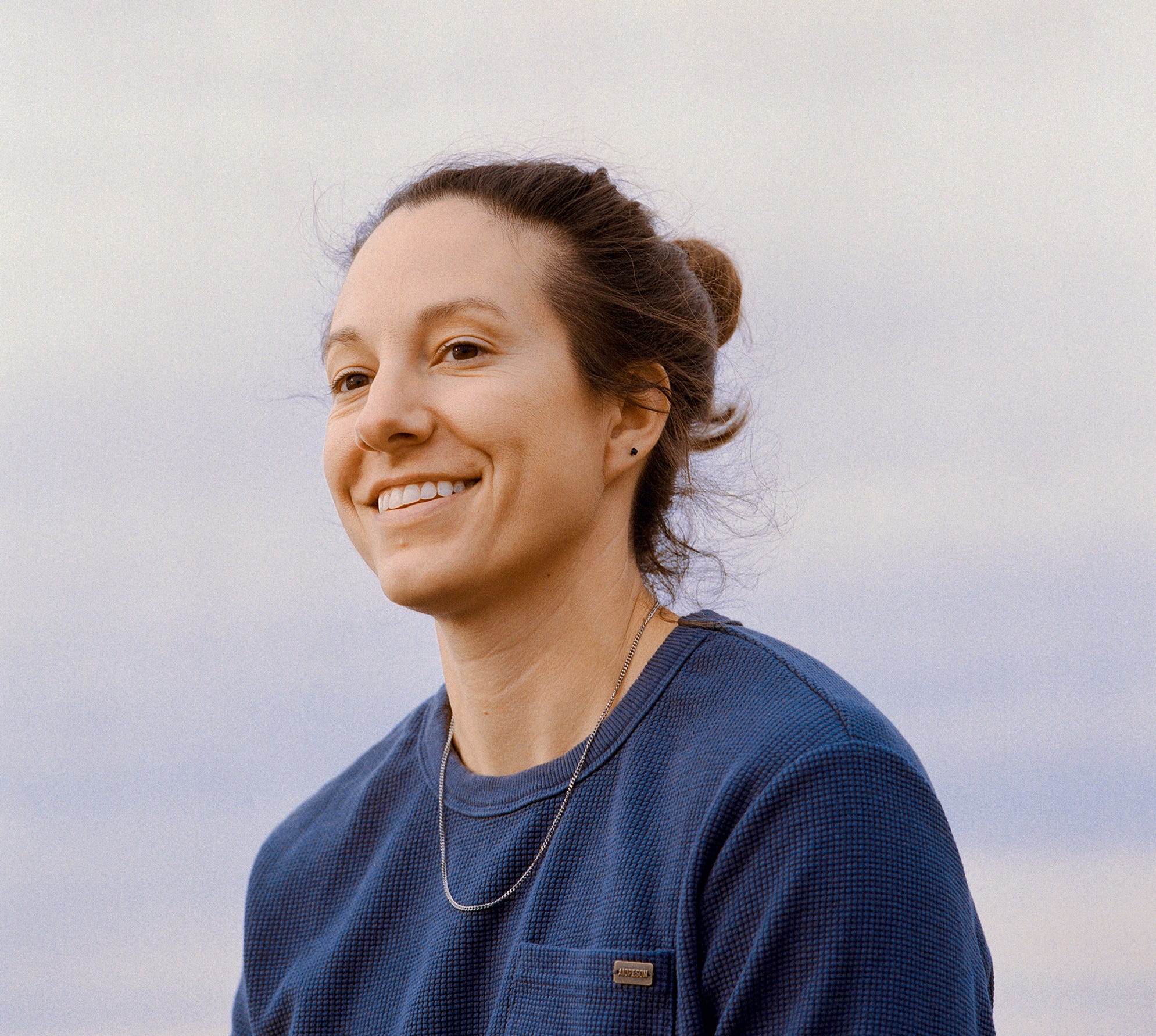
Mac Crane is a jock, parent, editor, and the award-winning author of the novels I Keep My Exoskeletons to Myself and A Sharp Endless Need, and the forthcoming short story collection, Perverts (July 7, 2026). They have received fellowships from the Sewanee Writers Conference, American Short Fiction, and Vermont Studio Center and have served as faculty at the McCormack Writing Workshop (formerly Tin House), the Lighthouse Writers Workshop, and Community of Writers.
Comments
Nothing yet. Say the first thing.
Sign in to join the conversation.