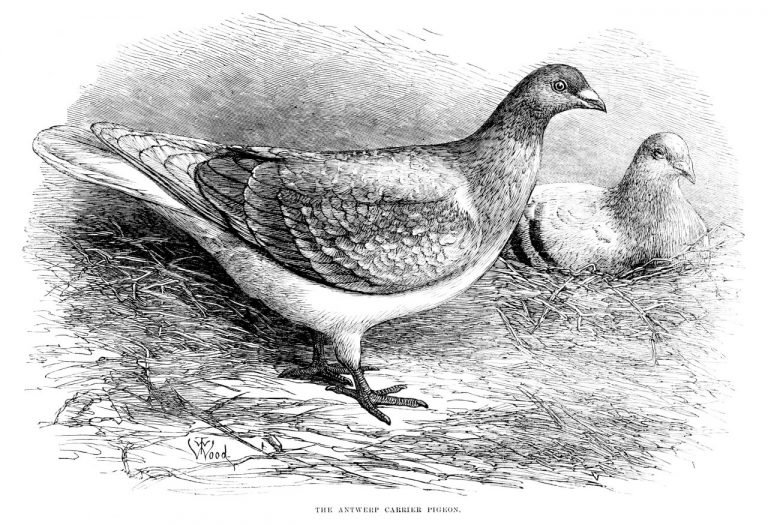
The Franco-Prussian War of 1870-71 is perhaps the most well known instance of pigeons being used to carry information in and out of a city during a siege. But nearly 40 years earlier, the Dutch military used pigeons in a similar fashion during the Siege of Antwerp in 1832. In this post, we examine the [ ]
When did the British Army first use pigeons in combat? World War One? The Boer War? The answer is the Hut Tax War of 1898, a relatively obscure colonial uprising in Sierra Leone. This week, we take a look at how the British Army, for the first time ever, relied on pigeons to communicate with [ ]
We’ve previously written about how Arctic explorers relied on homing pigeons in the late 19th and early 20th centuries. Recently, we uncovered facts demonstrating that Royal Navy personnel brought homing pigeons with them as they searched for the Lost Franklin Bay Expedition in the 1850s. Given that homing pigeons were very much a novelty amongst [ ]
In reading about military pigeons, one might be tempted to think that such services ended after the Second World War. For the most part, that’s accurate. Once electronic communication became cheaper and widespread in the post-war era, most militaries happily disbanded their pigeon services, eager to get rid of a seemingly archaic system. By the [ ]
Finland emerged as a latecomer to the pigeon arms race—while other countries had started supplying their militaries with pigeons in the late-1800s, it wasn’t until the 1920s that Finland implemented its own military pigeon service. This late start is unsurprising, as Finland was a possession of the Russian Empire from 1809 to 1917, known formally [ ]
The United Kingdom’s Royal Air Force (RAF) enjoys the honor of being the world’s first independent air force. For over 100 years, the RAF has protected Britain’s skies and air space from harm, playing a major role in the Second World War and the Cold War. Few people, however, are aware of the RAF’s predecessors [ ]
For all practical purposes, the Great War began when Germany invaded Belgium on August 4th, 1914. Despite the valiant efforts of the Belgian Army, it was an unfair fight and the small country was quickly overrun. For the duration of the war, German military authorities occupied nearly the entire territory. This is common knowledge, yet [ ]
The Balkan Peninsula was a hotbed of activity during the latter-half of the 19th century. The Ottoman Empire had ruled the region for centuries, but a rise in ethnic nationalism challenged the status quo. Following a series of wars and rebellions, the Sick Man of Europe gradually receded from the Peninsula. At the close of [ ]
On May 11, 1189 A.D., Frederick I, Emperor of the Holy Roman Empire, sailed from Regensburg with an army of over ten thousand. Traveling to the Levant, they would soon be joined by Philip II of France and Richard I of England and their respective armies. For the third time within a century, Europe had [ ]