
Part three of three. Read part one, Representing Them, and part two, The Vacancy.
Shri Thanedar will end his tenure in U.S. Congress with one solitary, signature achievement — and an unfinished one at that. On June 30, in a Rayburn House Office Building hallway outside the fifth annual advocacy day of the Coalition of Hindus of North America (CoHNA), I asked him whether he had written House Resolution 69 or whether CoHNA had written it for him.
Without hesitation, he declared: “No, I wrote it.”
Five weeks later he lost the seat when Donavan McKinney, a state representative from Detroit, beat him in the August 4 Democratic primary for Michigan’s 13th District by roughly 4,200 votes out of 112,000 cast. Thanedar will depart Congress in January.
The resolution won’t leave with him, but even as it continued to gather cosponsors throughout July, with its author no longer available to champion it, it will likely fall prey to Thanedar’s failed congressional career.
He filed it twice — first as House Resolution 1131 in April 2024, then as House Resolution 69 in January 2025 — and neither version defines Hinduphobia. Asked to define it himself, in the same hallway on the same afternoon, he said nothing.
He wrote the text, but appendages of the Hindu nationalist movement raised the demand four weeks before he filed it, at a briefing where he told them a resolution was already being worked on. The demand needed a sponsor in Congress, and Thanedar rose to the occasion and pushed it for four years while his own district took to calling him an absentee, and it appears to have cost him the seat.
On March 13, 2024, Thanedar spoke at a congressional briefing on Capitol Hill hosted by HinduACTion.
He was introduced by Jay Kansara, who was the Hindu American Foundation’s (HAF) longtime director of government relations until he left to work with Americans4Hindus, the political action committee run by California physician Romesh Japra. Both are part of the American Hindu nationalist network that Political Research Associates traces to India’s RSS, the paramilitary organization the US Commission on International Religious Freedom recommended sanctioning in March 2026. At the close, HinduACTion and the Namaste-Shalom Multifaith Alliance presented a joint declaration urging Congress to recognize anti-Hindu hatred through a formal resolution.
Twenty-eight days later, Thanedar introduced House Resolution 1131.
Three days later he went on HinduLounge, a HinduPACT program that airs live on the Vishwa Hindu Parishad of America’s YouTube channel. He was hosted by Tejal Shah (then VHPA’s joint general secretary and, since January 2025, its president), who opened by reminding viewers that HinduPACT is an initiative of VHPA. Her co-host was Sudha Jagannathan, CoHNA’s director of government relations. The episode was devoted to the resolution.
Then, on April 15, HinduACTion hosted a press conference at the National Press Club so that Thanedar could announce the resolution he had introduced five days earlier.
Lunch was served.
Although HinduACTion is independently incorporated, its executive director, Utsav Chakrabarti, also heads HinduPACT and has served as VHPA’s director of advocacy and public relations.
Chakrabarti’s outfit issued the demand in March and staged the rollout in April.
After H.Res. 1131 floundered, gaining only 23 cosponsors and never coming up for a committee hearing, Thanedar filed nearly the same text again on January 24, 2025. H.Res. 69 has fared marginally better, garnering 34 cosponsors with seven of them — including Rep. Ro Khanna of California — signing on in 2026. Yet it also has not come up for a hearing in over a year and a half.
Neither resolution defines Hinduphobia, nor does a simple House resolution bind anyone, fund anything, or change any law. It does, however, record a statement of sentiment: that Hinduphobia is bad, without saying what Hinduphobia is.
The movement has never had trouble supplying a definition when it wanted one. In March 2023, CoHNA won a symbolic resolution from the Forsyth County delegation in Georgia that defined the word, and then used it to push Senate Bill 375, which would have written the same definition into the state’s criminal code. That bill died without a hearing, a sister measure in the Georgia House died with it, and nearly identical resolutions in Minnesota also died at adjournment in May.
Every version carrying a definition is dead. Yet the one still gathering names carries none, which is arguably its value to the Hindutva movement, as the absence of a definition makes it easier to digest while the license to append a meaning remains with the people who raised the demand.
Anti-Hindu hate in America is real. Stop AAPI Hate found anti-South Asian slurs — many targeted at Hindus — in extremist online spaces roughly doubled between 2023 and 2024, and a few Hindu temples across the country have been vandalized.
A resolution condemning any of it would be unremarkable. However, since Thanedar’s resolution does not say what it is condemning, the meaning of “Hinduphobia” will be applied by the people who demanded and are promoting it.
In July the Indian American Muslim Council (IAMC) examined 242 items the three groups pushing the resolution had themselves filed under Hinduphobia. Most were persecution-abroad reports, temple-attack coverage, and legislative proclamations, naming no one. Eighty-seven named a target. One target drew the most, with 22 accusations: campaigns against caste discrimination. The rest fell on a Rutgers report, an academic conference, members of Congress, the US Commission on International Religious Freedom, and diaspora critics including Hindus for Human Rights. The people most frequently accused, IAMC concluded, are academics, journalists, Dalit activists, human rights advocates, elected officials, and civil society organizations, not perpetrators of anti-Hindu violence.
Not one category was anti-Hindu violence. Jewish Currents reached the same conclusion a year earlier, auditing HAF’s own list of incidents and finding that three in four failed the foundation’s own definition.
Thanedar himself had already extended the “Hinduphobia” label to anti-caste activism. Explaining at the March 2024 briefing why he had formed a Hindu caucus in Congress, he told the room: “We see California SB403, and that’s just the beginning.”
SB 403 was California’s bill to ban caste discrimination.
A resolution does not gather cosponsors on its own.
Normally, the party and the constituency guide a member’s agenda, and both can vote him out. Thanedar’s came from a movement scattered across the country, one that had become his party without ever needing to participate at the ballot box. He did not have to invent an agenda because the movement was writing it for him.
The Hindu nationalist movement’s work went beyond guiding his agenda.
CoHNA, for instance, worked the resolution. At its 2024 advocacy day, by the organization’s own count, more than 40 volunteers went through Capitol Hill to press for H.Res. 1131, visiting over 115 congressional offices. This year, at the fifth advocacy day, delegates held more than 50 meetings with congressional staff and visited over 120 offices to push H.Res. 69.
New cosponsors arrived on that schedule. Rep. Sanford Bishop of Georgia signed on July 14, 2025, a week before CoHNA’s fourth advocacy day. Four more names arrived the following April, while Ro Khanna added his on June 2 (four weeks before the fifth) and a final two joined this July.
When Khanna joined, HAF claimed the win. Thanking Khanna and Thanedar for championing the resolution, they said they had sent more than 3,000 letters to Congress, claiming: “This is what grassroots advocacy looks like.”
The money ran alongside the labor.
Rajeev Menon, CoHNA’s co-founder and vice president, started Hindus of Georgia PAC in August 2020, and CoHNA’s general secretary, Shobha Swamy, sits on its board. Seven members of Congress appeared at that June 30 advocacy day, and the PAC has written checks to six of them — Sanford Bishop, Buddy Carter, Rich McCormick, Brian Jack, Suhas Subramanyam, and Thanedar himself, who pocketed $5,000.
“I want people to know about Shri,” said Rep. Rashida Tlaib, whose Michigan district adjoins his, shortly before the primary. “Shri moved into Detroit to run for office. He’s a millionaire. He is someone that doesn’t show up.”
Claiming that her office fields “endless” calls from Thanedar’s constituents who find his office is unreachable, Tlaib added, “Constituent services is like an afterthought to him.”
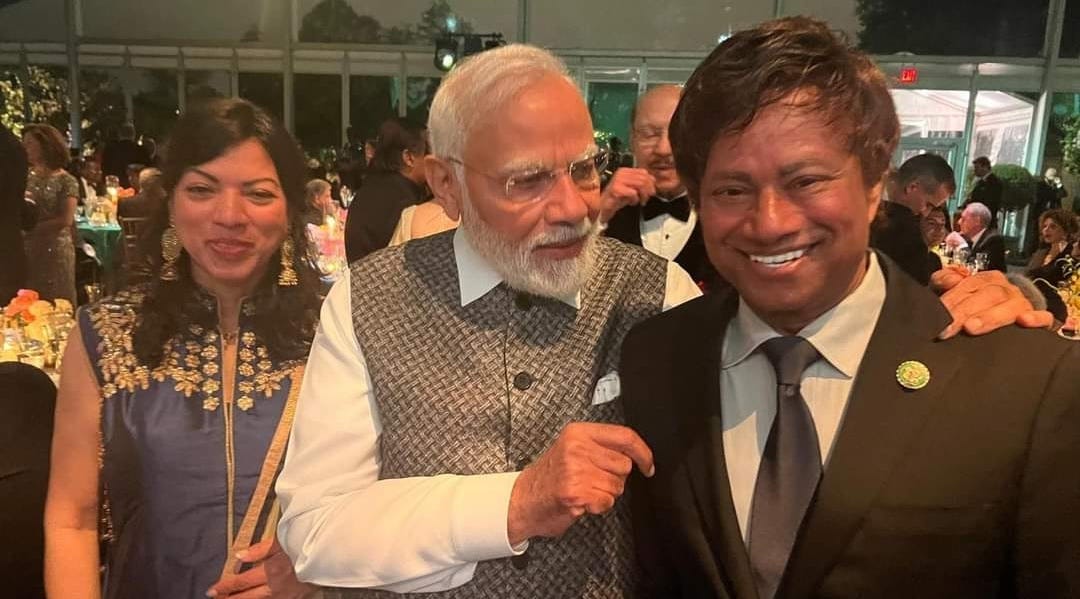
In 2023, he announced a Hindu caucus from the stage of Romesh Japra, whose PAC paid Thanedar’s campaign $5,000 the next day, and escorted Indian Prime Minister Narendra Modi into the Capitol. He turned up at CoHNA’s advocacy day as the only Indian American lawmaker there, then jetted to Delhi with a congressional delegation. In September, he launched the caucus at a press conference which Organiser, the RSS publication in India, covered as news.
On January 10, 2024, he spoke at the Capitol at a HinduACTion event called “Ramayana Across Asia and Beyond.” Thanedar condemned attacks on Hindu temples, said he was pressing colleagues on the Homeland Security Committee to “provide them the funds and resources they need,” and, asked about the opening of the Ram Mandir at Ayodhya, told ANI: “It’s historic and it’s a pride for every Indian to see that temple built.” That the temple stands where a mob demolished the Babri Masjid in 1992 apparently did not come up.
Then came the five weeks that produced the resolution: the briefing, the filing, the interview, the press conference. Everything after was work on that.
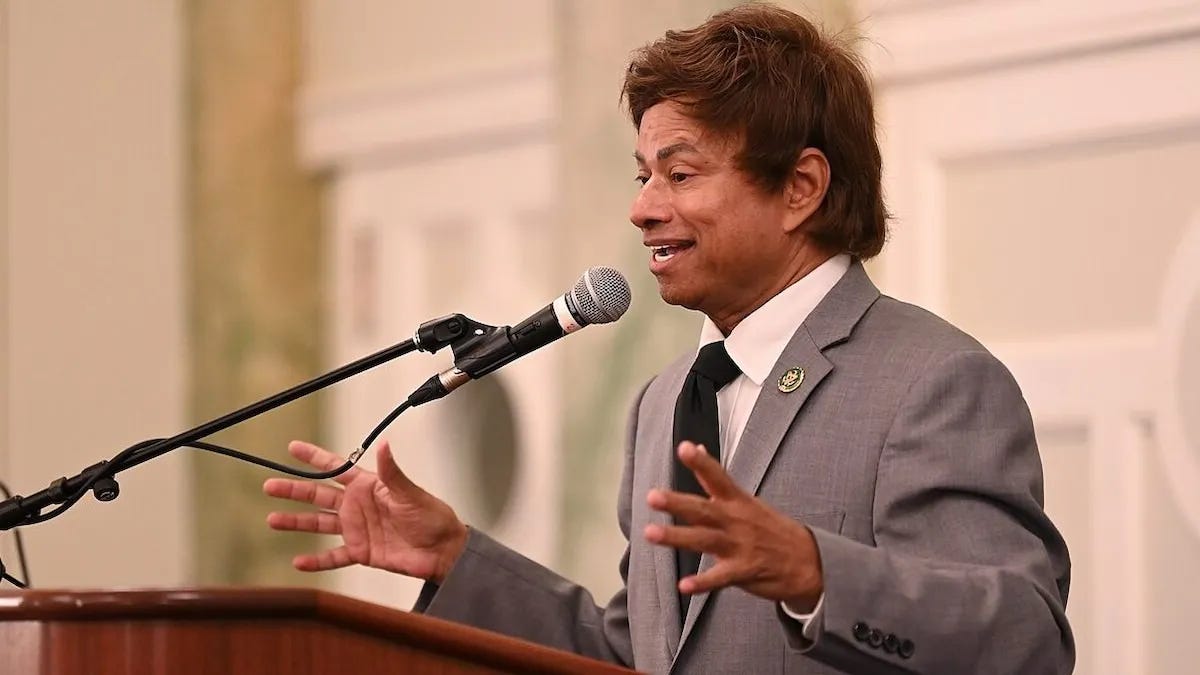
In March 2025 he stayed back after votes to headline the launch party of a South Asian newspaper in Tysons Corner, Virginia, telling the room that he usually gets the hell out of Washington the moment the votes are done, but that he had made an exception. He spoke at a second HinduACTion congressional briefing that May, and in July he headlined CoHNA’s fourth advocacy day, where volunteers were working the Hill for his resolution.
Then came Summer 2026 and, with it, the final fateful and fatal six weeks in his race for reelection to a third term.
On June 23, 2026, he addressed a diaspora advocacy event on Capitol Hill. A week later he headlined CoHNA’s fifth advocacy day at the Rayburn building, where I caught him in the hallway afterward. On July 25 he spoke at an evening gala at DAR Constitution Hall, organized by a consortium of more than forty groups that included HAF. That was ten days before the primary.
Thanedar described this whirlwind of activity as a sideline. “I spend a lot of my time, majority of my time I spend serving my constituents,” he told HinduLounge in 2024. “So while I’m doing all of that, I have a little bit of time I can spare in terms of helping the Hindu community.”
Yet, in Michigan, the complaints had been piling up for years.
In 2023, Tlaib called him an absentee congressman in a statement to the Detroit News: “While he is busy posting memes, his residents are calling my office asking for my assistance because he is absent from doing his job.” In 2024, Detroit Mayor Mike Duggan told reporters, “He’s not a bad person; he’s just not helping.”
After the August 2026 primary, a Detroit voter told Bridge Michigan, “Every time that there is a public forum, Shri either doesn’t show up or isn’t responding to the issues that his constituents have.” CBS Detroit reported that “opponents and colleagues criticize his lack of Detroit roots and his identity as a wealthy businessman who has spent millions on his campaign while representing Michigan’s poorest district.”
Thanedar, meanwhile, countered that his was “world class constituent communication, including a record 11 in-person town halls.” He claimed his was “one of the best offices” in Congress for constituent services, and his concession statement cited 4,300 constituent cases and $45 million secured for the district. Two weeks before the vote, he told Axios that any colleague was “more than welcome to walk around my district with me and see firsthand the love my constituents have for me, and the love I have for them.”
He is apparently one of very few people in Detroit who felt the love.
Every congressional office does, and is expected to do, casework. He built the caucus, the briefings, the advocacy days, and, above all, the resolution, and none of it was in Detroit, and neither was he.
Nothing in the district had a hold on him, because nothing in the district had put him there. The people who did lived in Sugar Land and Fremont and Marietta, and held their events in Washington, while he largely filled his campaign coffers with personal loans from his own pocket.
He did not neglect a constituency. He tirelessly attended to the only one he really had.
That constituency wanted the resolution most, so the resolution got the most of him — the briefings, the advocacy days, the years. It is the achievement he claimed as his own in a Rayburn hallway five weeks before he lost the seat, and it is the clearest measure of what he did with the office instead of representing Detroit.
Once results were in, Raju Rajagopal, a co-founder of Hindus for Human Rights, put it plainly: “The Man Friday of Hindutva groups and a Modi loyalist bites the dust.”
Thanedar entered the primary with every possible political advantage. Two terms in office, the endorsements of Hakeem Jeffries, Katherine Clark, and Pete Aguilar — the top three House Democrats — near-universal name recognition in the district, and roughly $5 million in cash on hand heading into election night against Donavan McKinney’s $142,853.
But McKinney had something else: he grew up in Detroit, served part of the city in the state legislature, and, above all, was present and reachable throughout, which he ran on. “This is the Blackest and poorest major city in all of America,” he told Punchbowl News, “and it’s time to number one, get our representation back, but number two, take our seat back.”
On August 4, McKinney won 51.9 percent to 48.1 — about 4,200 votes out of 112,000. In 2022, Thanedar took the seat with just 28 percent amidst a field of Black candidates who divided the rest between them, ending nearly seventy years of Black representation in a majority-Black district. The vote was not divided this time.
“The poorest district in the state can come together to defeat the richest lobbies and multimillionaires,” McKinney said after the results came in.
Nobody in the 13th District voted on House Resolution 69, but they voted on a congressman who was not there.
Being Hindu nationalism’s main man in Washington was a full-time job — four advocacy days, two congressional briefings, a caucus, a Capitol event with India’s ambassador, a newspaper launch, a gala ten days before the primary. It was not the job the 13th District hired him for. Tlaib was doing that one.
The movement lost its main man on August 4.
H.Res. 69 has sat in the Committee on Oversight and Government Reform since the day he filed it, gathering names and going nowhere, and when this Congress ends in January it dies on the calendar with or without him.
That has happened before. H.Res. 1131 died with the last Congress, and Thanedar refiled it as H.Res. 69 three weeks into the new one. Nothing about January requires that the next sponsor be him. Suhas Subramanyam, who took the PAC’s money and stood beside him in Rayburn on June 30, will still be in Congress. CoHNA will hold a sixth advocacy day.
The movement had become Thanedar’s party. Now he’s on his way out, partly — probably even largely — for it. Yet parties replace their members, and they refile their resolutions.
He wrote the text.
They wrote everything else.
This is the final installment of a three-part series. Part one, Representing Them: How Shri Thanedar Became Hindu Nationalism’s Main Man in Congress, documents his four-year alignment with the movement. Part two, The Vacancy: How Hindu Nationalism Became Shri Thanedar’s Party, follows the money.
Comments
Nothing yet. Say the first thing.
Sign in to join the conversation.