How to Set Up OpenClaw With Your Pieces Long-Term Memory
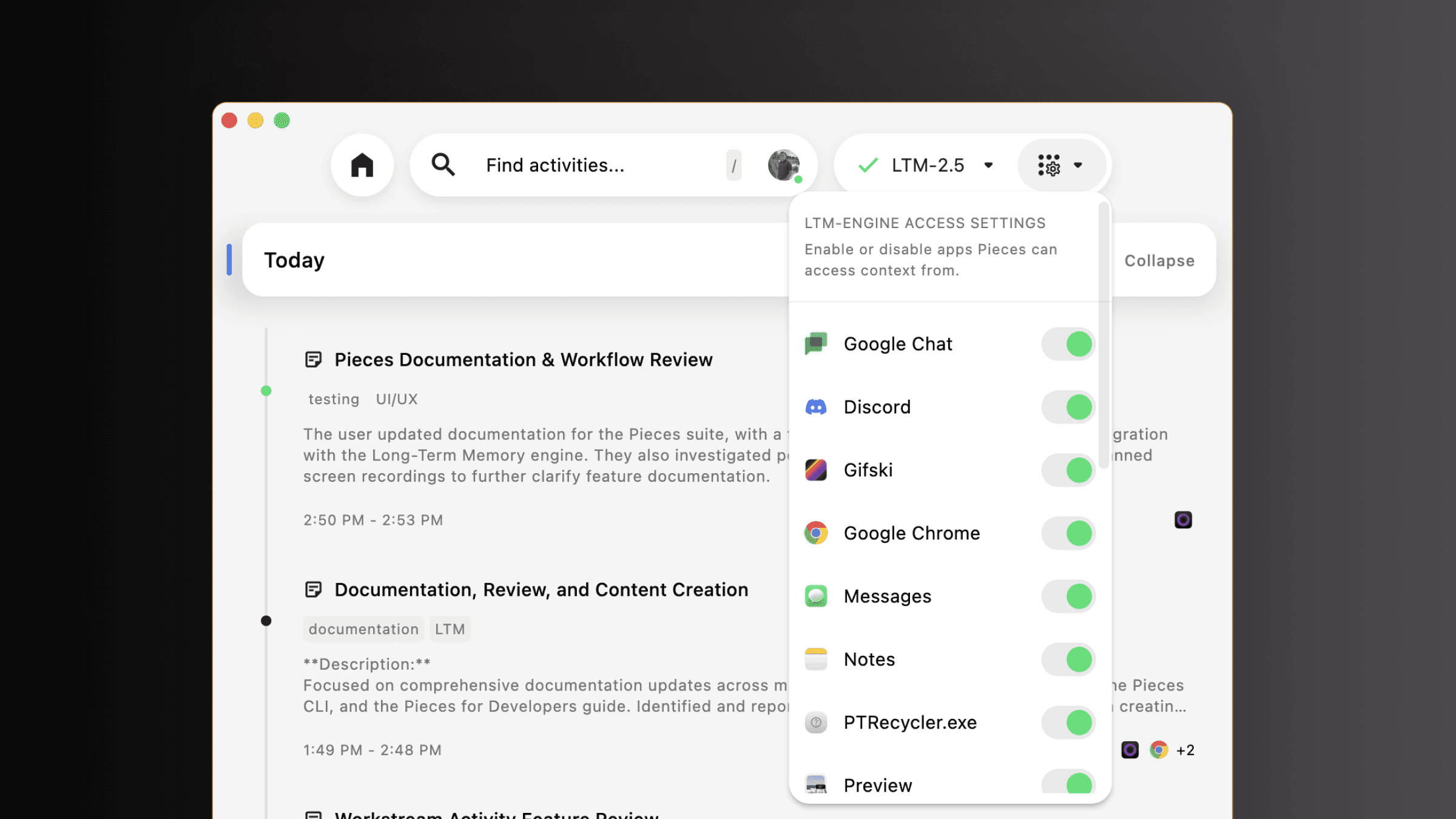
A stepbystep guide to setting up OpenClaw with Pieces LongTerm Memory so your AI agent has full context of your work from day one.

Guides, product deep-dives, and ideas on memory, context, and working with AI.
Live Last read · last published · next check
A stepbystep guide to setting up OpenClaw with Pieces LongTerm Memory so your AI agent has full context of your work from day one.
Indepth 2025 review of the best AI memory systems for developers. Compare architectures, features, use cases, and performance
Ditch standup bots. Use Pieces, an ondevice artificial memory that captures your work to generate accurate, detailed standup reports with a simple prompt.
Build a daily productivity app with Pieces in Part 4 of the series: polish the UX, tighten performance, fix edge cases, and make your app productionready with deployment best practices.
Build a daily productivity app with Pieces (Part 2) by adding AI intelligence with Google Gemini, covering architecture, prompts, integrations, and practical tips to ship smarter workflows.
Part 3: Flutter UI to bring your Pieces daily productivity app together.
Learn how to build a daily standup generator using the Pieces API. This first part of the series covers the SDK overview, key capabilities, and how developers can streamline workflow automation with Pieces.
Tired of awkward standup meetings where great engineers sound like they did nothing? I automated our team's standups with AI and got 3 people promoted. Here's exactly how we changed standups and made real work visible to managers.
Discover the top 3 ways to improve work performance, based on real experience, not just theory. Learn how to gain clarity through context tracking, reduce mental load by automating reporting, and turn daily updates into actionable personal insights.
Most teams hate standup meetings but keep doing them anyway. We used AI to capture our work automatically and skip the meeting entirely. Here's how it works.
Struggle to remember what you did before standups? Here’s why daily updates feel harder than they should, and how to make them effortless.
Stop treating standups like boring task reports. Learn how 1% of teams actually take advantage of that. Real example with team quotes and results.
Explore 11 top Python IDEs to boost productivity, streamline coding, and enhance your development workflow.
Stop scrambling to remember what you worked on yesterday. Learn how one developer automated daily standup updates with AI, transformed "no updates from me" into careeradvancing insights, and why this simple hack is changing how teams communicate their real impact.
Discover how to run daily standup meetings that actually drive results. Learn the meaning of a standup meeting, see classic and modern agenda examples, and explore best practices for team standups.
Explore how prototypes lay the foundation for longterm memory in AI. Learn why early experiments, iteration, and design “blueprints” are critical for building durable, contextrich intelligence.
Explore how prototypes lay the foundation for longterm memory in AI. Learn why early experiments, iteration, and design “blueprints” are critical for building durable, contextrich intelligence.
Tired of reexplaining your codebase to AI every week? Discover why developers need contextaware AI that remembers your workflow. Learn how Workstream Activity, Sources, and Time Ranges in Pieces give you control, continuity, and a searchable memory for your entire dev process.
Discover the different types of AI memory, how they work, key use cases, and the best prompting approaches to get accurate, contextaware responses
iscover how Pieces helps developers carry context seamlessly across browser, IDE, CLI, and desktop. From snippet capture to Copilotpowered reuse, learn how to eliminate lost time, preserve continuity, and stay in flow throughout your workflow.
Tired of losing focus while coding? Discover how Pieces helps you stay in flow, remember what matters, and move faster from idea to execution.
Explore the best AI code completion tools of 2025. Honest reviews of Pieces, Codeium, Copilot, Windsurf, ProxyAI, and Augment for real workflows.
AI isn’t a specialty anymore, it’s the foundation of modern software. In this guide, Ali breaks down the best programming languages for AI in 2025 and how your choice can make or break speed, workflow, and realworld result
Discover 10 questions no other AI can answer because only Pieces layers true memory and context across your work. OnlyInPieces
Why traditional documentation breaks down and how long term memory systems are changing how we preserve and transfer engineering knowledge.
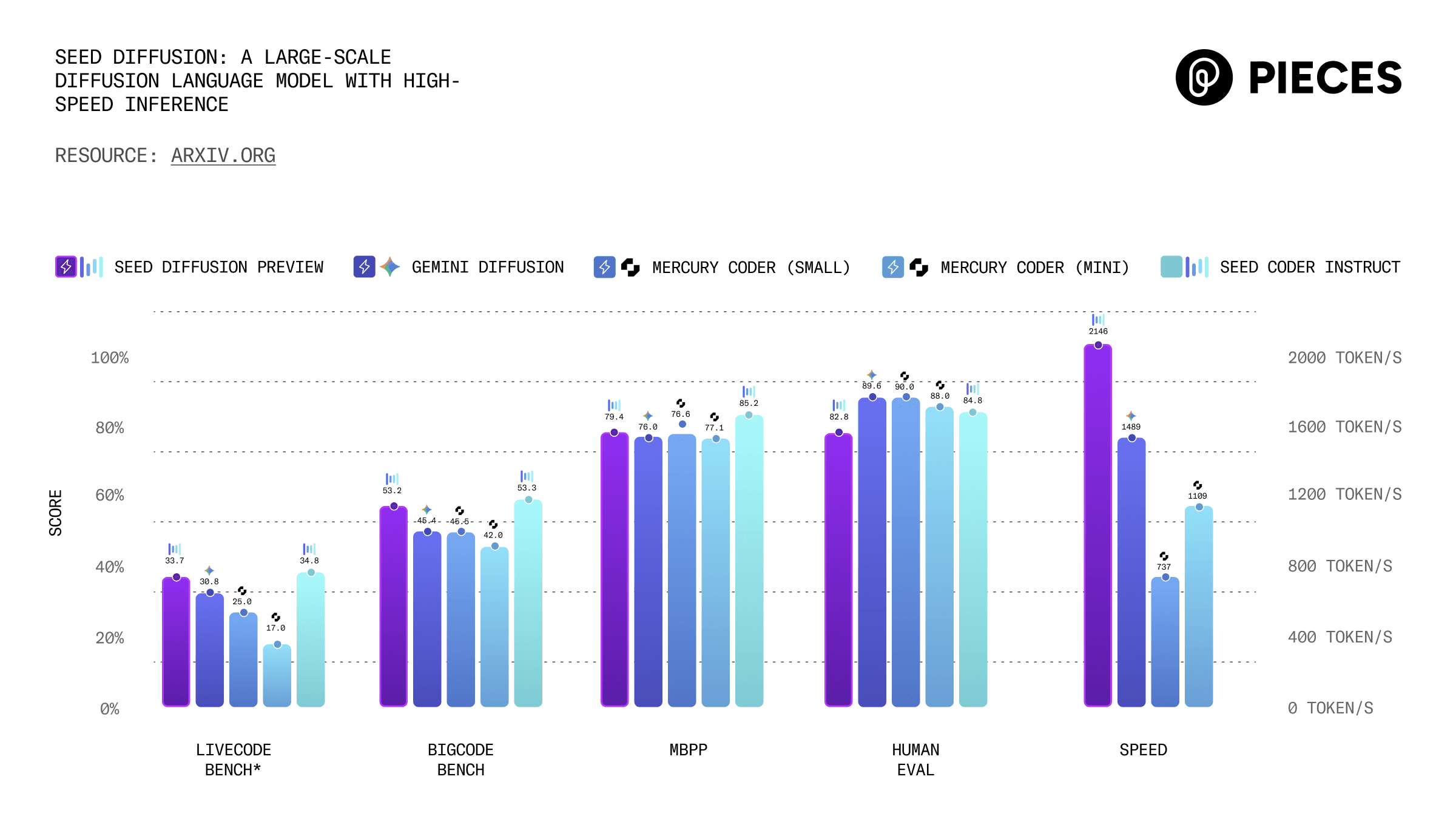
Seed Diffusion explores how we’re pushing large language models toward a parallel future where AI learns faster, works smarter, and opens doors to entirely new possibilities
Inside our ML team’s weeklong debate on OpenAI’s newly opensourced GPTOSS models versus Google’s Gemma3N architecture, from kernels and quantization tricks to efficiency, multimodality, and the quiet arrival of local AI’s future.
We put the top AI tools for Python coding to the test, not just to see which writes code the fastest, but which actually feels good to use, fits into your workflow, and makes building in Python more enjoyable.
We’ve all heard it — “the future of AI is in the cloud.” But the real story is that the future might be smaller, closer, and more personal. From Small Language Models (SLMs) to localfirst AI, agentic constellations, and even bioinspired designs, the next big leap in AI isn’t about scale. It’s about building smarter, faster, more private tools that actually work for you.
Local AI isn’t a distant dream, it’s already here. From nanomodels running offline to industrywide shifts toward privacyfirst architecture, discover why real breakthroughs are happening ondevice, not in the cloud.
NVIDIA is betting big on Small Language Models (SLMs), and at Pieces, we've been building for this future all along. Learn how nano models, local inference, and smarter AI architecture are reshaping the landscape
Pieces’ MCP and longterm memory are quietly becoming goto tools for developers who want smarter, privacyfirst AI that just works in the background.
Most people don’t think about tokens, and maybe they shouldn’t. But the way we use AI today has real implications for energy, cost, and the future of software. Here's why localfirst AI matters.
Explore the top AI assistants redefining productivity in 2025 – which tools actually deliver and how to choose the right one for your workflow, team, or daily routine.
Discover how AI’s obsession with scale led to a research monoculture, stifling innovation after ChatGPT’s success. Can we escape the Great Amnesia?
Discover why AI security is no longer optional in a cloudfirst world. Learn what matters most in 2025, whether you're protecting customer data, source code, or internal systems and how to navigate emerging threats without drowning in complexity.
Enterprise AI doesn’t fail because of the tech. It fails because people don’t trust it. Let’s fix that.
Learn about a realworld use case for using AI tools to write production documentation from soup to nuts: voicetotext, thoughtprocess checks, and assisted structuring all the way to a finished piece of effective, thoughtful technical writing
Discover how ondevice AI is reshaping the tech landscape by prioritizing privacy, speed, and user control, marking a powerful shift toward true data ownership and away from cloud dependency.
Learn what prompt evaluation is, why it matters in AI development, and how to systematically assess prompt quality to improve performance, accuracy, and reliability across use cases
Is AI memory that way ahead for effective building and shipping of software? In this article we will cover how artificial intelligence can help in knowledge management.
Build an AI agent that remembers, reasons, and adapts alongside you. Learn stepbystep workflows, memory architecture, and bestpractice tooling to create truly intelligent systems.
Discover what red teaming in AI really means. This complete guide explains how AI red teaming works, why it's essential for security testing, and how organizations use it to identify vulnerabilities and strengthen AI safety.
Explore the concept of LLM jailbreaking: how users bypass safety guardrails in language models, why it matters for AI safety, and what it reveals about the limits of control in modern AI systems.
Learn how to finetune Claude, Anthropic’s AI model, with this comprehensive guide. Explore customization strategies, use cases, and best practices for tailoring Claude to your organization’s needs.
AI systems don't behave like traditional software, so they shouldn't be evaluated like it. Learn how to assess accuracy, safety, reliability, and usability in realworld workflows, plus how Pieces helps teams track what matters.
AI reasoning goes beyond pattern recognition, it's about simulating logical thinking, decisionmaking, and inference. Learn why newer AI models prioritize reasoning updates and what this means for realworld performance.
Discover the Pieces Framework for AI Fluency – a practical, humancentered approach to developing the mindset and habits needed to work effectively with intelligent tools
Explore the technical foundations of large language models (LLMs), including how they work, their architecture, training methods, and realworld applications
Learn what sets AI agents and AI assistants apart, and why that difference matters for designing smarter, safer systems. Discover best practices with Pieces.