
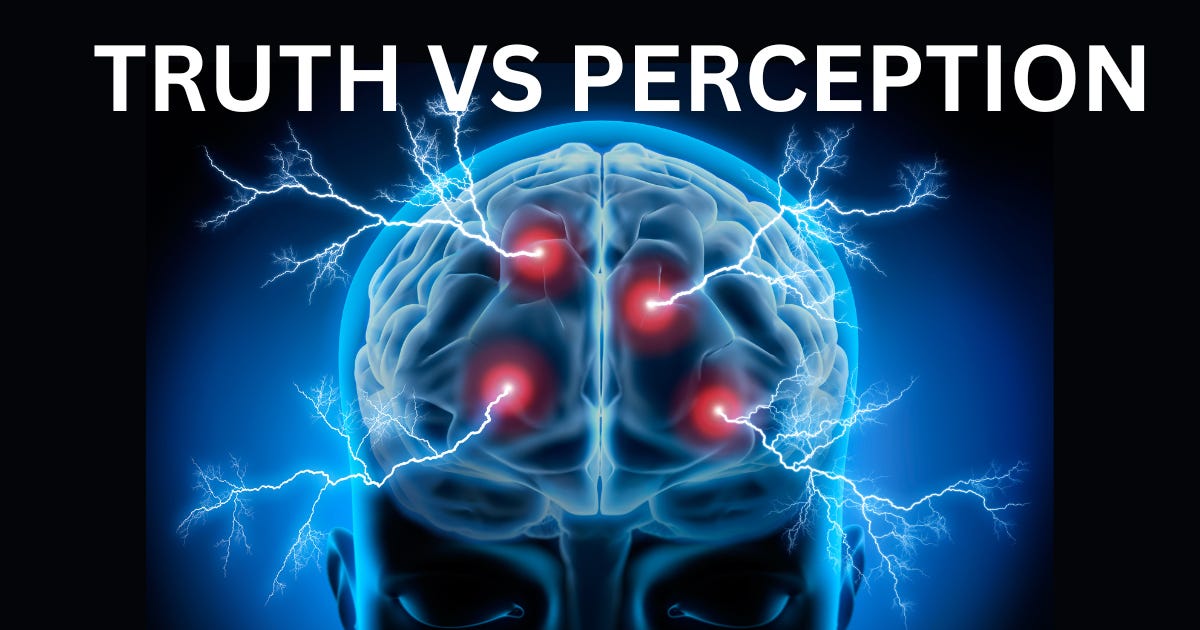
Touch is an illusion. Colors are not real. Time is something your brain invented to make sense of the world.
If you spend any time on science social media, you’ve seen these lines so often they’ve probably stopped meaning anything. Half my feed is some version of “you’re not actually sitting on that chair, you’re hovering above it.” And honestly, I judge myself a little for writing about this too.
But I’m doing it anyway, because underneath the clickbait there’s something genuinely useful. Thinking this way lets you see reality a little more naked. The cheap shock question (”is anything even real?”) falls away, and much better questions take its place. What is time, actually? How do we know that we know anything at all?
Let me start with touch, since I’ve covered it before [link: touch article].
A quick recap if you missed it: while you’re holding your phone or computer right now, the atoms in your hand and the atoms in the screen are not touching in any traditional sense. Electric fields push from a distance; no contact is required. The closer you force two atoms together, the harder the electrostatic repulsion fights back, and in the classical picture, making two electrons meet at a single point would take infinite energy. What you call “touch” is your nervous system’s translation of that repulsion.
Notice what this does and doesn’t mean. It doesn’t mean touch is fake. At our scale, “touching” is a perfectly good word for what’s happening. The definition came from perception, and for everyday life, perception is exactly the right tool. The word isn’t wrong; it’s just not fundamental. It’s a translation.
And there is nothing special about touch. Run the same argument through every sense you have.
Sight is nothing but light received by photoreceptors in your eyes. Millions of receptors fire signals toward the brain, and the brain assembles them into the full picture. Color is nothing more than a specific wavelength of light. Red is the wavelength around 700 nm, blue the one near 450 nm. Outside of a brain, the whole concept of color has no meaning; the universe contains only waves of different lengths. If we could see ultraviolet, our brain would presumably paint it as some new color neither of us can imagine. Bees and many birds don’t need to imagine it. They see it every day.
So perception is not reality; it’s a translation of reality. And your brain is not a passive translator. It’s an aggressive one.
The brain does not accept raw, unlabeled input. It is in constant search for meanings, patterns, and definitions, and it forces them onto everything it receives. Psychologists call these the Gestalt principles: the brain fills the gaps. The image below is only a couple of curved pentagons. There is no ball in it. Yet it’s not even possible for your brain to see anything except the ball. Try it.

That’s how weak and strong our brain is...
And it runs deeper than visual tricks. The image formed on your retina is flat, two dimensional, and upside down. You have never once seen that raw feed. Your brain takes an inverted 2D signal and hands you an upright, three dimensional world, so seamlessly that it took humanity most of its history to even notice this was happening.
There are famous experiments with inversion goggles, lenses that flip your vision upside down. Wear them long enough and the brain adapts. After days, subjects could move around and function again, and some reported the world beginning to feel normal. Whether their perception truly flipped back upright, or their brain simply learned to act inside an upside-down picture, is still debated. Which is almost the point: we can’t even be certain what they saw.
The brain will even generate sensation with no input at all. Ask any physician about phantom limb. Amputees feel the missing arm, its position, its itching, sometimes its pain, years after it’s gone. The limb isn’t there. The perception is!
None of this is fringe science, by the way. It’s textbook sensation and perception; I sat through lectures on it in med school. But it carries two consequences that reach far beyond psychology.
First, this perceptive machinery is a blessing and a curse. Pattern-forcing is why we learn absurdly fast: a child needs only a handful of examples to build a working model of an enormously complex universe. But the same ability makes us very prone to biases and false definitions. The most common is confirmation bias, which is basically Gestalt for ideas. The brain fills the gaps in new information with what it already believes, so we don’t really question anything, and everything conveniently confirms what we already know. Now imagine the transition from classical to quantum mechanics. To a mind exposed only to examples of continuity (smooth motion, smooth energy, smooth everything), the possibility of discrete entities was just insane. I’d argue that without confirmation bias, we would have reached quantum mechanics decades earlier.
Second, and this is the uncomfortable one: it becomes very hard to be sure of what we know. If touch is not exactly what it seemed at first glance, what else isn’t? We’ve already been through this once on this newsletter. Mass and energy, two obviously different things, turned out to be the same thing wearing different clothes [link: E=mc² post]. Every time physics matures, another “obvious” perception gets demoted from fundamental truth to convenient translation.
There’s an entire branch of philosophy devoted to this exact problem. It’s called epistemology, and it asks one main question: how do we know that we know? Which brings me to Friday, I’ve read a bit of Epistemology through the years because it’s incredibly fascinating to me and having studied physics and medicine, I have my own understanding on the subject. Full version as always is for paid subscribers so consider it, it’s free to try.
Hope you’re having a nice week.
Hasan
No posts
Comments
Nothing yet. Say the first thing.
Sign in to join the conversation.