
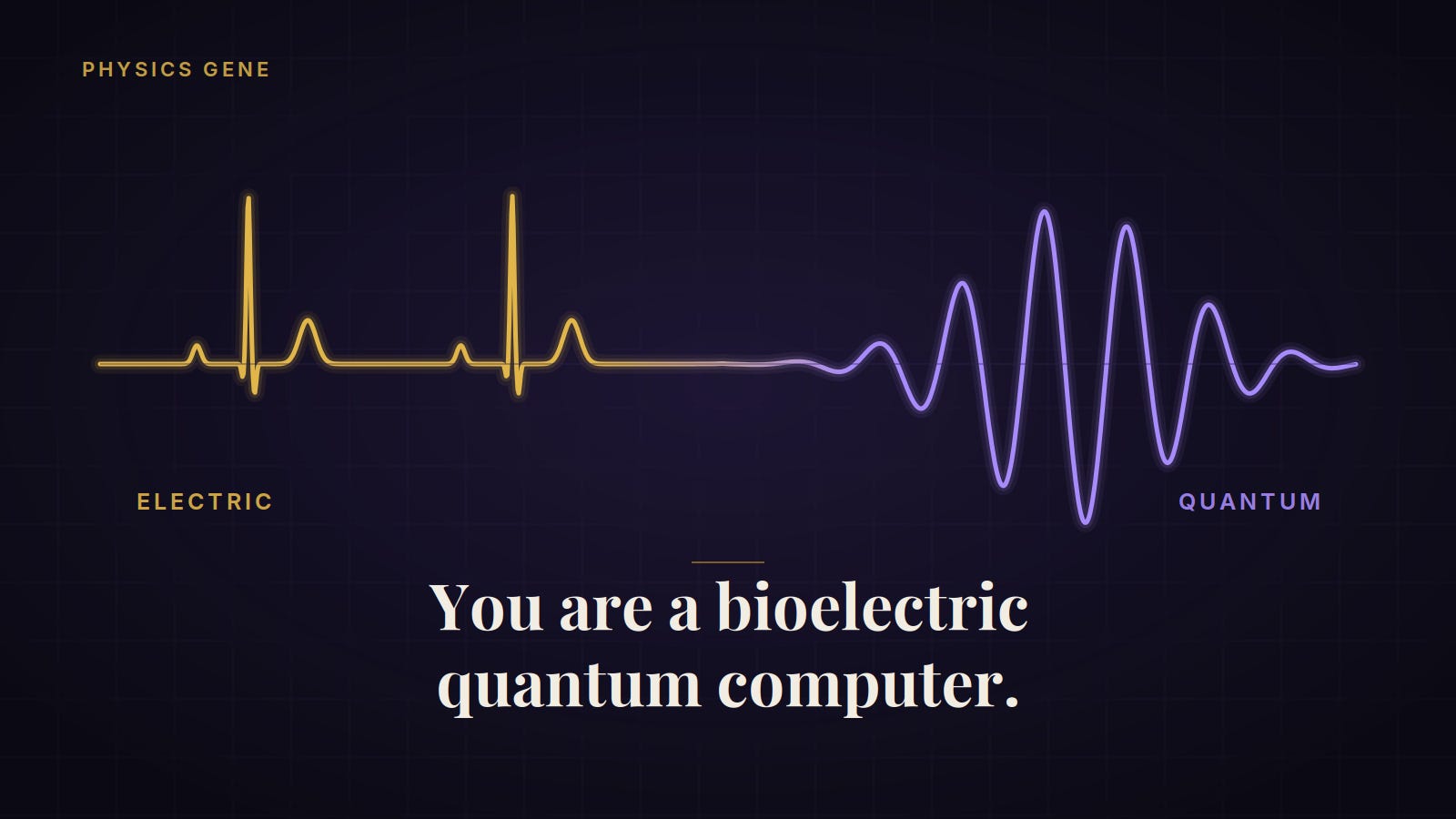
A nurse called me at three in the morning about a potassium of 7.1.
If you’ve never worked in a hospital, that number means nothing. Normal sits near 4. At 7, the lab doesn’t wait for anyone to open a screen. They phone the ward directly, because at that level the patient’s heart has started negotiating with an equation, and the equation usually wins.
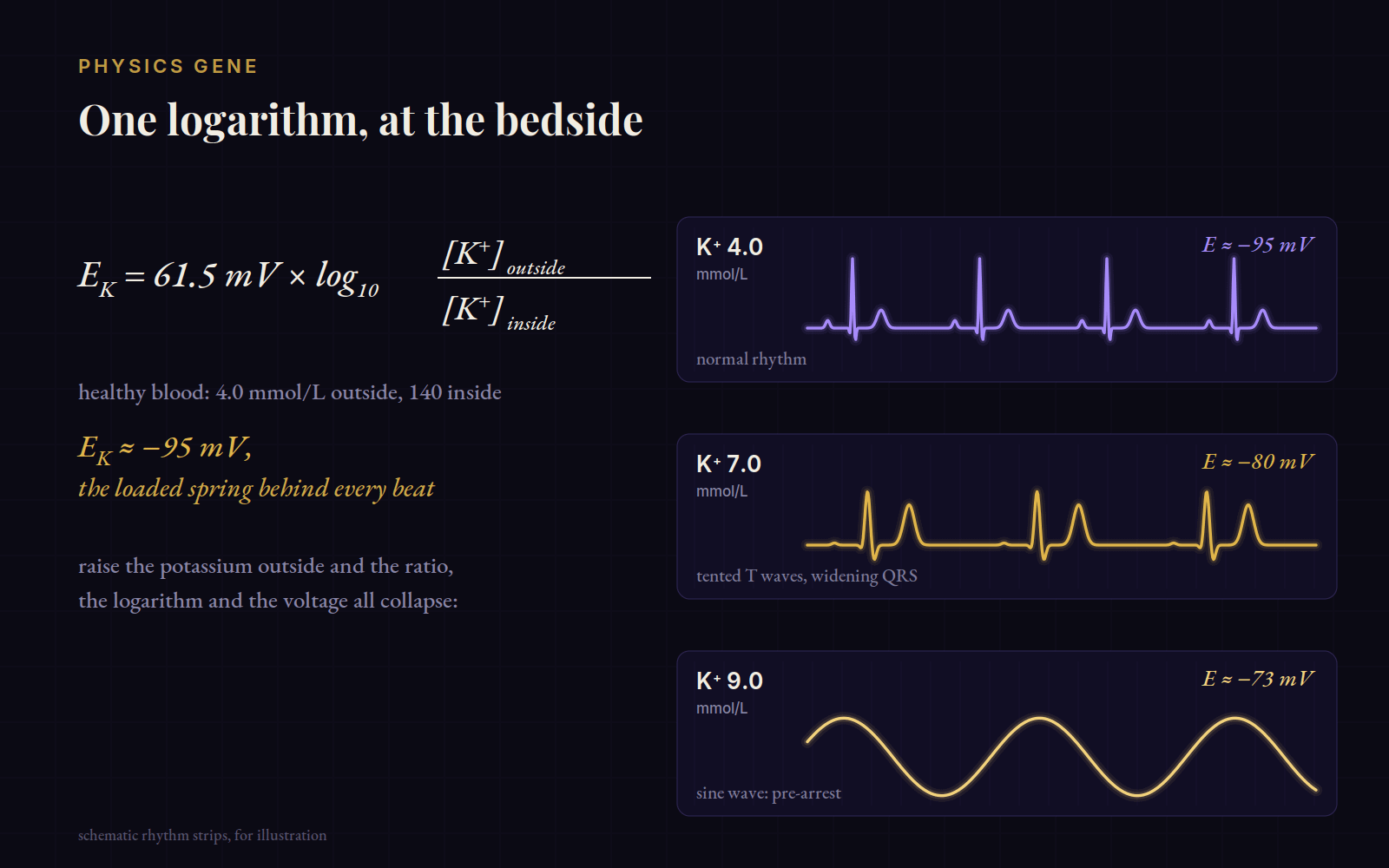
The ECG at the bedside told the rest. T waves peaked like tents, the complexes already starting to widen. Textbook, in the worst sense of the word.
The first drug we push is calcium, and here is the strange part: calcium removes none of the potassium. The number on the lab report doesn’t move at all. What calcium does is steady the voltage across the heart’s cell membranes, holding the electrical system together long enough for the actual fixes to work. Insulin with glucose, to drive the potassium back into the cells. Dialysis, if it comes to that, to pull it out of the body entirely.
Driving home the next morning, it occurred to me that I’d spent the night doing electrical engineering with a stethoscope around my neck.
The reason is an equation that hangs on no hospital wall I’ve ever seen, and quietly runs every ward anyway. Nernst worked it out in the 1880s, decades before anyone knew what a cell membrane was made of. It says the voltage across a membrane is set by a logarithm: roughly 61.5 millivolts multiplied by the log of a concentration ratio, potassium outside the cell divided by potassium inside.
Healthy numbers are 4 outside and 140 inside. Run the log and you get about minus 95 millivolts. That negative voltage is the tension a resting heart cell lives at. The loaded spring behind every beat.
Now raise the outside potassium to 7. The ratio shrinks, the logarithm collapses toward zero, and the voltage sags. Sodium channels, which need a properly negative resting voltage to reset between beats, stop resetting. Conduction slows and smears. On paper, the sharp spikes of a heartbeat begin melting into a slow sine wave, and a sine wave is the last thing many hearts ever write.
A logarithm can stop a heart. Nothing in that sentence is a metaphor.
That night was cardiology, but nothing about the physics is special to hearts.
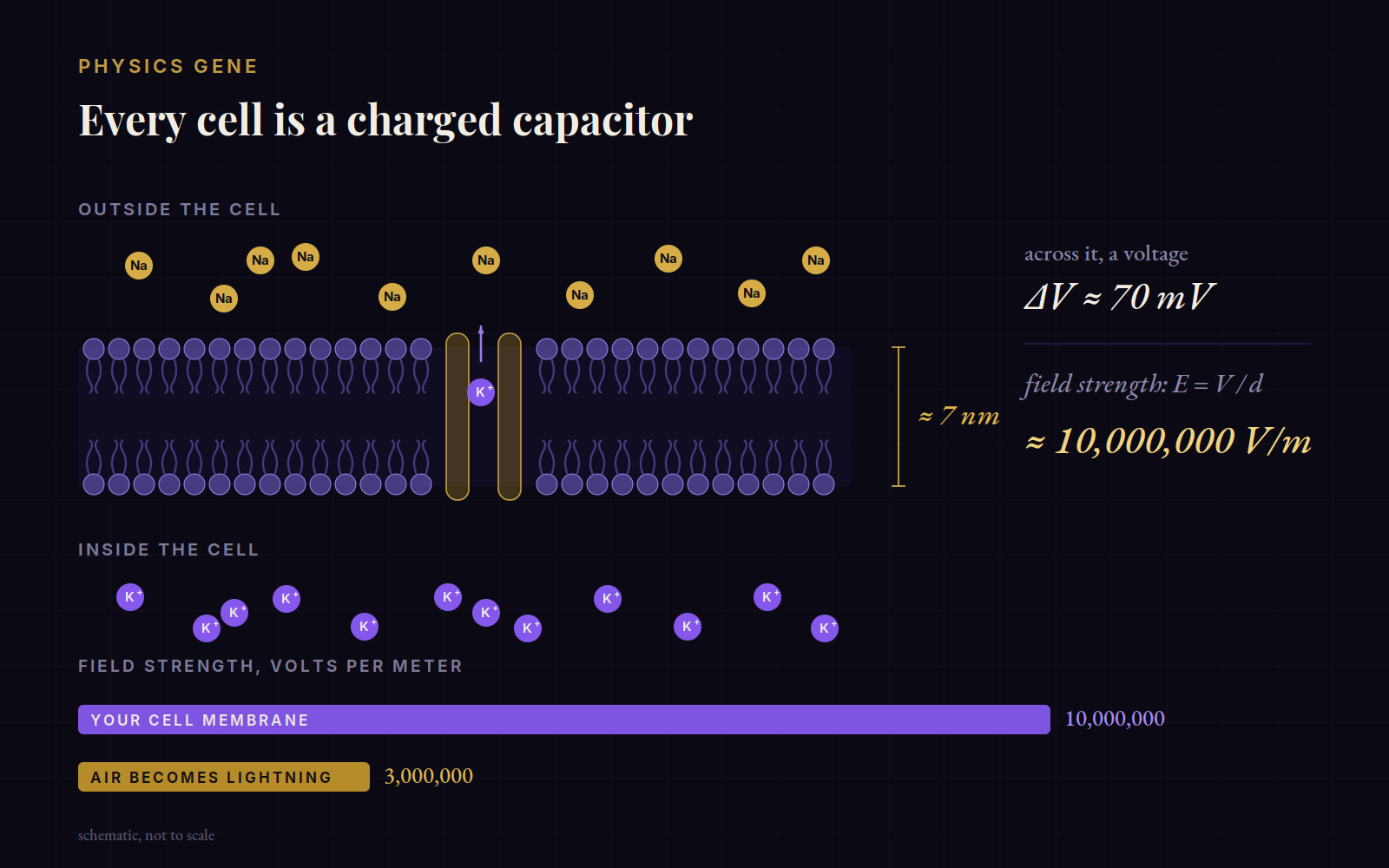
You’re built from roughly 37 trillion cells, and essentially every one of them holds a voltage across its membrane, around 70 millivolts in the busiest ones. Seventy millivolts sounds pathetic. A AA battery carries twenty times more.
But voltage was never the impressive quantity. The impressive quantity is field strength, volts per meter, and to get it you divide by distance. The membrane holding those 70 millivolts is about 7 nanometers thick. Do the division and it comes out near ten million volts per meter.
For scale: air itself tears apart at around three million volts per meter. That’s the threshold where electrons get ripped off molecules, the air turns to plasma, and we call the result lightning.
So the field across your membranes runs more than three times past the point where air gives up and becomes a lightning bolt. You maintain it across a wall ten thousand times thinner than a hair, in 37 trillion places at once, powered by whatever you had for lunch.
And your body doesn’t only use this voltage as power. It uses it as language. Your brain is 86 billion of these charged cells wired into a network that runs on roughly 20 watts, the draw of a dim bulb. Stranger still, the voltage seems to carry instructions for building the body itself. In 2012, biologists at Tufts changed the membrane voltage of cells in frog embryos, no gene editing, nothing else, and well-formed eyes grew where no eye belongs, lens and retinal layers included, some of them far down the body. Voltage isn’t only the body’s power grid; it appears to be part of the blueprint.
So the first half of my title costs me nothing. Bioelectric isn’t a claim, it’s a measurement. We monitor it at bedsides and implant its proof in chests.
The word I owe you is quantum.
If you have physics training, your guard just went up, and it should. Quantum states are famously fragile. We build quantum computers inside refrigerators colder than deep space, because a single stray vibration can wreck a calculation. A living body is warm and wet, and it never stops trembling. The standard objection says any delicate quantum state inside you should be destroyed in around a femtosecond, and that objection has a name and a number attached to it. We’ll stand in front of it before the end, I promise. First, though, two facts that are not speculation.
Enzymes cheat. Chemistry, as taught, is a story about climbing: a reaction gathers enough energy to get over a barrier, or it doesn’t happen. But when chemists measured certain enzymes transferring hydrogen atoms, the reactions ran far too fast, and they failed a classical test in a telltale way. Swap ordinary hydrogen for deuterium, its double-mass twin, and classical theory allows the reaction to slow down by a factor of seven at most. In an enzyme from soybeans, it slows down by a factor of about eighty.
A number like that has one honest reading. The proton isn’t going over the barrier at all. Its quantum blur reaches through, and it simply appears on the other side. Tunneling. The same trick that lets the Sun fuse hydrogen, the one I once wrote a whole chapter about, is running your biochemistry while you read this sentence.
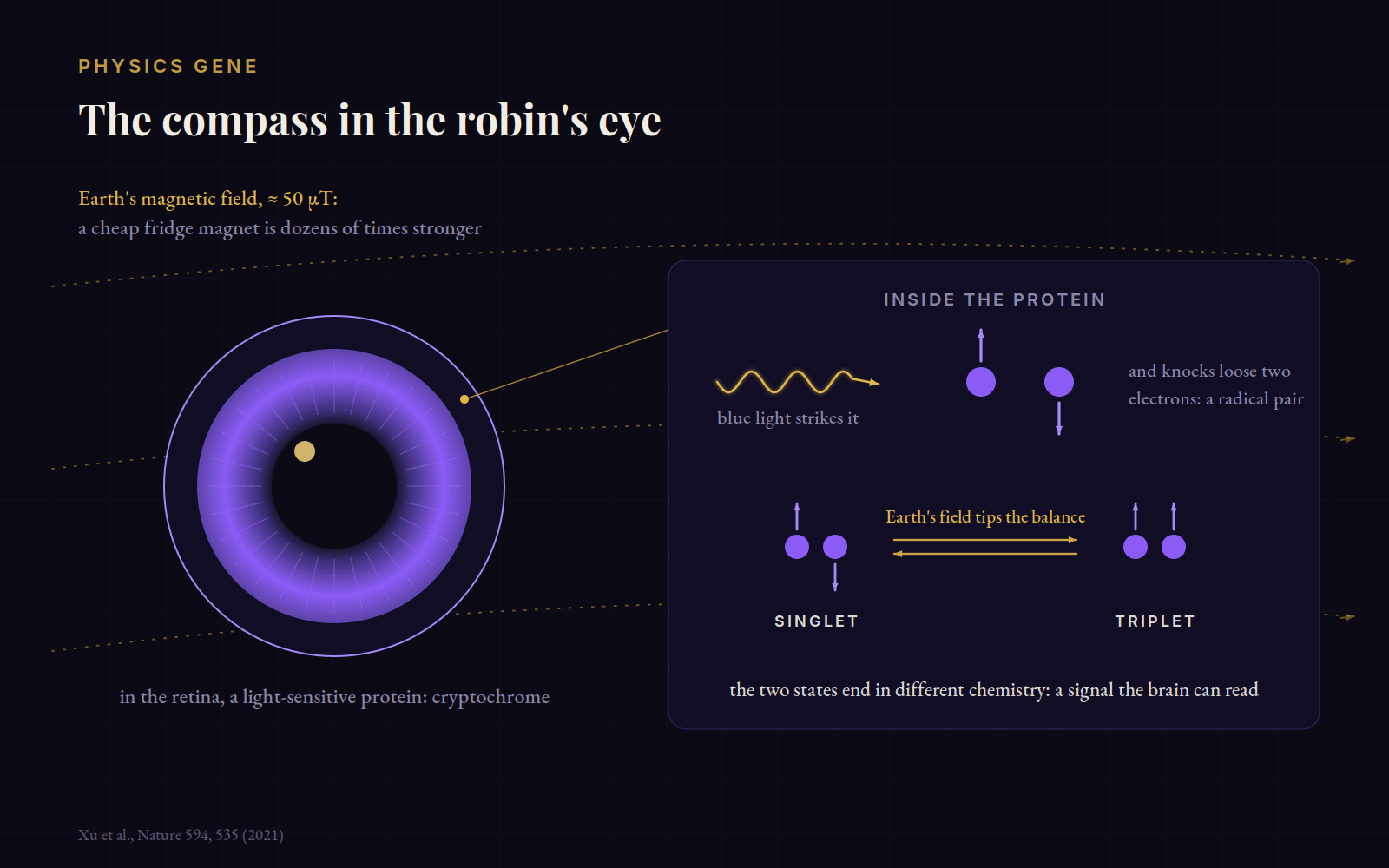
Then there’s the robin. Every autumn, European robins cross a continent, steering partly by Earth’s magnetic field, and Earth’s field is absurdly weak. Fifty microtesla, give or take. A cheap fridge magnet is dozens of times stronger. The best-supported explanation for how a small bird reads a field that faint lives in its eye. Blue light strikes a protein called cryptochrome in the retina and knocks loose a pair of electrons whose spins stay correlated, a genuinely quantum object called a radical pair. Earth’s feeble field is enough to tilt how those paired spins evolve, toward one state or another, and the two states end in different chemistry. Different chemistry, different signal, and the bird perceives a direction.
For a long time this was an elegant story in need of a killer experiment. In 2021 it got one. Researchers put the robin’s cryptochrome in a test tube and watched it respond to magnetic fields directly. The same protein taken from chickens and pigeons, birds that never migrate, barely responded at all. Evolution appears to have tuned a quantum sensor, and tuned it hardest in the birds that needed it most.
A compass built from electron spin, working at body temperature, in the rain, in an eye.
So let me draw the line where it honestly sits tonight.
That quantum effects run inside living machinery: settled. That evolution found some of them useful and sharpened them: strongly supported in enzymes, and probably in birds. Neither claim should scandalize a physicist anymore.
The strong claim is the one in my title. That your brain, the 20-watt electrical organ decoding these sentences, doesn’t merely contain quantum events but computes with them. That claim is not settled, and most physicists would bet against it, for one brutal reason. In 2000, Max Tegmark calculated how long a quantum state could actually survive amid the heat and salt of a working neuron. His answer: about 10⁻¹³ seconds, often far worse. Neurons operate on milliseconds. The mismatch is ten orders of magnitude. Publish a number like that, and a field considers the case closed.
Except it didn’t quite close. A physicist who has spent his career on the theory of quantum computation read the same result and asked a sharper question: is there anywhere in the brain that Tegmark’s math can’t reach?
Electron states die fast, yes. But the spin of an atomic nucleus barely talks to the surrounding chaos at all. And he believes he’s found one, a natural qubit, the nuclear spin of an element you swallow with every meal, protected inside a tiny cage-shaped molecule your own biochemistry already builds. If his math holds, that spin could stay quantum not for femtoseconds but for stretches you could measure on a clock.
And buried in the old literature, he found an experiment that should unsettle you. Decades ago, researchers gave lithium to rats, as two different isotopes. The same element, the same chemistry down to every decimal a chemist cares about. The only meaningful difference between the two is the spin of the nucleus. The rats’ behavior, reportedly, differed.
If that result holds up, then something inside a mammal’s skull can feel a nuclear spin.
I don’t know yet whether the title of this post is true. Nobody does, and I’d rather say that plainly than sell you a certainty that doesn’t exist. What I do know is what the night shifts keep teaching me: the border between physics and living things is much thinner than my textbooks let on. About seven nanometers, in most places.
Tonight, somewhere on Earth, a storm will pile up three million volts per meter and the sky will crack open, and everyone underneath will stop to watch. You’ve been holding more than three times that field, in the dark, in every cell, your entire life.
Thursday we find out whether anything in that dark is computing.
Thursday: The Trial of the Quantum Brain. The phosphorus qubit hiding in your own biochemistry, the lithium experiment that shouldn’t have mattered, and Tegmark’s number that was supposed to end the argument. Opening statements are free. The verdict is for paid subscribers.
No posts
Comments
Nothing yet. Say the first thing.
Sign in to join the conversation.