
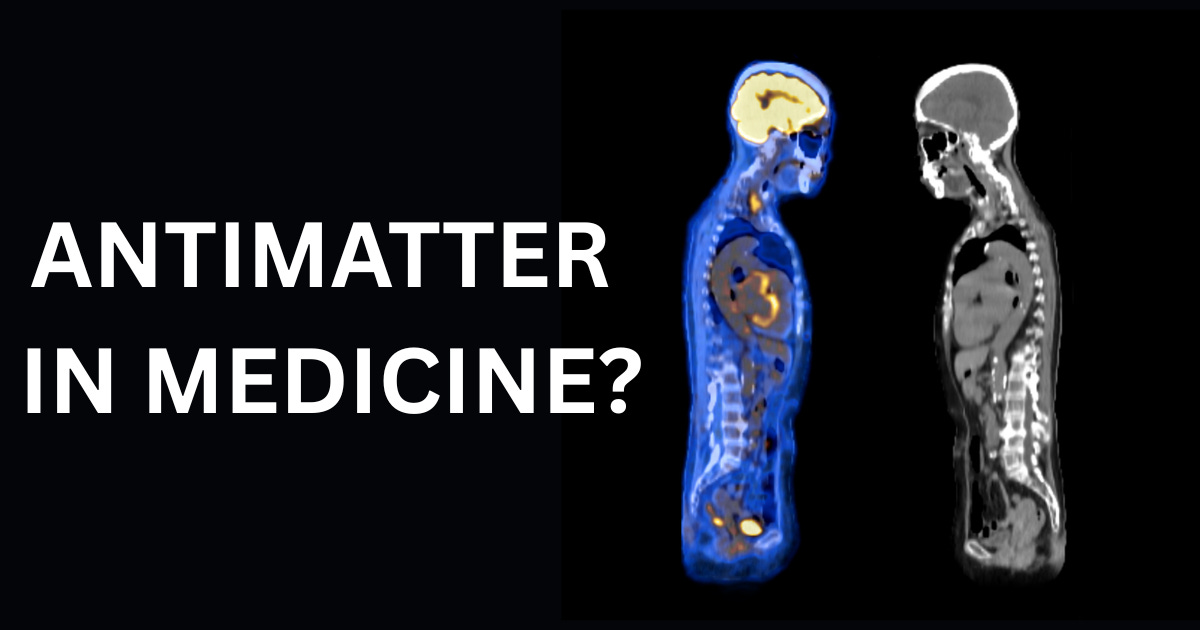
There is a form I sign in the hospital that I have never once signed without a small private pause. It sends a patient for a PET scan. The instructions we give them sound less like medicine and more like superstition. Nothing to eat after midnight. Sit still in a dim, quiet room for an hour. Try not to talk. Try not to shiver.
And then a nurse injects them with antimatter.
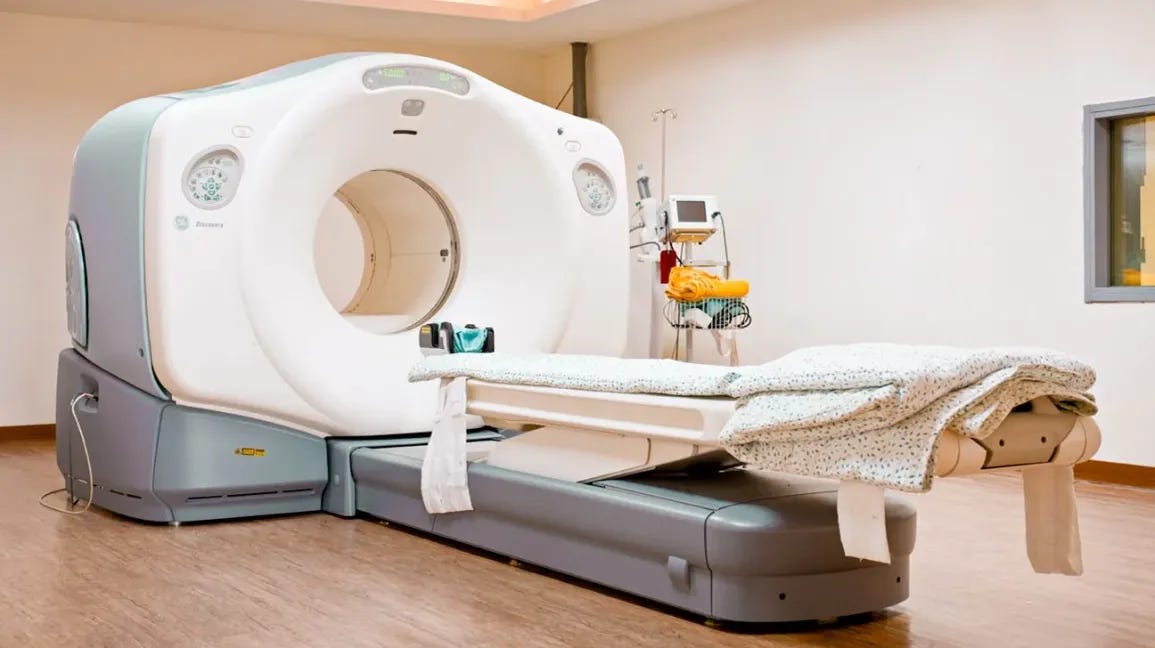
That sentence is not an exaggeration and it is not a metaphor. The syringe contains sugar wearing a radioactive disguise, and over the next couple of hours, inside the patient’s body, it will produce a few trillion particles of genuine antimatter. Each one will live for about a nanosecond, travel roughly a millimeter, meet an ordinary electron, and annihilate. Both particles vanish completely. Where they stood, two flashes of pure light fly apart in opposite directions, and a ring of cameras around the patient is waiting to catch them.
That is the entire scan. The most exotic substance in the universe, the fuel of starship engines and doomsday novels, is a Tuesday morning appointment with a consent form and a cannula.
To explain how that became routine, I need to tell you about the strangest man in physics, and about an equation that refused to behave.
In 1928, a twenty-five-year-old at Cambridge named Paul Dirac wrote down an equation. Dirac was famously, almost clinically silent. Niels Bohr called him the strangest man who ever visited his institute, and the physicists around him invented a joke unit called the dirac: one word per hour. What he wanted was an equation for the electron that obeyed both quantum mechanics and Einstein’s relativity at once, something nobody had managed cleanly.
The equation he found did it, beautifully. It predicted the electron’s spin without even being asked. Its predictions matched experiment. Dirac admitted years later that he was too scared at first to test it rigorously, terrified that some ugly fact would kill his beautiful theory. The ugly fact never came.
Something stranger did. For every sensible solution describing an electron, the equation insisted on a second one: a particle exactly like the electron, but with the opposite electrical charge. Dirac tried to ignore the extra solutions. They would not go away. He tried to argue they were protons, since the proton was the only positive particle anyone knew, and predicting a brand-new particle out of pure mathematics felt like arrogance. Colleagues closed that exit. Robert Oppenheimer showed the proton idea would destroy the hydrogen atom, and Hermann Weyl proved the mirror particle had to weigh exactly what an electron weighs.
So in 1931, Dirac surrendered to his own equation. He proposed, in print, a particle no one had ever seen: the anti-electron. Same mass, same spin, opposite charge. And the logic would not stop at electrons. If the electron has a mirror twin, everything does. Every particle of matter in existence should have an antimatter double.
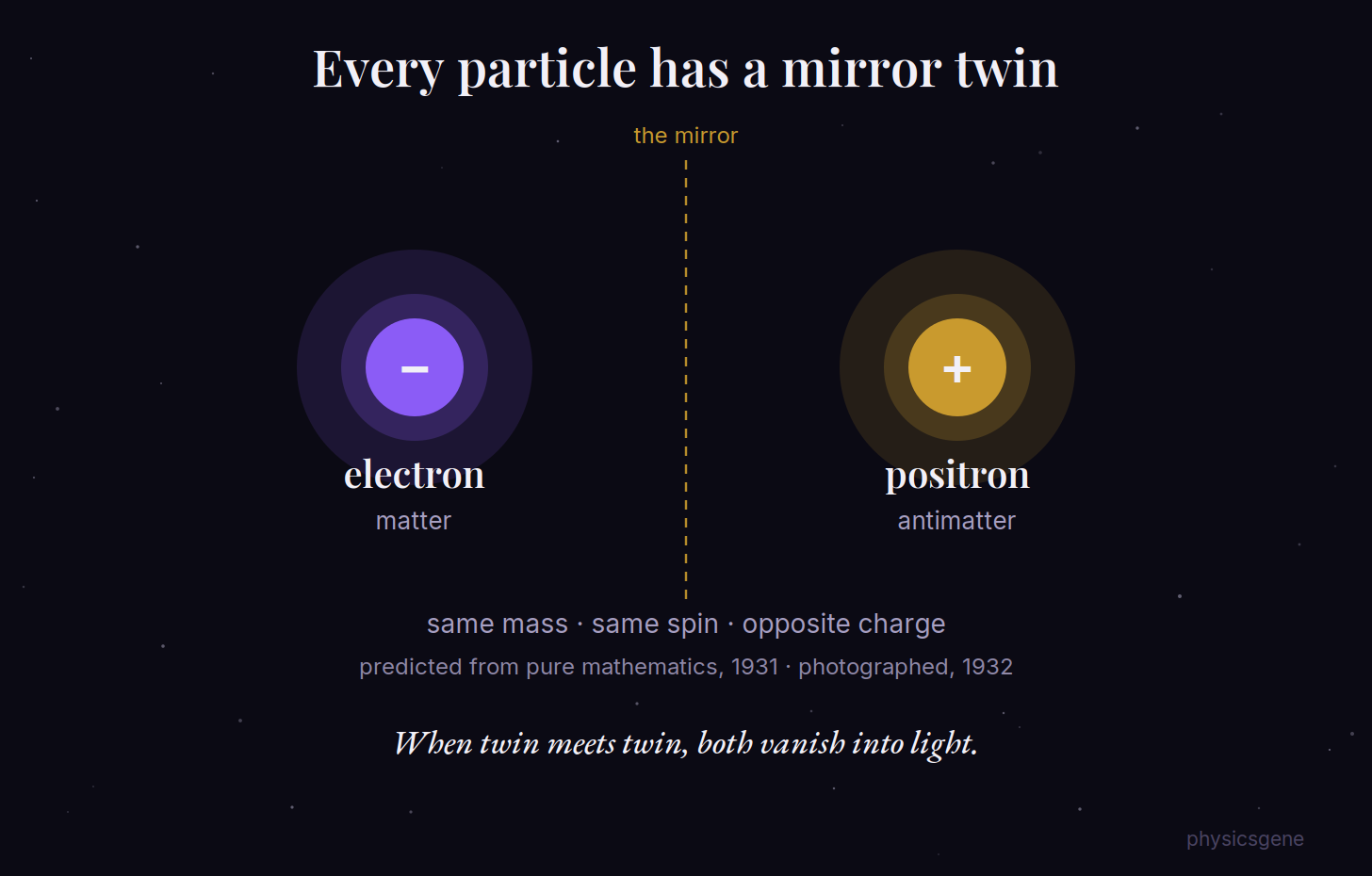
Caption: Same mass, same spin, opposite charge. Predicted on paper in 1931, photographed in 1932. Alt text: A dashed gold mirror line separates a purple electron labeled matter from a gold positron labeled antimatter, with a note that the twins share mass and spin but have opposite charge.
Physics had never seen this before. Until then, theory explained what experiments had already found. Here was a silent man telling the experimentalists what they were going to find, because his algebra left him no other option.
The confirmation came within a year, from someone who wasn’t even looking.
At Caltech, a twenty-six-year-old named Carl Anderson was photographing cosmic rays, the high-energy particles that rain onto Earth from space. His instrument was a cloud chamber, a box of vapor sitting in a strong magnetic field, where a passing particle leaves a thin white trail, curved by the field. Negative particles bend one way. Positive particles bend the other.
In August 1932, one photograph stopped him. A single track crossed a lead plate he had placed across the middle of the chamber, and the curve was gentle on one side of the plate, tighter on the other. Tighter meant slower, which meant the particle had lost energy in the lead, which told him its direction of travel: upward. And once he knew the direction, the bend gave him the charge. Positive. But the trail was far too thin and too long for a proton. Whatever drew that line had the mass of an electron and the charge of its opposite.
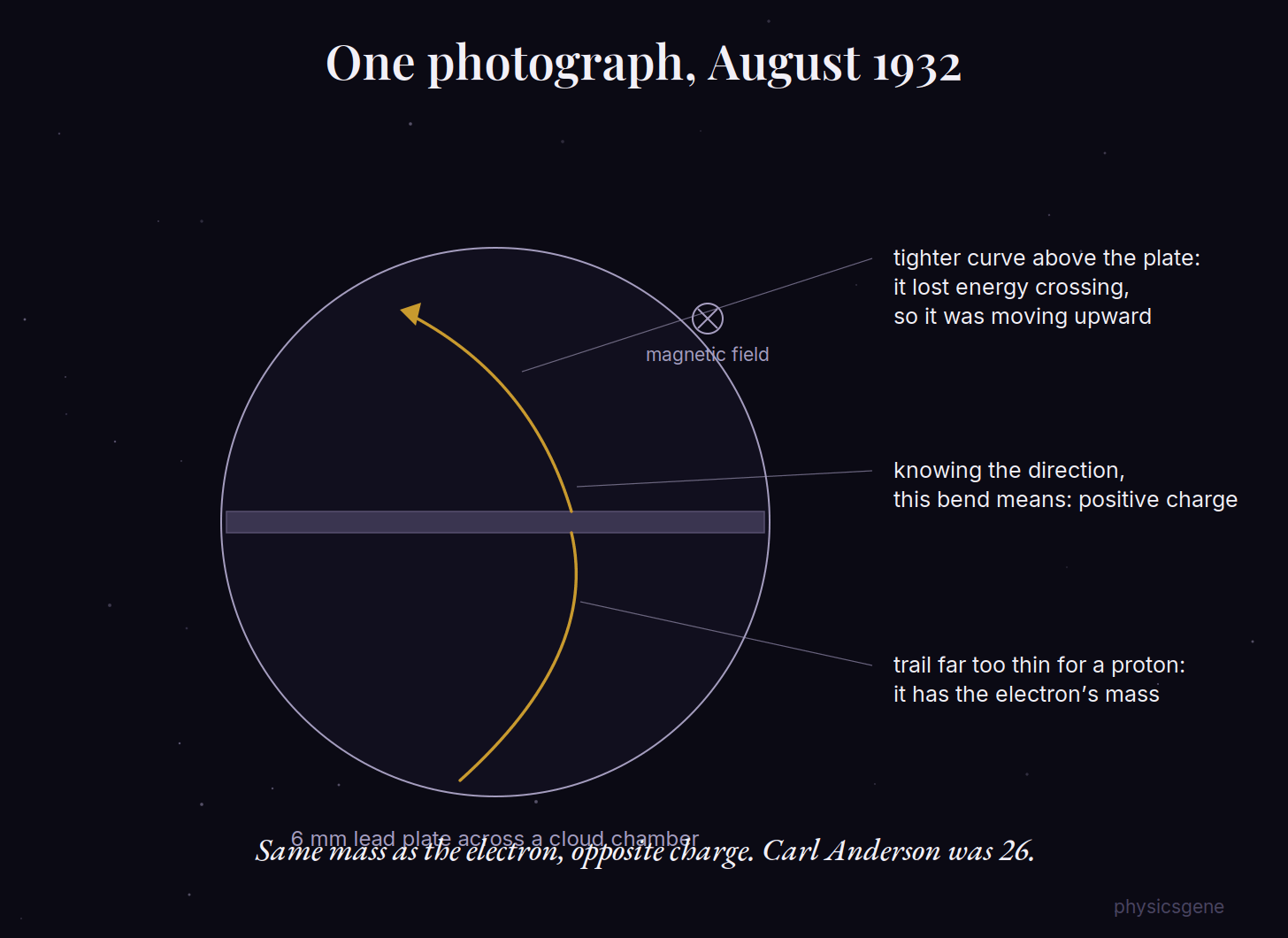
Caption: One curved line, three deductions, one new half of the universe. Alt text: A stylized cloud chamber with a lead plate across the middle and a gold particle track that curves gently below the plate and tightly above it. Callouts explain that the tighter curve means the particle was moving upward, the bend direction means positive charge, and the thin trail means it has the electron’s mass.
One curved scratch on a photograph, and the universe doubled. Anderson later said he hadn’t set out to test Dirac’s prediction at all; the mirror half of reality simply introduced itself. He named the particle the positron, and both men had Nobel Prizes before either turned thirty-five.
Now come back to the hospital, nearly a century later.
The tracer we inject is called FDG. It is glucose, ordinary sugar, except chemists have swapped one corner of the molecule for fluorine-18, a radioactive atom that cannot hold itself together. Every 110 minutes, half of whatever remains has decayed. And when a fluorine-18 nucleus decays, one of its protons turns into a neutron and the nucleus fires out Dirac’s particle. A positron. Antimatter, made fresh, inside a human body.
Why sugar? Because cancer is greedy. A tumor burns glucose far faster than the healthy tissue around it, something the German physician Otto Warburg noticed back in the 1920s. Flood the body with disguised sugar and the tumor hoards it the way it hoards everything. The disguise even jams inside the cell, one chemical step into being burned, unable to go further, so it piles up exactly where the hunger is.
This is also why the instructions sound like superstition. The patient fasts so the tumor is starving. They sit still and silent because working muscle takes up sugar too. Talk through the waiting hour and your voice box lights up on the scan. Shiver, and the strange heat-generating fat along your neck and spine glows like a garland. We are not being difficult. We are keeping the body quiet so the disease is the loudest thing in the room.
Then the physics takes over. Each positron born in the tumor travels about a millimeter, the thickness of a fingernail, before it finds an electron. For a fleeting moment the two can even orbit each other, a bizarre half-matter, half-antimatter atom called positronium, with no nucleus at all and a lifetime measured in nanoseconds. Then both vanish. Nothing breaks into fragments the way things usually break. Their entire mass turns into two photons of light, each carrying exactly 511 kiloelectronvolts, which is the mass of one electron expressed as energy, flying away back to back.
Every PET scanner on Earth is tuned to that same number. A ring of detectors surrounds the patient, and whenever two flashes of 511 arrive at the same instant on opposite sides, the machine draws a straight line between them, because the annihilation must have happened somewhere along it. One line tells you almost nothing. A scan collects millions. And millions of lines, laid over each other, cross densely in one place: wherever the sugar pooled.
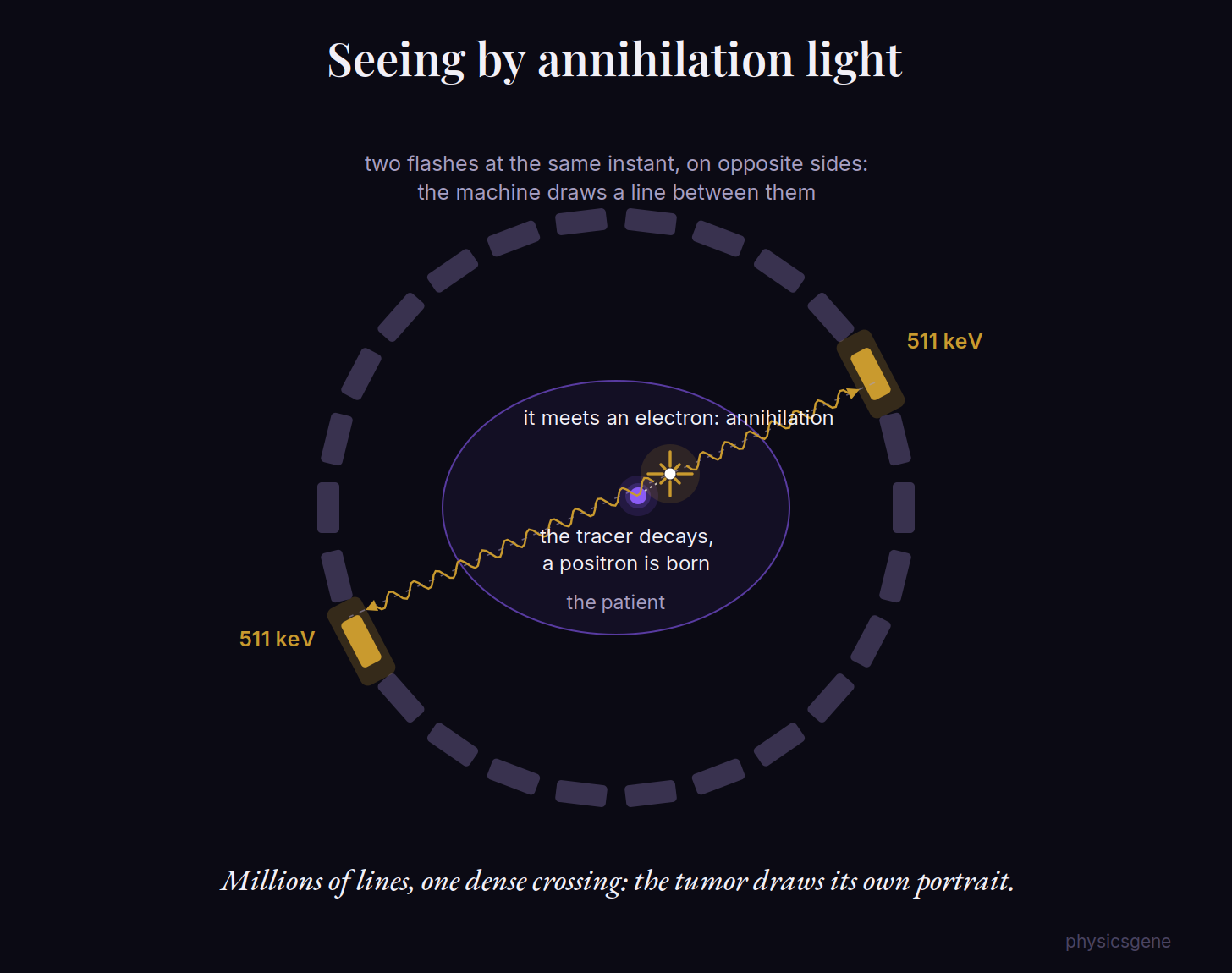
Caption: Two flashes, one line. Millions of lines, one tumor. Alt text: A ring of PET detectors around a patient outline. Inside, a tracer atom decays, a positron hops a short distance and annihilates with an electron in a starburst, and two wavy gamma rays labeled 511 keV fly in opposite directions to two glowing detectors, with a dashed line of response drawn between them.
The tumor draws its own portrait, in annihilation light, line by line. I have tried to write that sentence in a way that sounds routine, and it keeps refusing.
If the word antimatter has you checking the exits, the numbers are almost comically gentle. Add up every annihilation from an entire scan, trillions of them, and the total energy released is under a single joule, roughly the effort of lifting an apple off a table. The tracer’s radiation dose is real but modest, comparable to what the planet’s natural background gives you over two or three years of simply existing. Annihilation is the most complete energy conversion physics allows, one hundred percent of mass into light, and the one place humanity uses it routinely is to find sick cells early enough to matter.
And here is the part I find quietly wonderful. This is not even the only antimatter in the room. Your own body contains a trace of radioactive potassium, and a few thousand times a day one of those atoms decays by firing out a positron. There are tiny annihilation flashes going off inside you right now, unrecorded. Thunderstorms do it on a grander scale; a NASA space telescope has caught beams of positrons rising off the tops of storms. Antimatter is not exotic. It is merely outnumbered.
Which brings me to the question I have been avoiding, the one Dirac’s mirror forces on you the moment you believe it. If every particle has an antiparticle, then the Big Bang, which minted all the matter there is, should have minted the mirror half in exactly equal measure. Equal amounts, guaranteed to meet, guaranteed to annihilate. The universe should be a thin soup of light and nothing else. No galaxies, no planets, no patients, no you.
And yet.
Count the leftover light in the sky against the matter that survived, and the ledger is off by one part in a billion. For every billion twins that met and vanished, a single particle of matter stood alone, unpartnered, and remained. Everything you have ever touched is built from those leftovers. Why even one survived is one of the deepest unsolved problems in physics, and the leading attempts to answer it are stranger than the problem. That is Thursday’s story.
By the time you read this, the morning’s patient is home. Fluorine-18 halves every 110 minutes, so by midnight the antimatter factory in their blood has essentially run out, and the portrait it drew is waiting in a radiologist’s queue. Dirac’s impossible particle, predicted by a silent man who trusted his algebra over his instincts, spent one morning inside a human being, looking for trouble.
Medicine is full of miracles that arrive disguised as paperwork. This one still gets the pause.
Part 2 lands Thursday: The Universe Should Be Empty. Why anything exists at all, told properly. The first half will be free. The ending is for paid subscribers.
No posts
Comments
Nothing yet. Say the first thing.
Sign in to join the conversation.