
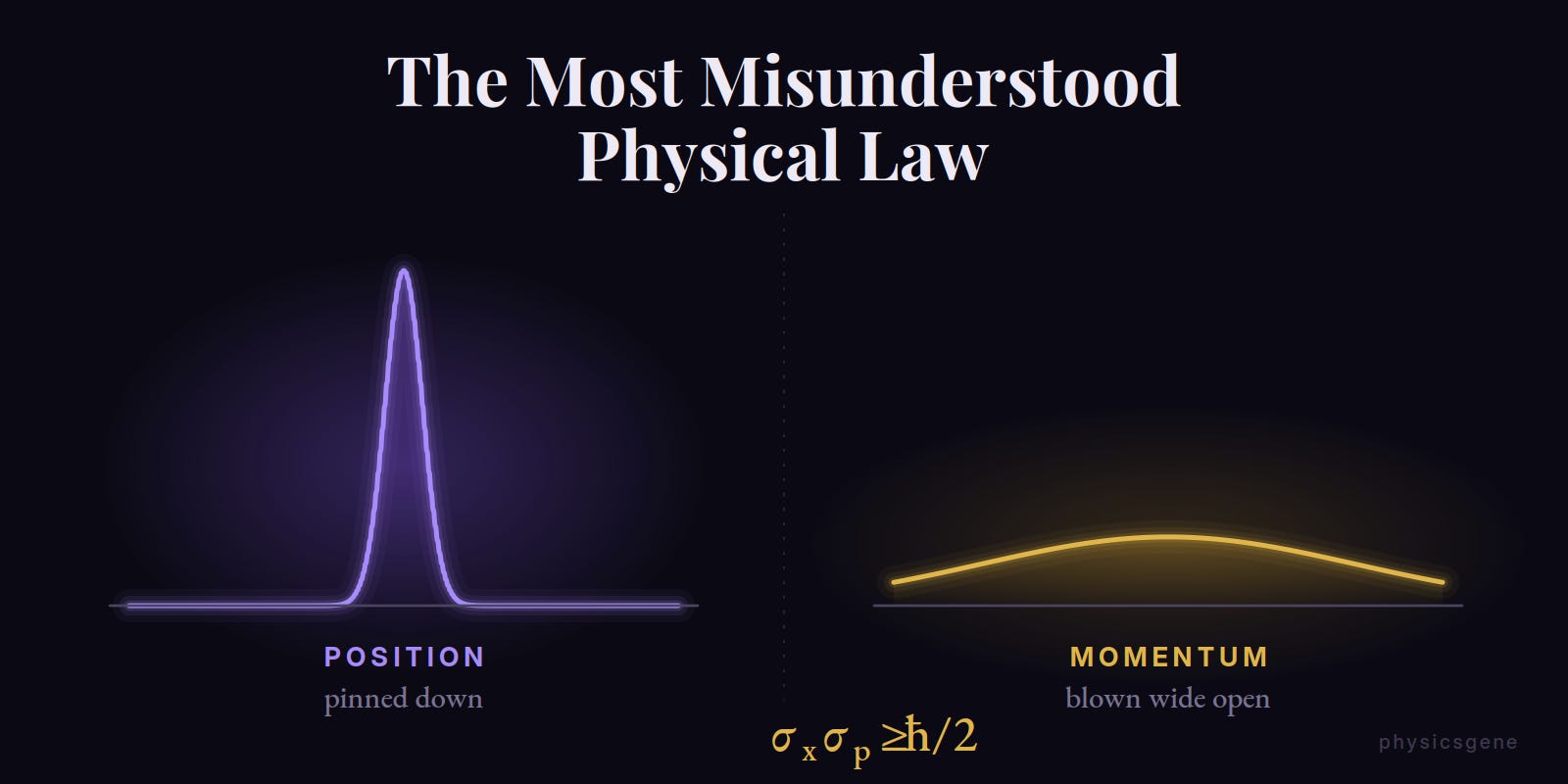
When I used to talk about quantum mechanics to my friends, the Heisenberg uncertainty principle was always brought up and everyone had their own opinion on it. They all sensed its existence in their lives. The uncertainty principle, as most people understand it, is an inverse relation between position and speed. If you knew very precisely the position of an object, you would not know its speed precisely. Also, as the measurement of the position becomes more accurate, the measurement of speed becomes less accurate. The opposite is also true where preciseness in the value of speed would sacrifice that of position. This can be represented easily in Heisenberg’s formula:
Δx Δp ≥ ħ/2
It shocked me at first to see that people claimed to understand this fact since I thought it is fairly complicated. The interesting part is that all people have the same wrong intuition about it. They imagine an object moving very fast, and they imagine trying to know the exact position of the object when making a measurement. Even when I imagine their imagination, I can see how they understand that the error in the measurement becomes higher as the speed increases. What about the opposite? If they are very confident in the accuracy of a position, they imagine a slow object where the speed is not clear now. I am not sure if you had the same intuition before reading this, but I hope you can spot how they perceive the principle.
As lovely as this sounds, in which everyone naturally agrees on the same logic, I am sorry to break it to you, but it is not true. The uncertainty principle is a quantum effect and it is defined only with quantum wave functions and nothing else. As we previously explained, a quantum object has a probabilistic distribution of position and momentum (speed). The uncertainty principle is actually:
σx σp ≥ ħ/2
Assume we have the two following graphs of the wave function squared as a function of position. At each position, the y-axis represents the probability of finding the quantum particle at that position. Now let us compare the two: they are centered at the same point where the center represents the mean in this case. The left graph is narrower than the right one; it has a smaller standard deviation. If we were to make a guess on where the particle is, the most likely option is at the mean. Moreover, if we did a measurement to find the position of the particle, the range of possible results is much more concentrated around the mean in the left graph than the right graph. So, we can say that the mean guess has a smaller error in the left graph than the right graph. In the case where the distribution is a probabilistic one, what can we get in the measurements? The standard deviation is exactly a representation of the error in what we measure. As the standard deviation increases, we are less sure if what we measured is true.
What about momentum? Speed is the derivative of position with respect to time, but a speed probabilistic distribution is not the derivative of a position probabilistic distribution. The momentum distribution is the Fourier transform of the position distribution. The Fourier transform of a vertical line is a horizontal line. Consequently, the Fourier transform of a very narrow and peaked distribution (resembling a vertical line) is a very broad and peakless distribution (resembling a horizontal line). So, because of this mathematical relation of position and momentum, the uncertainty principle exists where a limit of the precision in measuring will always be present between the two.
Short one, but it has a huge concept I think. In my eBooks, this was called the most misunderstood law in physics because of how easy it is to misinterpret such words. For thursday, the natural extension for me is to go a bit philosophical to another very badly understood topic: “what is a measurement in quantum physics”. Full version like always is for paid subs.
No posts
Comments
Nothing yet. Say the first thing.
Sign in to join the conversation.