
Particle physics asks perhaps the most ambitious question in all of science: what is everything made of, and how do those pieces interact?
Look around you. Trees, oceans, mountains, stars, the phone in your hand, the air in your lungs. The visible universe contains an almost incomprehensible variety of stuff. You might expect that explaining all of it would require a vast catalog of ingredients.
But it doesn't. Everything is built from a shockingly small number of fundamental particles.
The Standard Model contains seventeen fundamental particles.
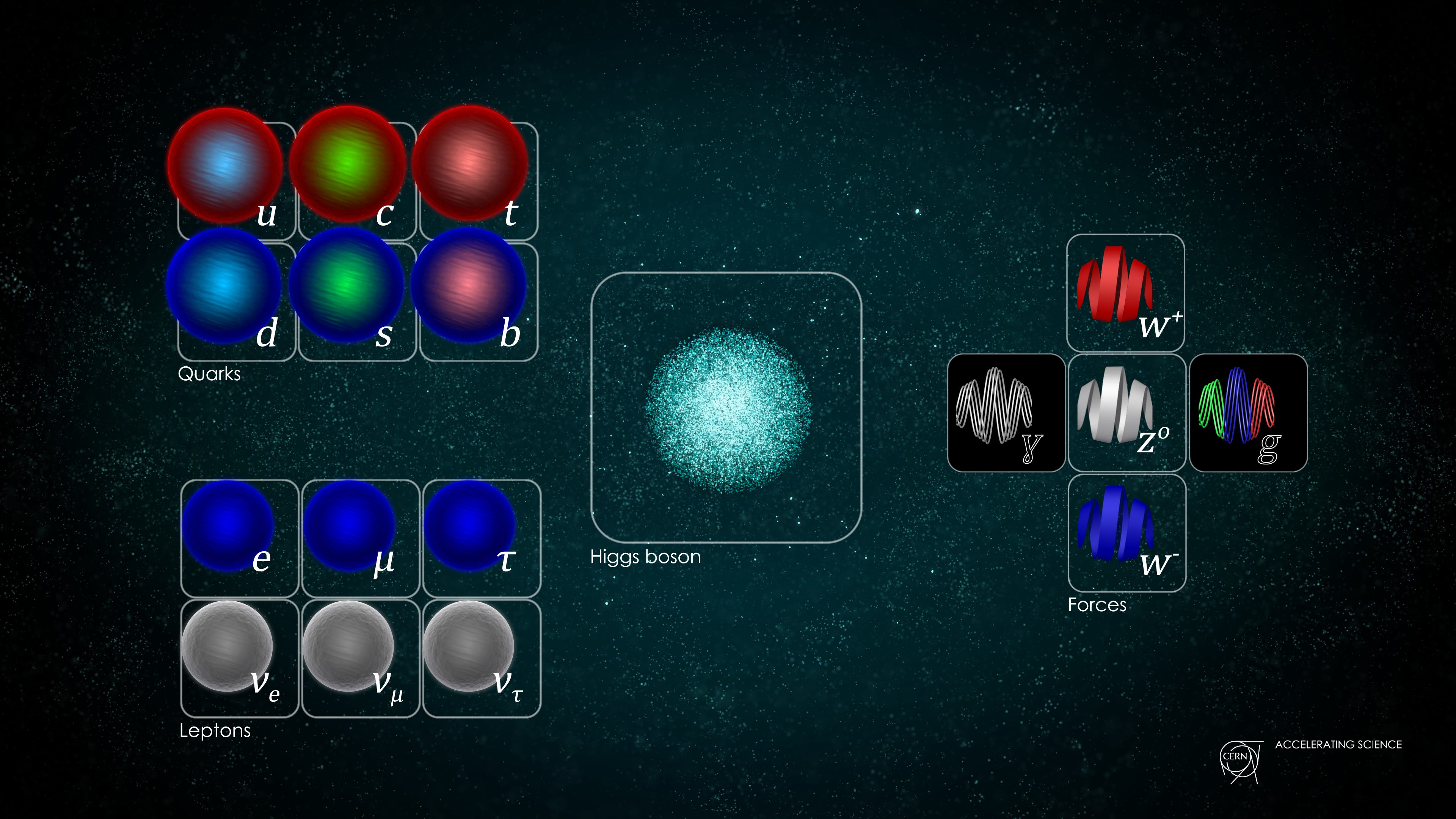
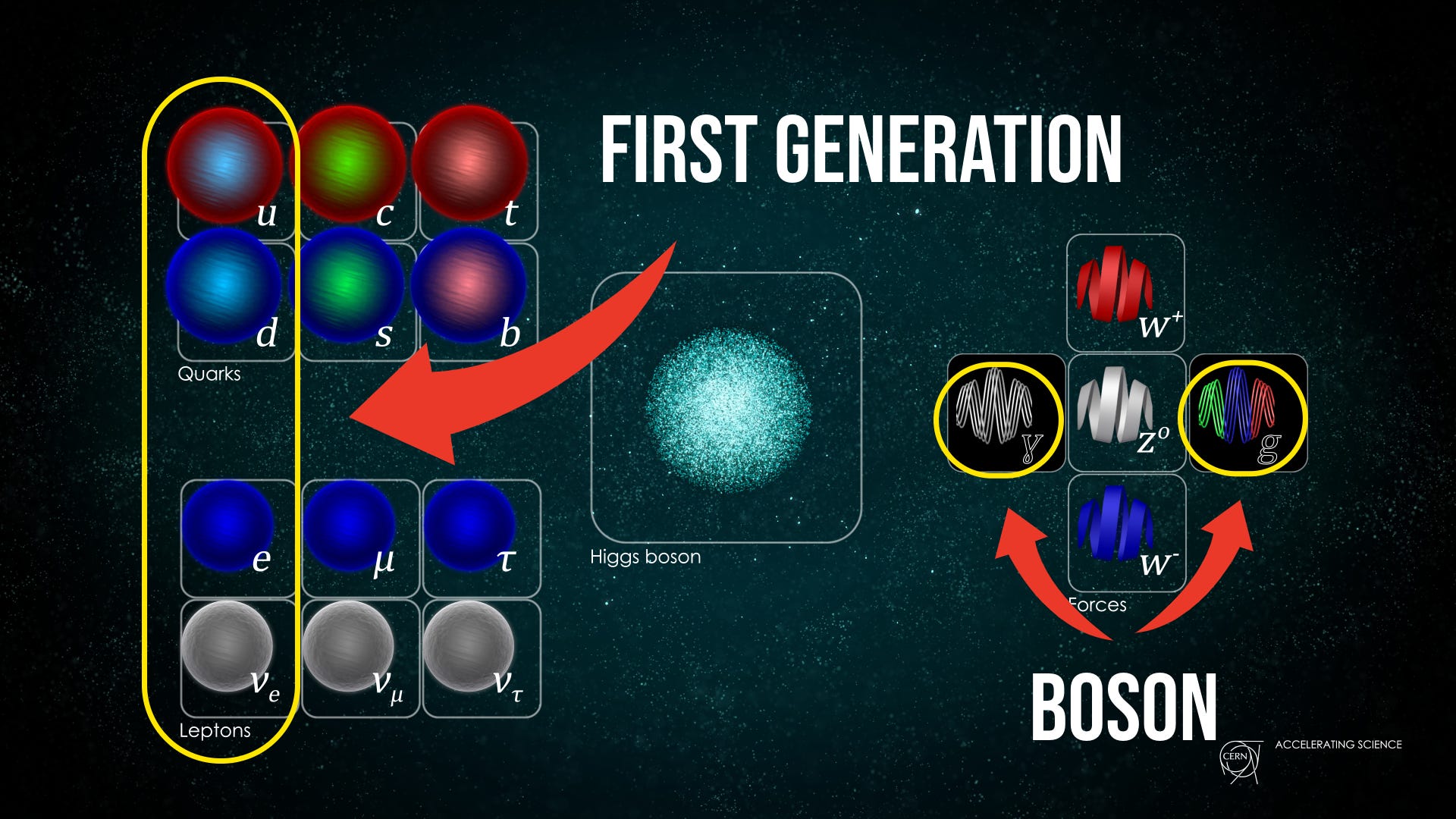
But it gets worse. The stuff you're made of, every atom in your body, every atom in the Earth, every atom in every star you can see, uses only particles from the first generation: up quarks, down quarks, and electrons, bound together by gluons and photons. That's it. Five particles build essentially everything you have ever touched.
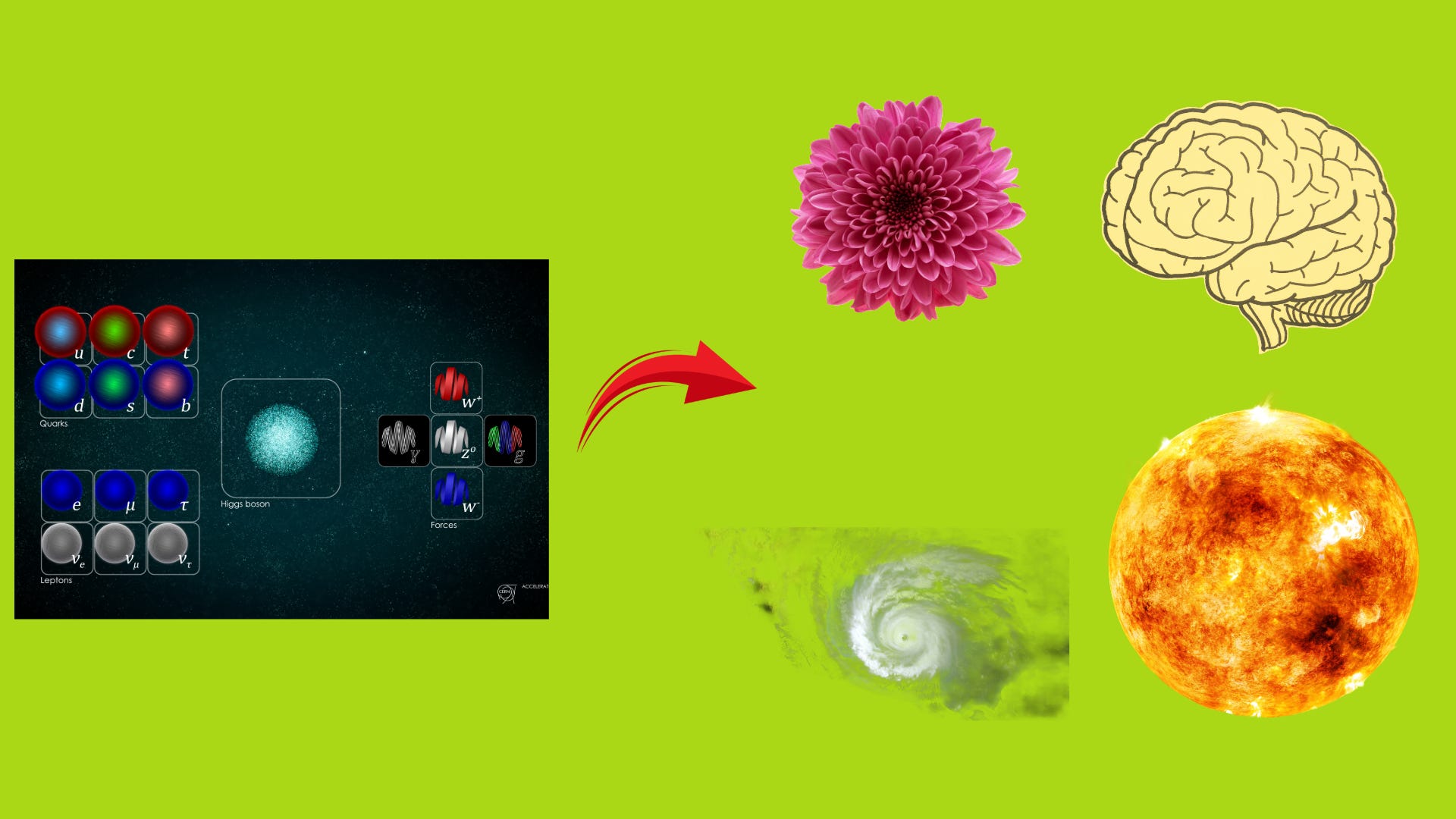
If you're reading this, you're already my kind of audience. I write here on Substack and post companion videos on YouTube. Subscribing is the easiest way to support the work and if you're able to pledge, it makes all the difference.Stop and think about what that means. The human brain, a hundred billion neurons firing in concert, conscious and aware. A star, burning for billions of years. A flower. A hurricane. All of it, every bit of it, is just these five particles arranged differently. That should sound crazy. It is crazy. And it's true.
Here is a fact so strange that it's easy to gloss over: every electron in the universe is identical. Not similar. Not approximately the same. Identical. You cannot put a scratch on an electron. You cannot dent a quark. There is no serial number stamped on a photon.
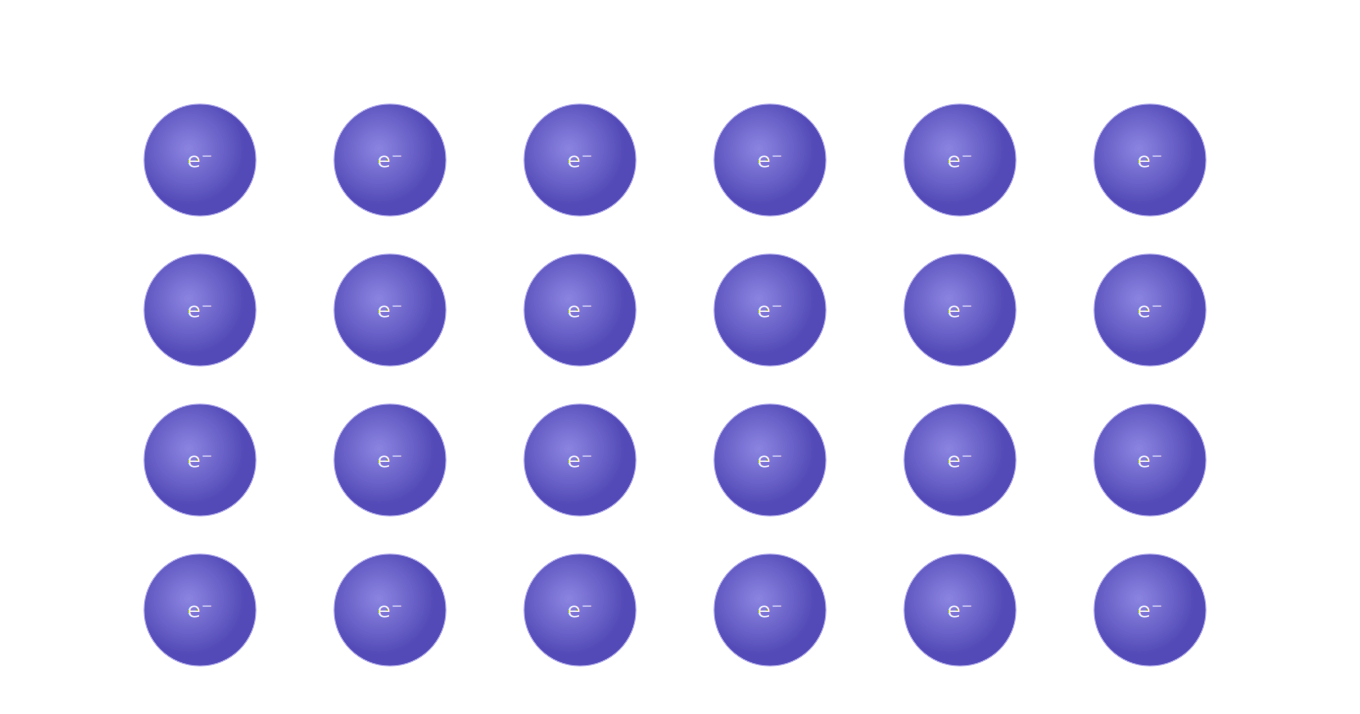
This is radically different from the everyday world. No two grains of sand are alike. No two snowfalkes are alike. But subatomic particles are manufactured, so to speak, from a single blueprint with zero tolerance for defects. Swap any electron on Earth with any electron in the Andromeda galaxy, and the laws of physics won’t notice.
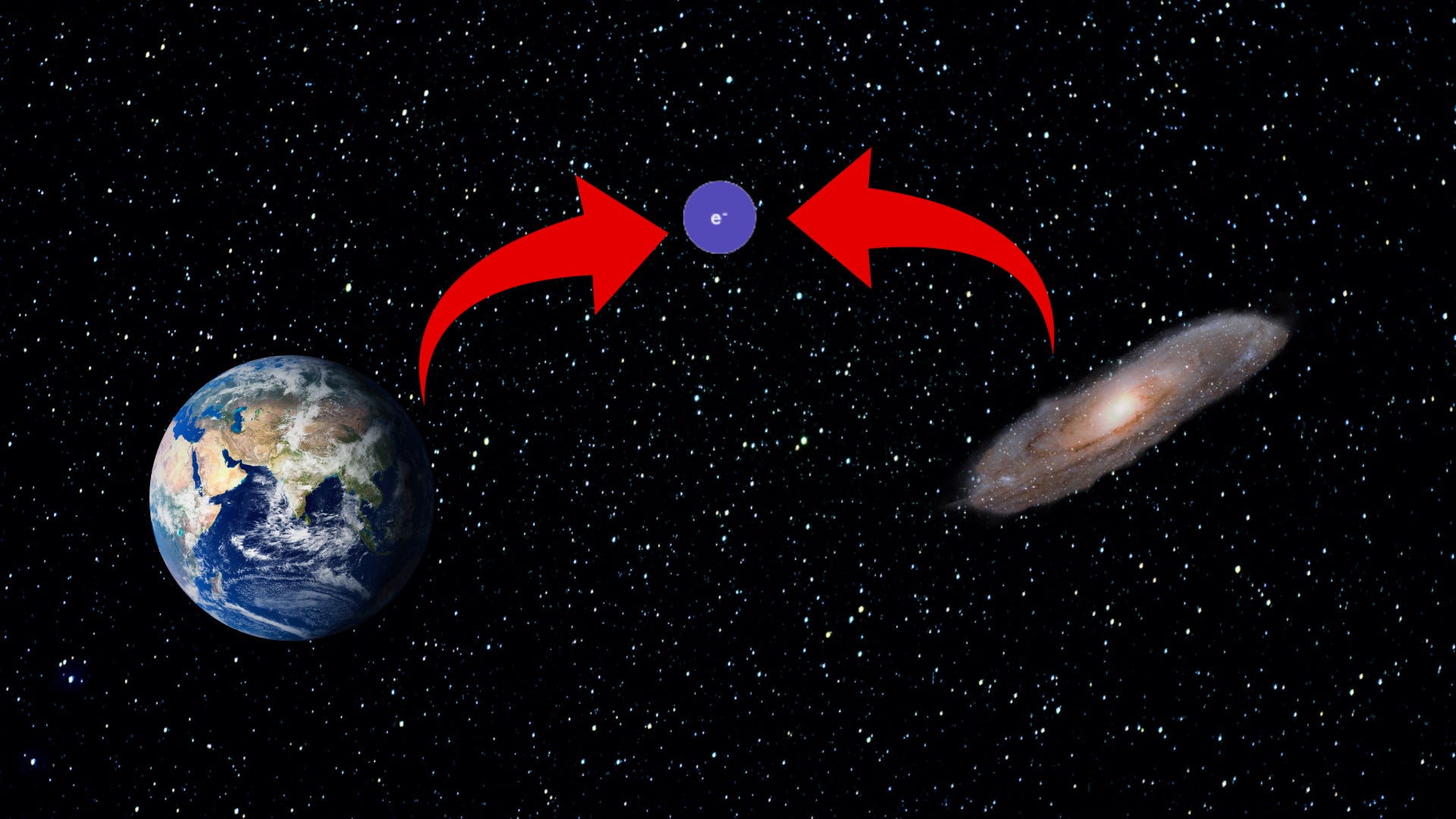
Because particles are perfectly identical, the laws we derive in a laboratory in Geneva apply equally on the surface of a neutron star. Indistinguishability is what makes universal laws possible. Without it, physics would be different in different parts of the universe, depending on whether your local electrons were a little fatter or a little lighter or slightly lopsided. There would be no universal laws. This indistinguishability is the founding miracle of the field.
For most of human history, understanding a force meant watching things interact. Hold a magnet near iron filings, and you see the field. Drop a ball, and you feel gravity. The method was empirical and direct: bring objects together, observe what happens, write down the pattern.
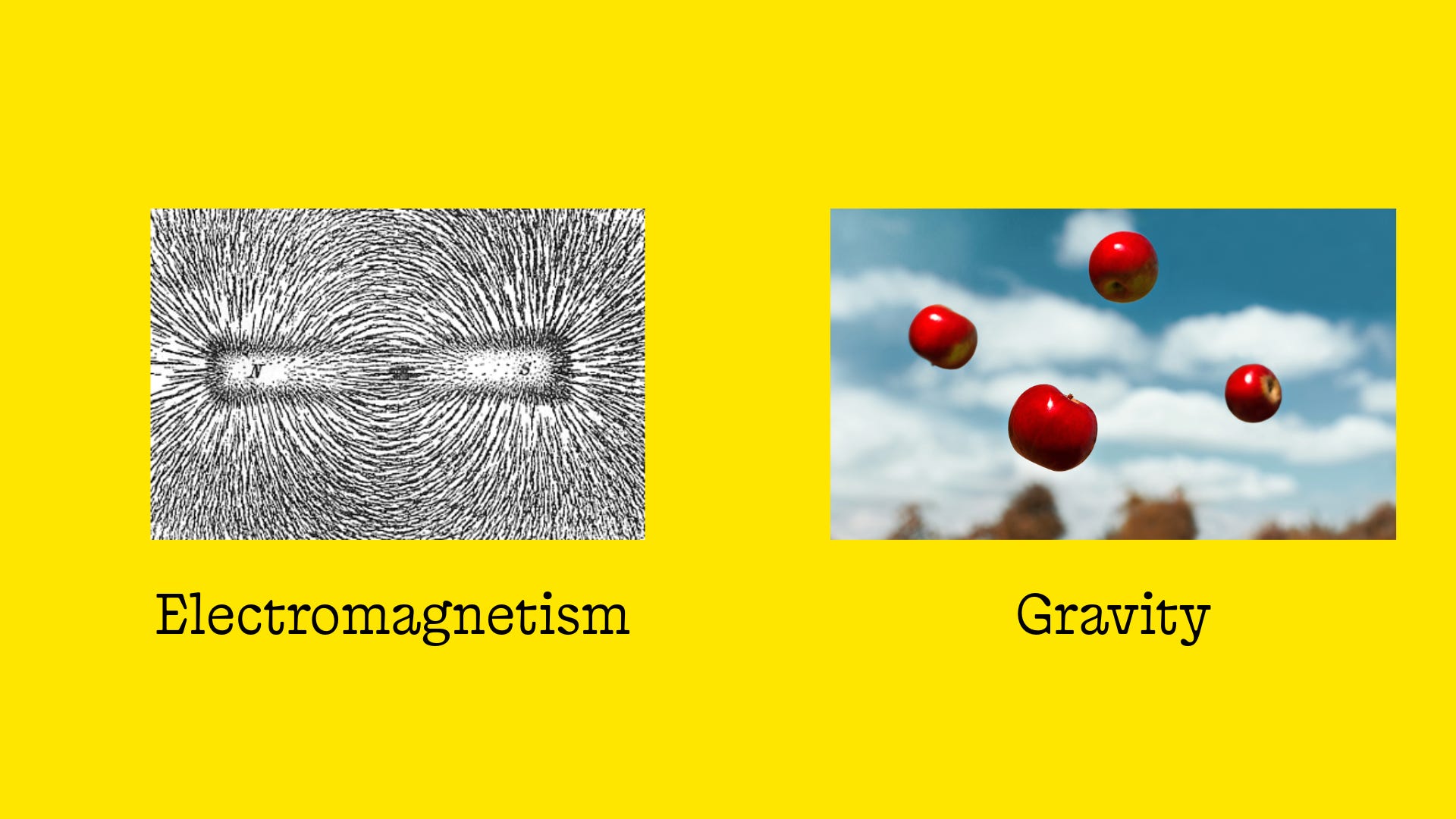
This strategy collapses at the subatomic scale. You can’t hold a quark in each hand and push them together. You can’t isolate a single gluon and poke it. The interactions are too fast, too small, and too quantum-mechanical to observe directly in the classical sense.
So particle physicists had to invent a completely different approach: guess the theory first, then check if nature agrees. But how do you make an educated guess about laws you cannot see?
Symmetry. Instead of asking “what does this force do?”, you ask “what transformation leaves the physics unchanged?” Every symmetry constrains the theory. Enough symmetries and the theory practically writes itself.
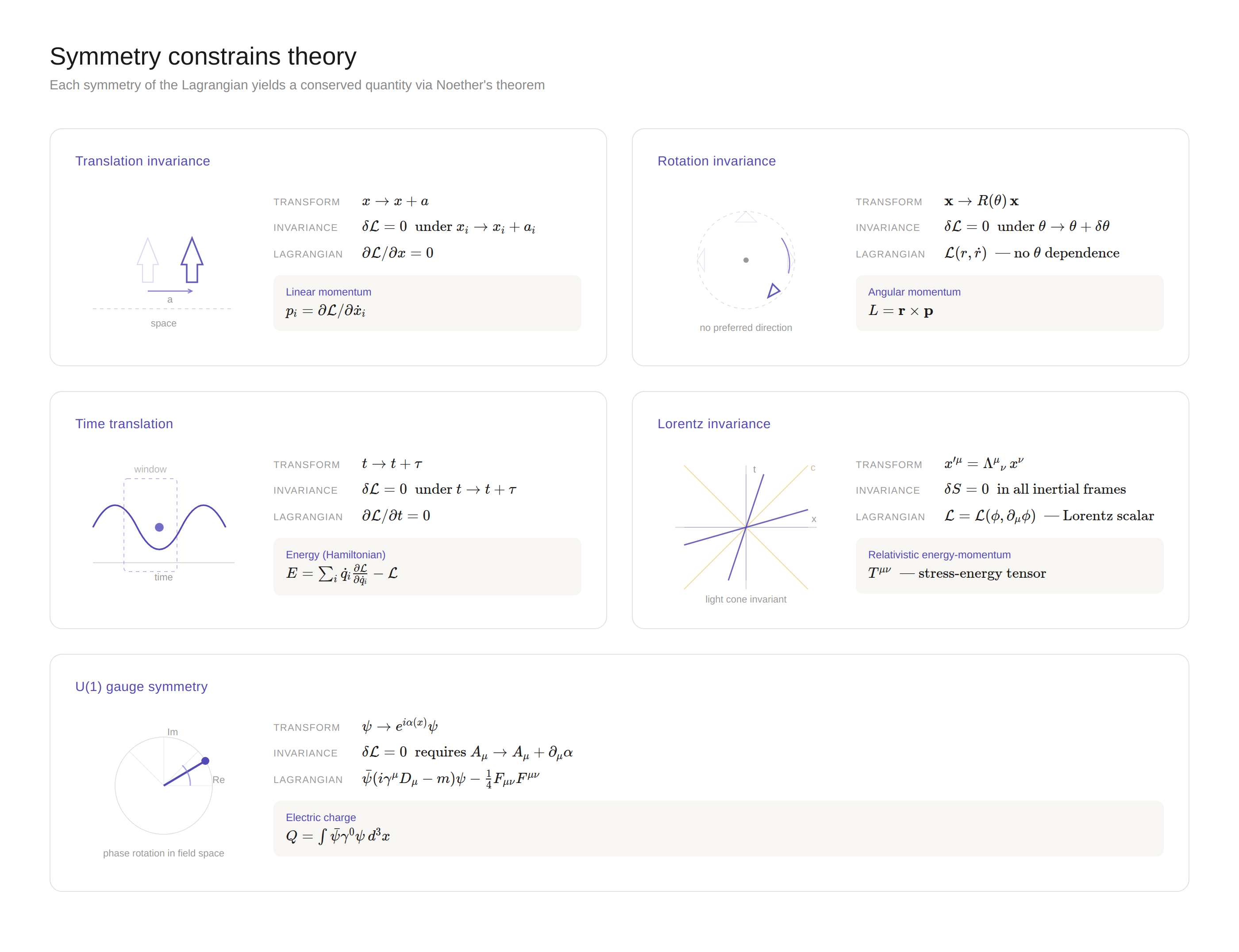
This is the profound insight behind modern particle physics. The structure of the Standard Model was not just discovered by looking at forces; it was deduced from the symmetry group
\(SU(3) \times SU(2) \times U(1)\)
Each group gives you a force. The representations tell you which particles feel which force. The mathematics of group theory replaces the experiment of pushing things together.
This leads to Noether’s theorem, which we will talk about in some other blog post. Noether’s theorem tells us a connection between symmetries and conservation laws. It takes a lifetime of education to learn to make such an educated guess, but this is the big picture.
Now for the framework. In physics, the tool you use depends on what you're studying. Big, slow objects? Classical physics. Fast objects, approaching the speed of light? Special relativity. Tiny objects, at the atomic scale? Quantum mechanics. But subatomic particles are both fast and small. So you need to combine quantum mechanics and special relativity. That combination is called quantum field theory.
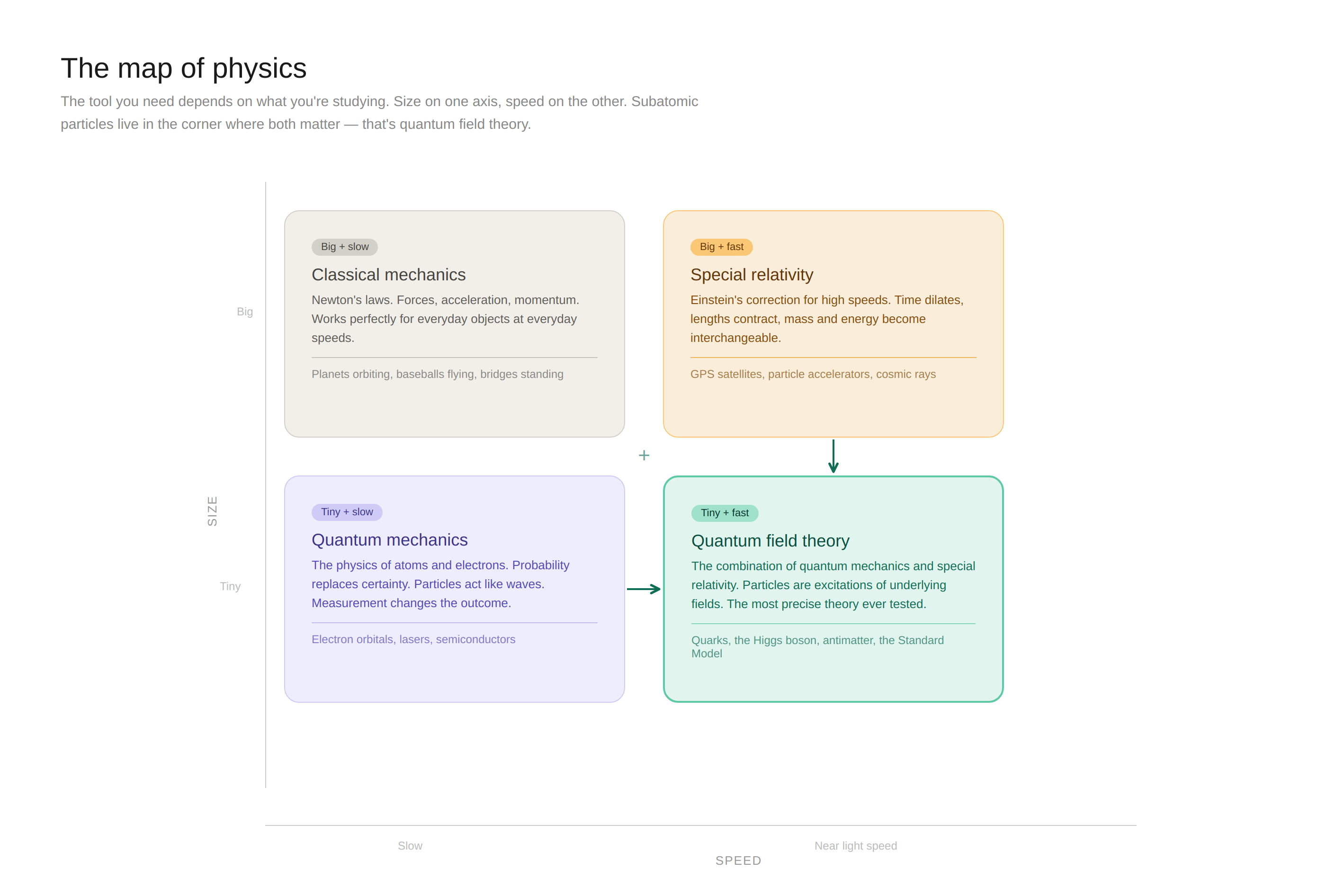
And this combination changes everything. Once you put quantum mechanics and special relativity together, you’re forced into conclusions nobody asked for. Antiparticles have to exist. Particles can be created and destroyed. Even empty space isn’t really empty; it’s full of fluctuations that pop in and out of existence. None of this was put in by hand. It all falls out of the math.
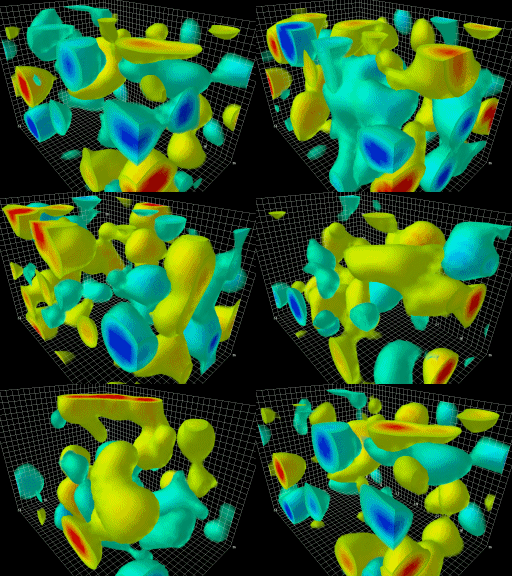
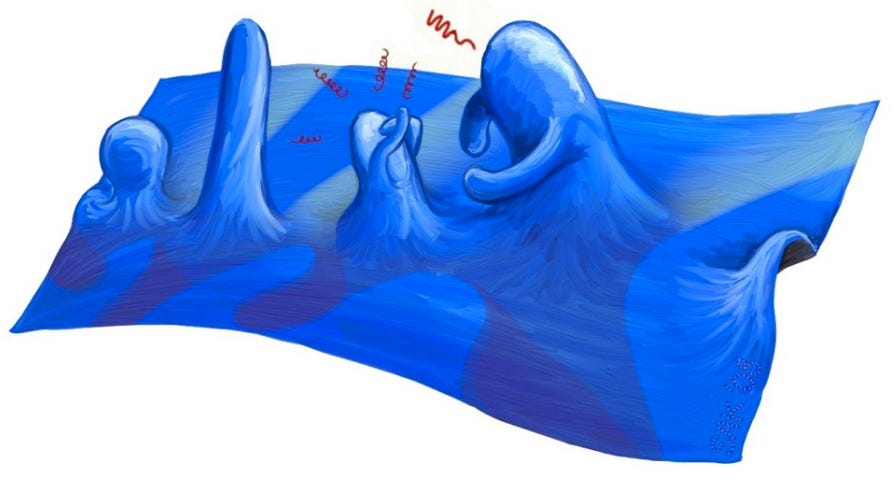
In QFT, particles are not little billiard balls sitting inside a proton waiting to be knocked out. They are excitations of fields that fill all of space. The electron field, the quark field, the photon field, they are always there, everywhere. A particle is just a ripple in the right field.
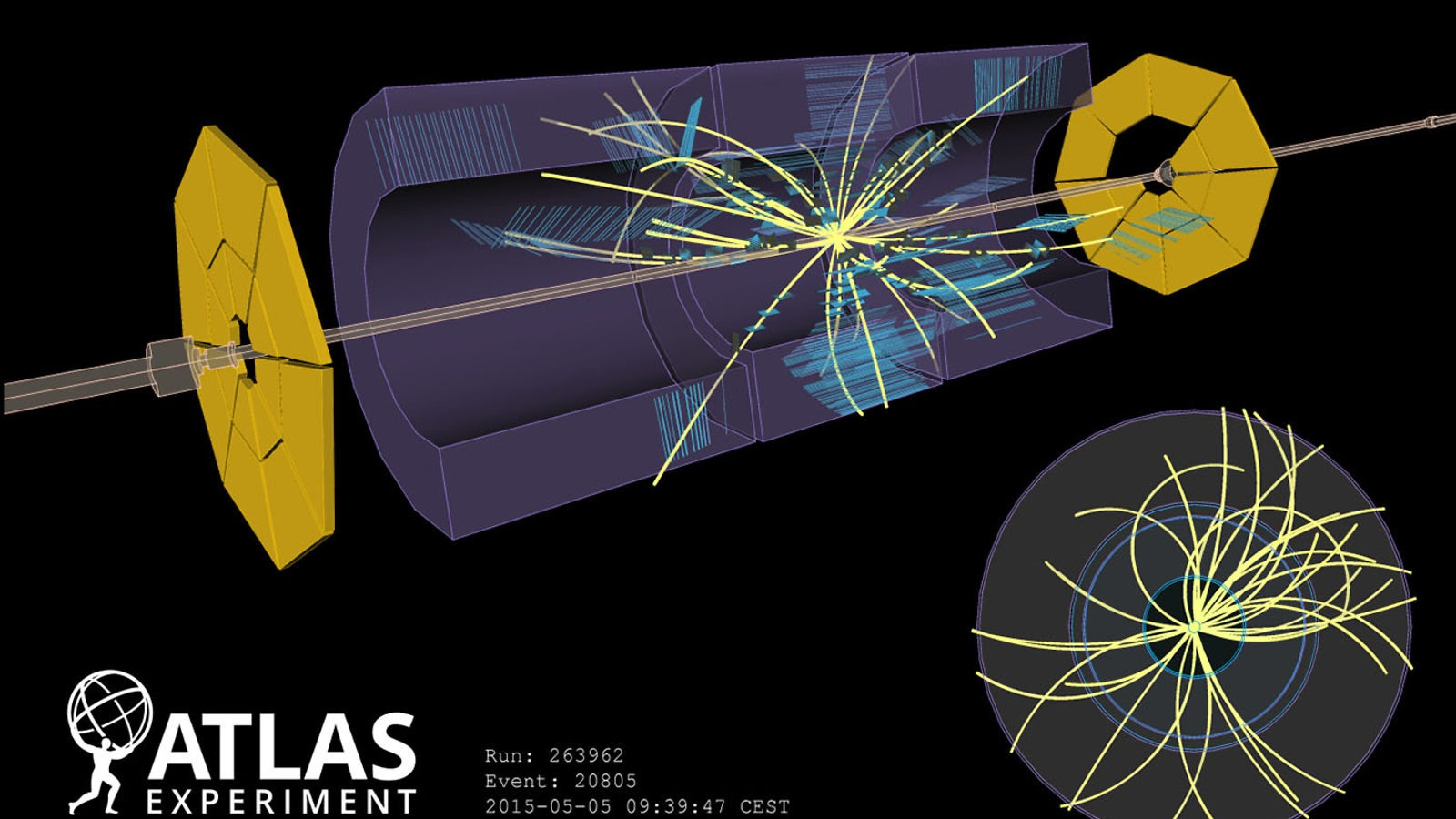
When two protons collide at the LHC, we are not cracking them open and finding stuff inside. We are concentrating enough energy in a tiny region of space that the fields themselves get excited into new vibrations. That is what a "new particle" is. It wasn't hiding in there. It was created from the energy of the collision.
Quantum field theory isn't just one approach among many in particle physics; it's the framework the whole field runs on. Every calculation, every prediction, every comparison with experiment is done in QFT. It's the mathematical foundation on which the Standard Model is built.
If you want to learn more about the Standard Model in plain language, consider subscribing, and if you can, a pledge helps me dedicate more time to writing and keep the blog going.
If you're reading this, you're already my kind of audience. I write here on Substack and post companion videos on YouTube. Subscribing is the easiest way to support the work, and if you're able to pledge, it makes all the difference.
No posts
Comments
Nothing yet. Say the first thing.
Sign in to join the conversation.