
For many years, I believed that leadership advancement worked in a fairly straightforward way.
You did excellent work. You took responsibility. You became the person others could count on. Over time, the right people would notice, and more significant leadership opportunities would follow.
That belief carried me through the early years of my own leadership journey. I worked hard, said yes often, and stepped into the roles I was asked to take on. When something needed to be done, I did it. When a problem needed to be solved, I helped solve it.
That approach helped me become a strong physician and a reliable leader. It also opened the door to my first leadership opportunities.
But at a certain point, it was no longer enough.
I began to see that the people advancing into more influential positions were not always working harder or contributing more. They were often better known by the people making decisions. Senior leaders understood what they were capable of and how they could contribute at the next level.
Meanwhile, I was still assuming that my work would speak for itself.
It took me time to understand that the strategy that helps you become a respected early leader is not necessarily the strategy that moves you into advanced leadership.
Many accomplished women physicians are never told this.
They are invited to lead a committee, direct a program, or take responsibility for an important area of work. They approach that opportunity the same way they have approached everything else in medicine. They prepare carefully, deliver excellent results, support their colleagues, and accept additional responsibilities when asked.
Then they continue doing more of the same, expecting that their performance will naturally lead to the next role.
Sometimes it does. Often, it does not.
When the promotion goes to someone else, many women immediately begin looking inward. They think that perhaps they need another credential, more experience, or a few more years to prove they are ready.
I understand that response because I had it too.
What I eventually learned was that advanced leadership requires more than competence and commitment. It requires understanding how decisions are made inside an organization. It means building relationships beyond your immediate circle, making your leadership interests known, and ensuring that influential people understand the value of your work.
Most physicians are taught almost nothing about this.
We learn how to care for patients, teach, and lead teams. We may attend leadership courses that focus on communication styles, emotional intelligence, or managing conflict. Those skills matter, but they do not help one become a serious candidate for a director, vice president, chief, chair, or other senior role.
Last week I wrote about how those leadership selections are often influenced long before a position is posted. People are already forming impressions about who is ready, who has influence, who can think beyond their current responsibilities, and who has the support of respected leaders. If the people having those conversations do not know your work, understand your aspirations, or see you operating at the next level, clinical excellence alone may not place your name on the list.
Learning this changed the way I approached my own leadership.
I became more intentional about relationships, influence, visibility, and positioning. I learned that I needed to give other people enough information to understand what I had accomplished and what I was prepared to do next.
Those shifts eventually helped me move into increasingly significant leadership roles and, ultimately, serve as the fifth woman president of the largest state medical association in its more than 160-year history.
I did not become more hardworking or more deserving during that process. I learned how to navigate a part of leadership that had never been explained to me.
That distinction matters.
When advancement has stalled, the most useful response may not be to work harder or collect another qualification. It may be to step back and look at your current strategy.
Who understands the impact of your work?
Who knows what kind of leadership role you want next?
Who could speak about your readiness when you are not in the room?
And are your current responsibilities helping others see you as prepared for broader leadership, or are they simply making you the dependable person who takes on more work?
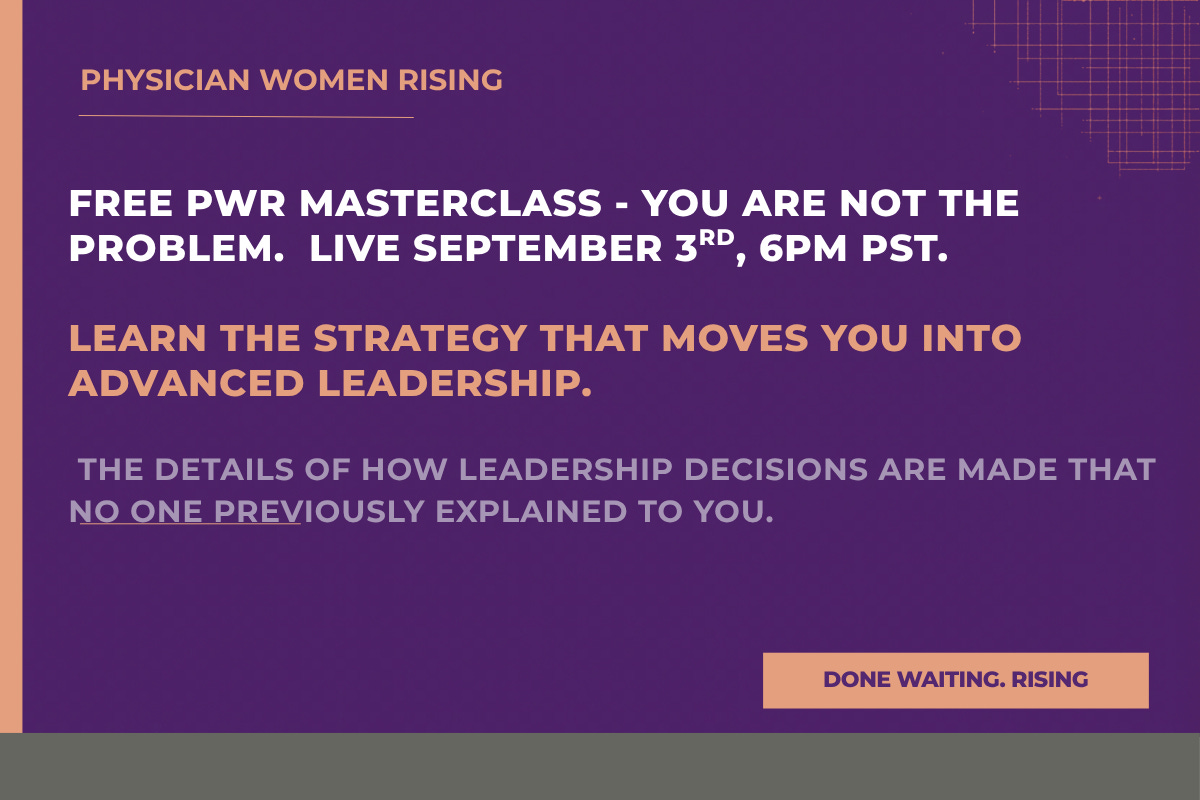
These are some of the questions we will explore in my free live masterclass, You Are Not the Problem, on Thursday, September 3, 2026, at 6:00 p.m. Pacific and 9:00 p.m. Eastern.
During our 90 minutes together, I will explain how advanced leadership decisions are actually made and introduce the first strategic moves you can make to become more visible, influential, and intentionally positioned for the roles where you can have the greatest impact.
You do not need to arrive with a perfect plan. Come with your questions, your experience, and the sense that your current approach may no longer be getting you where you want to go.
We will begin there.
Save your seat for the free masterclass → REGISTRATION LINK
Shannon
No posts
Comments
Nothing yet. Say the first thing.
Sign in to join the conversation.