
July: Always my least favorite month, a month of heat and slowing down. People go on vacation in July; I remind myself this when I refresh my email inbox and notice the lack of response. It’s a good month to retreat and get some summer reading done.
Books
1. Foam, Kate Zambreno
Generally, I’m a fan of Zambreno’s books, which bend the definition of fiction and non-fiction and transform their prose into something in-between. This novel, her latest—it’ll be published in September—meandered a little more than I would have liked, but with its shifting sense of space and interest in the domestic sphere, it feels like a spiritual sequel to her 2020 novel Drifts.
2. One Way Street, Walter Benjamin (translated by Edmund Jephcott)
Of course I liked this, it’s a fragmentary collection of newspaper feuilletons with a focus on cityscapes written by Benjamin. It’s perfect.
3. Anita Brookner: Art and Life, Hermione Lee
Fascinating biography of the British writer and art historian Anita Brookner, who won the Booker in 1984 for Hotel du Lac, written by the legendary biographer Hermione Lee (whose magnificent Virginia Woolf biography has been a great source of comfort and interest to me over the years). I hadn’t read any Brookner before reading this, but it prompted me to read Hotel du Lac last month, the first half of which I finished while sitting at a hotel bar upstate (thematically appropriate!). This biography is forthcoming in October.
4. Look at Me, Anita Brookner
My second Brookner novel, this one centered around a London writer who finds herself drawn into an attractive married couple’s inner circle. There are some great lines about writing in it, such as this towards the end: “No immediate plans, but then, when one is a writer, one does not have the same plans as other people. One is not expected to. One is, let it be remembered, an observer, an unblinking eye recording what is thought, at the time, to be unremarkable. These scenes, these actions, to be retrieved, at a later date, intact. No blame attaching, of course. Able to see the funny side.”
5. Time Travel: A History, James Gleick
A super-interesting popular history about the idea of time travel as a cultural fascination—I had no idea that it’s a relatively recent subject of interest and didn’t appear much in literature or in the popular imagination before H. G. Wells’s The Time Machine (which I haven’t read since I was a kid). A great book with which to whittle away an afternoon or evening.
6. My Year in Paris with Gertrude Stein: A Fiction, Deborah Levy
We’re in a bit of a Gertrude Stein moment, aren’t, between this, Lauren Elkin’s forthcoming book on her, and the Francesca Wade biography that came out last year? Of all the Modernists, Stein is the one whose work I’ve never really quite clicked with, but I very much enjoyed this winking, meditative novel (initially, I thought it was another one of Levy’s memoirs, in the same vein of 2018’s The Cost of Living) following a writer in Paris working on a long piece about Stein and the two women—a French woman who works in finance and has a lot of polyamorous lesbian affairs, and a Danish graphic novelist who’s in a long-distance relationship with her American husband in Seattle and who loses her cat—who live in her apartment building and befriend her. It came out in June.
7. The Information: A History, a Theory, a Flood, James Gleick
This popular history about the rise of information technology in the twentieth century ends up covering a lot of the same territory that Gleick later returns to in The Telephone, his history of telecommunications forthcoming from FSG this November (and that I read back in May). The day after I read The Telephone, I had an interesting conversation with a mathematician at a friend’s wedding about the impact of A.I. on our respective fields. More recently, at the end of July, there was another flurry of claims from OpenA.I. that its models had solved several high-level problems, and my Twitter algorithm for some reason has served me a lot of melancholy posts about this. And yet, A.I. still can’t—will never—create a piece of writing that is original, engaging, and has something to say, because the computer lacks interiority and writing hinges on the internal, the ambiguous. A win for the humanities, I have to remind myself, especially when I read things like this Atlantic cover story from July about how apparently no one is reading anymore in the U.S. The A.I. backlash—already bubbling away in certain pockets—can’t come soon enough.
8. Life of M, Rachel Cusk
With the Outline trilogy onwards, Cusk has cast a steely eye towards reality versus mimesis. In the Outline trilogy, she did this with an eye towards writing and literature, and the books featured an autofictional writer main character; in 2024’s Parade (maybe my favorite of hers, or at least this later stage of her work), she examined this question through the context of the visual arts. Now, in Life of M, forthcoming at the end of August, she returns to this via an actress, one that the internet and a particular review have been speculating is based on Natalie Portman (it seems likely, but honestly, who cares). In this cultural moment in which we are constantly refashioning our identities online in imitation of the actors and actresses we fawn over as celebrities, it’s an inspired authorial choice. The book is chilly, thought-provoking, and uncomfortable. I loved it.
9. Crossing the Wine Dark Sea: Journeys Through Ancient Literature, Emily Wilson
I haven’t seen Christopher Nolan’s The Odyssey yet, but it seems like a fun summer popcorn interpretation of the epic poem. The primary translation Nolan drew on for the screenplay was Wilson’s. This is a great, approachable collection about the task of translating an alien world and language—the ancient Greeks—into our own.
I wish all the assholes online who keep crossing over into my Twitter feed whining about Wilson’s translation would read this book, because it becomes very clear that her translation of The Odyssey is very much a restoration of a truer, sparer, more brutal Odyssey than, say, the more-fanciful Alexander Pope version. A few days ago, I had the misfortune of stumbling across a long-winded thread by some pompous guy in the tech-finance spheres claiming that he had created a better translation than Wilson via Claude, and it really upset me. Sorry to be grouchy, but this kind of unfounded arrogance that’s been emanating from those corners in regards to artificial intelligence really drives me mad. Back to the book: the essay on translating Sappho in this collection is also really fun, and I especially found Wilson’s thoughts on the use of white space as deployed by the poet (and trained classicist) Anne Carson in her own translations of Sappho to be very interesting.
10. The Past Pursues Us Like Detectives, Debt Collectors, Thieves, Juan Pablo Villalobos (translated by Daniel Hahn)
This short novel about a man returning home to Mexico after a long time abroad came out towards the end of July from And Other Stories, which is such a great small press and is really publishing some of the most interesting new releases out there right now. Something that stood out to me in this novel: the way Villalobos compresses and expands time on the page within the span of a fistfight between two old friends.
11. The Sculptor in Exile, Krishna Baldev Vaid (translated by the author)
I had a copy of this Penguin collection of short stories by the twentieth century Hindi-language writer Krishna Baldev Vaid lying around on my Kindle (not sure where it came from), and I picked it up on a rainy weekend. There’s a formally-experimental bent to a lot of the stories that I enjoyed, particularly one about the relationship between rag-picking and writing.
12. Smoke, Ivan Turgenev (translated by Donald Rayfield)
My summer of Turgenev continues! Of the three I’ve now read—First Love in May and Fathers and Sons in June—I think this one, released by NYRB in a new translation last month, is my favorite. If Fathers and Sons controversially questions if Russia will ever free itself from a push-pull cycle of political progress and nihilistic backlash, this novel, about a man who abruptly abandons his fiancée in order to pursue a mirage from his past, goes even further, and dares to ask if Russians are emotionally and morally capable of love. I’m exaggerating and writing this in jest, but apparently Tolstoy hated this book and claimed that Turgenev “loved only fornication, not his country” (I’m quoting from the book’s back description), which is quite an insult! I read this book on an Amtrak train leaving New York, which felt somewhat appropriate to its bath town setting (though I wasn’t going to an American equivalent of Baden-Baden, sadly).
Film
No Picnic, directed by Philip Hartman
Very fun! A lo-fi, rambling sort-of mystery set in and filmed around the East Village in the eighties. It’s also a film about growing up, change, gentrification and how it impacts the artists and the weirdos, and at what point the party, so to speak, is over. This was showing at Film Forum.
Toute une nuit, directed by Chantal Akerman
I saw this Akerman film, which follows a series of intersecting and unrelated city dwellers over the course of one night in Brussels, on the Fourth of July. One narrative thread I loved: a woman who leaves her suburban house after her husband falls asleep, goes into the city, wanders around with a suitcase, falls asleep in a hotel, and then returns home and to bed before her husband wakes up. When I left Metrograph after the film was over, the night was still relatively early, but it was dark enough that the fireworks had begun.
Can She Bake A Cherry Pie?, directed by Henry Jaglom
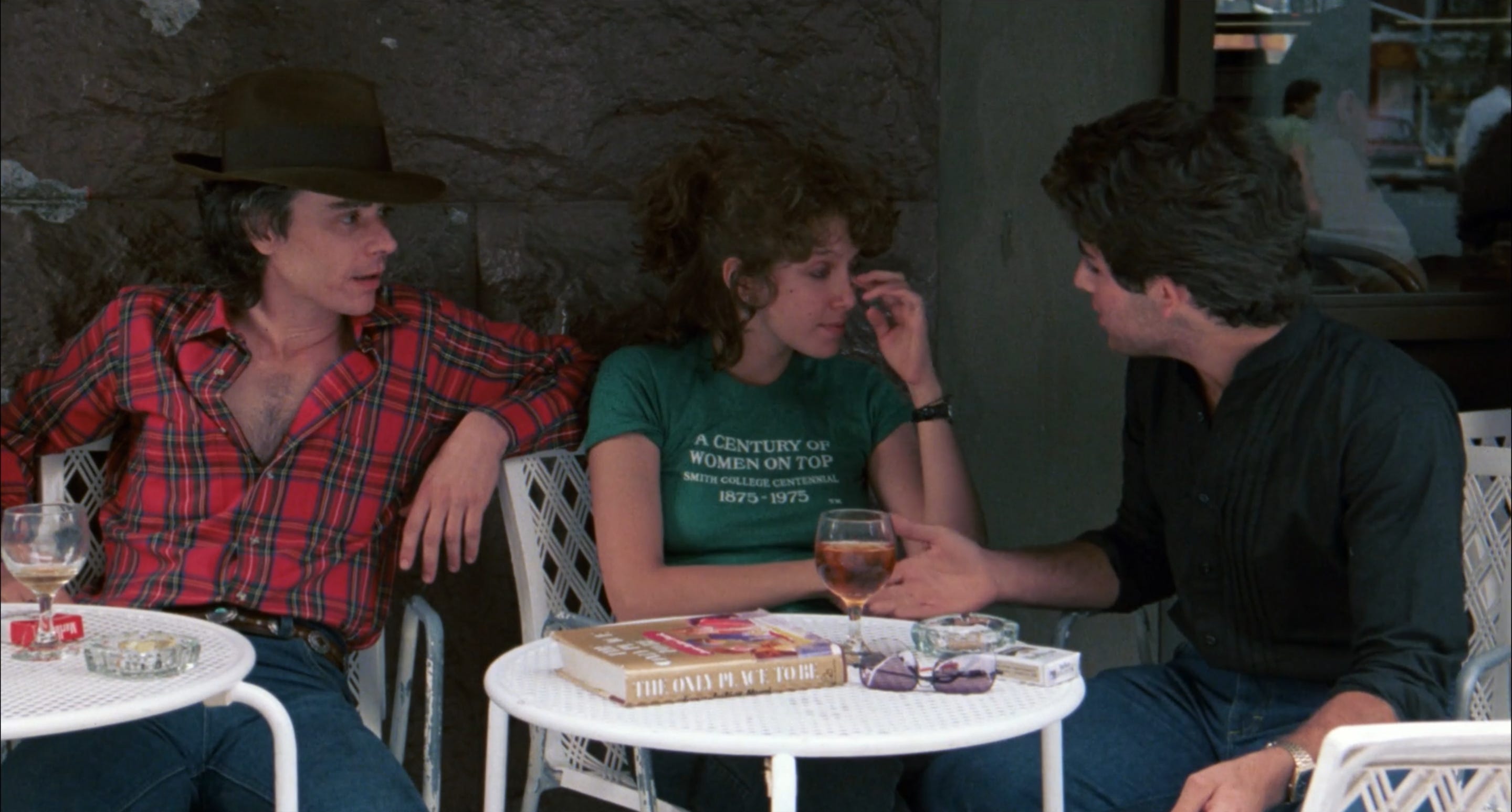
Another very New York movie, also taking place, like No Picnic, in the early eighties, though this one is set on the Upper West Side and so its characters—still charmingly strange and off-kilter in their own way—inhabit a very different world than the downtown denizens of No Picnic. A divorcee named Zee sits down in a café after her husband leaves her and starts a conversation with Eli, an equally-divorced social worker; romance ensues. Much discussion about the nature of men versus women occurs. A man wanders by with a trained pigeon perched on his head (he’ll become a problem later). A young Larry David is a side character. There’s also an extended sequence featuring a woman wearing a Smith College “A Century of Women on Top” t-shirt, which I wish my alma mater would restock.
High & Low – John Galliano, directed by Kevin Macdonald
I watched this documentary about the fashion designer John Galliano—who was infamously dismissed from Dior in the early 2010s after a series of public antisemitic and racist tirades—out of pure curiosity when I saw it on MUBI. A few days later, it was announced that he’d be the theme and honoree of the 2027 Met Gala, which, after seeing this…hmmm. I don’t know about that.
Something that struck me while watching this—and something that several people within the film itself comment on negatively—is just how devoted to the purely surface-level Galliano is, in a way that can rapidly turn tin-eared and reduce clothing to costumes. There is, for instance, the collection he designed for Dior in the nineties based on the homeless of Paris, which received a huge amount of backlash upon its release and that surely must have been the inspiration for the Derelicte collection in Zoolander. Watching this, Galliano comes across as pretty shallow, and I don’t entirely buy that he’s fully clean and sober. I don’t hate fashion by any means, but I do think there is something a bit dispiriting to Galliano’s rehabilitation in the public eye, especially when his—luxurious, visually beautiful, and stunningly impractical—vision of clothes hinges so completely on fantasy and dress-up, rather than something that women can actually wear.
Music
Confessions II, Madonna
I’ve got something I want to talk about: my obsessive love for Madonna Louise Veronica Ciccone and the best album she’s produced in years at the unheard-of (for a pop star) age of 67. I wrote a review on this newsletter that you can read below.
Performing arts
The Town, written by Walker Rutter-Bowman and directed by Reñazco
Tucked away in a small theater in Williamsburg towards the end of July, I attended a performance of a one-hour play by Walker Rutter-Bowman—who has read before in Wish You Were Here, the reading series I co-curate—featuring performances by another Wish You Were Here reader, Jonathan Woollen, and friend of the newsletter Brittany Dennison. This was fun, and featured disparate groups of characters converging in a nameless town in order to talk about robbery, commerce, and the relationship between profit margins, movie theater snacks, and art itself.
No posts
Comments
Nothing yet. Say the first thing.
Sign in to join the conversation.