
“The Holy Land of the Old Testament must be looked for elsewhere than in Palestine. The Holy Land of the New Testament Johnson found in Southern Italy.”1
In Part 1, it was revealed that the origins of the great Catholic system were traced to a literary confederacy composed of Greek and Latin monks, allied with Italian Jews in Southern Italy during the Middle Ages.
Upon further investigation, it was discovered that the region of Calabria in particular, played a central role in the development of ecclesiastical literature. Called the heart of Magna Graecia,2 Calabria may have been the true ‘Holy Land’.
Today’s Calabria contrasts starkly with its ancient and medieval periods, but during the Middle Ages it was the centre of Western spiritual thought. To fully grasp what it once was, we must immerse ourselves in its history. Historian Edwin Johnson urges us to examine Calabria and uncover its once-revered past.
“But perhaps her true Holy Land is Apulia, Calabria, and Sicily… We are there in the centre of our world.”3
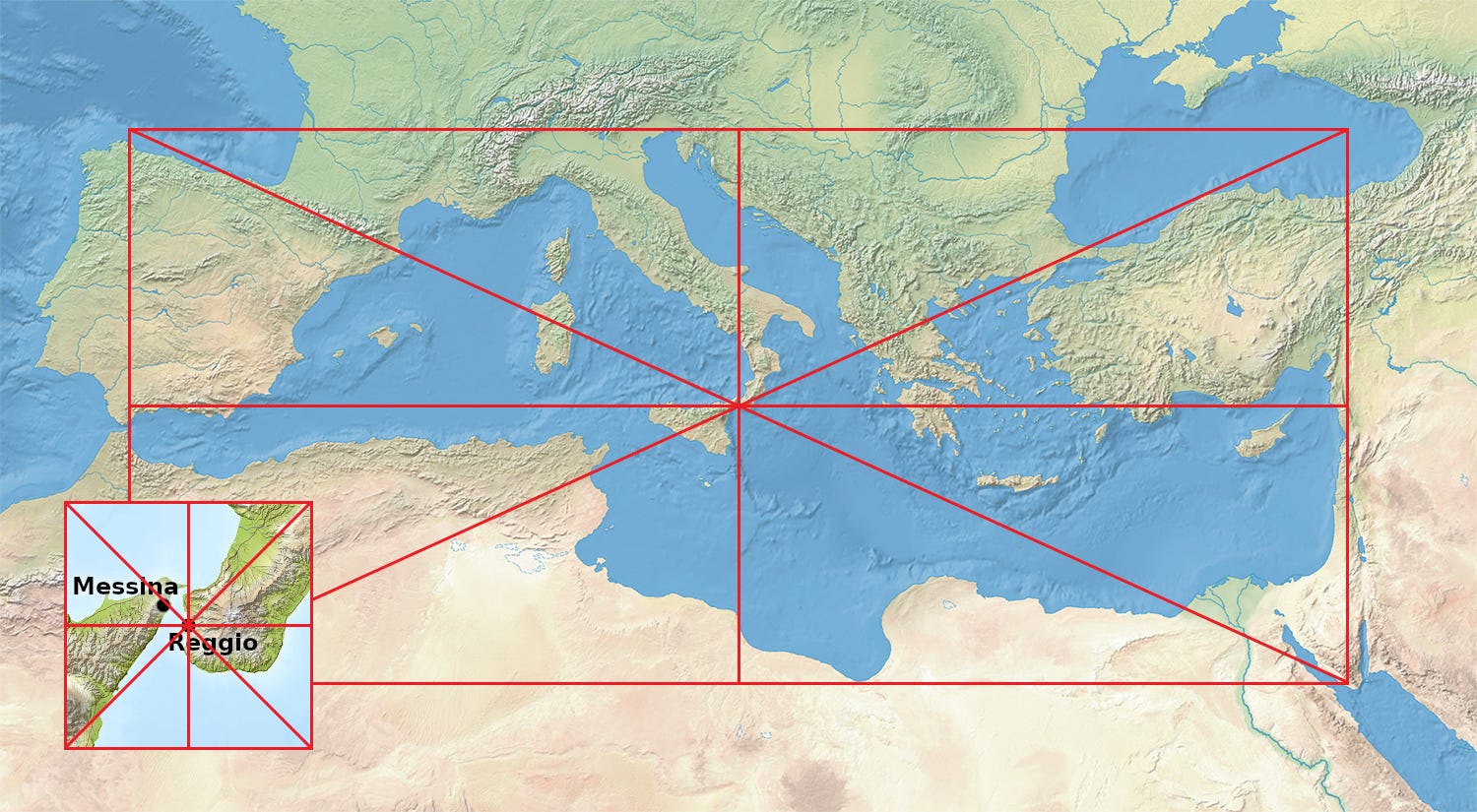
The Centre Of The World.
According to Judaism, Christianity, and Islam, the Holy Land, particularly Jerusalem, is historically and spiritually considered the “centre of the world”. But Johnson correctly notes that no such city appears on any historical map until the 12th century and the time of the Latin Kingdom.4 The Latin Kingdom of Jerusalem was established in the Levant immediately after the First Crusade, in 1099.5
The city of Reggio Calabria was one of the first Greek colonies in Southern Italy. Settled in 730 or 743 BC, it became one of the most important cities in Magna Graecia.6 It is located on the toe of Italy’s boot, and holds the distinction of being in the exact centre of the Mediterranean. For much of Western history, control of the Mediterranean Sea meant controlling the known world’s trade, wealth, and power.
Reggio, throughout the Middle Ages, was first an important centre of calligraphy and then of printing after its invention. Interestingly, it boasts the first dated, printed edition of a Hebrew text, a Rashi commentary on the Torah, printed in 1475.7
A major influence on early Christian monasticism was Saint Nilus the Younger (910-1005 AD), born in Rossano, Calabria. He was a Griko monk and abbot, and founder of Italo-Byzantine monasticism in Southern Italy. In 1004, Nilus founded the Basilian Monastery of Santa Maria in Grottaferrata (Grotta Ferrata), Rome.
Grottaferrata, along with Monte Cassino are identified by Johnson as the headquarters of the Greek and Latin monks: “The headquarters of the Basilians were once at Grotta Ferrata, those of the Benedictines at Monte Cassino, and that a literary confederacy existed between them which resulted in the production of the most important works of dogmatic and polemical Church literature.”8
Rossano, Calabria, is also home to the oldest surviving illuminated manuscript of the New Testament Gospels. The Rossano Gospels were discovered in 1846 in Rossano Cathedral. The exact time and place of its creation are still uncertain, but modern experts have dated the manuscript to the sixth century9 – apparently, they lay unnoticed for over 1300 years!
Comments
Nothing yet. Say the first thing.
Sign in to join the conversation.