
“The History of Europe – especially Ecclesiastical History – is founded largely upon assumption as well as upon tradition, legend, and error, the biographies of real persons being idealised… the larger part of the so called ‘Middle Ages’ is an imaginary or non-existent period; the Modern Period beginning soon after the breaking up of the old Roman Empire.”1
In 1904, just over 120 years ago, the New York Times published a short article titled; Abolition of History, dedicated to the posthumous publication of the book, The Rise of English Culture by the English historian Edwin Johnson (1842-1901).
Johnson discovered that in the late Middle Ages the whole of Christian literature and much of European history was manufactured by a literary confederacy composed of the Basilian and Benedictine monks, and was antedated into times when it could not have been written.2
Given that Johnson’s ideas significantly influence my own writings, I thought this short article might be of interest to readers. I have therefore reproduced it here in full. For those unfamiliar with Johnson’s findings, please refer to my post Edwin Johnson.

Abolition of History.
Generations of English schoolboys yet unborn will rise up and call blessed Edwin Johnson, if the contentions of his posthumous book just published here by the Putnams are successfully established.
“The Rise of English Culture,” which appears three years after the author’s death, undertakes to abolish all English history before the end of the fifteenth century. There simply is no such thing. It is an invention, not of the devil, as no doubt large numbers of English schoolboys in the past have thought, but of the Benedictine monks.
Respect for the powers and industry of this great hierarchy will be vastly enhanced if what Mr. Johnson maintains is true. In their monasteries was manufactured and turned out all the information, or what has hitherto passed for information, in regard to all the English Kings, all the achievements of the English people, nay, even all the history of Europe and all the literature that is supposed to date before that time.
“A wall of darkness seems to rise behind the faintly outlined figure of Henry Tudor and the fiendlike Richard,” says this uncompromising skeptic, “which shuts in the view of the observer and hides from him the earlier past.” The author puts it mildly when he says that this must come upon the unprepared mind with “a shock of surprise.”
Mr. Johnson is perfectly calm about it. His method and his manner are scientific, dispassionate, searching. He scrutinizes, and he gives his reasons. Being accused of having “Benedictines on the brain,” he gravely replies that it is modern history which he has on the brain, and he knows that this subject cannot be understood without attention to the Benedictine system. That system, as he explains it, is of a band of “dishonest fabulists organized and disciplined in the use of the pen,” “taught to agree upon a dogma and a fable.” From their hands came the whole of our Christian literature, the whole of our history, arranged to suit their purposes.
Why have these points been so long neglected, and why have they escaped the notice of the most skeptical and thoughtful historians? These fables were founded, to begin with, on “the imagination of the world.” Already during the Revival of Letters there were brought to light expressions of doubt. They were forgotten or suppressed. The fabulists were organized and disciplined, working for self-interest; the critics were not.
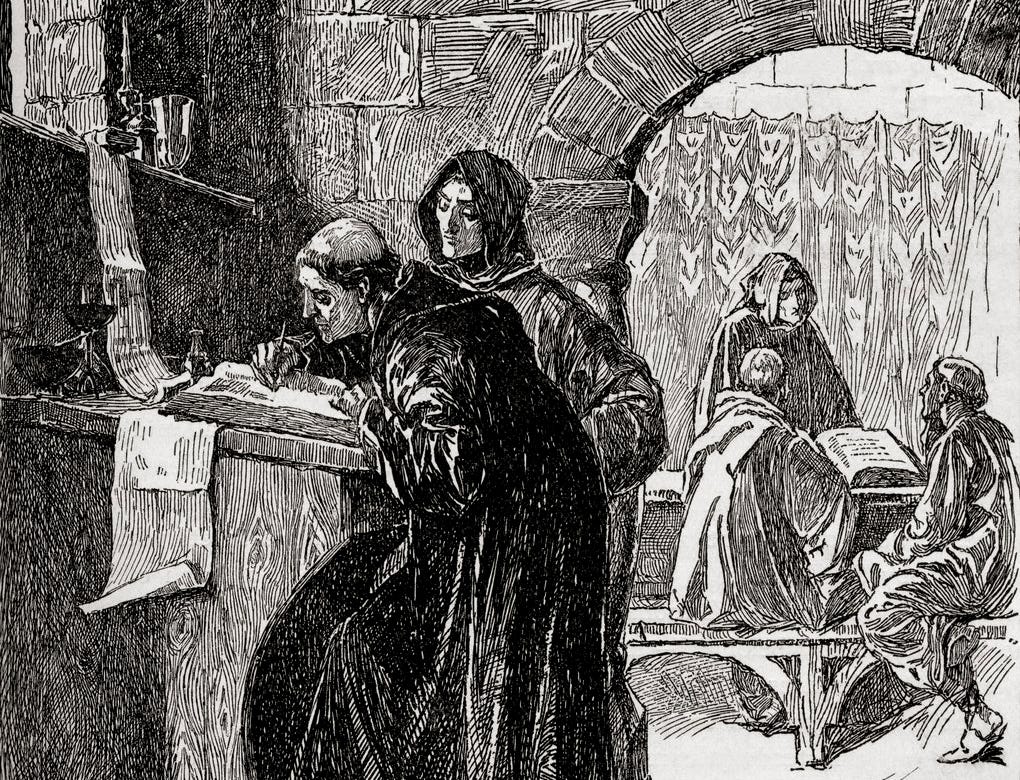
The imagination, fertility, and intellectual power of the fabulists at least are worthy of admiration. Not only all the Saxons, the English Kings downward from “William the Conqueror” – so our skeptic designates his mystical character in quotation marks – are phantasmagoria of Benedictine brains, but laws and literature, the bedrock of our ancient belief, are all products of “the forge and writing house of fable” in the monasteries.
St. Augustine and St. Jerome and Tertullian and a St. Thomas Aquinas and their works came thence. So did the Venerable Bede, the symbol of the literary activity of a knot of Benedictines, told off to the duty of illustrating the imaginary past of England. John Wycliffe is no historic-personality, but a convenient figure of the poor priests at which the monks and friars aimed their polemical arrows. “Chaucer” (and Mr. Johnson mentions with modest pride that he is the first to point it out) is a name under which masked a group of men of the English renaissance, keen but genial critics of the monastic system; we first hear of the “Chaucer legend” in 1540.
Dante is in a similar predicament. Rabelais is another mask, worn by a jesting monk, who poured contempt through it on the whole system of historic fiction then coming into vogue. Roger Bacon is another mythological figure set up, by the Merton friars through the necessity felt for cultivating the little science then current. We may not even keep our Caxton; he is a legend and not the man who first introduced printing into England. We must even give up Domesday Book and such a safeguard of our liberties as Magna Charta. Both are real, but both are late – and all that about King John and the Barons at Runnymede is fable.
In an introductory chapter, signed by Edward A. Pretherick, the reader is informed that Edwin Johnson was born in 1842 and died in 1901. He was a Congregational minister until he accepted the Professorship of Classical Literature in New College, London, in 1870. He wrote “The Rise of Christendom,” (1889) and translated the “Prolegomena” of Father Hardouin.3
The New York Times
May 14, 1904
Edwin Johnson, The Rise of English Culture, 1904 p.xxx.
Comments
Nothing yet. Say the first thing.
Sign in to join the conversation.