
A large part of networking is connecting with the right people, of course, but equally important is staying front of mind. There’s no point in shooting your shot with a cold connection on LinkedIn, going for a great coffee, and then never messaging them again. As much as we’d like to believe that everyone’s thinking about us all the time, I can unfortunately confirm that this is not the case. In fact, you might meet someone for a networking coffee, and tell them you’re looking for a very specific opportunity, like dog grooming for Frenchies on the Upper East Side of NYC, or a job as a Chief of Staff for a Series A startup based between Denver and Barcelona. You’ll ask them to keep an eye out for aligned opportunities, and they’ll enthusiastically agree they’ll be on the lookout. The following week, that exact opportunity might come across their desk, and they still won’t think of you. We’re all so busy and brainrotten that we can barely keep our own lives in order, let alone look out for opportunities for other people.
The solution? Find sneaky ways of staying on someone’s radar.
It’s a fine art — you want to stay top of mind without bothering them, which is a valid concern. The idea for this article came from one of my lovely readers (shoutout Mackensie), who suggested I write about the art of following up without feeling like you’re being annoying or unnatural. While some people might say there’s no such thing as too many follow ups, I like to keep it real, and yes, if you follow up too many times, there’s a chance your connection will be hovering over the block button. So without further ado, let’s look at how you can stay front of mind without making people hate you.
This is the golden time — you’re fresh in their mind, and you’ve hopefully just had a great conversation / coffee. Thank them for their time, and remind them of what you spoke about. If you mentioned you’re looking for something specific (introductions to people in the music industry, sponsors for your next charity event, a job as a high school teacher), this is the moment to remind them. As I’m coming to the end of a big project with a brand I love (the Michelin Guide), it’s time to think about what’s next, and so after my networking coffees I share a one pager PDF called ‘Meet Phoebe’ (I could probably get more creative with my naming here but it gets the job done).
This one pager includes:
The short intro: one paragraph summarising my profile
What I’m looking for: including suggested fractional titles like Content Lead or Head of Platform
Cool things I’ve done: A section on cool things I’ve done, like working for Apple and Airbnb
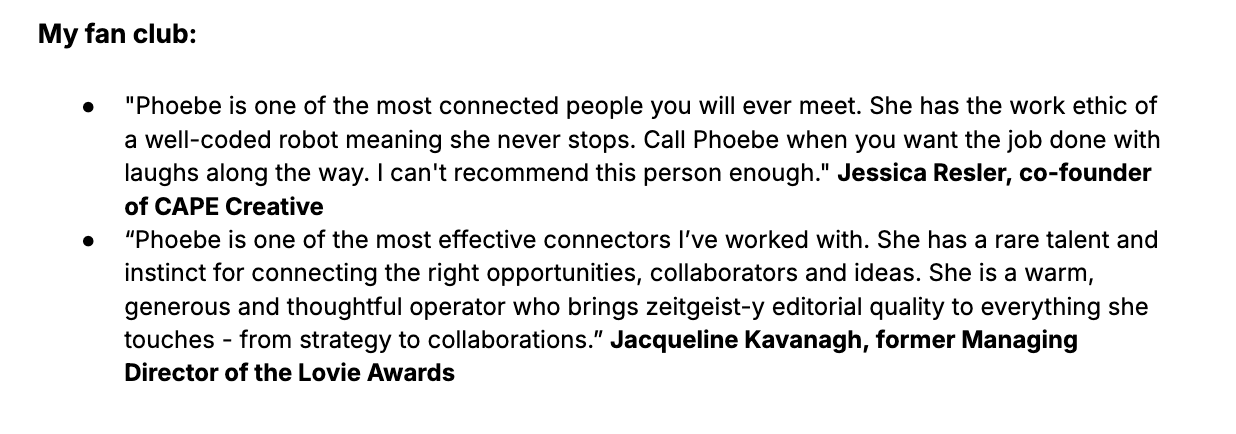
My fan club: a selection of my favourite testimonials
I have sent this out to a few people in the last couple of weeks, and they have already sent me a bunch of exciting opportunities — the trick is to make it as easy as possible for people.
So you’ve sent your initial follow-up right after your conversation, and then things go quiet for a few weeks. The next step is to boost their ego by engaging with their content. If you’re someone who regularly writes a Substack, or posts on Instagram or LinkedIn, or records a podcast, you’ll know how much interaction means. Don’t go too overboard where you veer into stalker territory, but most people will appreciate a like and comment when their post pops up in your feed. I also like to think of it as earning karma points that will stand you in good stead down the line.
If you want extra brownie points, reshare a post of theirs on your own account. They might even reach out to thank you, and you can continue your conversation organically from there. This might sound ultra calculated and cynical, which I can’t really deny, but at the end of the day you’re helping someone out, and you should only be taking this approach with content you genuinely enjoy and want to engage with. Sometimes, I’ll forget to reply to someone’s message, and then they’ll like a suspiciously old post of mine, and I always wonder if they’re playing an Uno-reverse and beating me at my own networking game — but at the end of the day it works, and I’ll reply to them straight away when their name pops up in my notifications. Either that, or the LinkedIn algorithm really is that bad.
I like this approach because even if nothing comes of your interaction, it’s always nice to be helpful. Let’s say there’s that director, or agent, or hiring manager, or founder on whose radar you want to stay. If they post on LinkedIn looking for tips for something (books, or for someone with a key skill you don’t have, or for recommendations for a certain software), try and help out. If you read an article that closely links to their business, send it to them. If you’re really desperate to stay in touch, you can even google an article with the sole aim of sending it to them. Networking’s a game, and we’re in it to win it baby.
Similarly, consider making a useful introduction for your connection. If you know they have young kids and don’t have many other parent friends in their neighbourhood, offer to connect them. If there’s someone in an adjacent industry you think they’d really click with, suggest an introduction. A few key things here:
The better the introduction, the more valuable it will be, so make sure you pick wisely.
Always ask both parties before making the introduction. You’ll probably be breaking some privacy laws if you don’t, especially if you’re sharing phone numbers or email addresses.
Don’t force anything — if either party isn’t particularly interested or excited about meeting, leave it. This isn’t something you want to get wrong.

A key date is always a great excuse to reach out. Think birthdays, business anniversaries, Christmas/ Hanukkah/ Eid (make sure you pick the right one!), New Year… any of these options work well. Bonus points if they’ve mentioned something to you subtly in conversation, like the anniversary of when they moved to your city. LinkedIn is a useful tool for this. It will tell you when someone has found a new job or got a promotion, as well as when it’s someone’s birthday (I always am weirdly touched when complete strangers I’ve somehow found myself connected with on LinkedIn send my birthday messages). Top tip: if someone’s started a new job, wait a few weeks before you reach out to them with congratulations, so your message doesn’t get lost amongst the others in their inbox.
Given the real goal here is to deepen connections, sometimes it’s a good idea to connect across platforms. I love connecting on Substack with people I’ve met on LinkedIn — it’s always really interesting to see how they express themselves and what they choose to write about. Likewise, when I find someone whose writing I love on Substack, I’ll follow them on Instagram for more bite-sized content. Don’t go out of your way to find people on other platforms, especially if they don’t use them for their work, and especially if their account is private.
That said, I really do have social media to thank for deepening my relationships with people I’ve met once or twice IRL. There’s the fashion designer who always messages me to discuss the Sex and the City reboot (we never agreed on whether our hate-watching crossed into actual enjoyment, but I have my doubts), the strategist who gave me a great Berlin tip after seeing my Instagram Story, and the person with whom a friendship blossomed as we discussed books online (my favourite hobby second only to networking… how cool am I).
Perhaps the most important tip of all: know when to call it a day. Networking naturally involves a lot of rejection, whether someone actually tells you they’re too busy to connect, or whether they just never reply (both have happened to me countless times, and I am happy to report that I’ve lived to tell the tale). Even if someone has agreed to a coffee, things can change and people get busy. You never know what’s going on in someone’s personal life, and you can’t take things personally. Send one follow up (they might have missed your first message, or they might have done my classic move of opening a message and forgetting to mark it as unread if I’m not replying immediately). You can reach out one final time a couple of weeks later (“Hi X, checking in to see if you received my message — totally understand if you’re too busy”), but after that, leave them alone. They might well come back to you a few months down the line apologising for the radio silence — or they might not. Both options are fine. Just move on, and focus on the ones that do reply.
On the Connection Pending Substack, we unpack the art (and science) of connection: from who to meet and how to meet them, to building your own ecosystem and creating those right-place-right-time moments that spark opportunity, whatever your goals in work of life. Start here with The 100 Connections Challenge — it might just change your life... You can find Phoebe at the imaginatively named phoebedodds.com.
Comments
Nothing yet. Say the first thing.
Sign in to join the conversation.