
…The Father of All Spirits said to the Sun Mother, “Mother, I have work for you. Go down to the Earth and awake the sleeping spirits. Give them forms.”
We would never interrogate Plato’s cave allegory the way we do our modern thought experiments like Mary’s room. We don’t ask how the prisoners could attribute their sensations to their shadows, or how they could be fooled into thinking their own speech was coming from the wall in front of them.1 We don’t wonder how they eat, sleep, or do numbers one and two. It all works out somehow in the dream logic of the cave. Plato manages to keep us under his spell, even as he pulls back the curtain on his own myth-making machinery.
“A strange image you speak of…and strange prisoners,” Glaucon remarks.
“They’re like us,” Socrates replies.
Really? The prisoners don’t even seem human. Their “higher reality” is merely our everyday world. We have “seen” the sun. We are the enlightened ones! So what does the allegory reveal about us? How are we like them?
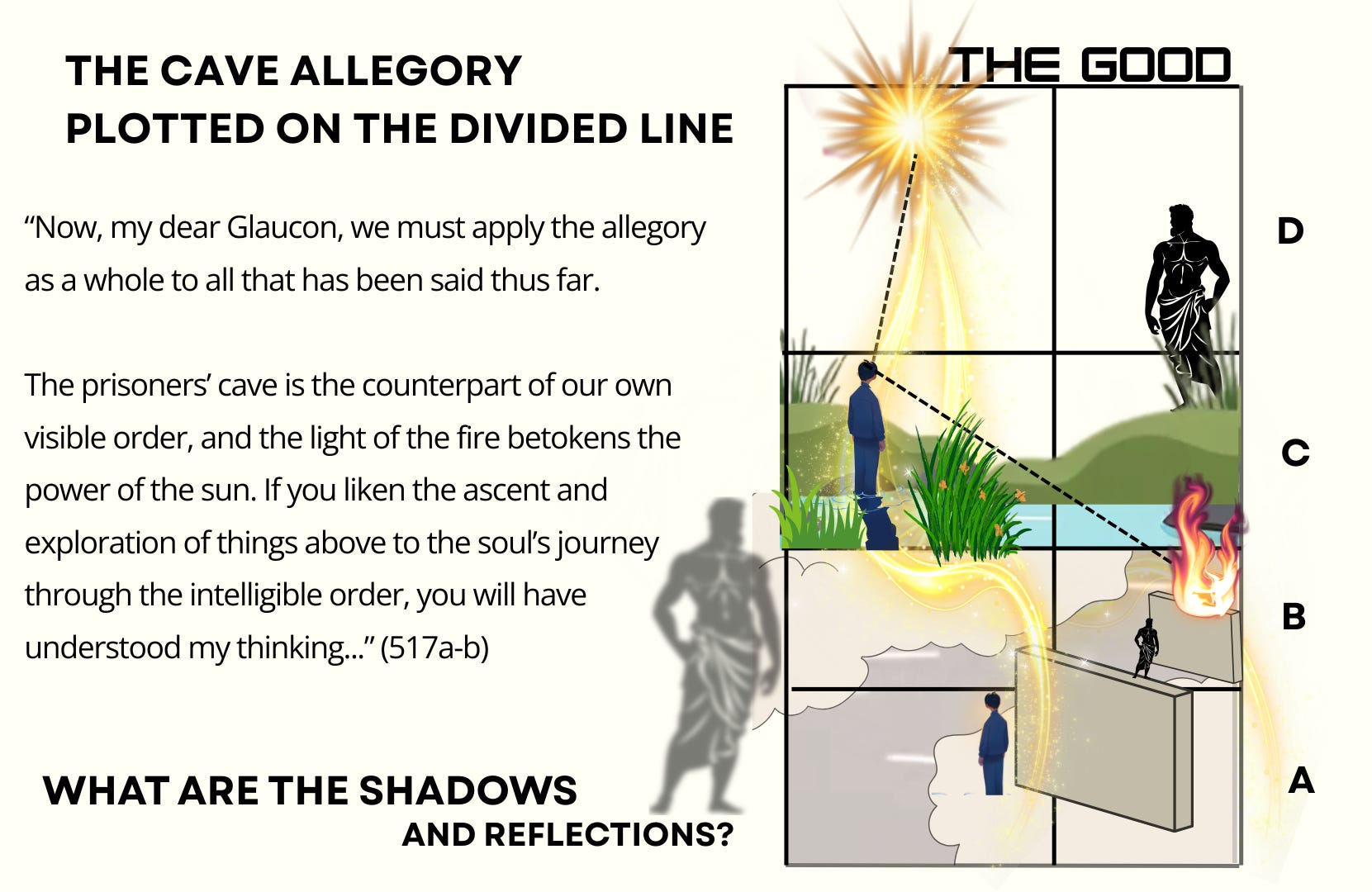
the Good : the sun
pure forms : natural objects
abstract particulars : shadows and reflections of natural objects
sensible particulars : manmade replicas of natural objects
images (eikasia) : shadows and reflections ?
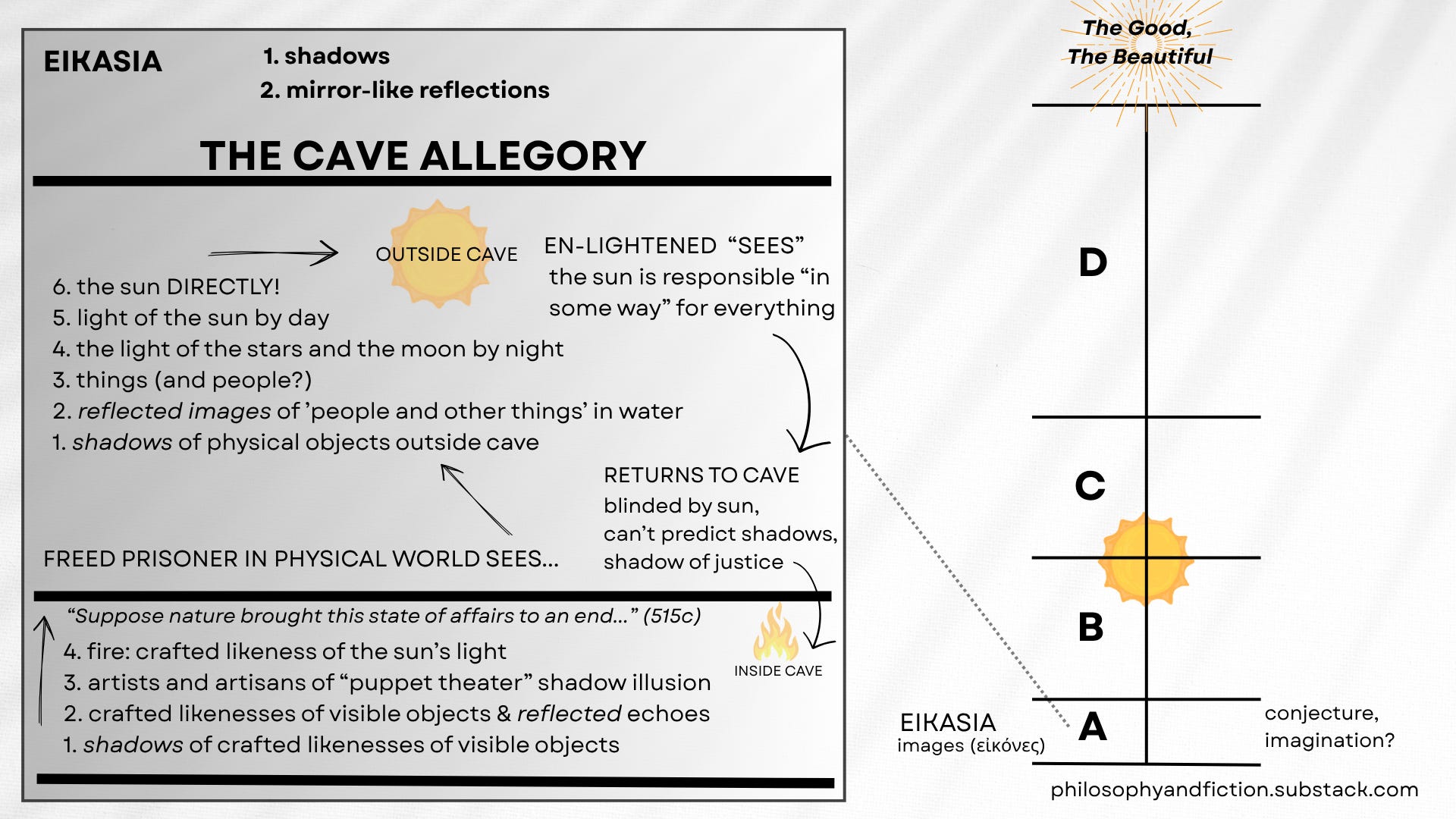
I tried to map the cave allegory onto the divided line to see if doing so would reveal anything about the lowest section, eikasia. Oddly, the cave only reiterates that eikasia stands for the “shadows and reflections” we mistake for reality.
But this is hard to make sense of. Surely Plato doesn’t think we get confused about shadows? I doubt even bugs are that stupid.
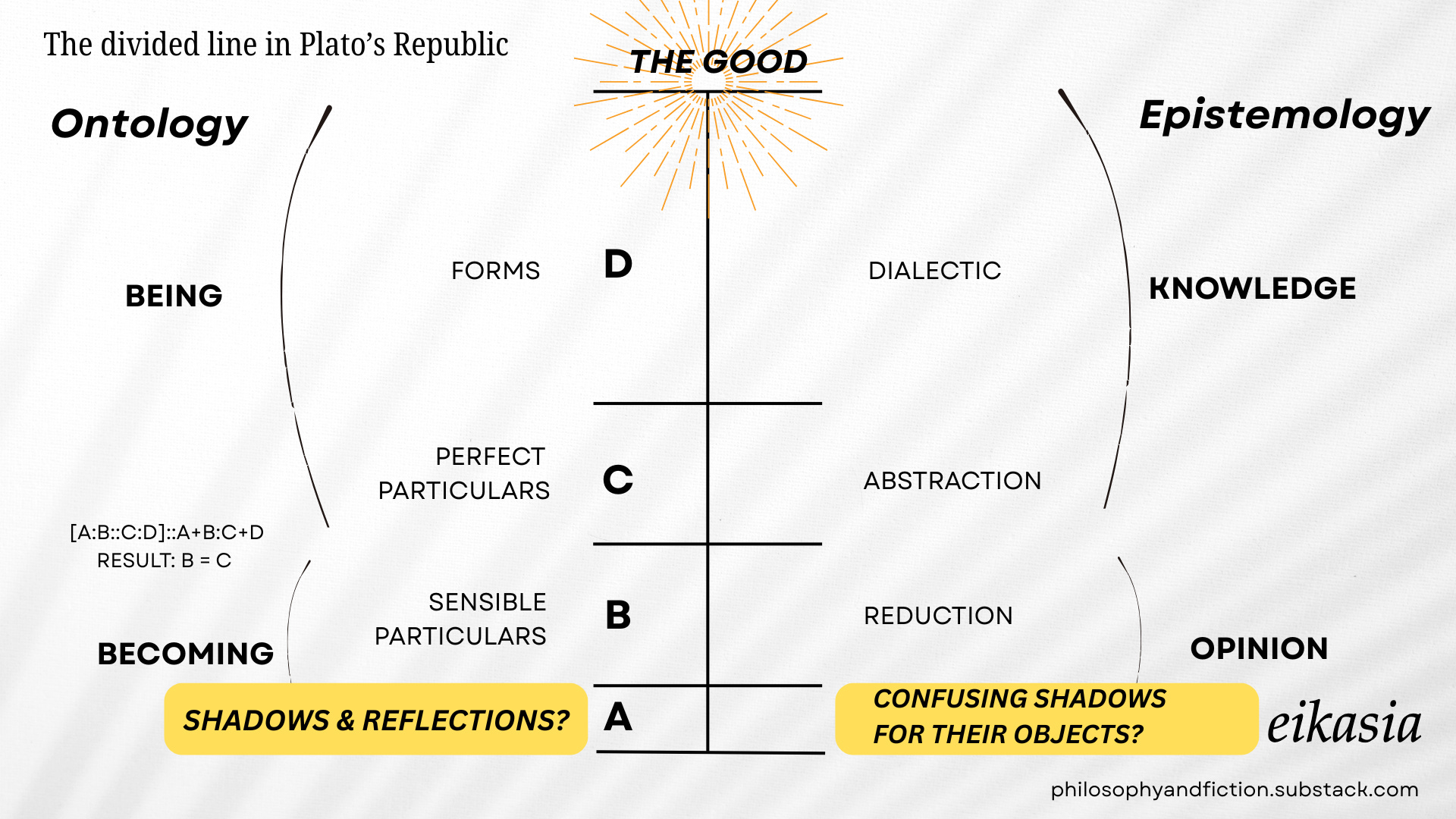
The standard interpretation places the “imitative arts”—those dangerous artistic influences so ruthlessly eradicated from the Beautiful City—in eikasia. Replacing shadows with cultural images makes this section a sort of “ethical eikasia” rather than a “sensory eikasia.”2 A key passage supports this. The freed prisoner returning to the cave “is compelled in courtrooms or elsewhere to contend about the shadows of justice” (517d). In this view, eikasia is the uncritical acceptance of traditional and cultural beliefs.
While I think this interpretation is basically right, it’s confusing. Once the phrase “shadows of justice” appears in the text, the descriptions start sounding like life outside the cave, not inside. The cave allegory makes everything go wonky with the divided line, and we still don’t have a clear idea of what goes on at the lowest level. What is eikasia?
Where were we? Where did we come from?
Did we wake up? Return to the past? The future? Come back to the present? Recollect something? Come to life? Come back to life? All of the above?
I vote for all of the above. That said, the connection to dreaming and the afterlife seems especially strong. To those who have seen the Good, Socrates gives this speech:
“Down you must go then, each in his turn, to the habitation of the others and accustom yourselves to the observation of the obscure things there. …our city will be governed by us and you with waking minds, and not, as most cities now which are inhabited and ruled darkly as in a dream by men who fight one another for shadows and wrangle for office as if that were a great good…”
These references to dreaming take place during a pivotal moment in the Republic, marking the beginning of the end for the Beautiful City. Philosophers are told to go down and rule—just as Socrates goes down to the port of Athens at the opening of the dialogue, the significance of which has been pointed out—but they can’t do so without breaking the “mind your own business” rule, the city’s founding principle. Insisting that justice can only be brought about when philosophers rule is like insisting that dreams follow the rules of waking life, or that the subconscious become aware of itself, in which case the subconscious would no longer be subconscious and dreams would no longer be like dreaming.
Dreams only seem spurious, unreal, once we’re awake. While dreaming, we uncritically accept whatever happens, however absurd, however impossible. And we often forget our dreams the moment we wake up, at least I do. It’s as if we’ve had too much to drink…from the River of Forgetfulness.
But I get the sense Plato intended the cave to represent more than dreaming—or dreaming involves more than we think. Perhaps he thought dreaming connected to the subconscious, imagination and the Muses, recollection, and, perhaps, reincarnation in the afterlife. All of these point to an underworld below our wakeful awareness, an underworld of a previous existence from which we now re-collect forms3—or, if you want to be prosaic about it, a “place” where a priori knowledge lives.
A passage in the cave allegory cautions us not to laugh at someone with trouble seeing, since that soul might not be coming from a darker world below, but a brighter world above.4 We find another underworld scenario at the end of the Phaedo which has us living underwater, but believing we’re above the surface. And then there’s the Ring of Gyges in which a ring of invisibility is found within a chasm, and then there’s the noble lie or myth of the metals about how different natures are sprung from the earth, and above all there’s the conclusion to the Republic, the Myth of Er, which describes souls descending through openings in the earth and ascending through openings in heaven, each bearing symbols of their deeds. Maybe when the prisoners in the cave give prizes to “the man who is quickest to make out the shadows as they pass and best able to remember their customary precedences, sequences, and coexistences”, this is an attempt to “read” their deeds, to predict who’s going where and why. This might explain why echoes—sounds, speech—are included in a metaphor that is otherwise entirely visual. The shadows could be for them (or us) a shared story, a mythic tradition about souls ascending and descending into brighter and darker regions (516c-d).
Recollecting forms isn’t all that different from receiving opinions handed down through tradition. Uncritical acceptance of tradition falls far short of knowledge, yet the beliefs of countless souls, beliefs that have stood the test of time, must get some things right.
I think the first stage of the divided line is a purgatory-like “space-place” which is difficult to talk about in ordinary terms.5 We almost have to tell stories about a realm of souls exiting the cave and either waking up or falling into this dream of becoming we call reality, since if it is a realm, it’s one we can only get a sideways glimpse of from time to time. This interpretation tells us, somewhat, the where. But the what, the shadows, still seem…blurry.
From the Divided Line:
“In the category of the seen the first section is images, by which I mean in the first place shadows, and in the second place reflections in water, or any dense, smooth, shiny surface. Everything of that sort, if you see what I mean.” (509d–510a)
This language appears again in the cave allegory. When the freed prisoner emerges:
“And at first he would most easily discern the shadows and, after that, the likenesses or reflections in water of men and other things.” (516a-c)
I find the addition of “in water” strange. At first I thought Plato just meant “mirror reflections”, but after doing some research I realized if that were the case, he could have just said so, since mirrors existed during his time. In fact, in Book X he uses the word mirror (𝑘𝑎𝑡𝑜𝑝𝑡𝑟𝑜𝑛) in a famous passage about artists creating the world by holding a mirror to it (596d-e). Here, however, it’s houdasi phantasmata, phantasms in water. WTF?
But it gets even weirder.
Later, when Socrates talks about using visual aids such as diagrams for thinking about invisible mathematical entities, he slips in, “of which there are shadows and reflections in waters” (510e). But that makes no sense! What sort of mathematical diagram creates a shadow? Okay, so maybe lines drawn in the sand make shadows. Sort of. But how do they create reflections in water?6 For some reason Glaucon doesn’t question this. Which makes me think shadows and reflections in water must symbolize something specific, something Glaucon, a member of the inner circle, is privy to.7 But we are not.
Maybe I’m making too much of this. But still, why subdivide the category of images into shadows and reflections in water in the first place? All accounts I’ve read lump them together, treating them as problematic in the same way. But knowing Plato’s careful use of imagery, I’m suspicious of this apparent excess of symbolism. I’m not sure it’s possible to get to the bottom of this, but that never stopped me from speculating!
With this goal in mind, I thought it might be fun to explore what shadows and reflections are and what they tell us.
Shadows can be highly misleading about their objects. This figure from Marco Masi’s Spirit Calls Nature8 illustrates how three different 3D objects—a cylinder, cone, and sphere—all cast identical circular shadows. If you had nothing to go by but the shadows, you might mistakenly believe their objects were identical.
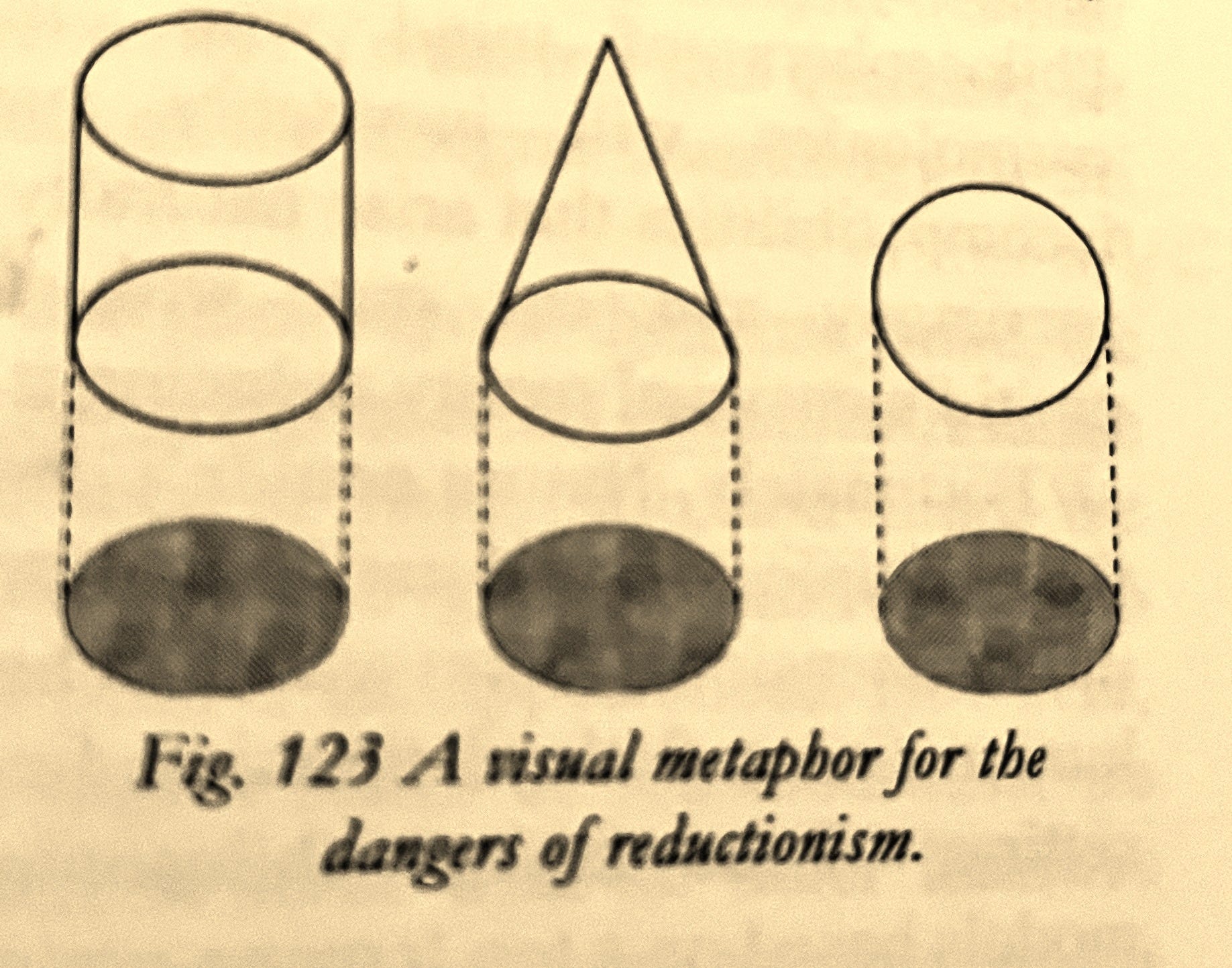
Shadows are the negation of light. This entails more than the absence of light, since they depend on an object actively blocking light—they thrive on contrast and opposition. Perhaps they can be thought of symbolically as the visible counterpart to invisible forms. Both forms and shadows are generic, but shadows are visibly so; they reveal basic shapes like a cookie cutter or outline. Perhaps shadows, being visible, form-like negations of light makes them symbolic of missing forms.
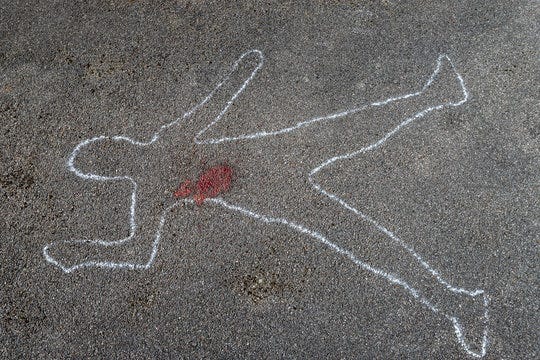
Reflections aren’t caused by the obstruction or negation of light; they’re more like replicas or copies of what they reflect, like the statues and imitations of natural objects being paraded before the fire in the cave. Detail and specificity make reflections capable of being clearer than shadows, despite being reversed or upside down. Even when distorted, they’re qualitatively truer to their originals (shadows are colorless, for instance), but with that fidelity comes a greater capacity to trick us.
Echoes might be thought of as sound reflections that can be more or less clear, despite being located away from their source. In the cave, echoes confuse the prisoners because they seem to come from the shadows, though they’re really coming from unseen actors. Later, Socrates notes that the freed prisoner sees the sun where it’s really located, not as a reflection in water. To the attentive prisoner, echoes might be the first clue things are not what they seem, even before the prisoner is freed. Causal connection is what’s at issue.
Shadows only reveal silhouettes, never much detail. Echoes and visible reflections, on the other hand, can be qualitatively close to their originals, at least under ideal conditions. But what do these different kinds of image represent?
I’ll go way out on a limb and propose, without any solid textual evidence, that shadows and reflections are symbolic of true and false opinion respectively. But with qualifications.
Shadows gain power when taken as icons : shadow-icons point away from themselves, giving us a paradigm, opening the path for our natural desire to obtain knowledge of the Good. Shadows represent missing forms, giving us vague intuitions of what we’re missing and what to seek.
Reflections in water lose power when taken as idols : reflection-idols deceive us by virtue of their qualitative clarity, especially when they’re used improperly and don’t compel us to keep up the search for wisdom. They have a lot of persuasive power which can lead us to accept false opinions that arrest our movement toward the Good. They place the soul in a danger zone of stagnation where it easily becomes smugly satisfied with half truths.
My interpretation may seem to contradict the divided line’s instructions to order things in ascending clarity and truth. Maybe it does, maybe not. Shadows can be qualitatively unclear and lacking truth (missing forms) while also being symbols of what’s missing.
The old man we meet at the beginning of the dialogue is a shadow watcher par excellence, but he seems like a good guy! A bit shallow, sure, but overall he’s got his head on straight. And when he ducks out of the philosophical discussion early on to attend the religious rites, he’s laughing. He embodies the conclusion about justice that Socrates attempts to arrive at through dialectic, that being just leads to happiness.9 Of course, the old man’s goodness comes from sheer luck, so it’s not secure. His cushy life might’ve made his soul flabby and ill-prepared for choosing the next one. Only knowledge is reliable. But we can’t deny what moderate wealth and time-tested hand-me-down beliefs can do for an already-decent soul.
Shadow watching might be an embryonic period, an incubation in which the prisoners get in the habit of preferring the general over the particular. Of course the prisoners wouldn’t be aware of the difference until after turning around and being inundated with particular qualities they’ve never experienced before. What do they want after experiencing that barrage of details and depth? They would be confused by them and forced to compare them to what they believed was real before—those generic, 2D shapes dancing, perhaps harmoniously, across the cave wall. Assuming the statues have details and aren’t mere blocks of wood whittled into rough shapes, they might reveal the difference between men and women for starters (a difference Socrates neutralizes in his construction of the city in speech). They might even show each human as possessing unique features; no more cookiecutter shadows, these statues show people not the same as each other.
The freed prisoners would have to choose which type of image to consider most real. Is there a reason to prefer the general over the specific? I imagine a third kind of image or criterion will need to tip the balance. But there is no third kind in the cave. They must be dragged out by force.
Outside the cave they see yet another type of image, the natural kind, and these must be compared to the stylized imitations inside the cave. This level involves more than a simple comparison of two kinds of object—it’s a triangulation of generic shadows and detailed statues to even more detailed natural things that move themselves, just as the prisoners do. The prisoners see themselves for the first time in “reflections in water” and maybe then they realize, wow, we’re like the statues, we don’t look the same as each other! And: wow, we’re not like the statues, we move ourselves!
Out here in the natural world, shadows turn out to be boring as hell. All they do is follow their objects around like lap dogs.
Again, a choice must be made: Which is the paradigm for reality? The shadows in the cave or the living things above? If the answer seems obvious to you, by what criterion do you judge? What makes yours the right criterion?
Try it on this way: Is justice invisible? What will the freed prisoners think? If they’ve chosen specificity over generality—and they likely have, since qualities and colors are certainly more compelling than shadows!—they might mistakenly believe their mythical shadows were lies, falsehoods, and justice doesn’t exist. They might try to prove this by pointing out the absence of justice in the so-called real world. And yet some of the prisoners might miss those shadow fictions. It was, after all, a tidy world down there, a world where good always triumphs over evil. Whereas out in the sensible world, good and evil can’t even be identified. It’s a confusing mess! Out here, heavenly objects don’t keep time the way the shadows said they would!10
Every soul must decide what’s real and true. But how?
By what lights we’ve got, that’s how.
Suppose our moral intuitions always told the truth. In that case they would always lead us down the right path. We could even wrongly believe we possessed knowledge and the world would throw up no evidence to the contrary. We would lead just lives, happy lives, but only by accident. But so what if it’s by accident? In that case knowledge really wouldn’t matter!
In such a world, idols and icons would be the same.
Unfortunately for us, we’ve been cut loose from the shadowy womb, and out here, our intuitions no longer have the power to make impossible things happen. Some of our moral intuitions command us to obey them, regardless of whether we know they’re true. Others seem clear enough at first, but then on reflection they become uncertain and confusing, and we hesitate. Out here, our intuitions can no longer be relied on. This is a dangerous situation. Being exposed to a higher degree of clarity and truth can give us confidence without protecting us against falsehood. Out here, images threaten to arrest the soul’s development and desire for the Good. Whereas shadows have very little power out here, especially when compared to idol images. But when thrown into a new light and taken as symbols, shadow-icons might point away from themselves, driving us to search for what’s missing, what we lack, what we desire.
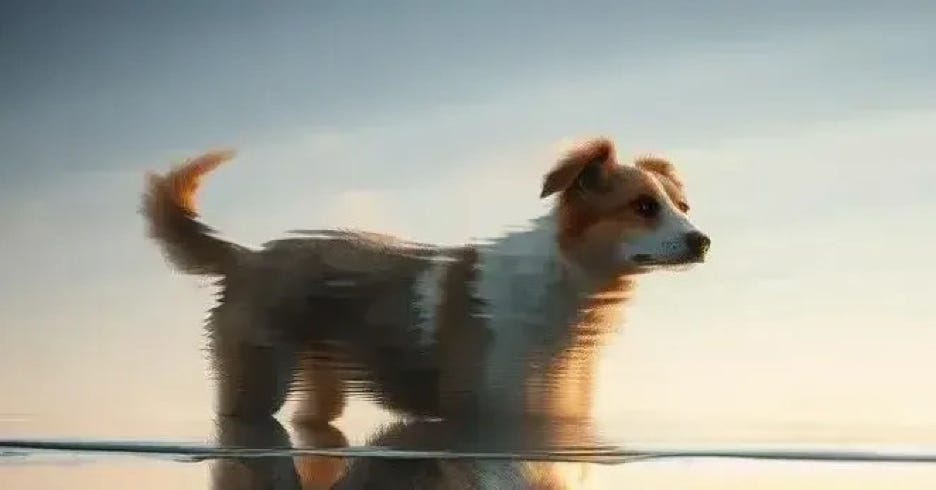
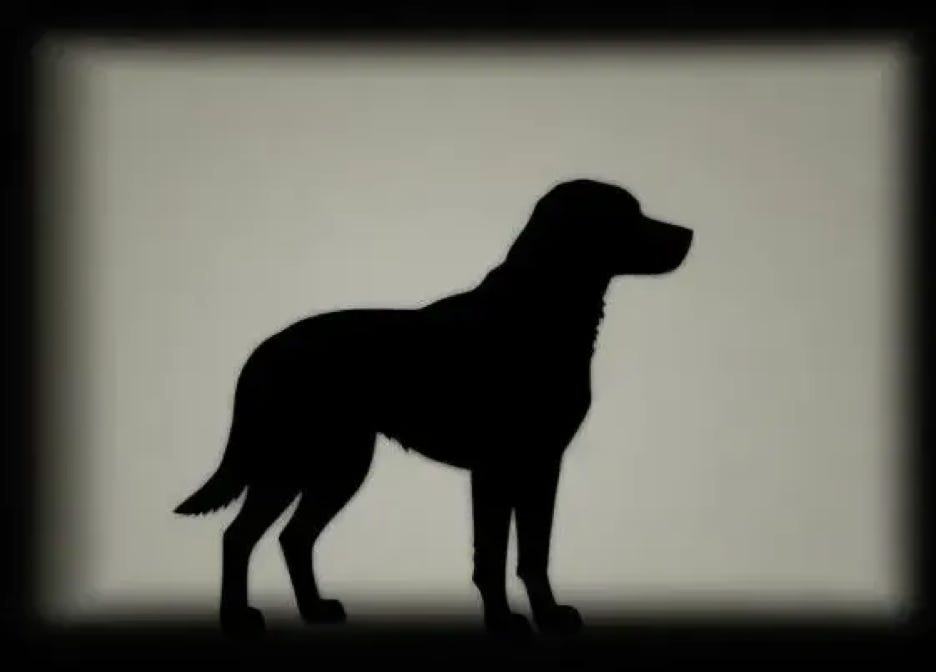
Knowing our intuitions are unreliable should lower our confidence in them—notice the parallel to the Socratic saying?—and yet, some intuitions are so strong, we can’t help but follow them. These tend to be negative, telling us, No, don’t do that!—again, notice the parallel? We don’t know justice or injustice. But we do feel we know the latter a bit better, don’t we? Even when it’s just a feeling or intuition, does it not sometimes feel less like a true belief and more like a command? Can you prove murdering babies for shits and giggles is wrong? Yet presumably you have no serious doubts about the matter.11
Rather than claiming to possess knowledge, Socrates attributes moral commands to his personal daimon. Whereas we attribute ours to a moral conscience. Well, what is that? Whatever it is, it isn’t knowledge. Or if it is, it isn’t ours. That’s what the journey out of the cave is about—the desire to make divine knowledge our own.
By the same token, the Good must come to “know itself” through its descent into its opposing indefiniteness, like light penetrating into darkness12. Everything comes around in a circle.
“They’re like us, I said. For, to begin with, tell me do you think that these men would have seen anything of themselves or of one another except the shadows…? (515a)
Taken literally, this is a strange thing to say. Socrates has just told us that the prisoners can’t see anything but shadows on the wall, so why’s he asking? We catch a bit of this tone in Glaucon’s reply:
“How could they, he said, if they were compelled to hold their heads unmoved through life?”
Like Glaucon, we probably missed the foreshadowing, at least on the first read. But from a distance we can see that the sun analogy, the cave allegory, and the divided line all throw into contrast the physical world we think we see with our eyes against the light of intelligibility within which illuminates all. Kant was not the first to propose “the inward turn”; the Copernican Revolution had started long before.
Nested minds, selves within selves…Is there a Republic within you?
Organism as justice…Scaling up the harmony of the soul in Plato’s Republic.
Is the universe intelligent? A Platonic response to the indeterminacy of interpretation.
Mechanism vs. Teleology Is reconciliation possible?
No one knows what they want, yet everyone wants the same thing... Is the object of our desire within reach?
Constructing the divided line in the Republic…if you teach Plato, this one’s for you.
Why your big toe is a Platonic form…and other surprise discoveries on our journey through the continuum of becoming.
Andrew Payne, Vision and Eikasia in Plato’s Divided Line
Rupert Sheldrake, The Sense of Being Stared At Part 2: Its Implications for Theories of Vision
Charles G. Gross, The Fire that Comes from the Eye
The Timaeus, translated by Peter Kalkavage
David Roochnik, The Political Drama of Plato’s Republic
Marco Masi, Spirit Calls Nature.
Fred Cummins, Frames and Tubes
John Niemeyer Findlay, Plato’s Unwritten Dialectic of the One and the Great and Small
James Leon Holmes, In Defense of Cephalus
To get full access to my published books and posts, upgrade your subscription. Find out more. You can customize which bits of this newsletter you receive by visiting your account.

Thanks for supporting my niche literary endeavors and off-beat philosophical speculations. Cheers!
—Tina Lee Forsee
Some of what Plato says can get lost in translation, but his word choices may help to explain the situation. The prisoners would hear sounds coming from behind them, but what would they think of these sounds? Which sounds would be considered real?
“Plato makes a clear distinction between speech as an audible physical phenomenon (“noises”) and speech as intelligible (a logos) and choses the appropriate verb depending on which viewpoint on speech he wants to stress in each case (this distinction is indeed not limited to the allegory of the cave and, in most cases, when Plato uses the verb phtheggesthai about human beings in the dialogues, it is to refer to speech as an acoustic phenomenon.”
Bernard Suzanne, Lexicon of Greek words important for understanding Plato
I think there’s a lot more to talk about regarding sound, esp. as compared to vision, but I’ll leave it at that.
“…every soul of a human being by virtue of its nature has seen the things that are, otherwise it could not have entered into this kind of living being; but it is not easy for every soul to recall those things on the basis of the things of this world. Some barely saw the things there at the time, and others who fell to earth had the misfortune of being corrupted by some of their associations and have forgotten the sacred things they saw before. Few are left who have much of a memory of them, and they, when they see some likeness of those things, are astounded and delirious, although they do not understand the experience because their perception is so unclear. Thus, there is no enlightenment in this world’s images of justice, judiciousness, and all the other things souls value. However, as they approach these resemblances with their feeble organs, a few do with difficulty see the original through the resemblance…When we saw those blessed visions with that happy company we were initiated into the mysteries…” which Plato describes as “pure brilliant light”— “let that be our tribute to memory…” Phaedrus 249d-250d
“For the soul which has never seen the truth can never pass into human form. For a human being must understand a general conception formed by collecting into a unity by means of reason the many perceptions of the senses; and this is a recollection of those things which our soul once beheld…” Phaedrus, 249b-c
Irreparably unjust souls are here depicted as prisoners in a cave who aren’t allowed to exit:
“We were at the mouth of the cavern, and, having completed all our experiences, were about to reascend, when of a sudden Ardiæus appeared and several others, most of whom were tyrants; and there were also besides the tyrants private individuals who had been great criminals: they were just, as they fancied, about to return into the upper world, but the mouth, instead of admitting them, gave a roar, whenever any of these incurable sinners or some one who had not been sufficiently punished tried to ascend…” Myth of Er, Jowett translation
It might seem the Myth of Er undermines the entire project set forth in the Republic, since Socrates was supposed to prove that justice is its own reward, yet here we have gods doling out rewards and punishments in the afterlife. Did Socrates fail? He failed to show how conventional notions of justice are ends in themselves, but if we accept his much broader definition of justice as each doing its own thing for the sake of the whole, it’s easier to see why this conception of justice needs no external reward. (The opposite of harmony is dissolution, death.)
It’s also important to keep in mind that conversion requires turning the entire soul around (see footnote 7), including that petty-minded infant in all of us who needs rewards and punishments to cooperate. If you can’t convince the whining baby inside us, you can’t convince us at all. Reason alone is not enough.
‘Education is not what some people proclaim it to be. What they say, roughly speaking, is that they are able to put knowledge into souls where none was before. Like putting sight into eyes which were blind.’
‘Yes, that is what they say.’
‘Whereas our present account indicates that this capacity in every soul, this instrument by means of which each person learns, is like an eye which can only be turned away from the darkness and towards the light by turning the whole body. The entire soul has to turn with it, away from what is coming to be, until it is able to bear the sight of what is, and in particular the brightest part of it. This is the part we call the good, isn’t it?…
‘Education, then,’ I said, ‘would be the art of directing this instrument, of finding the easiest and most effective way of turning it round. Not the art of putting the power of sight into it, but the art which assumes it possesses this power — albeit incorrectly aligned, and looking in the wrong direction — and contrives to make it look in the right direction.’ (518c-d)
Here Socrates means the lower part of the soul must be persuaded by the higher reasoning part of the soul, otherwise the conversion won’t work.
“A sensible man would remember that there are two distinct disturbances of the eyes arising from two causes, according as the shift is from light to darkness or from darkness to light, and, believing that the same thing happens to the soul too, whenever he saw a soul perturbed and unable to discern something, he would not laugh unthinkingly, but would observe whether coming from a brighter life its vision was obscured by the unfamiliar darkness, or whether the passage from the deeper dark of ignorance into a more luminous world and the greater brightness had dazzled its vision.” (518)
Speaking of space…
…one kind is the form…that which is intellection’s lot to look upon; and there is a second kind, which has the same name as the form and is similar to it—sensed, begotten, always swept along, coming to be in some region and again perishing from there, graspable by opinion with the aid of sense; and moreover, a third kind—that of Space—which always is, not admitting of destruction and providing a seat for all that has birth, itself graspable by some bastard reasoning with the aid of insensibility, hardly to be trusted, the very thing we look to when we dream and affirm that it’s somehow necessary for everything that is to be in some region and occupy some space, and that what is neither on earth nor somewhere in heaven is nothing.
Under the influence of this dreaminess, we become incapable of waking up and making all these very distinctions (and others that are brother to them)—even in reference to the unsleeping and truly subsisting nature—and of speaking the truth... Timaeus (51e-52d)
The full passage, for context:
“And do you not also know that they further make use of the visible forms and talk about them, though they are not thinking of them but of those things of which they are a likeness, pursuing their inquiry for the sake of the square as such and the diagonal as such, and not for the sake of the image of it which they draw? And so in all cases. The very things which they mould and draw, which have shadows and images of themselves in water, these things they treat in their turn as only images, but what they really seek is to get sight of those realities which can be seen...” (510d-e) Republic
Paul Shorey attempts to explain how “reflections in water” applies to diagrams in a footnote to his translation:
“…a bronze sphere would be the original of its imitative reflection in water, but it is in turn only the imperfect imitation of the mathematical idea of a sphere.”
I’m not convinced. Reflections in water is still weird.
“Reflections in water” could refer to the reflections we see of ourselves when we look into someone’s eyes. I’ve included a couple of interesting papers in the list of references on what Plato says about vision in the Timaeus (whether it’s an “extramission” or hybrid theory, I leave up in the air):
“Now once the entire stream of vision has become similarly affected through its similarity to the outer fire of day, whatever it itself touches at any time or whatever other thing it’s touched by, it spreads their motions throughout the entire body until they reach the soul and thus produces that very sensation by which we say that we see. But when the fire that’s akin goes off into night, then the stream of vision is cut off; for in going out into the dissimilar, it is itself altered and utterly quenched, no longer becoming one in nature with the neighboring air, inasmuch as this air doesn’t have any fire. So it stops seeing and, what’s more, becomes an invitation to sleep, since the gods contrived the nature of the eyelids as a safeguard for vision. Whenever they’re closed, they shut in the power of the inner fire, and this power disperses and tempers the inner motions; and when these motions are tempered, peace comes about; and when this peace becomes great, then an all but dreamless sleep comes over us. But if some fairly great motions are left behind, then, depending on what sort they are and in what regions they’re left, they produce corresponding phantasms, which are copied inside and remembered as outside when we’re awake.”
“As for the image-making of mirrors and anything else shiny and smooth, it’s no longer difficult to observe what happens. For from the communion of the inner and the outer fire, each with the other, and again at that moment when a single fire arises at the smooth surface and is remodeled in various ways, all such images necessarily appear in it—the fire of the reflected face having become compounded with the fire of the vision at the smooth and brilliant surface.” Timaeus, 45d-46b
There’s another reference to “shiny and smooth” “reflections in water” in the Timaeus regarding divination and the liver, but I don’t feel like looking for it.
“On the footsteps of Plato’s cave allegory, it illustrates what happens when we apply a ‘dimensional reduction’: Three very different 3D objects, such as a cylinder, a cone, and a sphere, projected—that is, reduced—to their lower 2D shadows, mislead us to believe that they are one and the same object (disk-shadows). Analogously, reducing the human being, with all its deeper qualitative and psychological dimensions, into a lower-dimensional theoretical framework made exclusively of material processes leads to contradictory results and a misleading belief system about human nature.”
Marco Masi, Spirit Calls Nature, Part 3, II.
“Quite correct, Socrates, if Simonides is to be believed, said Polemarchus interposing.
I fear, said Cephalus, that I must go now, for I have to look after the sacrifices, and I hand over the argument to Polemarchus and the company.
Is not Polemarchus your heir? I said.
To be sure, he answered, and went away laughing to the sacrifices” Book I, (331d).
There’s an educational parallel here that Glaucon and Socrates discuss directly after the cave allegory, and it goes like this:
arithmetic : making the right use of “this trifling matter of distinguishing the one and two and three” (522c). Here we see the beginning of forms discovered through paradoxes involving opposing sense perceptions. “For we see the same thing at once as one and as an indefinite plurality.” (525a)
plane geometry : paradoxes generated by visual diagrams and language of action about math (like “squaring” and “doubling”) even though math doesn’t do anything.
astronomy—wait, no, not yet! solid geometry : ditto on paradox. Socrates conspicuously jumps the gun here and says “in my haste I was making less speed” and the study of solids he “passed over because of our absurd neglect to investigate it.” (528d) This “hiccup” is no accident; Plato uses this structural device again and again to mark an important shift; here it’s the prisoners leaving the cave of two dimensional shadows, suggesting the cave allegory parallel begins at 2 (shadows = plane geometry, statues = solid geometry, natural things = astronomy).astronomy: ditto on paradox. At one point Glaucon assumes astronomy helps the philosopher to “look upwards…to higher things”, and Socrates gives him hell for it:
“apparently if anyone with a thrown-back head should learn something by staring at the decorations on a ceiling, you would regard him as contemplating them with the higher reason and not with the eyes” (529b).
Although astronomers study “the fairest and most exact of material things” they “fall far short of the truth…do you not suppose that he will regard as a very strange fellow the man who believes that these things [motions of celestial objects and regularity of the seasons] go on forever without change or the least deviation…?” (530b)
All these studies are useful insofar as they present paradoxes that compel the soul to move upward. These could never be seen as problematic without some notion of forms to begin with, a higher model must exist blurrily in the cave. This downgrading of all things visible may sound unscientific, but as Paul Shorey says in his footnote:
“Plato was an artist and Aristotle an encyclopedist; but Plato as a whole is far nearer the point of view of recent science than Aristotle.”
I agree.
For a more sophisticated version: Can you prove Kant’s categorical imperative wrong? When the Nazis show up to your door, you might feel it’s wrong to tell the truth about the Jewish friend you’re hiding, but why? Is it because you think you can predict the consequences? But can you prove you can? According to Kant, your truth telling is not to blame for whatever happens. Strictly speaking, you have done nothing wrong. If the Nazi murders your friend, the Nazi is to blame.
Plato ensures the sunlight outside penetrates into the cave. See the opening to the cave allegory.
Comments
Nothing yet. Say the first thing.
Sign in to join the conversation.