
Hello everyone. I’m Stephen West. This is Philosophize This!
So there’s a quote from one of the members of the Kyoto School that we’re going to be talking about today.
He said, “Religion without philosophy is blind, and philosophy without religion is vacuous.”
We’re going to be talking about the relationship between philosophy and religion, something many members of the Kyoto School were always rethinking and developing as they were doing their work.
I highly recommend reading the two posts we’ve done so far on Keiji Nishitani. Just a heads up, I’ll be using terms like Sunyata and referencing concepts from his work throughout this post.
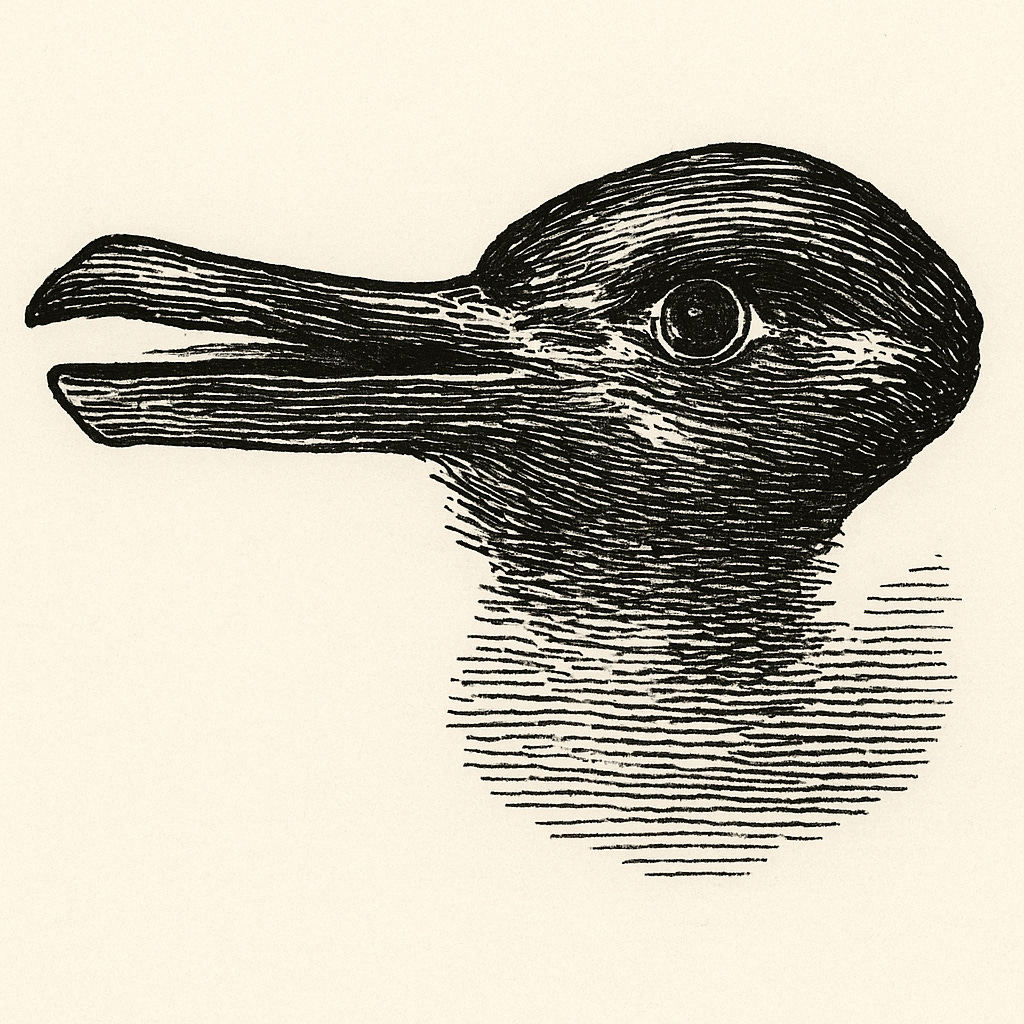
But all that said, I don’t even want to start with Nishitani or anyone from the Kyoto School for that matter. Today I want to start with something simple. I want to give some long-deserved attention to a very important cartoon character that’s come to be known as the duck-rabbit.
Who or what is a duck-rabbit, you may ask.
You ever seen one of those optical illusion things where half of the people that look at it see a duck and the other half see a rabbit?
There are tons of these things out there. It can be a sound. It can be a video. But the point is, aside from this just being some fun optical illusion on a kids’ menu at a restaurant, these are things that can show us something important about the way we see the world as human beings.
Ludwig Wittgenstein used the duck-rabbit in his work to talk about the meaning of words. But the duck-rabbit as a metaphor can actually be useful for all sorts of situations when we want to get out of seeing things in a classic, dualistic, abstract framing of the world, like we’ve been talking about in these posts lately.
And I’d like to take this moment to empathize with a certain kind of person out there reading this series so far.
This kind of person may say, “Look, I hear you. You keep talking about these different framings of our reality. One is a rational, utilitarian framing, where we create systems out of abstractions, I get that one.
But then you start talking about this phenomenological framing, sometimes you even say embodied or religious framing, where apparently in this type of awareness, we’re not breaking things down in this theoretical way anymore. This is more of a pre-theoretical, immediate connection to the world around us.
I hear you say all this, but I have to be honest: I don’t see it.
Not only do I not see it, I don’t know how to imagine my reality without chopping it up into abstract concepts and then making sense of it.
I want to remain open here, but when you start talking about religion and then you also start talking about the fact that we can’t describe this framing of the world using, I don’t know, words…my BS meter just starts going off, I’m sorry.
If this is such an immanent aspect of our experience, then why can’t I see this framing of things right in front of me?”
Well, consider the duck-rabbit for a minute as an example. Somebody can look at the duck-rabbit for the first time, and they might clearly see the thing that’s drawn on the piece of paper as a duck.
And if they were never told that it’s possible to see this image in any other way they might only see the duck every time they look at it.
But like this hypothetical person, they can be confused once they’re told that other people see it as a rabbit. Similarly, they will say things like, “I just don’t see it.” They can strain and look really hard for how this could ever be a rabbit, and still only see a duck.
But then there’s the moment where they see the rabbit for the first time. And then it can be hard for them to go back to seeing the duck.
If they keep practicing at this, there could even be a point that they start to be able to freely switch between seeing it as a duck or a rabbit.
Consider this as a metaphor for these different experiential framings of reality we’ve been talking about. It could be that you’re having a hard time seeing the rabbit, and it’s not because you’re a bad person, or a stupid person, or too smart of a person to see this delusional rabbit people are talking about.
It’s possible that it’s hard for you to see the rabbit because you live in a world where you’re surrounded by ducks, and it’s a world that often incentivizes seeing the duck instead of the rabbit.
However, there could also be a moment where some other way of viewing things snaps into focus for you. You all of a sudden see things around you in a different way, and like that moment with the duck-rabbit it becomes evident to you that this was something that was always there, right in front of you.
You just didn’t see it until now. More than that: now you can’t unsee it.
The point is: what if we’re engaged in this almost constantly when it comes to the way we’re framing the world around us? What if this isn’t just an optical trick, but part of the way our experience works?
What if the duck and the rabbit are not contradictions of each other, but when you’re able to see both of them they start to look like things that actually require each other for them to exist the way they do in the first place?
That the duck co-constitutes the rabbit and vice versa.
Maybe the biggest mystery of all here is what any of this has to do with the relationship between philosophy and religion.
Keiji Nishitani, as we know, thought a lot about religion in his work. And he’s somebody that if he could see the modern world and the state of the discussion that often goes on among people about religion, he’d think there’s a lot of room for us to grow.
As mentioned on one of the earlier posts, when you ask a question like “what is religion,” Nishitani doesn’t think there’s an easy answer to that question.
It’s easy to have an answer. Everybody has thoughts on what religion is if you ask them, but how many of those people have really examined it closely?
To Nishitani, to even begin to start answering the question “what is religion” in a remotely detailed way, you’d have to at least do a philosophical analysis of religion, an analysis of the history of religion, and most importantly what religion has actually been to people in their lived experience of it for thousands of years.
You’d have to take seriously what was meant when, for example, a 4th-century Christian mystic describes their communion with God. What they really mean when they described that?
Then you might compare that to the experience of a Zen monk, their daily practice, and their approach to how they view enlightenment. Then you might compare that to what is meant by a Sufi when they claim to have annihilated their own ego in the presence of divine love.
What I mean is you’d have to consider religion in a multidimensional way. As a source of meaning, as a mode of disciplined practice, as a political tool, as a framework for the glue that holds a society together.
In other words, if you want to respect the question “what is religion,” truly, then this whole thing would be a very big job for someone to do all on their own, something some people have dedicated their entire lives to.
What becomes clear is that coming up with an answer to “what is religion” is not just looking around you at a handful of religious people that you’ve happened to have met in your life and assuming they represent everything about it.
Just think of the kind of mistakes you could be making there. Would you feel like you knew everything there was to know about constructing things just because you met a couple douchey construction workers in your life?
For example, if you’re born into the modern United States, something you might see around you a lot are people who say that if you want to be considered a religious person, all you have to do is believe in the divinity of Jesus Christ.
That a core component of this type of religious experience. Some would say the most important component, is a belief in something.
That as long as up in your head somewhere you are assenting to a belief in the correct religious object: that’s the detail that truly matters and makes you “religious”.
To the point where it’s not uncommon to see people in the United States who act like very good people, their behavior is aligned with a religious community like this, but if they haven’t been saved by Jesus yet and believe; they’re met with skepticism from the community.
Where at the same time somebody can be treating people around them in bad ways, but as long as they believe in the right thing; they’re seen as just a fellow Christian who happens to be struggling right now.
If it was possible to reduce religion down to this, it’s no wonder so many people would look at it and think it lacks anything to do with moral accountability. It’s also no wonder they might think it’s kind of silly.
“What, I just have to believe in this thing hard enough, and that’s what really matters to you guys?”
Even more than this, if you only met people like this throughout your life and you concluded that this is mostly what religion has to offer, you might be surprised to find out this is actually nothing like what most religious experiences have been over the course of human history.
That this is actually a very modern, post-Enlightenment, specifically post-Protestant Reformation version of a religious experience.
See, during the Protestant Reformation, when Martin Luther writes his 95 Theses, sends these corrections to the church and shakes up the whole Western religious world, that was an event that would start a multi-century shift in what it was to have a run-of-the-mill religious experience in European and American Christianity.
What was once a situation where most people didn’t speak Latin and were unable to even read the scripture they were following, Luther talked about creating what he called a “priesthood of all believers.”
And what this led to is that more so than ever before in the world after this, people began to think of their religious experience as a personal connection that they have to God. It started to become more common to speak to God directly during this time, to interpret the Bible personally when deciding what your relationship to God is.
But this was not the common way that it was to be a Christian before this.
And when the individualism of the Enlightenment comes along, and the rise of liberalism in the West, this idea that my religious identity is grounded in an individual belief that I have about some religious object becomes standard practice.
For whatever it’s worth this also mirrors other conversations about identity that have come out of Enlightenment-style thinking as well.
The assumption is that my religion is really an aspect of my individual identity. And that religious identity is ultimately something that’s decided by my choice to be it. This becomes more and more pronounced as a core piece of what it is to be this type of Christian as the years go on.
But Dostoevsky, who we’ve been talking about a lot lately in these posts, thought the Protestant Reformation was a huge step in the wrong direction for Christianity, hence his commitment to Orthodox Christianity.
Because the fact is, for most people who have ever considered themselves religious on this planet, religion has not primarily been about a belief in something.
In fact, as far as we can tell, for most of human history, whether or not you really believed in the god-status of something didn’t really matter as much as how you treated people.
Daily practice was more of what mattered historically. Religion was more defined by how you engaged in the roles of your community and the religious traditions and rituals. Your identity was not something that was determined by some belief you had; identity was something that exuded out of you as you lived a religious practice every day of your life.
As a point of contrast, consider the world that Keiji Nishitani lived in and how different it was.
Early 20th-century Japan is a place where the country is facing an enormous amount of pressure internally to modernize and “catch up” with the rest of the world.
As they’re doing this, they’re looking at every way that Japanese culture functions and comparing it to European culture as they try to decide which things they want to emulate and make their own.
When they do this comparison, Nishitani realizes on his end that when it comes to the word religion, at least in the way that word is being used by Europeans, the Japanese language doesn’t even have a word at this point to describe exactly what these Europeans are talking about.
That there’s so much historical baggage that’s connected to their word religion, concepts like religion and philosophy, are not just separated from each other, they’re often thought of as antagonistic.
Broadly speaking, from a more European use of these terms, the religion side of things would be the daily practice. The meeting up in church, rituals, confessional, prayer, whatever it was.
And the philosophy side of it would be more the metaphysics that underlie the religious practice. The conceptual analysis of the world, the deep reflection some thinkers do on the nature of what exists.
But again, compare this to some of the traditions of Nishitani’s Japan. Zen Buddhism as just one of them.
In Zen Buddhism, there isn’t this kind of strict separation between the daily practice of a follower and the philosophy of Sunyata that underlies it.
For thousands of years, can you imagine the idea that you’d be meditating for hours, reciting koans every day, questioning the nature of the self, deepening your experiential understanding of the groundless ground of reality, and then to say,
“That’s my religious practice. Oh, and then there’s this totally separate thing that we call the philosophy of Sunyata!”
Uh, no. To Nishitani, whatever the Europeans have been calling separately philosophy and religion for so many years, he realizes that for the Japanese this has been more of a unified tradition. One where it feels pretty impossible for these two to be seen as totally separate from each other.
And this brings us to the quote that we talked about at the beginning of the episode.
Said by the great philosopher and scholar of Zen Buddhism Hisamatsu Shin’ichi, one of the big inspirations of Nishitani. He said, “Religion without philosophy is blind, and philosophy without religion is vacuous.”
This is of course alluding to how these two things are linked more than we typically realize in the West, but it’s also speaking to the point that either of these two, if they were isolated and without the other one, kind of like the duck-rabbit, they would just be missing something deeply important about the very process that makes them what they are.
Shin’ichi talks about it more in the longer section of this famous quote. He says:
“Philosophy seeks to know the ultimate; religion seeks to live it. Yet for the whole human being, the two must be nondualistically of one body, and cannot be divided. If religion is isolated from philosophy, it falls into ignorance, superstition, fanaticism, or dogmatics. If philosophy is alienated from religion, it loses nothing less than its life…”
Consider the first sentence of that: philosophy seeks to know the ultimate; religion seeks to live it. Sounds a lot like a line of thinking we’ve been talking about in Dostoevsky lately.
If philosophy as it’s traditionally been done in the West is a type of conceptual engineering, where it creates concepts, analyzes the connections between concepts, all in an attempt to capture truth in whatever way words are capable of, then that may be one of the most important things we can possibly do, and it may be something that underlies all other fields of study.
But it still is something that is limited to concepts. Or in other words, it’s something that’s limited to a theoretical abstract framing of our reality, and how those pieces connect together into a larger system.
Consider how necessary it may also be to not just spend your life constantly system-building. To see more than just the duck on the piece of paper you’re looking at.
It can sometimes feel like anything you need to know about the world can be arrived at by just reflecting on things more. That’s how you solve problems.
But what Shin’ichi is saying here is that at a certain point you have to stop doing philosophy and start with what many people throughout history have called a religious practice.
It’s an effort to learn to receive a less abstract framing of your reality, and to make space to directly experience the more immanent nature of reality to shine through.
And this is why so many contemplative practices over the years focus on the quieting of the mind as a key starting point. It’s not necessarily to rid you of anxiety, or to 4x your productivity this quarter; this is about getting used to receiving reality and affirming it as it is, rather than living purely in abstractions about the world.
It’s not until the mind is quiet that anyone can ever understand this connection to what’s often called the eternal now, where the present moment is literally all there is in this framing.
But hypothetically, if someone could get to this place, would it be completely out of line for someone like Shin’ichi to call this living the truth?
And couldn’t we also at that point call philosophy the attempt to know the truth and conceptually articulate what we can about it?
More than that, wouldn’t these two activities be massively helpful to each other?
To get back to Shin’ichi’s larger point here: you can imagine how if someone just tried to live their life solely in a religious dimension and didn’t take the time to frame this experience in terms of philosophy, then they’d very likely just fall into ignorance, superstition, fanaticism, etc.
But if you’re a philosopher and all you do is try to conceptually frame the world instead of trying to live it and embody it, then it’s very common for this kind of thinking to just turn into hollow intellectualism.
This often ends up becoming someone who feels lost. The results of their thinking feel vacuous. They arrive at conclusions that don’t change anything about how they live, and a lot of the time this is someone that’s left feeling pretty dead inside.
These two different ways of framing our reality, like the duck-rabbit, are not opposites, and they’re certainly not an either/or thing. And to Nishitani, it’s very important for us to realize this connection between philosophy and religion. It’s one of the things we’ve definitely lost over the years, and it’s one of the most crucial things for us to have a daily practice to try to remember.
And while he’d probably say that the main way a modern person can benefit from understanding it is through a deep, existential engagement with both of these fields, if you wanted to learn more about this outside of your own lived experience, one useful thing can be to study and reflect on the work of one of these people that have asked the question “what is religion” and then dedicated their entire lives to studying it.
One of Nishitani’s favorites in this department is going to be a philosopher by the name of Friedrich Schelling.
Schelling was a man whose work was very complicated. His ideas change significantly from his earlier work to his later work. And even if they didn’t, this was a man who started his career as a German Idealist, in many ways responding to problems he saw in the work of Hegel.
So what that means is that he’s existing in a time that requires quite a bit of prior knowledge to even understand why he would care about all this stuff in the first place.
There’s no way I can cover it all today, but I am hoping I can show you a couple exciting things about his work from this line of conversation we’re having. I’m also hoping I can show why Nishitani, living over 100 years after Schelling, still draws on his work for inspiration, though ultimately thinks he was limited on many of his conclusions.
Schelling predicted a decline of religion and institutions like the church before most people even realized there was going to be a problem at all.
I saw it put one time that Friedrich Schelling was living during a time in history where he thought it was becoming harder and harder for someone to be a religious person by simply going to church and following the normal religious activities.
And that he sees this as a potential crisis.
In response to this he starts asking the kinds of questions we’ve been referencing so far in this post.
What is religion, and to what extent can the conceptual analysis of philosophy disclose religion in a way that is accurate?
In what ways can philosophy be a bridge for people between the world of the knowable, a world that can be framed and articulated, and the unknowable, the part of existence that has to be experienced and embodied to be witnessed?
Schelling’s answer was absolute nothingness. He thought when it comes to religion, what he calls the Ungrund in his work, the groundless ground is going to play a central role in understanding what a religious practice is truly a reflection of.
So keep in mind when I say “absolute nothingness” in the context of Schelling, this is a nothingness that’s along similar lines to the emptiness of Sunyata. This is a no-thing-ness.
And while this is by no means a perfect comparison, it is far more accurate to compare this nothingness to Buddhism than basically anything you’re ever going to find in Western philosophy that we’ve talked about.
For Schelling, absolute nothingness is a reference to the conditions that allow existence to unfold into the future. That there is no independent existence of people, things, nature, whatever it is. And the part of this that makes it different from Buddhism is that for Schelling: all of these things are part of a dynamic, self-revealing process that is constantly moving towards something.
And this progression towards something is going to be a very important piece of his work. Because there’s things he thinks are true about reality that develop out of this assumption he makes.
For example, if you’re studying human history, then for Schelling you’re really just studying the ways that human consciousness has unfolded as one piece of this universal process.
More than that, he thinks if we want to understand this universal process we can never understand all of it simply through abstract concepts like the ones that are used in philosophy. That much like Nishitani’s point about Sunyata: absolute nothingness resists categorization and can’t be fully captured in philosophical terms.
Still though, for Schelling, human events and ideas are a particularly accessible access point if we ever wanted to study as much of this absolute nothingness as we can.
These events are the symptoms of absolute nothingness, you could say.
And a very important thing he thinks we need to study when it comes to human ideas is going to be religion. Because he thinks religion for any given time period that it’s in is an expression of humanity’s relationship to this absolute nothingness.
A relationship that is always evolving and becoming more sophisticated. So much so that if you look at the history of religious practice, from the primitive mystery cults all the way to modern-day monotheistic Christianity, all of this has been a progression, for Schelling, towards a greater and greater understanding of the nature of absolute nothingness as framed by religious practice.
And he’ll go into all sorts of examples of this progression in his later work.
First example: he talks about these ancient mystery religions that there used to be. He talks about the Samothracian practice. Or the Eleusinian practice in Greece.
And he says far from these being about a belief in any sort of religious object, these were religious groups that were centered around trying to access the mysterious, unknowable aspects of our existence.
Where the whole experience of practice was actually pretty crazy if you read the stories. People would volunteer. And then they’d go through a secret, intense ritual process as part of their daily practice. Super secret.
In fact, there’s reports that in some cases there’d be the death penalty if you revealed what some of these secret rituals were.
From what little we know that’s been leaked over the years they would apparently take these people on things like a 20-mile hike, they’d have them hold some giant heavy religious artifact the whole way, they’d put these people out in the elements trying to bring people to a place they’d never been before in their own mind.
The logic of the whole thing being that there are certain insights into what existence is that can only be experienced. So, through all this craziness, we’re going to give you that experience.
To Schelling these religions were primitive ways of trying to gain access to these deeper truths about absolute nothingness. That the real purpose of doing any of this is to show people an aspect of existence that lies beyond anything philosophy could ever articulate in a classroom.
He gives another example of this dynamic, a bit later in history, in what he calls the great polytheistic attempts at conveying absolute nothingness.
He has respect for how effectively the polytheists expressed this in their time with things like a god of the sun, god of the sea, pantheons of gods sometimes. But then eventually he thinks, humanity’s relationship to nothingness progresses again, where people start to see that behind all these seemingly different gods that made up different forms of polytheism, there was a unified source of becoming that was responsible for all of them.
For Schelling, this shift in religious consciousness is going to become the rise of monotheism in the Western world.
And even within monotheism, with Christianity as just one example of it: Schelling thinks if you do the work, you can still observe various different distinct periods of how Christianity is practiced that correspond to different stages of our growing relationship to absolute nothingness.
For example, he describes early Christianity as the era of the book of Peter. Meaning many of the most influential passages from the theology of this time are taken from the example of Peter as an apostle.
He thinks it’s because of this inspiration from passages surrounding Peter, that this also is a time in our history where Christianity largely spread by conquest.
The goal in part became to create a Christian empire and ultimately for it to occupy more physical space in the world. In other words, for Schelling, this era assumed a metaphysics at the base of our religious consciousness, that prioritized space in the era of Peter. And you can see the philosophy there being inseparable from the religious practice.
But interestingly, years after this Christianity changes. It eventually develops into an era he thinks that more centers around passages from the gospel of Paul.
This becomes an era of practice where it isn’t so much about spreading Christianity externally anymore. Now we’re more focused on the internal experience of the religious person, especially when it comes to the importance of the concepts of faith and grace.
Once again for Schelling, the philosophical framing of Christianity during this particular period becomes inseparable from the religious practice. And for whatever it’s worth: this, the era of Paul, was the period that he thought that he was living in.
Now again, Schelling thinks all of this is heading towards a greater and greater understanding of this absolute nothingness. So the natural question you might want to ask him could be, “What do you think is next?” What is the next evolution of religious thinking that we have to look forward to?
Schelling believed that one possible answer to that would be an age of religious practice that centers more around the gospel of John.
Where in the gospel of John, when Jesus says things like “I and the Father are one,” he thought relative to the other gospels, there are far more passages from John that align with a new way of imagining religious practice that doesn’t break our view of the world down into so many rigid dualities.
What he’s referencing is that there are tons of dualistic ways that Christians will often break down their experience of reality. You have good and evil, being and non-being, and probably one of the most influential of these is this distinction they make between the sacred and the profane.
This idea that God, divinity, is something that exists out there, not of this world, that’s the sacred. And that this world, the world that’s in need of saving, that’s the realm of the profane.
Schelling thinks it’s possible, and even likely, that we are moving into a direction when it comes to religion where the distinction between God and the world is not a valid distinction anymore. That the two of these will be reimagined as co-constituting one another, not unlike our example of the duck-rabbit.
He thinks there are plenty of passages in the Bible, especially surrounding the apostle John, that can move this religious practice into a direction where the sacred, or the groundless ground, is actually part of the experience of what we call the profane in this era.
In other words, this would be an era of Christianity for Schelling where the metaphysics are more along the lines that God is immanently all around you. That there’s no true separation between the sacred and the profane. And where the path to the sacred is not through conquest or through some internal belief you have, but by opening your awareness to see the sacred that’s among us.
Imagine a form of Christianity that resembled that.
And if you’re someone who was born into this world where you feel like the religious options you have always seem like an ancient relic of the past, outdated, tribalistic, painfully simple in terms of framing this connection to the unfolding of reality— well hearing this from Schelling, that you may just be someone who’s born during a big transition period between a shift in religious consciousness, I’d imagine it can almost feel to some people like you’ve been robbed of a religious connection to the world that may have been possible for you.
Next post is going to be the first of a series we’re doing on all the major books of Albert Camus.
Thank you for reading. Talk to you next time.
No posts
Comments
Nothing yet. Say the first thing.
Sign in to join the conversation.