
Tonight, we take a break from regularly scheduled programming to discuss a regularly scheduled program in my most mitochondrial post yet.
Since I was 15, I’ve had some pretty debilitating, on-the-tile-floor, painting-the-roses-red periods. So it was no surprise when my pediatrician prescribed me birth control for the first time when I was 16 as treatment. What was surprising however, was that the 10/10 pain once a month was somehow preferable to it.
I have been on and off birth control many a time throughout the past decade, and each time, I couldn’t do it for a stretch longer than 3 or 4 months, because I couldn’t stand the way that I felt on it. When I’ve tried explaining this to people, I was met with the usual assumptions in the form of questions— did it make you super depressed? Did it give you major anxiety? Did it make you gain weight? Were you suicidal? And the fact that the answer to all of these questions was a resounding “no” was just as confusing to me as it was to anyone else. And when it came to trying to articulate why I hated the feeling of being on it so much, I felt like I didn’t have the lexicon to put a name to the sensation. There was nothing I could put my finger on— no smoking gun, no hysterics— whatever it was felt more like the absence of something rather than a presence. It was a numbness, an emptiness, a constant sameness. My natural tendency towards flat-affect became even flatter. I began to miss the ups and downs that came with having an unaltered menstrual cycle— the rush of energy and sharp-mindedness after a period ends, the creativity , high spirits, and flushed complexion accompanying ovulation, and most of all, yet perhaps most strangely, I missed the abject, unadulterated, righteous indignation, silent, feminine rage of PMS. The inactive-pill induced “withdrawal bleed” at the end of each pack felt underwhelming and unsatisfying. Unlike the usual rush of bright red blood I was used to seeing, the blood was brown and oxidized by the time I saw it. And as time went on, I felt like there was some kind of tension growing inside of me with no mechanism to release it.
This isn’t going to be some pseudoscientific diatribe against birth control— I think it’s good that birth control exists. Hormonal contraceptives can give agency to a woman over her own body, regulate moods and periods for women less masochistic than I, and act as treatments for PCOS or estrogen-related cancers. But like with any drug, you should only take it if the potential benefits outweigh the potential downsides, and for me, that’s just not the case.
In her 2017 book, How Emotions are Made: The Secret Life of the Brain, Lisa Feldman Barrett challenges the classical view of emotion, which holds that they are universal, biologically hardwired responses triggered by specific situations such as the idea that fear, anger, or happiness are caused by specific brain structures (like the amygdala) and are recognizable across all cultures. Instead, Barrett proposes that emotions are not reactions to external events, but rather constructions of the brain, which (1) interprets sensory input, (2) predicts outcomes, and (3) categorizes bodily sensations into emotional experiences using concepts learned from culture and language.
For example, Barrett shared a story where she suddenly accepted a date from a guy heavily pursuing her whom she was previously never interested in. Throughout the date, she found herself surprisingly attracted to him— her heart was racing, she felt butterflies in her stomach, and her face felt flushed. When she got home, she realized that she had caught the flu and had a mild fever. When her fever subsided, she was no longer attracted to her date. In this story, barrett’s body was noticing physiological sensations such as a rapid heart rate, and based on the context of the situation— a date, interpreting and predicting them as feelings of romantic attraction.
Though I believe Barrett overcorrects and at times leans too heavily on the social-constructivist end of things, I think her work is crucial in terms of providing a cognitive underpinning for the mechanism behind how we can mediate and ultimately control our emotional states. We know that this is at least in part, possible, otherwise therapies such as CBT and DBT would be rendered entirely useless. But the information shared in this book can take our brain’s meta-understanding of itself one step deeper.
And when it comes to female hormonal cycles, I think that a lot of negative experiences women associate with those things, are often the result of cultural expectations of how women should interpret their bodily sensations during these times, rather than some kind of inherent property of menstruation. And perhaps, it’s time for all of us to recontextualize our own mental models of the way we interpret our own hormones. This is by no means to say that if you simply think hard enough, menstruation will feel like a Swedish massage—
Rather, I think that one of the biggest diservices modern American Culture has done us when it comes to our emotional sensibilities, is telling us that feeling bad is always… bad. The standards for being diagnosed with depression have been significantly watered down, and almost anyone can go to a psychiatrist and get a prescription for an SSRI in a matter of weeks, alcoholism in on the rise as our social institutions encourage us to drink away our problems in excess, new age spirituality ‘gurus’ preach on TikTok about how any ounce of “low vibrational energy” will cause bad things to happen to you, politeness has become synonymous with a chelsea smile and performative cheerfulness, and artists like Lana Del Rey get regular criticism for romanticizing sadness and abuse, just for being honest about real parts of their female experience.
To be clear, I’m not saying that negative emotion should never try to be alleviated. I think there is a delicate balance to be struck when it comes to a person’s emotional landscape. But things like sadness, fear, grief, and even depression do serve a purpose in moderation. And I think that periods of time where you may be predisposed to feeling this way due to hormonal shifts such as at certain times during the menstrual cycle, can be used to slow down, reflect on issues going on in your life, get it out of your system, and then start anew.
Emotional sensitivity is often spoken about as being synonymous with neuroticism— a measure of the tendency of a person to experience negative emotion. But I think that a better and more accurate definition, is simply a lowering of the threshold needed to experience a stimulus. I find that during a week or so before my period starts, this is exactly what happens, and without discrimination between positive or negative emotion. During this time, music sounds better, art appears more beautiful, and movies hit deeper. It is almost like being on a mild drug that makes you experience everything in a slightly more profound way, and I don’t think women appreciate this enough, even if it comes at the expense of lows being a little lower.
I think that at this point it’s important to mention that sometimes, speaking about our emotions as though we always have ultimate control over them can be invalidating and gaslight-y towards people who are struggling with conditions where the physiological underpinnings of their bodies create a situation where no amount of therapy, recontextualization, or perspective-changes can do much in the ways of mood improvement. One such condition, PMDD (premenstrual dysphoric disorder), characterized by extreme and crippling depression, mood swings, and even suicidality in the weeks leading up to menstruation, we will discuss in a bit, but before that, let’s do some much needed apologetics for female sex hormones.
Though they get a bad rap, both estrogen and progesterone are actually feel-good hormones, albeit for somewhat opposite reasons. Estrogen is intimately linked with the body’s serotonin network and can aid in serotonin-linked diseases, modifies the production of endorphins, assists in working memory and brain function, and overall helps boost mood and energy. Progesterone on the other hand has anxiolytic effects, helps regulate your sleep schedule, and produces a metabolite called allopregnanolone which acts as a potent GABA-receptor agonist, GABA being your body’s primary inhibitory neurotransmitter. An interesting thing to note here is that only endogenous progesterone gets synthesized into this metabolite, which could account for why some women taking hormonal contraceptives containing synthetic progestins such as drospirenone, report feeling increased levels of anxiety, as compared to being off of them. During and in the days leading up to menstruation, both estrogen and progesterone are at an all time low, with androgens on the rise, so much of the negative emotion often attributed to female hormones, cannot even be pinned on them.
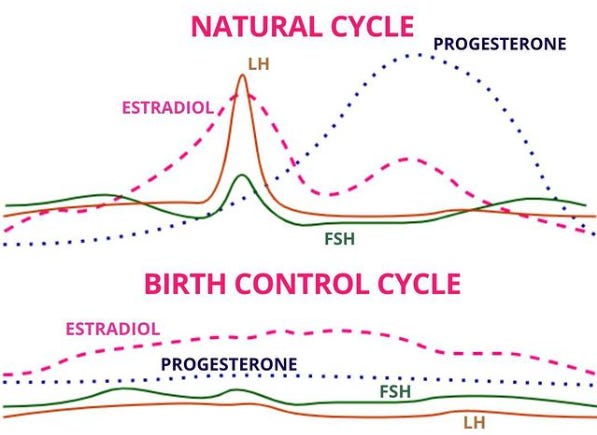
So then what may be causing women to sometimes face debilitating mental health outcomes in association with their menstrual cycles? I recently came across a women speaking about how taking an over the counter antihistamine for heartburn, accidently cured her of her PMDD symptoms. This story, supported a hypothesis that PMDD isn’t caused by the rise of progesterone itself during the luteal phase, but rather, an immune reaction to it. Upon searching for ‘histamine’ in the r/pmdd subreddit, thousands of results came up of other women sharing the same exact story, which of course sparked a stage 4 terminal autism-induced hyper-fixation rabbit hole into the endocrinological importance of histamines in the body.
I used to think that histamines were just a substance that was released whenever someone was having an allergic reaction, but it turns out, they are so much more than that. Histamines are vital for digestion and are largely responsible for producing stomach acid, they play a crucial role in brain function and help maintain wakefulness and arousal, they dilate blood vessels which increases permeability and lowers blood pressure, and they are also a major neurotransmitter, responsible for mediating numerous others including serotonin, dopamine, acetylcholine, and norepinephrine. There are four types of histamine receptors in the body:
H1 receptors: are found all over the body primarily in smooth muscle tissue including the heart, uterus, the gastrointestinal tract, and respiratory system. These are the receptors that are targeted whenever you take an antihistamine for allergies such as Benadryl (Diphenhydramine) or Zyrtec (Cetirizine Hydrochloride). H1 antagonists are also used to treat nausea and motion sickness due to their anticholinergic properties as found in medications like Dramamine (Dimenhydrinate), which is basically a slightly diluted form of Benadryl. First generation H1 antihistamines cross the blood-brain barrier which also allows them to be used as a treatment for insomnia, though this usage is starting to fall out of favor because of its potential link to Alzheimer’s and Dementia, particularly in older adults.
H2 receptors: are found in your stomach and stimulate the production of hydrochloric acid. They are also found in smooth muscle tissue like the H1 receptor, and play a role in cardiac function and vasculature. H2 receptor antagonists are used to treat GERD, ulcers, indigestion, and are found in many OTC heartburn medications such as Pepcid (Famotidine) which reduce stomach acid production.
H3 receptors: are primarily found in the brain, though there are some in the gastrointestinal and bronchial tract, and regulate the release of histamine, dopamine, acetylcholine, and serotonin, to name a few. They play a role in sleep/wakefulness, neuroinflammatory diseases, pain modulation, moderate drug addiction, and are associated with diseases including Alzheimer’s and ADHD. Though there are currently no medications targeting H3 receptors on the market, research shows that their usage may be potentially groundbreaking in terms of treating all sorts of psychological and neurological conditions including Schizophrenia, Parkinson’s, ADHD, Alzheimer’s, obesity, substance abuse, epilepsy, narcolepsy, and pain.
H4 receptors: are found throughout the body and play a role in immune and inflammatory responses. There has been less research on this histamine receptor, so I’m not going to speak about it much here.
As it relates to PMDD, women reported that taking both H1 and H2 receptor antagonists led to a significant decrease in their symptoms, with Famotidine, in particular, seeming to be the most effective choice based on anecdotal evidence. Though it is an under researched area, clinical trials are beginning to support the experiences of these women.
Several Covid-19 studies have recently linked the effectiveness of Famotidine in controlling immune responses with its effects on the Vagus Nerve— the primary nerve of the parasympathetic nervous system which is responsible for communication between the brain, heart, digestive tract, and immune system. A researcher stated,“it has become clear that famotidine kick-starts the vagus nerve, which then signals the release of anti-inflammatory molecules that are used to turn down potentially life-threatening inflammation in the body”.
Moral of the story, if you are struggling with PMDD, extreme PMS, Covid-related symptoms, autoimmune issues, or even mild anxiety, adhd, or any of the number of things histamines apparently play a role in— perhaps you need to look no further than the allergy or heartburn section of your local drugstore.
Whatever you took away from this, I hope it encouraged you to be a little more introspective when it comes to your own body, and appreciate the natural ups and downs of life— even if you are not a woman and you don’t have a built in mechanism for it. And if nothing else, I hope this post solidified the one thing I’ve been tirelessly attempting to prove—
I’m not like other girls— I like that god punished me with a period.
Comments
Nothing yet. Say the first thing.
Sign in to join the conversation.