
Below is the final entry in the “Soundtrack to Hellworld” series, focused on Chapter 12, “Hill of Ash.” Throughout, the chapter uses country music as a narrative device, noting many of the key instruments’ origins in Africa and both the historic audience for the genre on the continent and its recent rise to prominence in places like rural Kenya. This then allows me to compare earlier settler-colonial industrial trends in gold-oil-ag economies like Bakersfield, CA, to those observed today in the Sahel. So the focus of the soundtrack provided here moves slowly from the breadth of contemporary Sahelian guitar music, epitomized by Desert Blues, to the classic American country sounds you’ll hear across rural East Africa today. Here, let’s first look at some of the history gestured to in the piece, beginning with what we might call the “deep history” of inherited instruments, namely the guitar and banjo, since it is in this practical history of musical knowledge, invention, and material experimentation that the “spirit meets the bone,” to quote from one of the Lucinda Williams songs included below.
Both originate with early forms of lute, records of which arguably (depending on one’s definition of “lute”) date back to 3000 BCE from Mesopotamia. Mesopotamia is also where we see the first historically-documented case of the instrument’s widespread adoption over the subsequent centuries and art featuring instruments clearly recognizable as long-neck lutes becomes common by the later Uruk period. This long-neck lute reaches Egypt soon after (by at least 1500 BCE) and reaches Greece by around 300 BCE. As the lute developed eastward, it shortened, eventually resulting in the Indian vina and Chinese pipa (琵琶). Early on in its history, the lute became associated with lower-class social gatherings, frequently pictured alongside nude dancers. Plato famously prohibits the use of any instrument other than the harp and lyre in The Republic. In Rome, the pandura lute was similarly a lower-class instrument. Take, for example, this hagiography of St. Theodoulos the Stylite:
when God is testing the saint, he tells him that he will inherit the Kingdom ‘with Cornelius the pandouros [i.e. pandura lute player] from the city of Damascus’. Theodoulos is horrified at being associated with a man from the theater … and he is even more horrified when he goes to Damascus and finds Cornelius at the Hippodrome, holding his instrument with one hand, and with the other, ‘a bareheaded prostitute’.[1]
If we understand the lute as the ancestor of both banjo and guitar, then, we might argue that iteration of the instrument also generates its own honkytonk, complete with a moral panic about the lumpen character of its adherents.
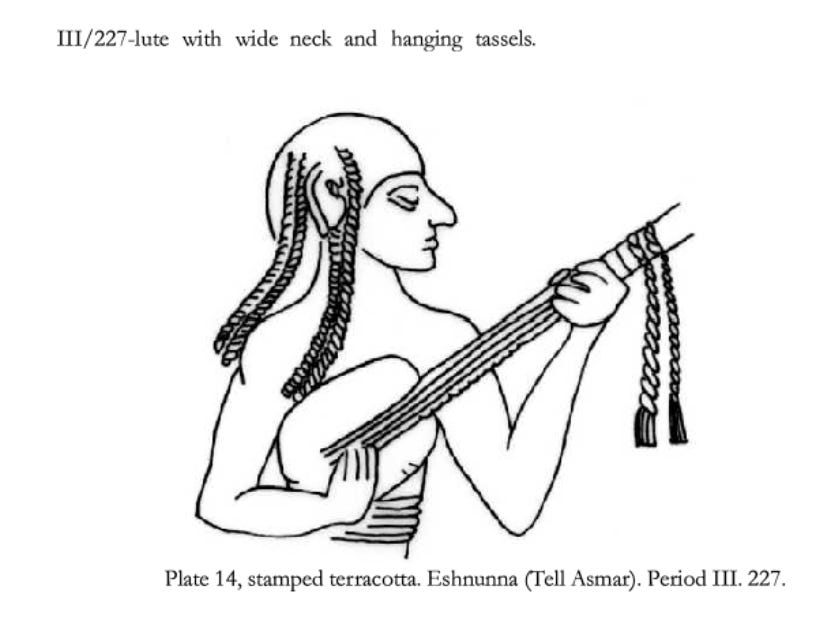
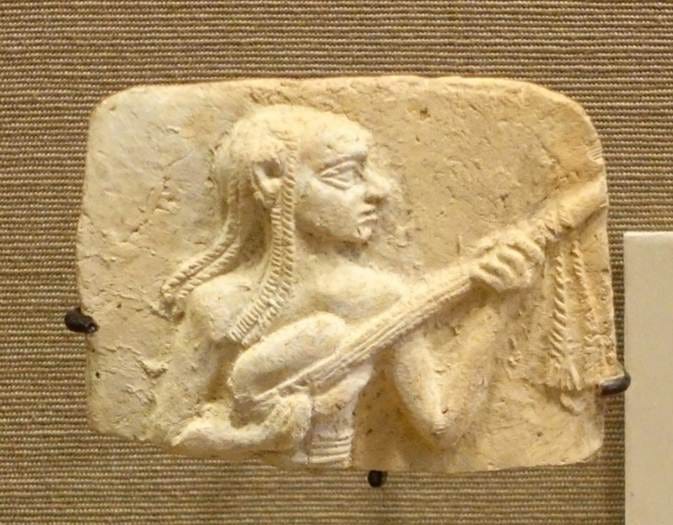
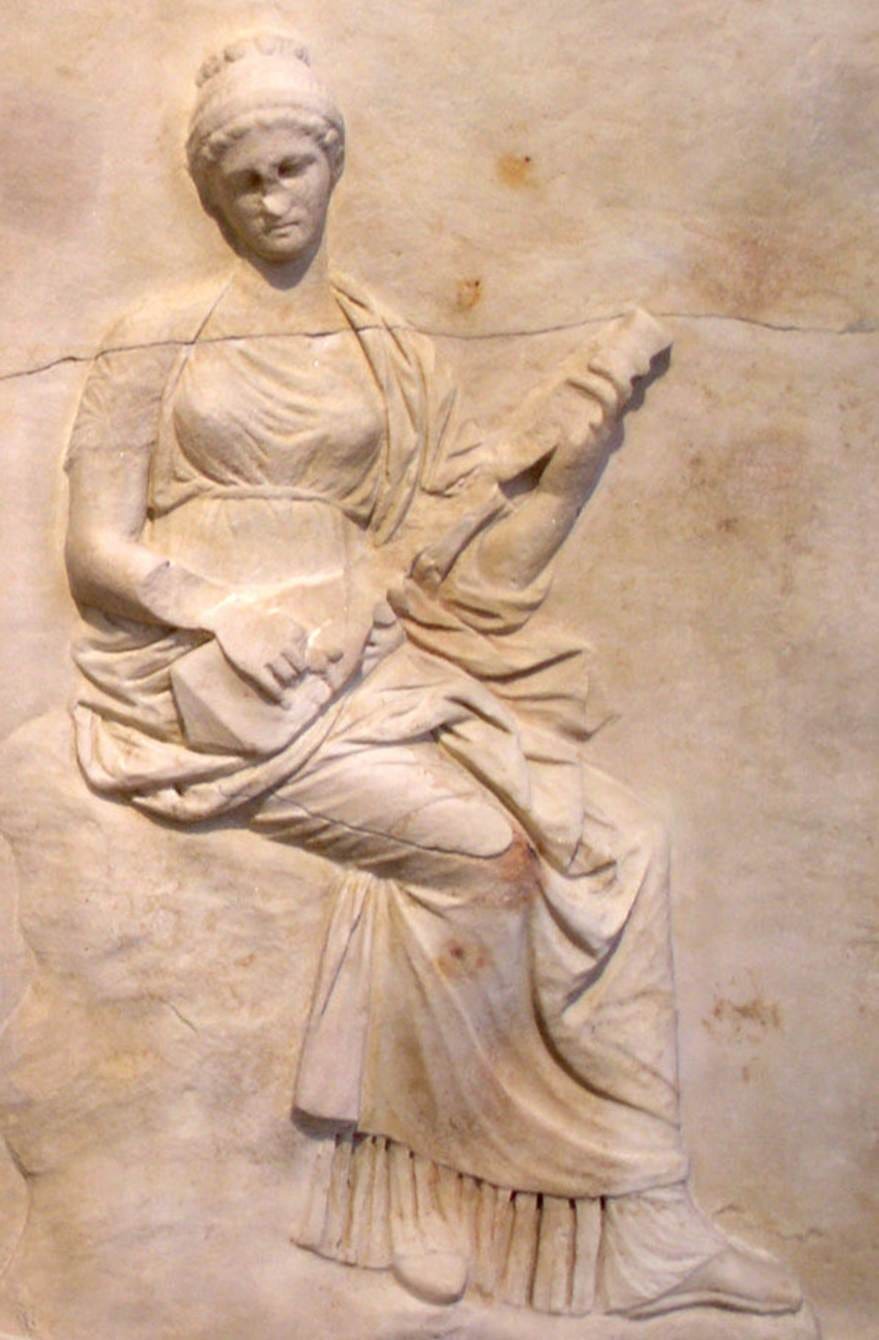
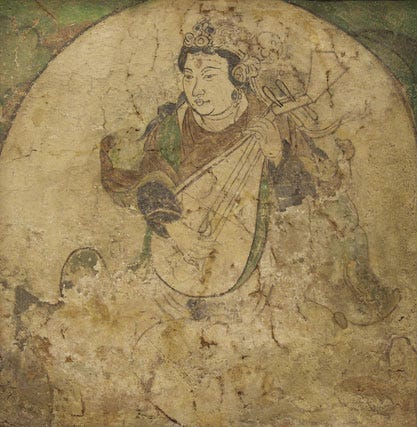
The key moment in the development of the guitar occurred via the Arabic oud (ʿūd عود), which developed out of the Persian barbat (بربت), allegedly brough to Mecca from Persia by the Arab physician Nadr ibn al-Harith – who coincidentally was one of the major opponents of Muhammad – sometime around 600 CE. The instrument was thereby adopted into the mercantile Arab Quraish tribe and, after unification in the Umayyad Caliphate, gained widespread use across the early Islamic world. Crucially, the Umayyad conquests brought the instrument across North Africa, where it absorbed some influence from other lute lineages, and into Hispania, which thereby became Al-Andalus, or Andalusia in the Latinate languages. Andalusia became a major cultural center and a hub for the manufacture of instruments under the subsequent Abbasid Caliphate. Given that the area had once been ruled by the Romans (though it had since fallen to Germanic conquests), the influx of Islamic settlers effectively recombined two major strains of lute, the pandura and the oud and, placed alongside other European stringed instruments already in circulation, this created the musical environment out of which emerged the first guitars (as well as the first violas, mandolins, and similar stringed instruments). Another transfer occurred in Sicily slightly later, where either Byzantine or Muslim traders reintroduced the lute as the oud, leading to a re-dissemination of lutes across the Italian peninsula.
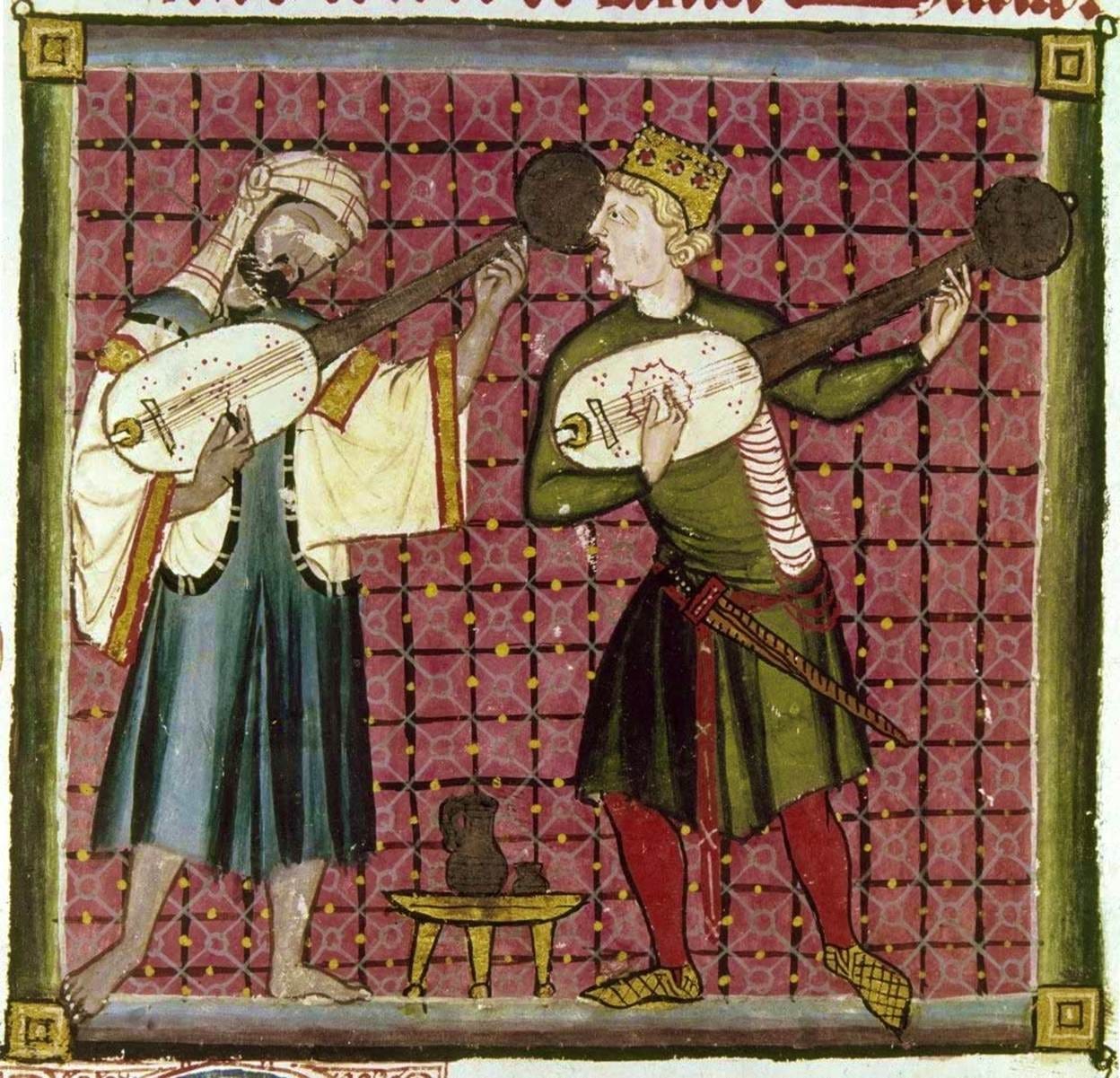
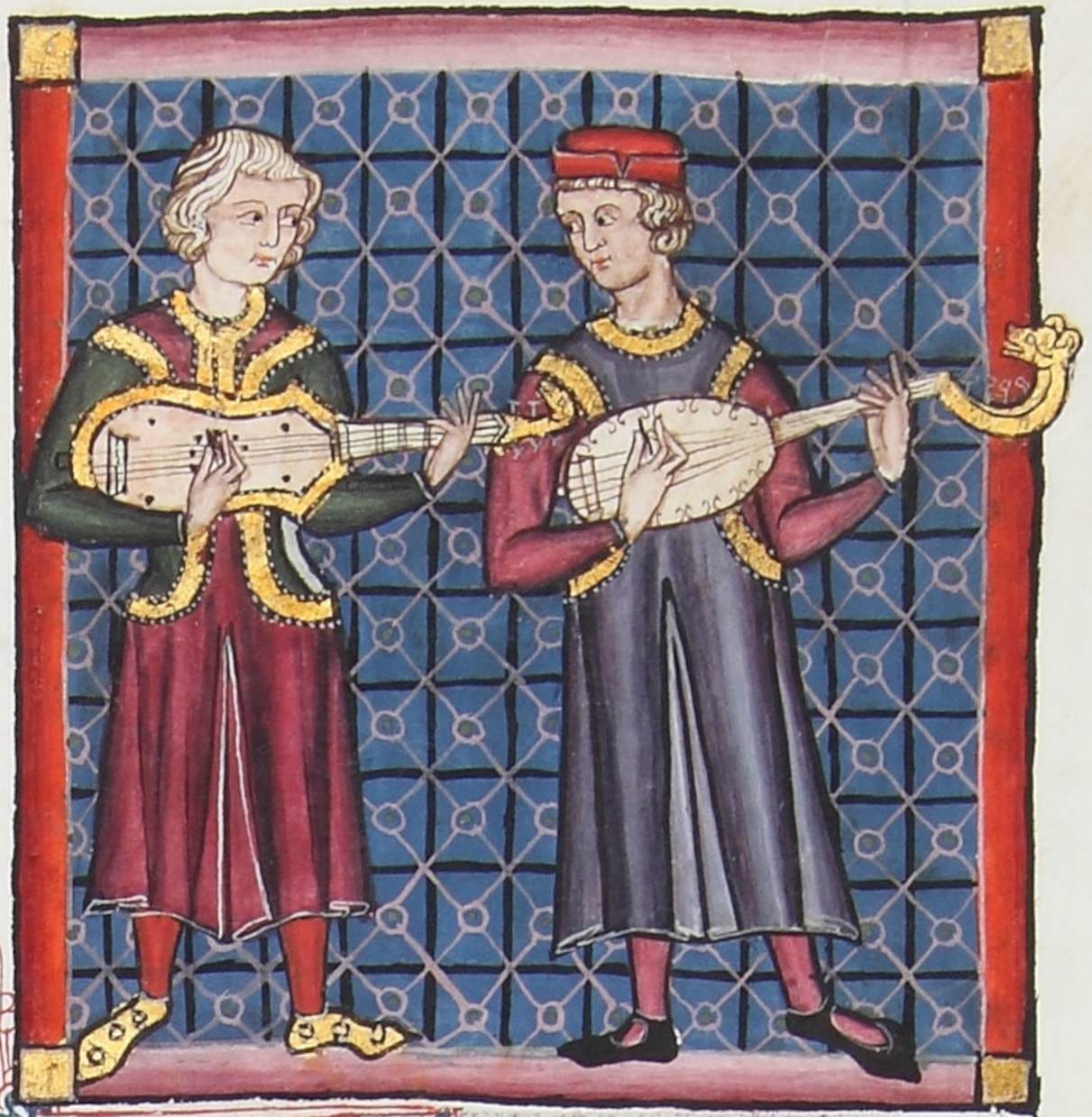
Obviously, the path taken is hardly linear. Moreover, as with any kind of materially embedded social knowledge, every transit carves its own channel, shaping the space through which it passes and itself being reshaped by the passage. Thus, we should see the movement of the oud across North Africa as not simply a transit to Andalusia and the endpoint of the guitar but also as a productive process in and of itself, involving various local fusions, inventions, and a continual return of practices passed on, evolved, and routed back into the old territories that once shaped them. For example, the passage of the oud through the region produced the oud arbi and oud ramal, and the return of the lute to North Africa from Iberia as the Algerian kwitra. Similarly, later music would be influenced by West African lutes, particularly the teherdent lute from Mali, related the ngoni of West Africa (see below).
In the modern era, it was this tradition that then seeded what would later become the expansive guitar music of the Sahara, which is most popularly (but only partially) captured under the “Desert Blues” label. The genre was pioneered by pastoralist cultures, namely the Tuareg spread across Mali, Niger, Libya, and Algeria, though also with contributions by Sahrawis in Moroccan-occupied Western Sahara (see Group Doueh), and now imitators further afield. As such, it is linked explicitly to themes of exile, exclusion, displacement, and rebellion against colonial and post-colonial powers: the Tuareg first against the French and, later, against post-colonial nations within which they were seen as a dangerously nomadic minority (crucially, Tamasheq-speaking Tuareg people and several key musicians in the movement were given military training and exposed to pan-African ideas in Libya); and the Sahrawis against Moroccan occupation. Migrating to the cities after a major drought following decolonization, the Tuareg were, in many places, among the first populations exposed to the sort of long-term urban unemployment that would, decades later, become a general condition of life, helping to trigger the revolts of the Arab Spring. Perhaps it was not coincidental, then, that the Desert Blues movement that had originated in ‘80s and ‘90s exploded in popularity in the 2000s and 2010s.
Given the fact that the final chapter of Hellworld compares political trends in the Sahel to the colonization of California, the playlist below therefore begins with Desert Blues before shifting toward American and African country music. Much of the material for the Desert Blues section derives from the Sahel Sounds label, which has gained global fame in the years since its earliest releases of Music form Saharan Cellphones. As usual, most of the albums on that label are worth listening to in their entirety. For Desert Blues, this is particularly true, as the genre is inherently immersive, meant to simulate the expansiveness of the Sahara and themes of recurrent nomadic transit through the desert. A personal favorite is this live recording by Les Filles de Illighadad:
Also see Tassili from 2011, by Tinariwen, perhaps the most well-known Desert Blues artist:
It is also certain that, in its movement across North Africa, the oud came into contact not only with the older lute heritage of Egypt but with existing musical traditions from West Africa associated with stringed instruments such as the ngoni, xalam, kora and, particularly, the akonting. And it is here we find another lineage of modern country music, via the banjo, which traces its origins to precisely these instruments, as reinvented by enslaved people after their forced relocation to the Americas. Crucially, drums, horns, and other “loud instruments” had been illegalized in the wake of the Stono Rebellion of 1739 – the largest slave rebellion in the British American colonies – given the role they played in marching, rallying, and the transmission of messages. As a result, stringed instruments formed an even more important element of musical culture. Often, the resemblance between the modern banjo and these West African precedents is striking. See, for example, Daniel Laemouahuma Jatta playing the akonting:
And, of course, the banjo was one of several musical traditions that evolved in this fashion, forming a fundamental pillar of American music. For an overview, see this short explainer:
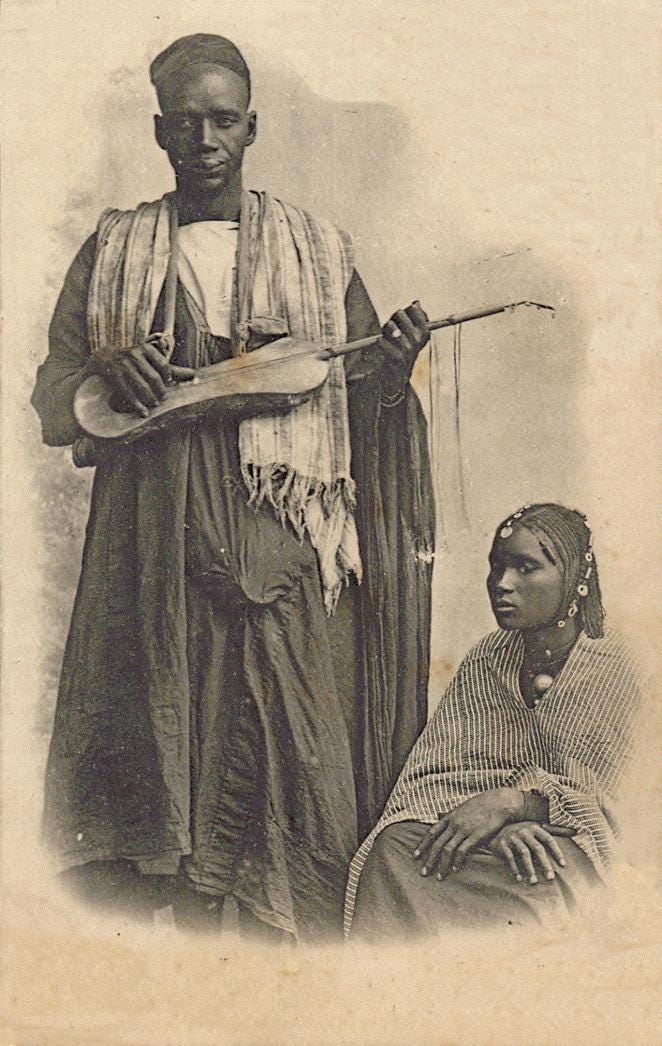
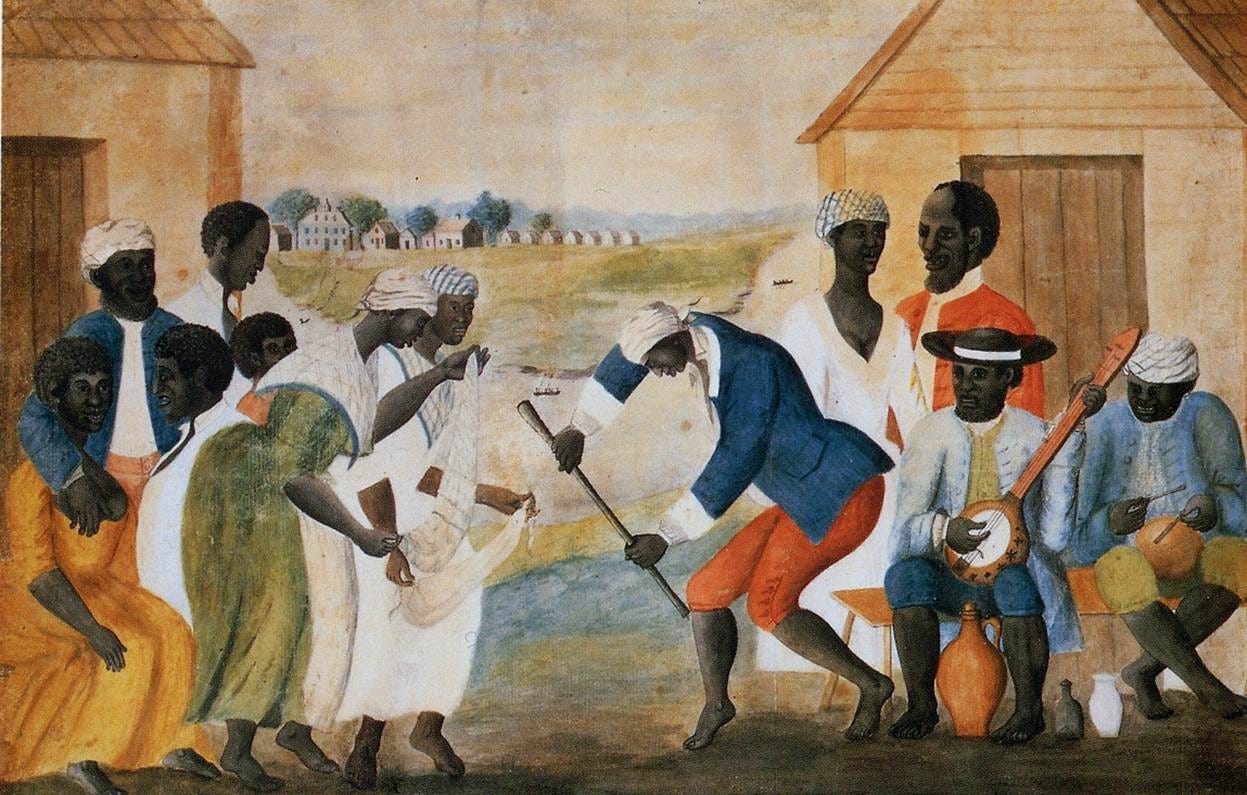
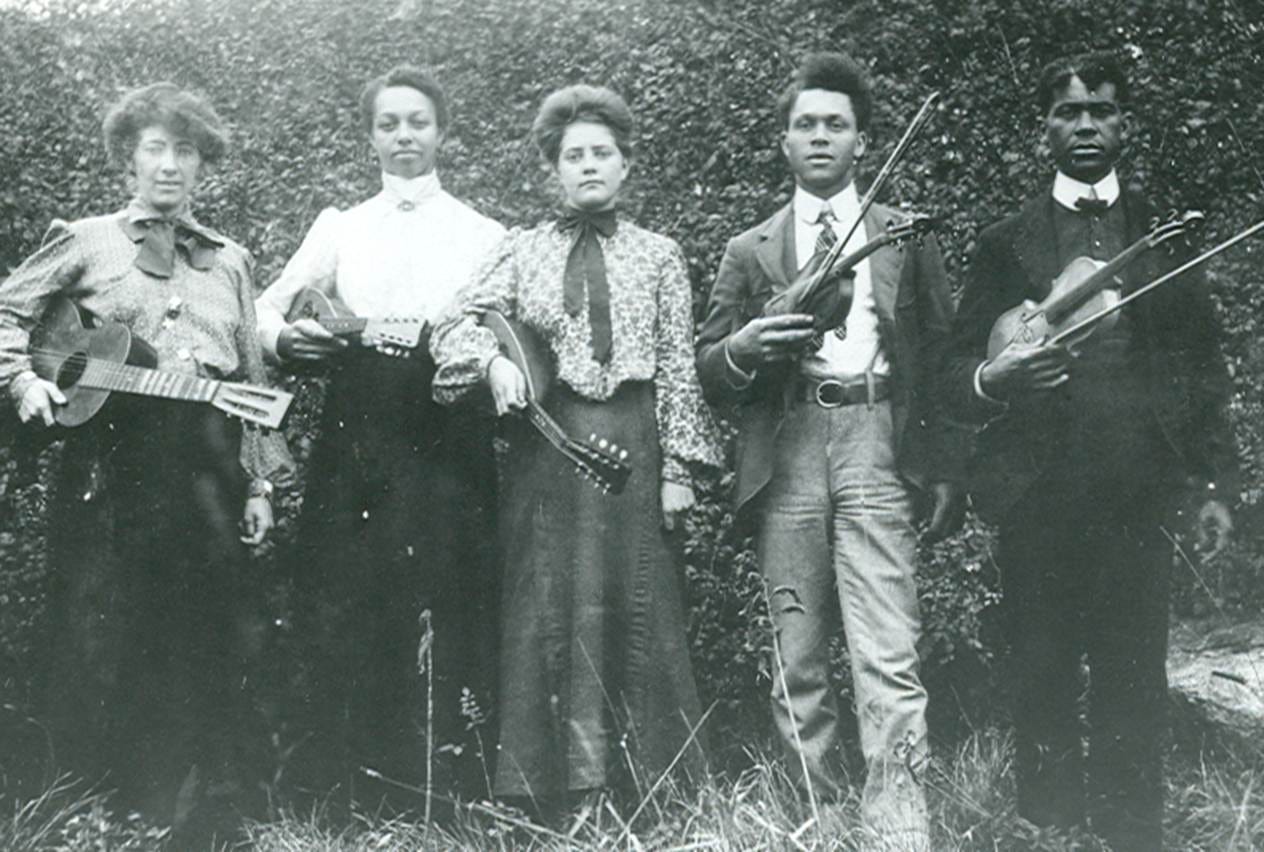
This is, of course, also the origin of American country music, as the chapter explains. Recordings of string music from black musicians clearly show these lineaments, combining the banjo, guitar, and the scotch-irish fiddle tradition – the latter of which derives from the medieval fiddle, developed out of the Byzantine lira. See, for example, this archival recording:
These origins are fairly well documented today and need no further articulation here, though the chapter covers the basics, such as the relationship between Lesley Riddle and the Carter Family, which was more generally representative of an early country music (at the time marketed as “Hillbilly Music”) trend in which white artists doing the recordings had learned from black artists who remained largely unrecorded. But the more interesting transit, in my opinion, is the movement back to Africa. The chapter points to the earliest evidence of the reintroduction of the music tradition to places like Kenya, via the famous “Chemirocha” case, in which the Kipsigis people were exposed to early recordings of Jimmie Rodgers by missionaries and subsequently came to perceive Jimmie Rodgers as a mythical figure, featured in a number of Kipsigis songs that were then recorded by an anthropologist. Examples of these recordings are included in the playlist below. And here is a video going into that history in more detail, tracking down ancestors of the Kipsigis asked to make those original recordings:
The chapter then reviews how American country music was popularized across the continent and, in particular, within anglophone countries, which then spawned new generations of local country musicians as early as the 1950s. See, for example, the Bulawayo Blue Yodel collection of Country-Western music from Zimbabwe, South Africa, and Kenya in the 1950s:
Or the Ivory Coast group Jess Sah Bi & Peter One from the 1980s:
In fact, here is an entire Bandcamp Guide on the genre in this early period.
Today, the genre remains populated by American imports. But there are a number of local artists recording their own covers and original songs. Kenya, in particular, has become something of the center of African country music, with a number of original artists: Ythera Cowgirl, Steve Rogers, Sir Elvis, to name only a few. Often, they perform covers of classic country songs in English or local languages like Kikuyu. See, for example, Ythera Cowgirl’s cover of Dolly Parton’s “Coat of Many Colors”, here:
They also write original songs in local languages, as in “Thìì Nã Ikínyã” by Steve Rogers:
And, of course, their own originals in English, as in “Loving Man” by Sir Elvis:
Nor are local artists limited to Kenya. See, for example, Dusty & Stones, from Eswatini:
Moreover, the countryside genre’s popularity has been growing alongside the development of the countryside itself, in a pattern similar to that which popularized country music in the US itself, not to mention genres such as luk thung in Thailand, discussed in an earlier chapter of the book and featured on a different soundtrack post. A range of songs from African country artists are featured on the playlist below. But the rising popularity of country music across Africa has also been occurring in the midst of a re-popularization of the genre in the US itself. While country music has obviously always been a major popular musical genre, this popularity has seen substantial demographic fluctuation, appearing to pass through moments of narrowing appeal limited to a core audience crafted via mid-century marketing campaigns followed by broadening appeal that appears to threaten that pseudo-traditional core constituency. This threat is often posed in racial terms, as when the release of “Old Town Road” by Lil Nas X and the rise of Shaboozey to the top of the charts helped revive the genre’s popularity in the late 2010s, thereby also reviving tired debates about what constitutes “real” country music – debates which are always, in fact, about who is allowed to be considered a “real” country artist.
But the reality is that country music has always had a broad popular appeal that extends well beyond the white core demographic crafted by mid-century record labels. This has been particularly clear in the adoption of the genre by native artists, long present in the genre. For example, Lakota singer Buddy Red Bow, who recorded throughout the 1980 sand 1990s:
By the time of the late 2010s country revival, indigenous country musicians were gaining popularity in every corner of the genre. William Prince, a Saulteaux artist from Manitoba, released a series of albums in these years before seeing his Opry debut in 2023:
Choctaw-Apache artist Vincent Neil Emerson also released his first album in 2019, followed by a series of new albums over the subsequent years and prominent features of his music in TV shows like Reservation Dogs and Yellowstone. Nor has this popularity been gained by disguising its indigenous origins. In fact, just the opposite. In his song, “The Ballad of the Choctaw-Apache,” included in the playlist below, he recounts the displacement of Chotcaw-Apache associated with the Toledo Bend Reservoir. The video for “Little Wolf’s Invincible Yellow Medicine Paint” similarly places its indigenous themes front and center:
More recently, Blaine Bailey, a Keetoowah Cherokee singer, gained increasing popularity after the release of his album Indian Country in 2025, with a more or less neotraditionalist sound:
Many native country artists also incorporate broader elements of americana and folk, as with Metis singer-songwriter Kyle McKearny:
And Cherokee singer-songwriter Ken Pomeroy, from Oklahoma, who has a track featured on the soundtrack below:
While others, such as Christian Wallowing Bull, push at the edges of the genre itself. See his track “Wallowing Bull,” inset into a miniature documentary video set on the Wind River reservation in Wyoming:
But perhaps the most extreme example of such syncreticism is in the work of artists like Rhiannon Giddens, who draws from her own black, indigenous, and white Appalachian heritage and from a wide range of americana, folk, gospel, bluegrass, soul, blues, Celtic, and country influences to effectively weld traditional American music back together into a single corpus. The country and bluegrass dimensions are particularly clear in her collaboration with Justin Robinson:
One of my personal favorites among the new generation of indigenous country artists, again featured on the soundtrack below, is the neotraditionalist Cherokee-language album “Nasgino Inage Nidayulenvi” by Agalisiga “Chuj” Mackey, whose background and approach to songwriting is described in this article. The album is available here:
And this live performance is worth watching as well:
This resurgence of native country musicians has been part of a larger, grassroots resurgence of the genre as a whole in the US, playing out beneath the more spectacular mainstream success of chart-leaders like Shaboozey and major-label artists like Morgan Wallen. Perhaps ironically, much of this new crop of country music derives somewhat directly from the oogle, crust punk, and busking traveler culture of the 2010s. It is no exaggeration to say that several of today’s most prominent indie country artists first learned to play a banjo so they could busk with their folk punk band riding the trains and running the old circuit through New Orleans, Oakland, Arcata, and Olympia. The best-known of these artists are figures like Sierra Ferrel and Charley Crockett, but the list would also include Nick Shoulders, Benjamin Todd, and Vincent Neil Emerson. Meanwhile, a similar spirit is captured by the Appalachian traditionalist revival epitomized by both neo-traditionalist artists like Tyler Childers and the new, weird country of singers like Willi Carlisle:
In all of these ways, the genre has been forced back to its proletarian roots and, even when the long road through homelessness and addiction leads back to a life of farming and church-going, the genre itself has attracted a substantial left-wing following. Nearly every city’s left-wing political milieu now has a not-insubstantial subculture of communist country and bluegrass fans and musicians. Though similar in kind to the leftwing folk phenomenon of the 1960s, the distinguishing feature of today’s communistic country music is its paradoxical but simultaneous stress on neotraditional sentiments and extreme experimentalism, driving the genre both back to its roots and out toward new realms of proletarian experience.
Many of these trends are well-documented by streaming outlets and social media promoters such as Western AF, Gems on VHS, and The Sticks Music which today fill something like the role played by local radio stations in the genre’s early development, providing a relatively accessible platform for new artists that’s also capable of plugging into a broader audience on social media, assisted by the outlets’ own refusal to be confined to any single genre (they are hardly limited to American country and folk music). The disposition of these outlets is something closer to the diy punk ethos and much of the audience is, doubtlessly, semi-retired hardcore fans. The genre itself is also absorbing new musical strains in subtle ways and reinventing itself in new directions. On the one hand, this is visible in vocal approaches that emulate those in proximate popular genres. For example, the unique, near-emo singing technique used by Alyssa Grace:
Or the working class “grunge country” of Sam Donald, which calls up the spirit of Southern Rock routed through Nirvana:
This grunge disposition also allows for one of my all-time favorite covers, by Stephen Wilson Jr:
On the other hand, this reinvention is often openly experimental. We see this in the rise of ambient country as a genre unto itself, represented by figures such as Austin Ray:
Alongside Hayden Pedigo, who recently released a collaborative album with experimental metal band Chat Pile:
But perhaps the most extreme example comes from figures like Elly Crampton Chuquimia Quiñones-Tancara, who releases country-inflected experimental electronic music under the name Chuqimamani-Condori, including both original tracks:
And a series of edits and covers:
They’re also a regular host on NTS Radio.
That said, the playlist below offers a slightly narrower view of contemporary country, focusing in on relatively traditionalist approaches, interwoven with songs by country artists from Africa:
Thanks for reading The Planetary Factory! This post is public so feel free to share it.
[1] Charlotte Roueché, Aphrodisias in Late Antiquity, Society for the Promotion of Roman Studies, Journal of Roman Studies Monograph No. 5, 1989. P.174
No posts
Comments
Nothing yet. Say the first thing.
Sign in to join the conversation.