
The future of architecture is often discussed as a technology question.
Will artificial intelligence replace architects?
Will clients generate their own designs?
Will platforms automate documentation, compliance, visualisation and project delivery?
Will architects still be needed when software can produce hundreds of options in seconds?
These questions matter. But they are not the deepest questions facing the profession.
The deeper question is this:
What will architecture be for?
By 2050, the world will be very different. Artificial intelligence will be woven into everyday design work. Climate adaptation will no longer be optional. Material scarcity will shape what can be built. Existing buildings will need to be repaired, adapted and reused at a much larger scale. Communities will expect more influence over the places they live in. First Nations custodial authority will continue to challenge the assumption that land is an empty site waiting for a project.
In that world, architects may still design buildings.
But designing buildings may no longer be enough to describe the role.
The profession will need to decide whether it is mainly a service to clients and assets, or whether it is also a public, cultural and ecological practice. It will need to decide whether it defends inherited territory, or whether it reimagines its value for a time of transition.
I recently completed a scenario inquiry into the future role of the architect to 2050. It began with a simple question:
How might the role and identity of the architect evolve between now and 2050, as the profession navigates AI disruption, ecological crisis and civilisational change?
The scenarios that emerged are not predictions. They are four possible worlds. Each one is already visible in fragments around us.
They are useful because they show that the future of architecture will not be determined by AI alone.
AI will matter deeply. But AI is an amplifier. It will strengthen whatever system governs it.
The real issue is not whether architects use AI.
They will.
The real issue is who controls design intelligence, and what purpose it serves.
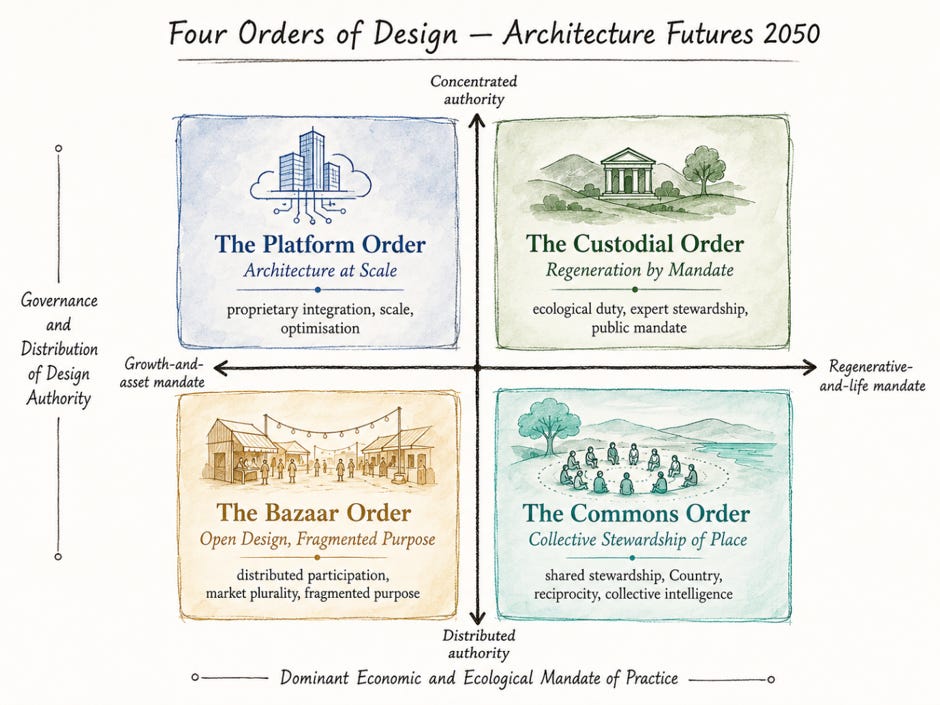
The scenario inquiry was built around two big uncertainties.
The first is about authority.
Who will have the power to define, generate, evaluate and approve built-environment decisions?
Will authority become more concentrated in governments, corporations, platforms, regulators and large professional systems?
Or will it become more distributed across architects, communities, First Nations custodians, civic institutions, allied disciplines and public technologies?
The second uncertainty is about purpose.
What will architecture mainly serve?
Will practice remain organised around growth, asset value, property development, speed, yield and construction throughput?
Or will it shift toward a regenerative purpose: caring for Country, climate, community, material cycles, future generations and the long-term life of places?
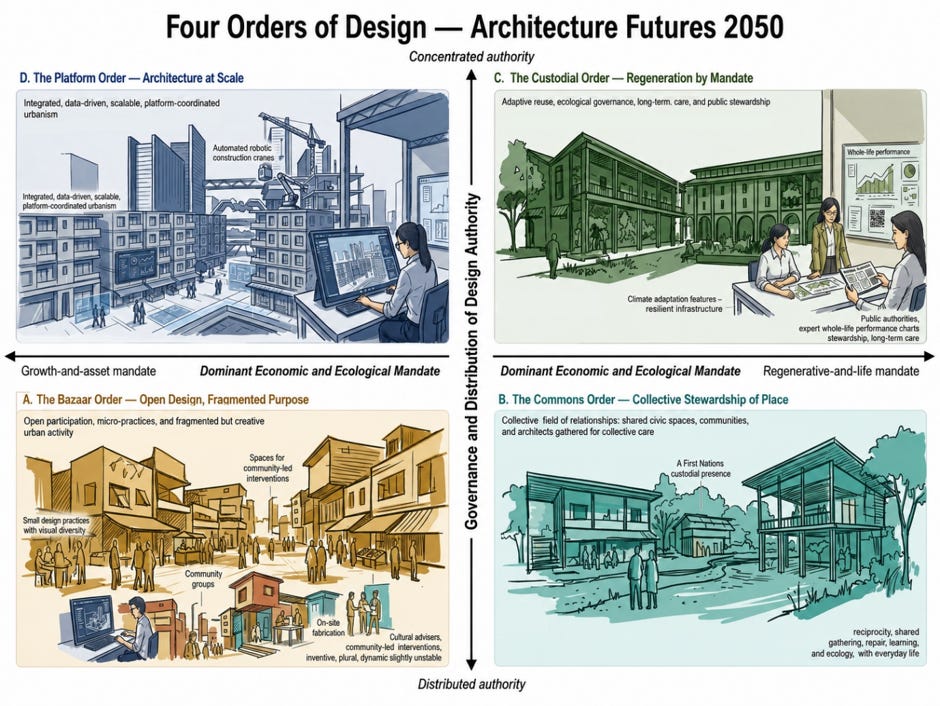
When these two questions cross, four future worlds appear.
I call them the Four Orders of Design.
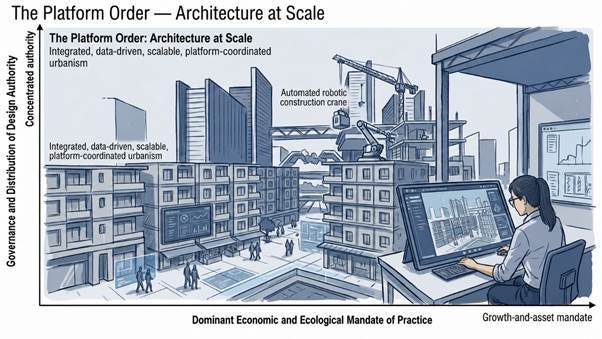
In the Platform Order, architecture is increasingly organised through large technology, development, finance and construction platforms.
AI systems generate options. Automated compliance tools test regulations. Digital twins monitor performance. Component libraries connect design to manufacturing. Housing can be delivered faster. Defects may fall. Energy performance may improve. The process becomes more integrated.
This future is not a cartoon dystopia.
In many ways, it works.
Governments under pressure for housing supply may welcome it. Clients may welcome certainty. Developers may welcome speed. Communities may receive more options than conventional mass housing once allowed.
But there is a danger.
Design intelligence becomes enclosed.
The data, rules, assumptions and choices that shape the built environment sit inside proprietary systems. Architects may still be involved, but their role changes. Some become platform curators. Some become systems auditors. Some customise atmosphere and experience. Others operate within workflows designed elsewhere.
Architecture scales.
But the architect is contained within the systems that make that scale possible.
The key question in this world is:
Who governs the platform?
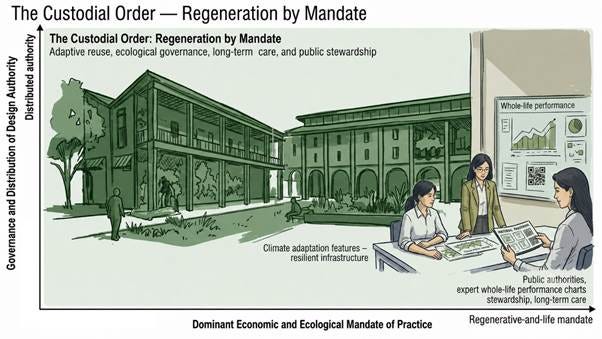
In the Custodial Order, ecological limits become unavoidable.
Climate damage, insurance pressure, carbon targets, material scarcity and public safety concerns push governments to act more strongly. Demolition becomes harder to justify. Whole-life carbon becomes central. Existing buildings are treated as material and cultural assets. Public authorities coordinate housing, infrastructure, water, energy, biodiversity and climate adaptation across regions.
Architects regain public importance, but on new terms.
They become custodians, building physicians, material stewards and public-interest advisers. They help decide whether a building should be repaired, adapted, retained, transformed or replaced. Their duty extends beyond the immediate client to future users, ecological systems and long-term public value.
This future has real strength.
It gives architecture discipline. It makes ecological responsibility more than a slogan. It recognises that private development decisions have public consequences.
But it also has a danger.
Care can become control.
If ecological responsibility is governed only through experts, regulators and compliance systems, the lived meaning of place can be flattened. Country can become a checklist. Community voice can become a procedural step. Regeneration can become another technical regime managed from above.
The key question in this world is:
Who decides what care requires?
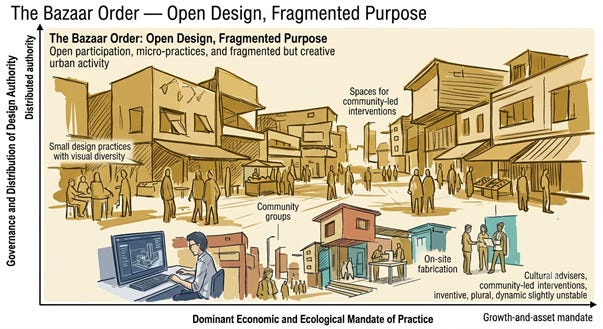
In the Bazaar Order, design tools become widely available.
Clients use AI directly. Communities generate their own visions. Micro-practices multiply. Manufacturers offer configurable systems. Designers, facilitators, cultural advisers, coders and builders form temporary networks around projects.
The old professional boundary becomes more porous.
This future is alive with possibility. It opens doors. It allows more people to shape places. It challenges the idea that architectural imagination belongs only to registered professionals or elite firms.
Architects become network brokers, trust anchors, civic translators, participatory facilitators and entrepreneurial specialists.
But the deeper economic purpose often remains unchanged.
Land value, property ownership, development yield and market visibility still dominate. More people may participate in design, but they may still be playing inside the same extractive game.
Participation expands.
Authority does not necessarily follow.
Country-Centred Design can become a marketable style. Co-design can become a way to de-risk development. Sustainability can become a branding layer. Communities may be invited to shape the look and feel of a project without changing who owns the land, who captures the value or what the project is really for.
The key question in this world is:
Does participation change power, or only decorate it?
The Commons Order is the most hopeful future.
It begins with a different question.
Not, “What can we build here?”
Not even, “What does the client want?”
But:
What relationships sustain this place, and who must participate in deciding their future?
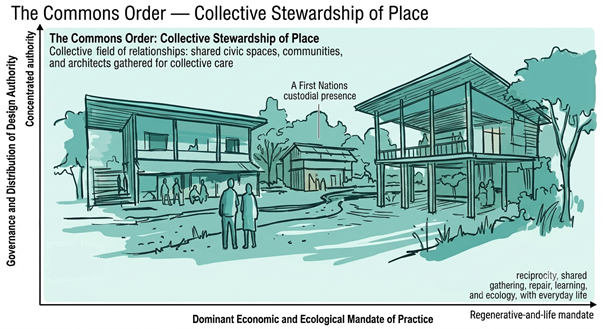
In this world, architecture becomes a practice of collective stewardship.
Communities help shape the brief. First Nations custodians hold real authority in matters affecting Country. Public institutions protect ecological limits. Architects bring technical, spatial and ethical judgment. AI helps people see consequences, but does not decide for them. Metropolitan and bioregional bodies coordinate issues that cross local boundaries: heat, water, materials, biodiversity, housing and infrastructure.
The architect does not disappear.
The role becomes more demanding.
Architects help hold together knowledge that is usually separated: client needs, community life, Country, ecology, material histories, climate risk, AI-generated possibilities, construction realities, financial limits and future consequences.
Sometimes the result is a building.
Sometimes it is repair.
Sometimes it is adaptive reuse.
Sometimes it is a shared-use agreement, a material recovery plan, a cooling network, a stewardship contract or a decision not to build.
This future is not easy.
Participation takes time. Shared authority can become messy. Local voices can exclude others. Responsibility can become diffuse. Good intentions can become process fatigue.
But the Commons Order points toward a deeper possibility.
Architecture becomes less about imposing form and more about sustaining life together wisely.
The key question in this world is:
Can we share authority without losing responsibility?
Of the four futures, the Commons Order is the one I would most want to work toward.
But I do not think the answer is to choose the Commons and reject everything else.
Each future contains something architecture will need.
From the Platform Order, we need integration. The built environment is too complex to govern through disconnected fragments. We need better tools, better data and better coordination. But we need them without proprietary enclosure.
From the Custodial Order, we need discipline. Climate, carbon, biodiversity, water and materials cannot be left to aspiration. There must be ecological floors that cannot be negotiated away. But discipline must not become paternalism.
From the Bazaar Order, we need openness. Architecture has been too closed, too expensive and too attached to professional mystique. More people should be able to shape the places that shape them. But openness must not become fragmentation.
From the Commons Order, we need shared stewardship as the guiding purpose.
That is why the preferred future is Commons-led, not Commons-only.
It is not anti-technology.
It is not anti-expertise.
It is not anti-institution.
It is not anti-market.
It is a reordering of these things around life, place and responsibility.
The old image of the architect is no longer enough.
The heroic author is too narrow.
The compliant service provider is too small.
The platform operator is too passive.
The neutral facilitator avoids too much responsibility.
The future architect may need to become something else:
an integrative steward.
This does not mean the architect knows everything. It means the architect helps bring things into relationship.
The integrative steward can work with AI without surrendering judgment.
They can read an existing building before rushing to replace it.
They can ask what materials remember.
They can see a site as Country, not just property.
They can help a community imagine more than one future.
They can tell a client when the brief is too small for the consequences it will create.
They can hold technical, cultural, ecological and financial realities in the same conversation.
They can design buildings, but they can also design agreements, processes, transitions and forms of care.
Most importantly, they can help society see what it is building before that future hardens around us.
This is not a retreat from architecture.
It is a deeper version of architecture.
A building has never been only an object. It is a decision about how life should be arranged. It shapes memory, movement, energy, heat, belonging, exclusion, maintenance, cost, care and future possibility.
Every project is a proposition about reality.
It says something about what matters.
In 2050, I hope architects are not asking only how to remain relevant.
I hope we are asking how to become worthy of the moment.
The future of architecture should not be measured only by what we are able to produce.
It should be measured by what we are able to hold.
Can we hold Country?
Can we hold climate?
Can we hold community?
Can we hold the future users who are not yet in the room?
Can we hold the more-than-human life affected by our decisions?
Can we hold the courage to repair instead of replace?
Can we hold the humility to share authority?
Can we hold the discipline to say no?
If architects can do that, the profession has a powerful future.
Not as the master of the built environment.
Not as the servant of the market.
But as a steward of relationships across place, time and life.
That future will not arrive by itself.
It has to be designed.
Four Orders of Design: Architecture Futures 2050 and the Future Role of the Architect is available as a FutureSense Signature Paper (11200 words). It is not a technical report. It is a scenario inquiry, written for architects and urban designers who care about the future purposes of architecture, shaped by forces of change such as AI, ecological crisises and civilisational change.
Thanks for your attentive spirit and for reading Poetic Designs! If this field note resonates with you, please do me a favour and share it with your comment.
Comments
Nothing yet. Say the first thing.
Sign in to join the conversation.