
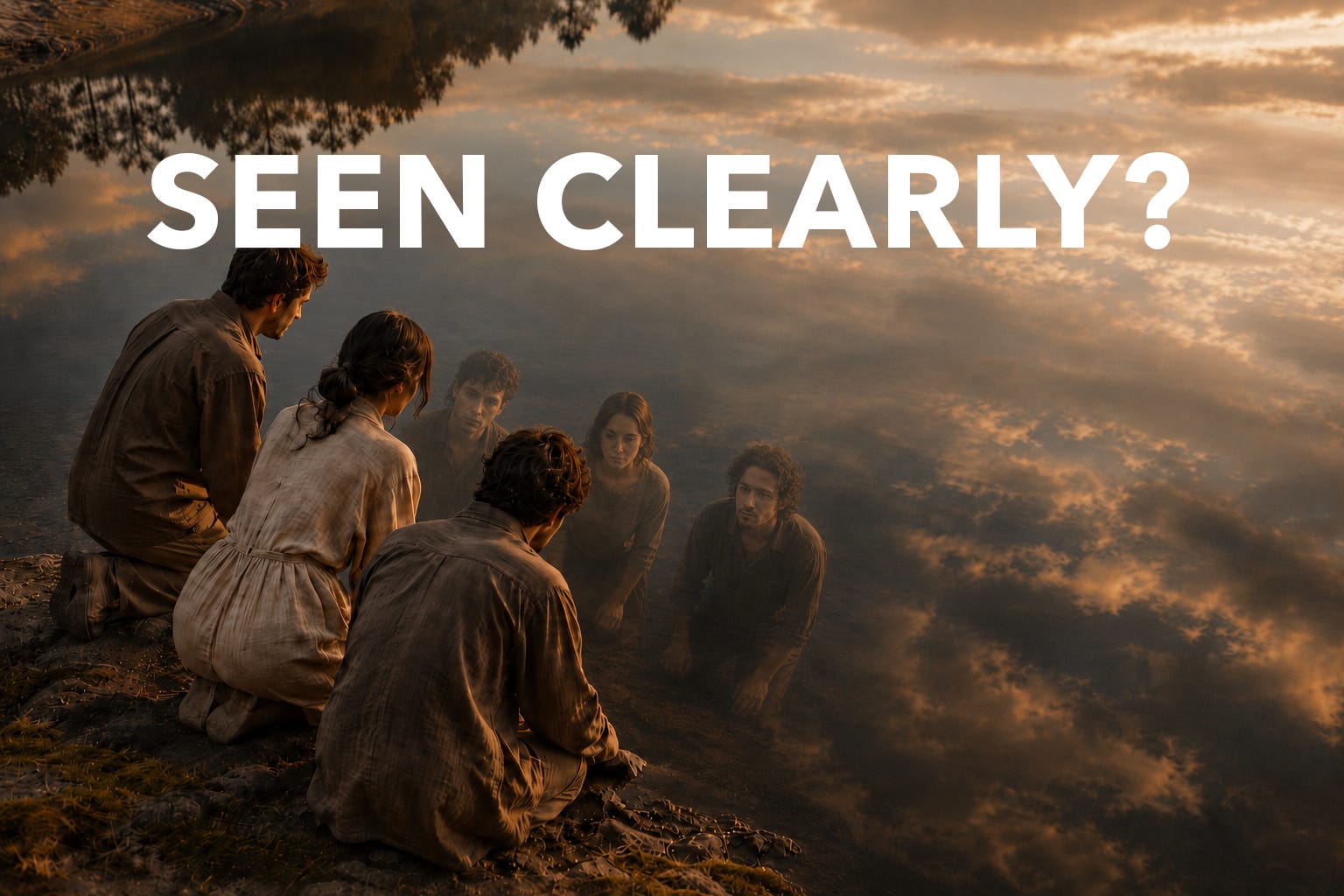
Not every mirror helps us grow.
Some mirrors distort. They show us only our failures, our awkwardness, our unfinished edges. They make us shrink around the part of ourselves that feels least capable.
Other mirrors flatter. They show us only what we want to see. They protect us from discomfort and call that kindness.
Neither kind wakes growth.
The mirror this law points towards is different. It reflects with compassion and clarity. It shows what is present without reducing us to it. It reveals the edge of what wants to grow without turning that edge into shame.
Still water shows the face clearly. Disturbed water shows only the disturbance.
The quality of the mirror determines what becomes visible.
I keep returning to a spring morning in Nambour in 1998.
We gathered in Quota Memorial Park, with Petrie Creek moving nearby and red bottlebrush trees heavy with nectar. Lorikeets lunged and squabbled overhead, all colour and appetite.
Kelvin Spiller walked us through the park with easy authority. He was then leading Maroochy Shire Council through organisational change, but the lesson did not arrive as a lecture. It arrived as a slim yellow book passed from hand to hand.
Who Moved My Cheese?
No grand theory. No heavy explanation. Just the invitation to recognise ourselves.
Kelvin trusted us to notice our own relationship to change. Who was resisting? Who was adapting? Who was waiting for the room to decide what was safe to say?
His phrase became a kind of refrain.
“Like it. Live with it. Or leave.”
He did not say it as a threat. He said it like a choice we were trusted to make.
That mattered.
A lesser mirror would have judged resistance. A softer mirror would have pretended resistance was not present. Kelvin’s mirror did neither. It reflected the situation clearly enough for us to locate ourselves within it.
Perhaps the reframe is this.
Feedback is not correction.
At its best, feedback is a relational mirror in which truth and possibility become visible together.
This is why mirroring cannot be reduced to technique. The interior condition of the person holding the mirror matters. If the mirror is clouded by agenda, irritation, superiority, or the need to manage another person, the reflection carries that distortion.
But when the mirror is held with presence, something developmental becomes possible.
A teacher sees readiness before the student trusts it.
A mentor names capacity before the emerging leader fully claims it.
A friend reflects a pattern without imprisoning the person inside that pattern.
Growth is not forced. It is scaffolded into visibility.
Years after that walk in Nambour, a manager leaned towards me during a branch meeting and said something I have never forgotten.
“You listen, often silent. But when you speak, the whole room listens.”
I felt the sentence land in my body.
Not as ego.
As recognition.
She had named something I had not fully seen. A capacity was reflected back with enough care that I could begin to trust it. That is how growth often wakes. Not through being pushed, but through being accurately seen.
Rosa Parks held a mirror of another kind.
Her refusal to give up her seat in Montgomery did not command a community to rise. It reflected a truth that thousands already carried in their bodies.
We do not have to perform our own subordination.
That reflection became movement because people recognised themselves in it. Not only the violence of segregation, but the dignity that had not been extinguished by it.
Ubuntu offers the deeper relational ground for this law. A person becomes a person through other people. We are not sealed selves, growing alone by private will. We become through recognition, responsibility, truth-telling, and the relationships strong enough to hold us at the edge of change.
To mirror another person well is an act of care.
It asks us to see without rushing to fix.
To name without diminishing.
To reflect the shadow without removing the light.
To recognise potential without forcing performance.
This matters in leadership because people and systems often cannot become what they cannot yet see.
A team may not recognise the wisdom already present in the room.
A community may not see its own courage until someone reflects it back.
A leader may not notice the pattern they are repeating until it is named with enough compassion to be faced.
A true mirror does not shame people into growth.
It helps growth recognise itself.
That is why relational intelligence culminates here. Not with agreement. Not with harmony. Not even with trust alone. It ends with the capacity to hold a mirror clear enough that truth can be faced, and generous enough that possibility remains visible.
The purpose of relationship is not comfort.
It is growth and awakening.
I have held derivative content, as requested.
If you prefer to listen, this week’s 3-minute video explores Law 44 — Mirror to Wake Growth.
Book drafting continues steadily. Law 44 is part of the Relational Intelligence cluster within the 48 Laws of Regenerative Power.
Next week I’ll share Law 45: Pace Evolution Wisely
Thanks for your attentive spirit and for reading Poetic Designs! If this field note resonates with you, please do me a favour and share it with your comment.
Comments
Nothing yet. Say the first thing.
Sign in to join the conversation.