
I spent my teenage summers breading and deep-frying clams at a Howard Johnson’s on the Garden State Parkway. By August the kitchen was its own weather system, that wall of heat off the fryer stacked on top of whatever New Jersey was already doing outside. Nobody called it climate anything back then. It was just August. Fifty summers later I read about a 900-year-old bank vault in Emilia-Romagna running its cooling systems overtime to keep half a million wheels of cheese from going soft, and I thought: same problem, bigger scale.
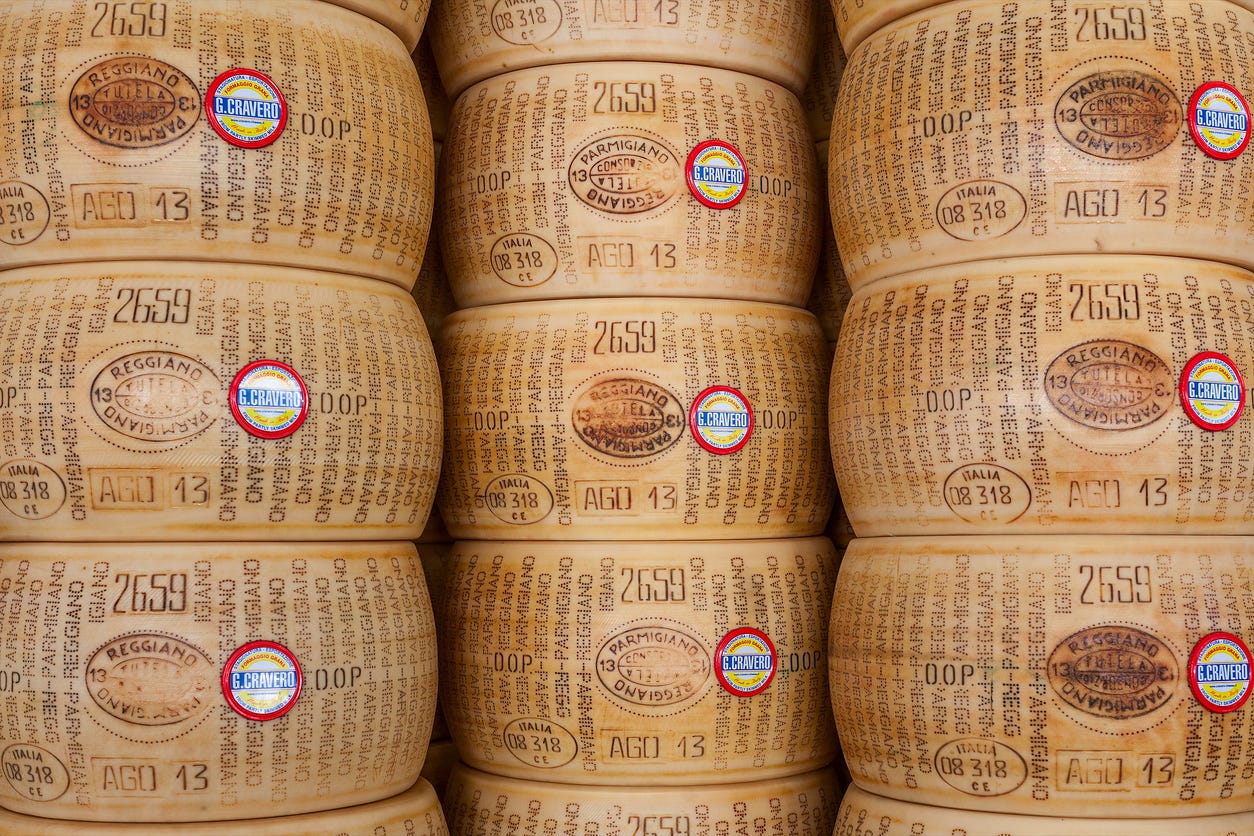
This is a genuinely strange story. Since 1953, an Italian bank called Credito Emiliano has taken Parmigiano Reggiano as loan collateral, young wheels straight from the dairy, aged a year or more in a climate-controlled warehouse while the bank lets farmers borrow against what the cheese will be worth once it’s ready. Clever setup. It’s also gotten expensive in a way it wasn’t five years ago. This year’s heat pushed daily energy use at those warehouses up roughly 30%, and the bank has had to spend real money on cooling systems and insulation just to hold the temperature and humidity a wheel needs to mature safely.
The cows feel it too. Heat-stressed dairy cows lie down more, eat less, and give up to 10% less milk in a bad year. My father spent his career in the cheese business, and he had one rule: when milk output drops, so does cheese output, and the price adjusts all the way down the chain. A Wharton economist quoted in the Fortune piece on this put it well, heat’s economic toll usually doesn’t show up all at once. It hides, then it lands on somebody’s balance sheet months later. That’s Emilia-Romagna right now.
Same heat, different foods. Franciacorta's wine harvest started July 30 this year, the earliest ever recorded, after bud break came in more than a week ahead of schedule. Sicily's growers stretched their picking across nearly 100 days, working microclimate by microclimate to stay ahead of repeated heat waves. Coldiretti, the big Italian farm group, has been tracking the toll at the national level: drought and flooding tied to the climate crisis have cost Italian agriculture more than 20 billion euros over the past four years, with 2026 alone already adding another 1.5 billion euros in damage from extreme weather, according to the Italian Farmers’ Association. Olive oil tells the same story from a different angle: this year’s national output is projected around 270,000 to 300,000 tons, well under the historical average of more than 350,000 tons. When a harvest window compresses or shifts, everything downstream, labor scheduling, transport capacity, mill throughput, gets affected.
Personal note: Even the Supermarket Guru needs a week off the shelves. The Lempert Report is taking a break the week of August 24th—vacation time! We'll be back to our regular Tuesday/Friday schedule starting September 1st. If anything big breaks while I'm out, don't worry—I'll write it up and get it to you that week regardless.
I’ve spent a good chunk of my career watching the coffee category and I’ve never seen prices fluctuate like this. Arabica futures hit a record $4.38 a pound in February 2025 on the back of Brazil’s worst drought in memory. By June of this year, prices had fallen back toward $2.39, then spiked nearly 50% in a single month, the sharpest weekly gain since 2000, before settling in the $3.20 to $3.40 range on renewed concerns about Brazilian harvest quality and a new U.S. tariff on Brazilian imports. Brazil and Vietnam together grow close to half the world’s coffee, so when either country’s weather swings, the whole category feels it. Droughts have always happened; what’s changed is how violent and unpredictable the swings have gotten, and every roaster and retailer now must buy their futures by betting against weather – that’s easier said than done.
Behind every one of these stories sits the unglamorous infrastructure of refrigeration. Cold storage construction now runs $130 to $350-plus per square foot, two to three times the cost of a standard dry warehouse, mostly because of the insulation, refrigeration systems, and backup power that extreme heat now demands as table stakes rather than upgrades. When I first started working for my dad, I toured a cold storage warehouse and asked why the walls were a foot thick. Now I know. The people I follow in cold-chain trade press are calling 2026 a pivotal year for the sector, smarter refrigeration controls, AI-driven energy management, because heat events that used to hit once a decade are landing closer to once a summer. Layer the Kigali Amendment’s phase-out of HFC refrigerants on top of that, and the whole industry is rebuilding its cooling infrastructure at the exact moment the climate is raising the stakes on getting it right.
Then there is diesel. Reefer trailers run their cooling units on diesel, independent of the truck's engine and the price of diesel has climbed from $3.56 a gallon in January 2025 to $5.13 since the Iran conflict began, reacting even more sharply than gasoline because diesel markets are so exposed to shipping disruptions through the Strait of Hormuz, the corridor that normally carries roughly a fifth of the world’s oil. A cold storage facility runs on electricity. Getting product to and from that building, and the backup generator that kicks in when the electric grid fails during a heat event, runs on diesel. Add it all up and the cold chain is getting squeezed by heat on one side and a war on the other.
Researchers tracking the relationship between warming and foodborne illness have documented a connection between rising temperatures and elevated Listeria and Salmonella alerts, and warming oceans are extending the range and duration of harmful algal blooms that make shellfish unsafe. Wetter, hotter patterns are widening the window for mycotoxins in staple crops like maize and wheat.
I’ve written before about this year’s cyclospora outbreak tied to Taylor Farms iceberg lettuce, and about the FDA’s decision to push back the Food Traceability Rule’s compliance deadline from January 2026 to July 2028. A food safety system that’s already been thinned out by staffing cuts and delayed rules has less margin for the added pathogen pressure that heat and humidity are now bringing to the table. This is a dangerous situation and it’s one grocers and processors need to plan for rather than just react to when there is a problem. The retailers and brands that treat climate risk as a supply chain and food safety issue, are the ones who’ll keep product on shelf and prices within reach.
You’ve heard me talk and write for years about the Fifth Force of Food Inflation, the pressure sitting underneath labor, transportation, packaging, and commodities that quietly resets what things cost at the register. Climate is that fifth force, and I don’t think most retailers are pricing it in yet. My father used to tell me the market always collects, one way or another. He was talking about milk quotas in 1975. He’d probably say the same thing today about a bank vault in Emilia-Romagna cranking its air conditioning to protect 300 million euros of Parmigiano. Some things really don’t change.
Thanks for reading The Lempert Report!
A behind-the-scenes note: I use AI tools to help with research, tagging, proofreading, and fact-checking on The Lempert Report. The take is always mine - 40 years in this industry doesn’t come from a prompt.
Comments
Nothing yet. Say the first thing.
Sign in to join the conversation.