
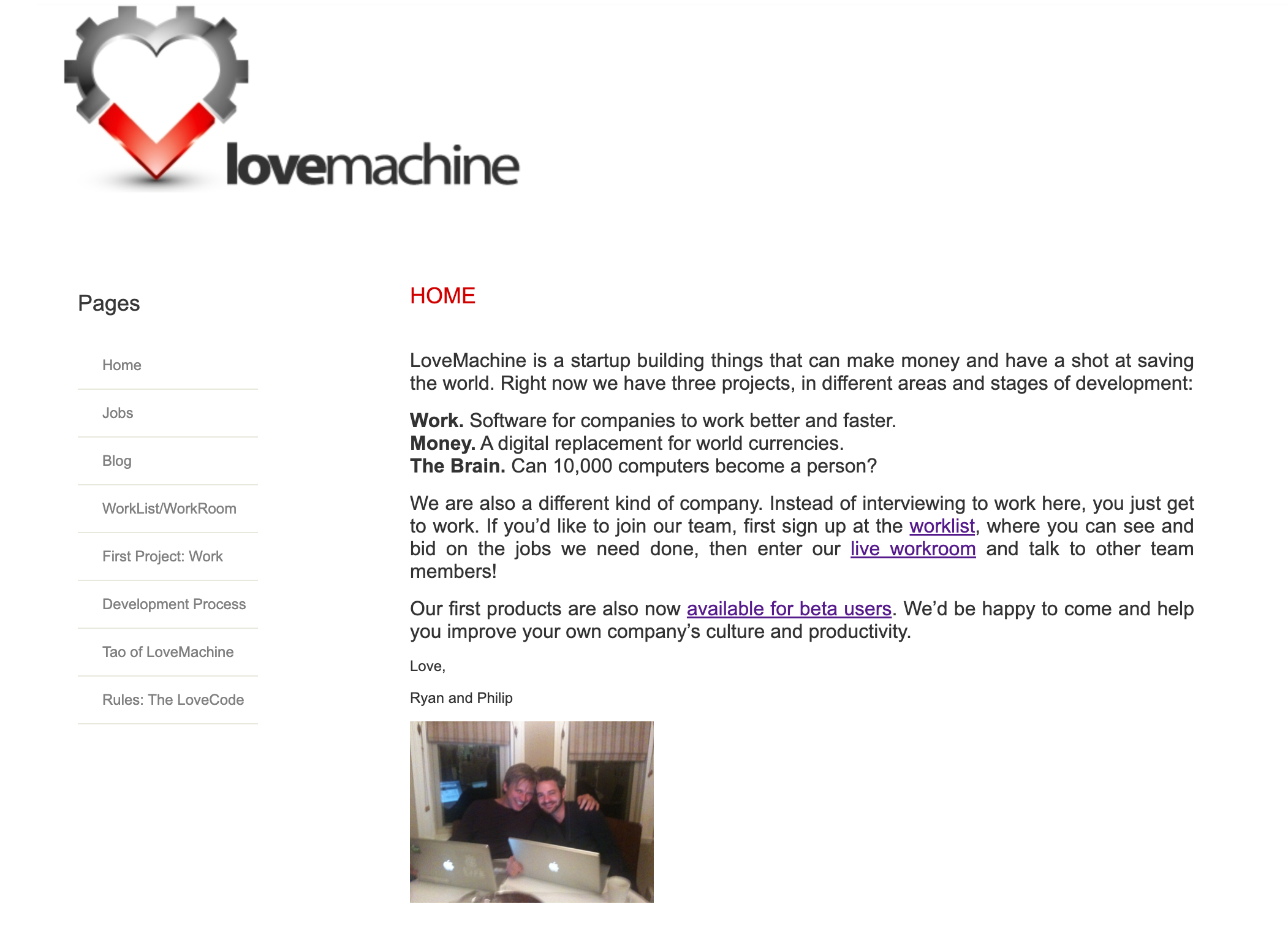
In late 2009, my friend Ryan and I left our jobs at Second Life (I had been CEO, and Ryan was Chief-of-Staff) to start a new company we decided to call Love Machine. We initially took the name from a piece of internal work-culture software that we had built inside Second Life and productized as a “stretching exercise” (as we called it at the time) - the first of three new ideas:
Work. Software for companies to work better and faster
Money. A digital replacement for world currencies.
The Brain. Can 10,000 computers become a person?
A few years later the Oculus Rift kickstarter showed up, and we pivoted our whole team to an exciting but ill-fated adventure to try and build a new kind of Second Life for VR headsets. It didn’t work out, because making VR headsets mainstream turned out to be much harder than anyone had thought — just ask Facebook.
But sixteen years later, those second and third ideas continue to capture my imagination and energy:
At CIMC.ai, we are designing artificial neural networks and architectures that mirror the bottom-up, self-assembling structure of the brain with the goal of creating consciousness in machines.
The digital money idea eventually became Fairshare, a design for how communities can re-take control of their economic destiny by printing their own digital money. And some of my friends are playing with an unreleased app that wraps the core Fairshare economic system in a new kind of contact manager and group messaging system… stay tuned, coming soon.
Looking back, I just love how the name pairs with that open-ended question about AI. It seems all the more poignant now, with many computers seemingly at the edge of becoming real in much the way I was imagining. Roughly, in terms of compute, those 10,000 circa-2009 PCs would have been equivalent to about ten H100s. And we are indeed seeing some very person-like thinking capabilities emerging from that scale of compute. Will we collectively build a love machine, or a hate machine? At the moment, the answer seems very uncertain.
The same ambiguity applies to digital money: We watched crypto begin to play out, with bitcoin appearing in that same year lovemachine launched. Many people shared the initial enthusiasm that crypto would be a powerful equalizer - giving everyone an equal ability to print their own currency and take power back from banks and governments. So far, that hasn’t happened. An arms race to build faster and faster computers to mine the increasingly-valuable cryptocurrencies meant that the resulting distribution was even more unequal than the government currencies we’d hoped to replace. A lot of development energy went into building increasingly sophisticated financial instruments to enable speculation on the volatile coins, rather than trying to simplify the UX and solve other problems around day-to-day use of digital money. But this could just as easily change. New kinds of digital money could indeed create local safety nets and life rafts to escaping the rapidly concentrating dollar. The right new kind of money could truly be a ‘love machine’. Financial technology, like all other technologies, is not inherently a force for good or evil. The choice is ours.
P.S. In our relentless efforts to ‘keep it weird’, we paid $100 to commission the logo in the picture above on one of those early crowdsourced design sites. In the posting, we said that lovemachine was a heavy metal band, not a software company.
love,
Philip
No posts
Comments
Nothing yet. Say the first thing.
Sign in to join the conversation.