
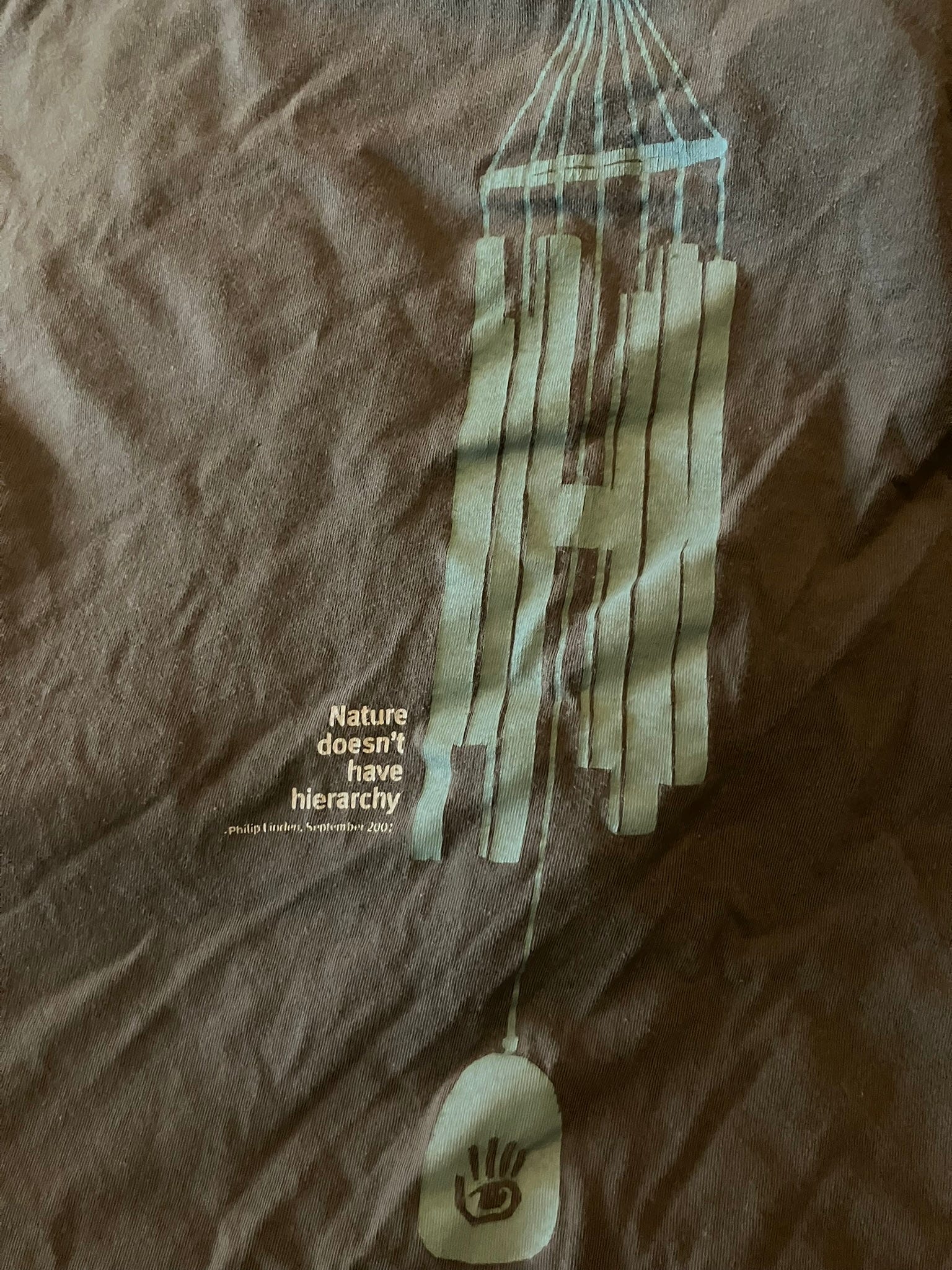
Second Life’s first CTO Cory and I got into an interesting design debate early on about the need for ‘hierarchy’ in virtual worlds. It became something of a running joke - so much so that the company printed the T-Shirt shown above to celebrate our 1 Millionth signup for Second Life. The image was a fun poke at me. My combative/inscrutable quote “Nature doesn’t have hierarchy” was there - alongside a picture of a lovely windchime that I had built with the early scripting language. Cory’s point was to confront me with a useful object that I myself had made, very much possessing the need for hierarchy: the ‘child’ chimes hanging from a central ‘parent’ ring.
At the heart of our actual debate was whether to imbue the fundamental primitives - the ‘atoms’ of Second Life - with an explicit knowledge of parents and children. I didn’t want to, and he felt that we wouldn’t be able to make lots of typical/useful things without them.
In the end, what we shipped was a mix. We added the ability to ‘link’ primitives into a ‘set’, but didn’t add the ability to be parents or children to primitives themselves. This made many things harder to build, and in retrospect maybe we should have gone with Cory’s idea. Probably a lesson in there somewhere about design-by-committee.
Looking back now, 20 years later, I think I better understand and can perhaps better articulate and defend the ‘gut’ sense I had back then about hierarchy that was driving the debate:
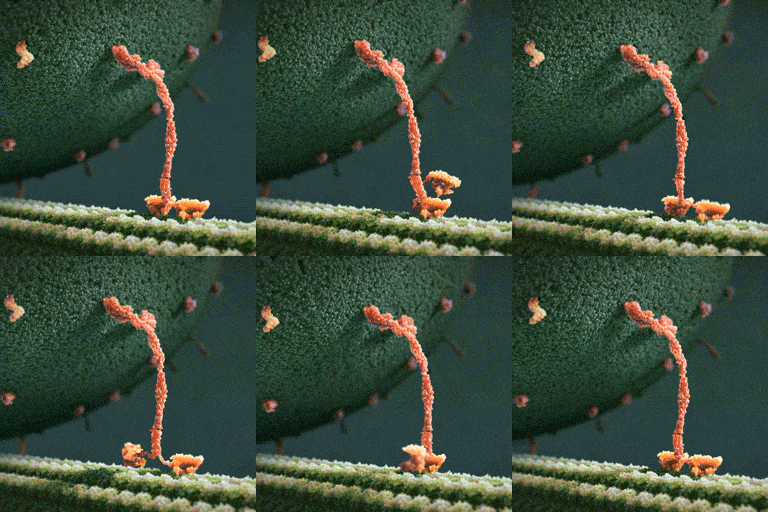
A beautiful example is be the emergence of multicellular life on earth, built from the lower layer of atoms: Atoms - when you examine them - don’t have any implicit structure readying them to connect to other atoms, and certainly nothing defining their place in a hierarchy with other atoms. Atoms are very simple - they only interact by bumping into each other, with their connections to other atoms being a result of electromagnetic forces and the details of their shapes and charges. They don’t store any additional hidden information (this is provable in various ways), meaning they certainly can’t store information about hierarchy. But if you wait billions of years and add a little free energy, you get something amazing like multicellular life, where you can certainly see a rich set of hierarchies: Cells contain ‘child’ parts, some of which were once simpler cells themselves. And the cells are often themselves part of larger structures such as organs. Inside the cells there are also amazing ‘creatures’ like the Kinesin ‘walker’ (shown above) that are clearly also expressing emergent hierarchy. Similarly, trees are obviously beautifully hierarchical - a branching network of roots connected by a central trunk to another branching network of limbs and leaves.
But the hierarchies of cells and trees are emergent - they were not there before. They arise from the interaction of a huge number of non-hierarchical parts (atoms). I wanted Second Life to be like that - to have very simple low-level rules that would give rise to hierarchy, not by building in in a-priori. While that has happened to some extent in social order and group behaviors, Second Life doesn’t (yet) have enough atoms jiggling around inside to give rise to emergent hierarchies.
This is an interesting topic to revisit because we now have computers fast enough to simulate worlds in which hierarchies and probably even life itself emerges from the underlying rules. Single cells are made up of around a trillion atoms, and people are made up of trillions of cells. Networked computers now have the capacity to simulate systems with comparable number of atoms, and it is likely that we will find shortcuts that can help create very complex evolving systems with a simpler system. For example we are already doing this with artificial neural networks like LLMs, where we can capture the essential functionality of a neuron without needing to simulate a trillion atoms.
So, in summary, this is an incredible time to be alive and the right time to be thinking about new kinds of virtual worlds. If we design the right ‘laws of physics’, we may soon be able to rapidly evolve life inside a simulation, and bring the search for extra-terrestrial intelligence to a CPU near you!
No posts
Comments
Nothing yet. Say the first thing.
Sign in to join the conversation.