
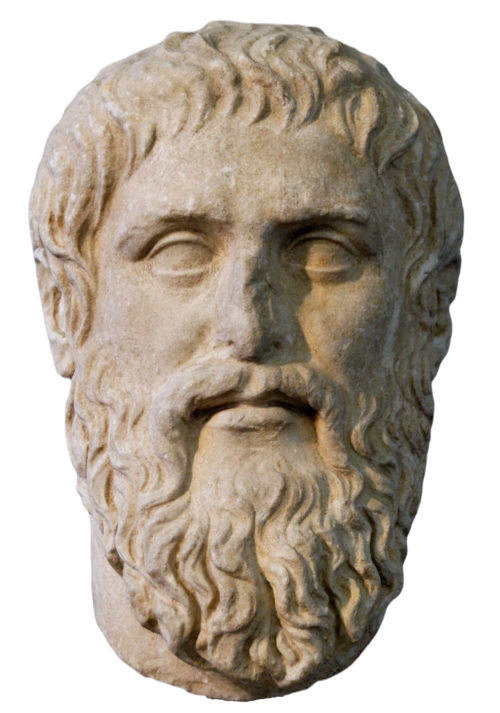
Where does mathematical knowledge come from? Plato believed that our souls existed in the realm of the Forms before we were born. In this pre-birth existence, we enjoyed direct contact with mathematical entities (e.g. numbers), with the essences of things (e.g. the Form of Justice), and with the Form of the Good, which for Plato was Ultimate Reality and the source of mathematical and moral truth. When we grasp mathematical or moral truths, we recall our pre-birth acquaintance with mathematical and moral entities. In his dialogue The Meno, Plato conveys this with a beautiful story of an uneducated slave boy being led to mathematical knowledge.
Part of the reason Plato was led to belief in our pre-existence was that his metaphysical picture was very dualistic, with the imperfect physical world on the one hand, and the perfect world of the Forms on the other. If in our current existence we are separated from mathematical and moral entities, it’s hard to explain how we know about them. Positing a pre-existent state that we can recall is Plato’s attempt to solve this mystery.
But what if Plato had held the mystical view that the ultimate transcendent entity is somehow at the core of our being, plain to behold in the right state of consciousness, perhaps when the mind is calmed through prolonged meditation? If the Form of the Good – the source of mathematical and moral truth – were located at the core of our being, and as such were accessible to the conscious mind, then we perhaps wouldn’t need to posit pre-birth acquaintance with it to explain our mathematical and moral knowledge. More would need to be said, of course, but there is the beginnings here of an explanation of our capacity to discern eternal truths of mathematics and morality.
I believe this question is not just of historical interest. Platonism, about both mathematics and morality, is a popular position in contemporary academic philosophy. And yet its proponents, in my view, dodge the epistemological question of how we know these timeless truths of morality and mathematics. They don’t buy Plato’s story of pre-birth existence but they don’t tend to offer an alternative either. The average contemporary Platonist believes three things that, whilst not strictly logically inconsistent, are very hard to reconcile:
There is a transcendent realm of mathematical and moral entities outside of space and time.
These transcendent mathematical and moral entities do not causally impact anything in the physical world.
We spatio-temporal creatures have knowledge of these transcendent mathematical and moral entities.
If there is no contact between Platonic entities and our brains, how do we know about them? In contrast, for mystics who believe we have direct contact with something like the Form of the Good, our knowledge of transcendent reality is much less surprising.
Perhaps it’d be too much of a leap to argue for mysticism on the basis of our need to explain mathematical and moral knowledge. But there are many who already take mystical claims seriously, usually on the basis of mystical experiences, and I have recently been arguing that these experience-based beliefs are rationally defensible. At the very least, it would be a point in favour of a mystical conception of reality if it turned out that our mathematical and moral knowledge is deeply mysterious on a naturalistic view of the physical world but utterly unmysterious on a mystical view of reality.
I recently had a wonderful chat with the distinguished philosopher of mathematics Mary Leng that’s just gone out on my YouTube channel. Mary has very different strategy for dealing with our mathematical knowledge – mathematical fictionalism – but, as we got to at the end of our discussion, problems still remain. I raised my alternative mystical solution towards the end of our discussion – check out the discussion if you want to see whether Mary was persuaded.
It’s hard to talk about this stuff, because there is a cultural assumption that mystical claims are “woo woo” fluffy thinking that’s not intellectually serious. I believe this results from the fragmentation of the intellectual space which occurred when Galileo took consciousness outside of the domain of science to create mathematical physics. This was a good move, as it focused “natural philosophers” on a very specific task of mathematically describing the behaviour of fundamental physical entities, and this project has made extraordinary progress in the last 400 years. But this rightly celebrated success has resulted in everything outside of this narrow project being deemed unserious.
It’s time we returned to a unified worldview able to incorporate not only the claims of physical science, but also phenomena we know about in other ways: the reality of conscious experience, and the timeless truths of mathematics and morality. Accounting for our moral and mathematical knowledge in terms of the claims of mystics may turn out to be an important step in this reunification.
PLEASE SUBSCRIBE AND SUPPORT MY PUBLIC WORK FINANCIALLY IF YOU’RE ABLE.
“Galileo’s Error” is my book on consciousness and panpsychism:
My book “Why? The Purpose of the Universe” explores the spiritual implications of panpsychism.
No posts
Comments
Nothing yet. Say the first thing.
Sign in to join the conversation.