
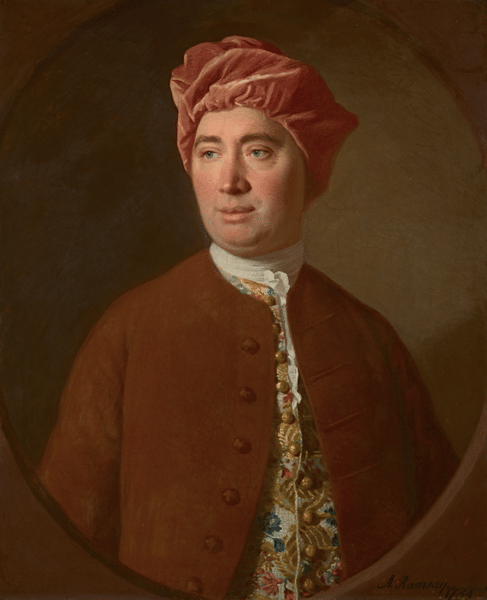
The 18th century Scottish philosopher David Hume put forward a theory of human motivation that remains highly influential to this day. On Hume’s view, motivation always bottoms out in desire. Reason is merely a tool for helping us to satisfy our desires. The desires themselves – at least our most basic desires – are not subject to rational criticism. As Hume put it, ‘Tis not contrary to reason to prefer the destruction of the whole world to the scratching of my finger.’
One big problem I have with Hume’s view is that the word ‘desire’ is used in different ways, and philosophers sympathetic to Hume are often unclear which they mean. Here are three different meanings of ‘desire’:
Yearning – A conscious craving for something. In a strong form, being driven by hunger or lust. In a weaker form, feeling enthusiastic about a trip to the cinema.
Psychological aim – A long-term decision to do something. Perhaps I have a fixed decision to volunteer every Wednesday in my neighbourhood – it’s something I ‘want’ to do – even though I don’t feel any pleasure from it and would rather be at home watching Netflix.
Preference – The fact that one enjoys something when one does it. Often this goes along with yearning for the thing but not always. Maybe I never feel like going for a long walk but I always enjoy it when I do.
Human motivation is a mix of all three of these things. The final category of preference is especially important, as once we take on board the role this plays in motivation, the Humean dogma that motivation always bottoms out in desire collapses. This is because, in the case of preference I am essentially motivated by a fact about the world, namely that I would enjoy (for example) a long walk. But if I can be motivated by the fact that I would enjoy something, I can also be motivated by the fact that somebody else would enjoy something. If I can be motivated by the fact that something will make me suffer less, I can be motivated by the fact that something will make someone else suffer less.
Humeans insist there’s always a desire in the background. Yes, I am motivated by the fact that I will enjoy walking in the country, but that’s only because I desire to feel good. But in what sense of ‘desire’? It can’t be the yearning sense because I don’t always yearn to feel good. The Humean could postulate a ‘desire’ in the psychological aim sense: I have made a long-term decision to feel good. But I don’t see the need for a deeper level of explanation here. The bottom-line is: I went for the walk because I knew it’d make me feel good. If someone says, ‘But why did the fact that you would feel good motivate you?’, I wouldn’t say, ‘Because I’m psychologically aimed at feeling good.’ I’d say, ‘What are you talking about? There’s nothing more to be said.’
If Hume were right, then we just happen to be psychologically aimed at feeling good, whereas we might have been psychologically aimed at feeling pain all the time, or psychologically aimed at counting as many blades of grass as possible (even though this brings us no pleasure). For Hume, all of these fundamental psychological aims are rationally on a par, and the job of reason is just to tell us how best to satisfy these fundamental aims.
To my mind, the Humean view of motivation makes no sense when you think it through in this level of detail. Yes, sometimes we do things because of our yearnings, or because we’re just psychologically directed at a certain goal. But a lot of the time we pursue things because they are worth pursuing. One’s own happiness is a worthwhile pursuit. So is the happiness of others, or scientific advancement, or creativity. We are motivated by these things not because we happen to ‘desire’ them but because they are worth doing. In contrast, pursuing one’s own pain for its own sake, or counting blades of grass for the sake of having blades of grass counted, are pointless activities, which is why we tend to avoid doing them.
Welcome to moral objectivism.
In case you’re not yet convinced, here’s a 2.5 hour debate I had on my podcast (Philip Goff Philosophy) with Humean philosophy YouTuber Alex O’Connor. If you ain’t got that long, here’s a 2 minute taster of our chat.
“Galileo’s Error” is my book on consciousness and panpsychism: https://www.amazon.co.uk/Galileos-Error-Foundations-Science-Consciousness/dp/1846046017
My book “Why? The Purpose of the Universe” explores the spiritual implications of panpsychism: https://www.amazon.co.uk/Why-Purpose-Universe-Philip-Goff/dp/0198883765
PLEASE SUBSCRIBE AND SUPPORT MY PUBLIC WORK FINANCIALLY IF YOU’RE ABLE.
No posts
Comments
Nothing yet. Say the first thing.
Sign in to join the conversation.