
Today’s post is a glimpse into what it is like to live with my particular style of learning disability, because to me the board was beautiful. I want you to understand that first.
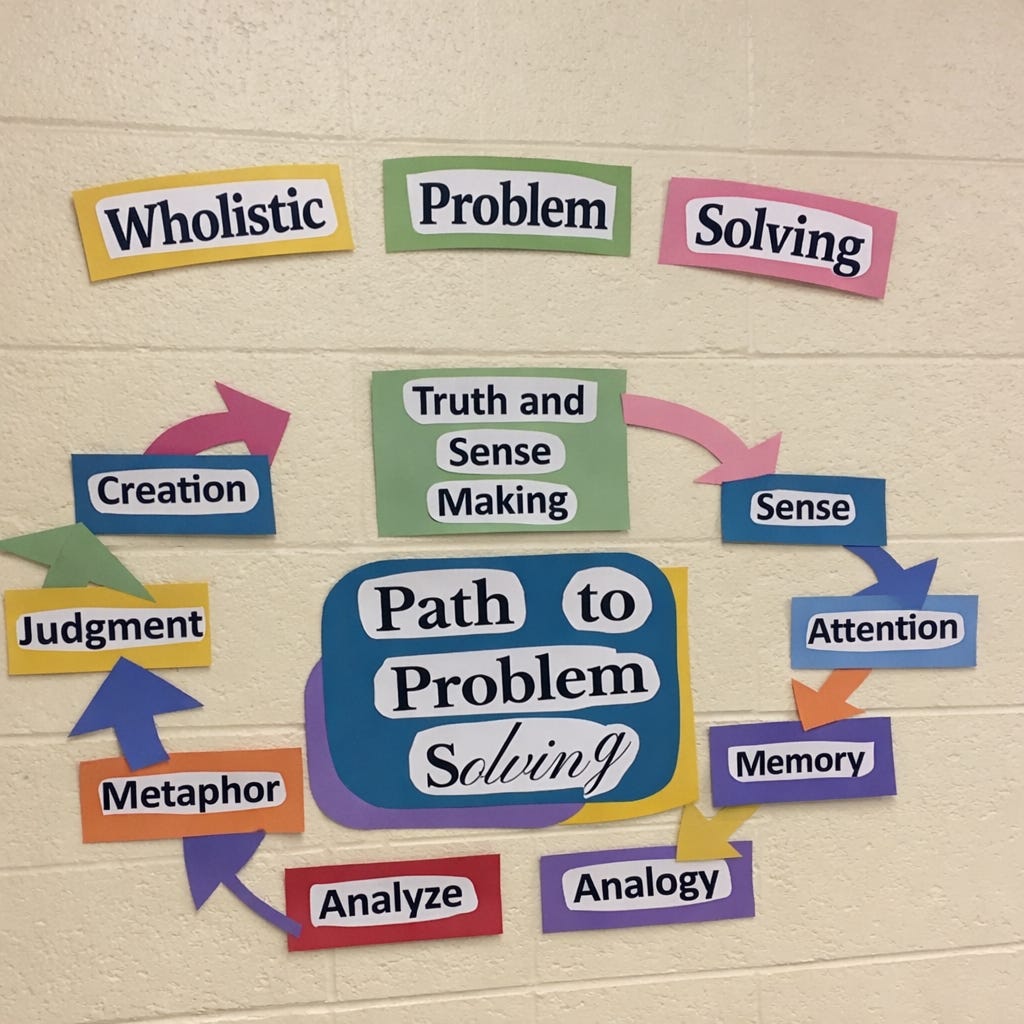
I had built a large visual model of the program and hung it on a blank spot of wall behind my desk, like a bulletin board. It laid out the kinds of thinking related to problem solving. This way if a student began demonstrating any one of those things, I could point at the wall and say, “there, that, right now, that’s what you’re doing!” Sort of catch them in the act of thinking. It made those abstract parts of the learning process that are generally invisible, visible. It was one of the better teaching tools I’ve ever made. And at the top, in letters big enough to read from the back of the room, was the name I chose for the program.
WHOLISTIC PROBLEM SOLVING.
And then Katie, my fantastic coworker, came in, looked at my board, and said, “Phil. Are you sure you want to spell it that way... I think it’s spelled holistic.” Katie was my biggest hero. My weakness was her strength. She was always helping me spot spelling mistakes that I just did not see, and as I reflect, she was probably the first person to see that this particular spelling mistake was not as clear-cut as some of my more usual run-of-the-mill spelling errors.
The Spiral
There’s a thing that happens in moments like this that I’ve come to call the spiral, and people who haven’t lived it get confused by the scale of its impact.
It is not proportional to the situation. When a typical person hears “you made a typo,” they feel a common flicker of mild embarrassment, which leads them to fix the mistake and get on with their life. The correction is a small object. It has edges. It stays proportional to the size it is.
For me, the correction does not stay the size it is. It expands. Within about four seconds the simple phrase, “you spelled a word wrong”, provokes my mind to go on alert. Throwing up things like: “you spelled a word wrong…on the wall.. In letters a foot tall!… in your own classroom!!! In front of the students you are supposedly teaching!!! On a program you invented!!!... and you did not notice… and you would never have noticed had someone not pointed it out… and how many other things out there have you not noticed!!! How many people have been quietly not telling you about it just to be polite!!! What exactly makes you think you should be teaching anybody anything?!?
That’s the spiral.
It goes down fast, and it goes down further than the error can possibly justify, and the terrible thing is that from the inside it does not feel like an overreaction. It feels like the truth finally arriving.
The confusing fact of the matter is the person who corrected me was being kind. They noticed something; they told me quietly, and they were genuinely trying to help. They did nothing wrong. And it still put me into a downward emotional spiral for the rest of the afternoon.
That gap between what a correction “costs” to give and what it “costs” to receive is one of the most underappreciated facts about living with a learning disability. Nobody has to be cruel about it. Despite Katie’s kindness to me that day. It still hurt. I think this is why certain dyslexics come off as being a little bit oppositional, and I am not totally sure if it is part of the biology or something that has been bred in through social forces and repetition. Wherever it comes from, I have had to learn to manage this heart-wrenching reality through the brutal instruction of life.
The rule I arrived at is when someone tells me I’m wrong, I start from the assumption that they have noticed something I missed. Because I do miss things. Especially with language. That is a real, documented, well-evidenced fact about my brain, and arguing otherwise has not worked out for me.
This is a genuinely useful metacognitive rule and I recommend it.
It has saved me from a great deal of embarrassment and a certain amount of unnecessary conflict. These days I tend toward a more reflective response, like “maybe I am wrong”, or “let me look into that.” It is a good rule of thumb that helps me avoid many of the pointless conflicts that I have historically found myself in.
But here’s the trouble with all rules of thumb: they have their shortcomings. Some aspect of how the world functions that is not dealt with by the rule. And the problem with this rule of thumb is that sometimes you can actually be right.
And when you have spent your whole life training yourself to assume you’re the one who missed something, because you spent an earlier portion arguing you didn’t without realizing what you have the capacity to miss, you realize you must, to avoid error, become very, very slow to take a stance in an area you know you are prone to errors in. Like spelling for me.
But sometimes your perspective is not the error. Sometimes your perspective is piercing something in “their blind spot”.
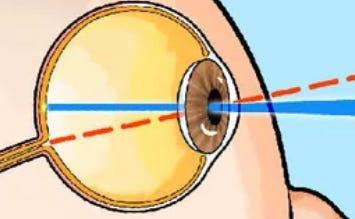
And we are truly looking at a blind spot here. At least for me, when it comes to spelling. However, you can have other neurocognitive blind spots. Like the dead spot in the center of our vision, because the optic nerve must connect to the eye in that spot. And just like that spot in our field of vision, these other neurocognitive blind spots are likely blended into the field of our other thoughts and experiences in a way that we do not notice the blind spot that is there even exists.(find your blind spot here)
It is telling, and often embarrassing, when we reflect upon what we did when we occupied that spot of holding a truth that lives in another person’s blind spot. Arrogance and ignorance often keep us from thinking about how we could let this other person know this information so they can actually receive it and not get upset or defensive, like you know you would get?. When you make that metacognitive turn, you suddenly realize the difference is not between right and wrong. In fact, it may not even be a disagreement over what the truth is.
What you are confronted with is not a disagreement at all. It’s a breakdown in communication provoked by a convention called a mistake. This is because what we are calling a mistake may not always be a mistake in the classic sense. It may simply occupy a gray area of meaning. And so from this perspective, dyslexia may not be a deficit of phonological understanding, but a surplus of potential symbolic meanings overlaid on those symbols.
If you can follow that logic, then you will really understand me when I tell you this is what was happening with the title of this bulletin board. My reflexive response was to take down the name. So I did, and then I couldn’t put it down. It didn’t sit right and this feeling fueled a bit of research on what is the correct way to spell Wholistic, or is it Holistic.
Wholistic Is a Word
So my first instinct was to check if wholistic was in fact a word (believe it or not, I do this sometimes, maybe someday I will write more deeply on this linguistic difference of mine in the future). But there it was. It was in the dictionary. I did not misspell anything.
And I would encourage you to go look it up yourself. Because when you do, you will find something I hope you can appreciate with the full comic effect I believe it deserves. Because as a dyslexic man who had just been told in hushed tones that he may want to check the spelling of a word on his bulletin board, I was exasperated. I turned to Marriam-Websters dictionary, and found I was oddly and ambiguously validated with the definition of wholistic. Which was holistic.
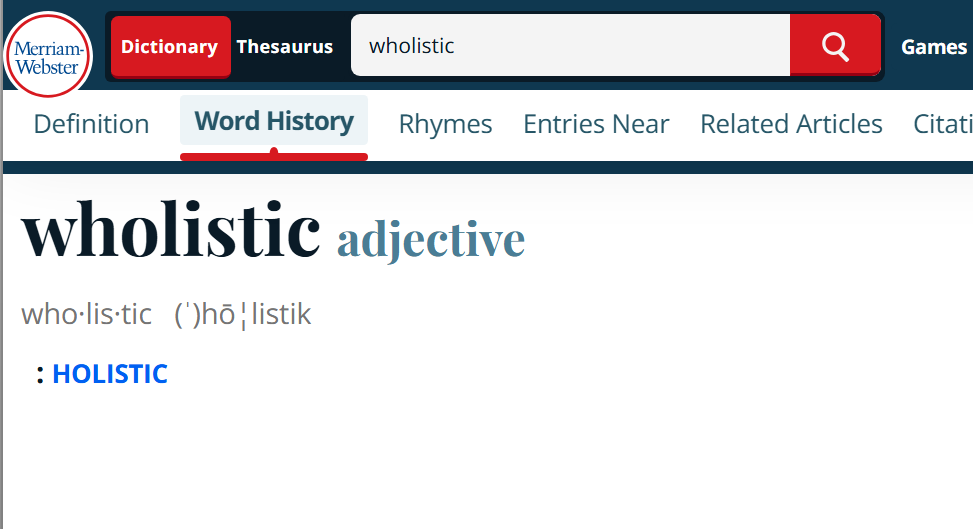
That was it. That was the definition. One word. Same sound, same meaning, different letters.
Linguistic anomalies like this are definitely why some of us with diagnosed learning disabilities occasionally get a bit loopy dealing with the spelling police. However, realize, dear reader, this was not enough to get me to put Wholistic backup. I reasoned that the dictionary says these are the same, and since people might complain about “Wholistic” I made a new title spelt “Holistic”.
Whole vs. Hole
But then I started really looking at the two words. Whole seemed to me to encompass everything. The totality. All the parts, together, making the thing. But hole… that was an empty space in the ground. It was nothing. Absence.
I had built a program about seeing a student’s entire experience,their strengths, their weaknesses, all at once, to gain the full picture, and I was being told that the correct spelling of that idea grows out of the root word “hole”. Out of a hollow empty space?
I wasn’t teaching a hole-istic approach. I was teaching a whole-istic one. To my eye, the standard spelling looked wrong. It looked like the opposite of what it was supposed to mean.
Now I was really confusing myself. So I looked up the etymology. What I found blew my mind. The word whole did not originally have a W in it. It originally came from the Old English word hāl; meaning entire, unhurt, sound, healthy. (It’s the same root that gives us hale, as in hale and hearty. And heal. And health. It’s a rich, generous little word.) In Middle English it was written hol, or hool.
The W shows up in the 15th century. Turns out Whole is what etymologists call a unetymologica. Meaning somebody just put it there. And why? Well, scribes added the W to keep the word from being confused with hole…You know, like the hole in the ground.
So I really did not misspell wholistic in the first place.
I made, a bulletin board in a special education classroom with the precise same judgment that produced the modern English word “whole” in the first place.
I can already hear pencil necks sharpening their pencils, so let me get out in front of them, because they’re not wrong if they come at me with something like, “Phil, ‘holistic’ doesn’t simply come from the English word ‘whole’ at all. It comes from the earlier Greek holos, meaning entire. You’re doing folk etymology.”
And to that I say, sure. That could be true. The word was built out of the Greek by a man who knew exactly what he was doing. “Holos” and “whole,” despite meaning nearly the same thing and sounding nearly the same way, come down to us through two entirely separate family lines. But notice what just happened. We have two things that are true at once. Neither W or H is an error. And yet the law of the language police requires one of them to be spelt wrong.
We live permanently inside a paradox of perception that is designed to help us perceive one thing or another. But sometimes we must hold, at the same time, two things as one. Perception struggles with these kinds of paradox. And in turn we all struggle with the knowledge that we are likely missing something, but paradoxically we must realize our flawed perspective might also be the thing everyone else is missing.
You cannot drop the rule of assuming you are wrong. Drop it and you become the guy who argues with the dictionary. But you equally cannot stop believing in your own perspective either. Drop it and you slowly stop trusting the one instrument you actually have to know with. One could lead you to create needless conflict and social isolation and the other could leave you spending your life deferring to rooms full of people who cannot see what you can see.
But it is difficult to hold both. Most processing is simply an either-or kind of thinking. So holding a balance between two things can be mentally exhausting if you are not used to it. Plus, insults and trauma can accumulate, exhausting our energy to remain vigilant even more. Because the corrections keep coming in. Maybe they are small ones, kind ones, well-meant ones, delivered in hushed and pitying tones by people who are genuinely trying to help, but each one lays down another thin coat of self-doubt, until you’re carrying around a varnish of it so thick that you can’t tell anymore which of your ideas are wrong and which are just yours.
And the cruelest part is that the person correcting you is usually right, and usually kind, and you usually do need the help.
I do need help with spelling.
I lack that automatic sense of a word’s correctness that the rest of the world seems to carry around for free. Katie understood that about me, and I appreciated it.
Her kind question about if I really wanted to spell it that way showed that she understood this.
That it could be both at the same time.
So I kept the spelling and put the original title back. Not out of spite… although to be honest, you could absolutely read it that way. I can imagine stubborn eleven-year-old me might have seized upon similar logic like this to get out of the need to rewrite it, because I just didn’t want to rewrite it.
But I kept it because Wholistic Problem Solving is a program about looking at a learner’s entire situation instead of just the medicalized slice of it. And its name, by pure accident of my own broken spelling instinct, permanently carries the thing it is trying to teach: that our language keeps forcing us to sort perspectives into “right” and “wrong” when what we are actually looking at is a “difference in where somebody is standing.”
That reflexive conversion, of different into wrong, is not a footnote when living with a learning disability, it is a demonstration of the mislabeling that is the core injury. It’s what builds the varnish quicker than anything. And I have some how been able to inject this meaning it into the name of my own program without even meaning to, which is either the best joke my dyslexia has ever played on me or it is the single most useful mistake it has ever produced.
Probably both.
Now there is a twist to this story. One that sort of sealed the deal with me, but to shareitwould have sent this whole discussion down a much different track, and it is a strange and dark one. Because somebody had to invent the word “holism” in the first place. And in this case it was in a book, written by a man who was a statesman, a soldier, and a philosopher. A man who built an entire worldview around the idea that wholes are greater than the sum of their parts, that things must be understood in their totality, that unity is the fundamental creative principle of the universe…He is also, by most accounts, one of the more grotesque hypocrites of the twentieth century. So next I will continue this discussion and tell you about the man who coined, “holism.”
Philip R. Hulbig, Ph.D.
Live Whole is where I’m building this book in the open, one piece at a time. If this cracked something open for you, or if you’re the kind of geek who wants to argue with me about Greek, the comments are right down there. I read everyone.

Comments
Nothing yet. Say the first thing.
Sign in to join the conversation.