
In my last piece I told you about how I went from being embarrassed that I may have spelt Wholistic incorrectly to feeling vindicated after doing a little research. Well I want to pick that story up where I left it, because what I found down was the holistic rabbit hole needs it on space.
When I went digging into where “holistic” comes from, I didn’t just find an etymology. I found a person. Somebody who sat down and built the word out of a Greek root, on purpose, and put it in a book, and the book was wildly popular and went on to shape how a whole century thought about holeness. A story that convinced me the wholeness I was building with this program in my classroom was not the same holeness.
Jan Christiaan Smuts was a South African lawyer who became a famous Boer commando general. So famous the British put a thousand-pound bounty on his head. Smuts fought the British across two thousand miles of open African veldtland and then, when the war was lost, despite being associated with the “bitter-enders,” a group of South African hardliners who refused surrender, he sat down in a tent at Vereeniging and talked his own comrades into laying down their arms. However, not as a surrender, he argued, but as the start of something larger.
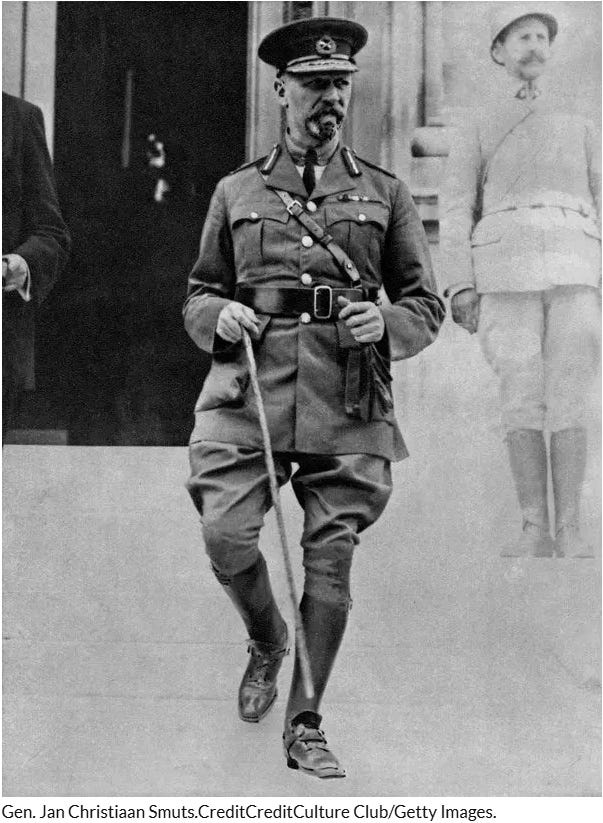
Within a decade, this guerrilla war veteran had become one of the most trusted men in the British Empire. He was Prime Minister of South Africa, twice. He was a British field marshal. He helped found the League of Nations after the First World War, and then helped found the United Nations after the Second. He is the only person to sign the peace treaties ending both world wars! Churchill adored him.
And in between all of that, he was working out a philosophy that he published in 1926, in a book called Holism and Evolution. And in it he coined a word we now use without thinking: holism. Built from the Greek holos, meaning whole, his argument was that nature has a persistent tendency to gather units into ordered wholes, and that when it does, something genuinely new appears. Something that could not have been predicted from the parts. Atoms into molecules. Cells into organisms. Notes into music. He said the hole isn’t just a pile of parts; it reaches back and changes what the parts are and how they behave. He even argued each hole has a kind of surrounding field, a penumbra of influence.
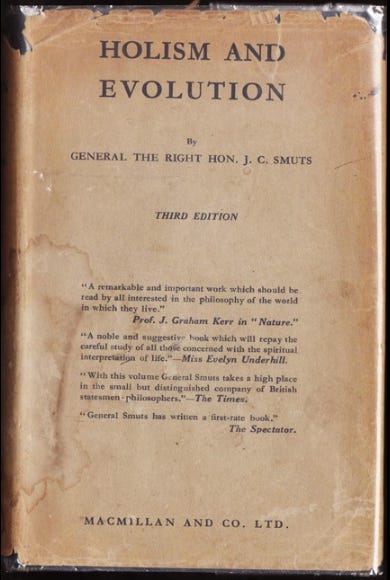
If you have ever heard anyone say “the hole is greater than the sum of its parts,” you have heard Smuts. His fingerprints are on systems theory, on ecology, on Gestalt therapy, on holistic medicine, on the vocabulary people reach for when they want to say that context matters and you cannot fully understand a thing by taking it apart.
The Other Word Smuts Helped Popularize
The earliest recorded use of the word apartheid is also attributed to Jan Smuts. It comes from a speech he gave in 1917. Yes, the man who gave the English language its word for wholeness also gave it one of the first airings of its word for apartness.
This really is a grotesque piece of linguistic irony, but I want to be careful here, because it would be tempting to just call Smuts the founding father of apartheid, but what I found turned out to be stranger than that, and instructive to the field of metacognition and psychology more generally.
Smuts did not build apartheid. Apartheid is the formal, legislated system constructed after 1948 by the South Africa’s National Party, and Smuts was the man they beat to do it.
However, what he did do was lay the foundation the Nationalist Party would later stand on. Smuts was an architect of South African segregation for forty years. He governed a state where the land was carved up by race, where Black South Africans were disenfranchised, where movement was controlled and enforced by laws, where the whole machinery of separation was assembled, piece by piece, on his watch and often by his hand. The history shows that few people did more than Jan Smuts to install the racially ordered government that emerged in 1910.
That is the author of Holism and Evolution. The philosopher of holeness. The man whose entire published worldview is that you cannot understand any part except in its relation to the whole, and that unity is the fundamental creative principle of the universe. A statesman who also described Black Africans as, “almost animal-like in the simplicity of their minds and ways.” And built a country and social order that deprived the majority of its citizens of the fundamental creative right to be wholly human.
1945: The Preamble
In May 1945, with Europe still smoking, Smuts went to San Francisco for the founding conference of the United Nations. Smuts was tasked and largely responsible for writing the UN’s Preamble. A document that opens by declaring the peoples of the world to reaffirm their faith in fundamental human rights. That the leaders of the world commit to preserving the dignity and worth of the human person.
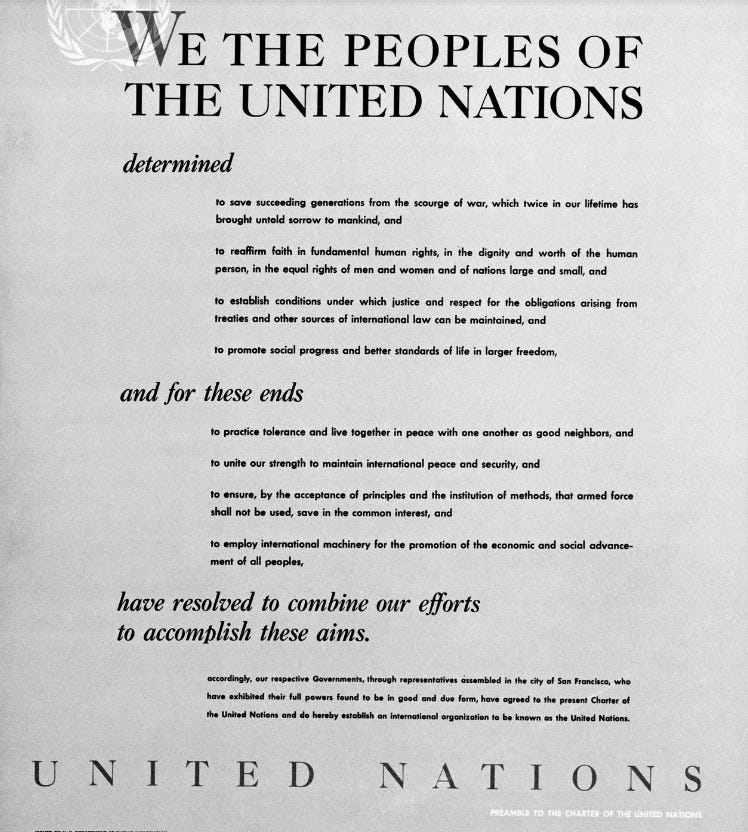
Human rights. Dignity. The worth of the human person. All ideas written, in significant part, by the Prime Minister of a state that denied all three.
We don’t have a clean descriptive word for what Smuts was expressing in this moment. “Hypocrisy” feels too small. Hypocrisy is what you call it when a man preaches temperance and drinks in private. Does that really compare to the actions of a man authoring the moral vocabulary of the postwar world with one hand while, administering the very machinery of human suffering and misery he was speaking against with the other?
1946: The Bill Comes Due
The divide between his rhetoric and his actions did not go unnoticed.
At the very first session of the UN General Assembly, in 1946, India brought a complaint against South Africa over its treatment of South Africans of Indian descent. The Assembly took it up in December, and affirmed that South Africa’s treatment of Indians had to conform to the Charter… The Charter whose Preamble Smuts had written.
He was condemned to his face, in the chamber he had helped build, on the strength of words he had written himself. He called it a bitter experience. And then he said this, the author of the preamble of the UN Charter, wrote he was, “exposed as a hypocrite and a double-faced” man.
He knew. He could see it, at least in the moment of humiliation, he was able to see what was occurring with total clarity. He watched these two irreconcilable halves collide in front of an audience of nations and he had the exact right word for what he was.
And there is a smaller moment from that same period that says even more about Smuts. The president of the African National Congress, Dr. A. B. Xuma, was in New York at the same time, lobbying against an aerial bombing, backed by Smuts, that killed more than 100 in South West Africa. The two men crossed paths at a press gathering. Xuma had traveled ten thousand miles to be in the same room as his own head of government and he is said to have remarked: “He (Smuts) talks about us but won’t talk to us.”
The philosopher of holeness would talk “about” the parts that made a hole. But he would not talk “to” the people who he wanted to believe where set apart from his philosophy.
The Twist Inside the Twist
In 1948, Smuts lost power. He was defeated by Daniel Malan’s National Party, who immediately began legislating apartheid into formal existence.
And one of the reasons Smuts lost, one of the things that was held against him by the electorate that removed him, was that he had backed the Fagan Commission. A commission that recommended relaxing some of the more egregious restrictions on Black South Africans. This made him unpopular with Afrikaner voters, while Malan’s pro-apartheid stance won the National Party the election. He lost narrowly, and in a fact that is ironic to our present political situation here in the US, won the popular vote without carrying the necessary certified votes to win the election.
Sit with that.
The man who gave us “holism” also gave us “apartheid.” A man who spent over forty years building the architecture of segregation was the same man who wrote human rights into the founding document of the modern world. A man who was ultimately condemned under his own words and in the end knew exactly what he was.
He was finally thrown out of office for being insufficiently committed to separation.
There is no clean moral here. Every direction you push on this man, he deforms. He is not a villain with a good idea, and he is not a good man with a blind spot. He’s a person. A person who espoused a philosophy that said you have to look at the whole person to be intellectually honest about how the world works, and this was precisely the thing he refused to grant anyone who wasn’t white the freedom to do.
So What Do I Do With the Word?
Here’s why I’ve spent three thousand words on a dead South African general.
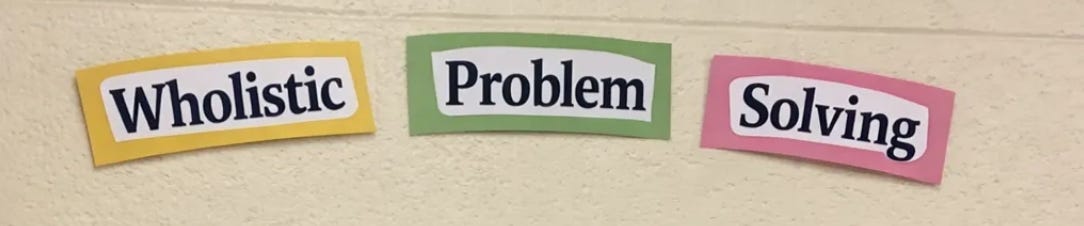
I built a program called Wholistic Problem Solving. Its entire premise is that you cannot understand a struggling learner by chopping them into diagnostic slices. That you have to hold the whole person, the whole history, the whole surrounding field, all at once. And the word at the top of my bulletin board traces back to a man who articulated that principle better than almost anyone, but then spent his life doing the exact opposite to millions of people.
Do I have to throw the word out?
I don’t think so. But I think you have to know. And I think there’s something in this story that is load-bearing for the whole approach.
Smuts proves that holding a beautiful theory of wholeness does not make you whole. He had the concept. He had it more precisely than his contemporaries did. He could describe emergence, interdependence, the way parts are transformed by the wholes they enter. And none of it reached his conduct. What he knew had no impact on how he regulated himself because he had drawn a line around who counted as a part of his whole, and everything outside that line was, to him, scenery.
That is not a historical curiosity. That is the single most common failure I see in education.
We have the theory. We have whole-child language coming out of our ears. We have mission statements about the dignity and worth of every learner that would not look out of place in a UN preamble. And then we build systems that sort children into slices, that fund the sorting, that hand a kid a list of deficits and call it a plan, and the gap between what we say about wholeness and what we do to actual children, in miniature, is Smuts’s gap.
The lesson isn’t that holism is tainted. The lesson is that a philosophy of wholeness is worth exactly nothing until you extend it to somebody it costs you something to include. Smuts wouldn’t. That’s the failure. Not the idea…the boundary he drew around it.
And One Last Thing About the Spelling
I’ve been building toward this since the last post, and now I get to say it.
Holistic is his word. He made it, out of Greek, and he made it while he was busy being the man I’ve just described. That H comes down to us from ‘holos’, and it comes to us ‘through him.’
Wholistic is my spelling, the one I got quietly pitied for in a special education classroom. It doesn’t come through him at all. It’s built on the plain English ‘whole’: the word that meant ‘entire, unhurt, sound, healthy’, that gave us ‘hale’ and ‘heal’ and ‘health’, and that got its W in the fifteenth century for no reason except that some scribe decided wholeness should not be confused with a hole in the ground, which as a dyslexic is a consideration I appreciate.
That’s an older, humbler, more useful lineage. It isn’t the property of a great man. It belongs to whoever needed it.
I’m not going to pretend I chose my spelling for that reason. I chose it because my dyslexic brain looked at hole and said “that isn’t what I mean.” Everything else I found afterward.
But I’m keeping it now for that reason.
Philip R. Hulbig, Ph.D.
Next time we leave the etymology behind and get into the actual problem: what happened to education when we solved the wrong problem. See you then.
Live Whole is where I’m building this book in the open, one piece at a time. Comments are open, and if you know this history better than I do, I especially want to hear from you.
References
Heyns, C. (1995). The preamble of the United Nations Charter: The contribution of Jan Smuts. African Journal of International and Comparative Law, 7(2), 329–348.
Oxford University Press. (n.d.). Whole (adj.). In Oxford English dictionary. Retrieved July 23, 2026, from
https://www.oed.com/
Plaut, M. (2019, July 2). South Africa’s racist founding father was also a human rights pioneer. Martin Plaut. https://martinplaut.com/2019/07/02/south-africas-racist-founding-father-was-also-a-human-rights-pioneer/
Smuts, J. C. (1926). Holism and evolution. Macmillan.
United Nations General Assembly. (1946, December 8). Treatment of Indians in the Union of South Africa (Resolution 44 (I)). https://digitallibrary.un.org/record/209791
Link to the earlier article on the origins of Wholistic Problem Solving
Comments
Nothing yet. Say the first thing.
Sign in to join the conversation.