
Last Saturday morning, I was at my Go club in Heidelberg with two friends. We were training for an upcoming tournament, but because there were three of us, we had a problem: Go is a two-player game.
So we improvised. And what happened next helped me finally understand something that had been bugging me about AI for a long time.
If you haven’t played Go, and I realize most people haven’t, bear with me for a few paragraphs. I promise this is going somewhere.
Two players, black and white, take turns placing stones on a 19×19 grid. The goal is to surround empty space to claim territory. Stones that get completely surrounded by the opponent get captured and removed.
There’s no king to checkmate. Instead, a player is running multiple battles at once across the board. Building in one corner, defending in another, deciding when to cut losses somewhere and start fresh. Games can last 150 to 300 moves, and every one of them carries the weight of the ones before.
When a group of stones I’ve been building for twenty moves comes under threat, it’s visceral. I’m calculating, yes, but I’m also feeling it. The fear of loss. The faster heartbeat. The sting when I see a mistake too late.
That’s Go. Now here’s what happened.
Because we were three, we played a variant called Zen Go. Same board, same rules, one difference: instead of each player owning a color, we took turns alternating between black and white. So I might place a black stone on one turn, then play white on my next, potentially undermining the very position I just built.
We played a full game. The moves were sound. One color won.
None of us felt a thing.
Then we played normal games, and the room changed. Heartbeats quickened. Territory became my territory. An invasion felt personal. A group I’d been building for twenty moves was suddenly under threat, and it mattered. It was mine. I could lose it. I’d invested something real in keeping it alive.
If you’d looked at both games side by side, you might have called the Zen Go game better. It was cleaner, more “correct.” Three minds contributing, no one getting in their own way. But it left no impression on the humans playing it.
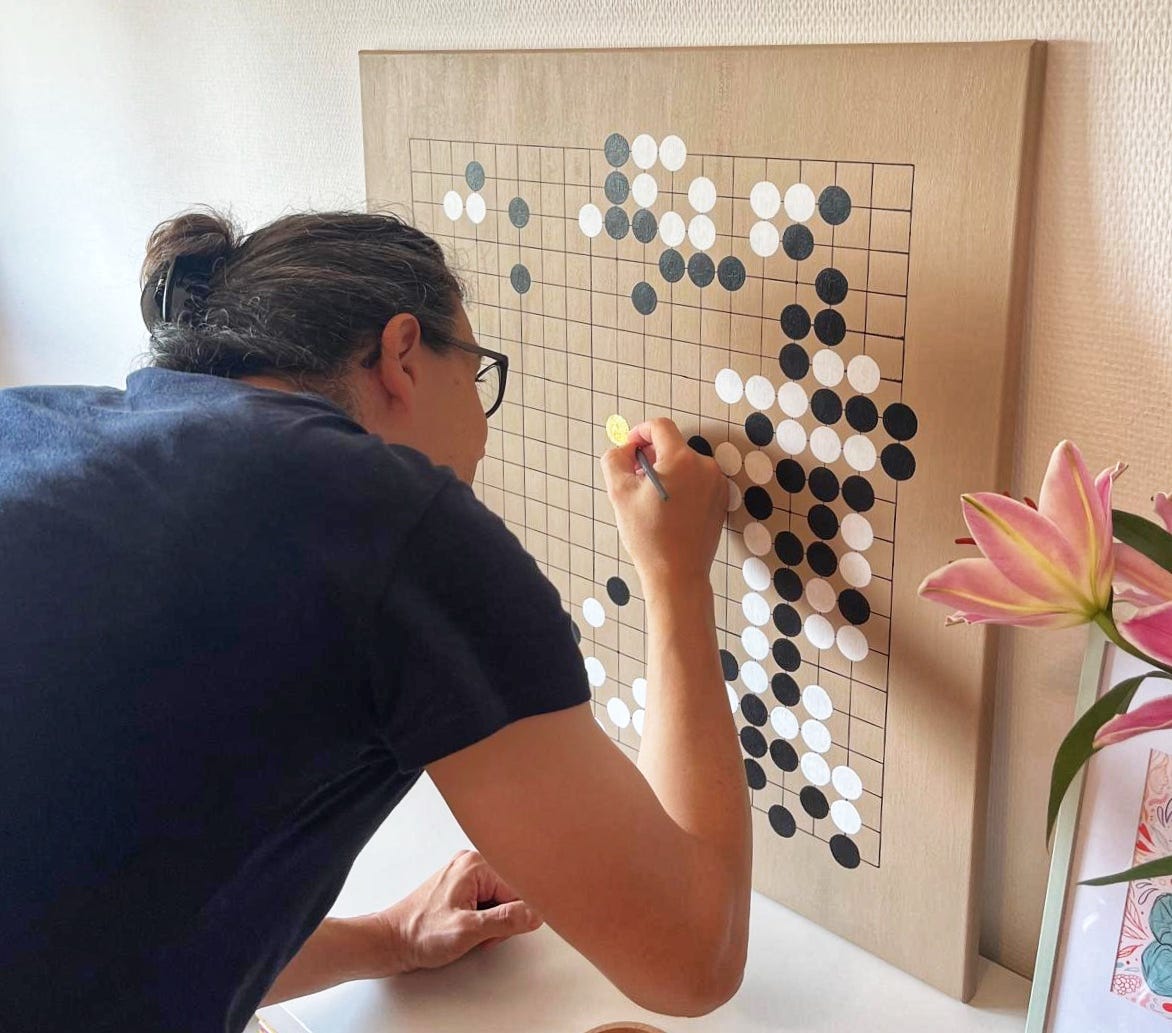
Here’s the thing that really struck me: it was the same three people playing both games. Same brains, same skill level, same Saturday morning. The intelligence at the table didn’t change between the Zen Go game and the normal games. This matters because when people talk about AI and creativity, the assumption is usually that it’s an intelligence problem. That once the models get smart enough, the gap will close. But our Zen Go game showed me something different. The gap isn’t about how smart the player is. It’s about whether the player has something to lose.
So what actually changed between the two games? Not the rules. Not the skill level. Not the board.
The easy answer is “stakes.” But I think that word is doing too much work. When I sat with it, I realized that what disappeared in Zen Go was actually five separate things, all at once. And they matter separately, because they’re absent in different ways when AI tries to write.
Ownership. These stones are mine. This territory is mine to defend. In Zen Go, no one owns a color. In AI writing, the machine doesn’t own what it produces. Everything else on this list depends on this one.
Emotional investment. Because when something is mine, it can be taken from me. That possibility is what makes my hands tense up when someone plays a stone near my corner. In Zen Go, there’s nothing to lose because nothing was ever mine. I might place a great stone, but on the next turn I could be working against it.
Narrative continuity. In a normal game, I’m threading a strategy across forty, sixty, a hundred moves. The twentieth move remembers the fifth. In Zen Go, three players alternating means no single mind is carrying an arc. Each move is good on its own, but no one is telling a story across the whole game.
A persistent self that can lose. Someone who accumulates experience across the game, carries the weight of earlier decisions, and can be cornered. Without that, there’s no desperation. And without desperation, there’s no courage.
Ego. This is the hardest one to talk about, and it might be the most important.
In a real game, I’m not just playing moves. I’m aware that my opponent is watching. That my choices say something about the kind of player I am.
When I’m writing my book, this gets far more intense. I think about specific people when I write certain sections. Former colleagues who will read the systems thinking chapters and judge whether I really understand this stuff. Friends who will read the personal stories and update their image of me. My daughter, someday.
The book is both the ideas and me, and people will judge both. That shapes everything. Which anecdote to include. How much to reveal. Where to hedge. Where to be bold.
Sometimes ego makes the writing worse. I over-explain because I’m afraid of being misunderstood. I hold back a story because it feels too exposed. But even when it gets in the way, it leaves a mark on the writing. Readers can tell when someone had skin in the game. They can tell when they didn’t.
An LLM has no social self. No one it’s trying to impress, no one it’s afraid of disappointing. You could probably imagine a computer having something like the first four things on this list, at least in theory. But ego? That’s just a human thing.
You can remove any one of those five things and the game still works. Remove all of them and the game still functions (the moves are legal, the rules are followed) but something essential is gone.
Here’s the connection to writing, and it’s the thing I keep coming back to: we don’t just read for information. We read to watch someone think through a problem. When you’re reading, you’re not feeling the writer’s emotions directly. But you can tell whether someone was actually working something out or just arranging words. There’s a difference, and most people can feel it even if they can’t explain it.
When that’s missing, the writing can be perfectly correct. But it’s the Zen Go game. Everything works. Nothing stays with you.
Go isn’t just a convenient metaphor here. It’s literally where the modern AI era started.
When AlphaGo defeated Lee Sedol in 2016, Move 37 in Game 2 became legendary. A move no human would have played, a shoulder hit on the fifth line that commentators initially called a mistake. It turned out to be the move that won the game. AI had crossed a threshold that most experts thought was decades away.
I’m not here to argue with any of that. AI plays Go better than any human ever will.
But the story doesn’t end at the scoreboard.
Two games later, in Game 4, Lee Sedol was already down 3-0. The match was lost. And then he played Move 78, a wedge in the center of the board that AlphaGo calculated only 1 in 10,000 humans would find. It massively increased the complexity of the position, triggered an error in AlphaGo’s search algorithm, and Lee won the game.
The DeepMind team spent the evening looking for bugs in their system. Their conclusion: there were no bugs. The “bug“ was that Lee Sedol came up with an ingenious move.
Both moves, Move 37 and Move 78, had a 1 in 10,000 probability. One came from a machine exploring beyond human conventions. The other came from a human who was cornered, outmatched, and playing with all five of the things I described above: ownership, investment, narrative, a self on the line, and an ego that knew the whole world was watching.
Lee Sedol lost the match 4-1. Within months, AlphaGo Zero came along and beat the original AlphaGo 100-0. From a technical perspective, Move 78 was a bug that got patched.
The scoreboard belongs to AI. Let the engineers have it; they earned it.
But the documentary, the one that made millions of people who’d never heard of Go cry, that belongs to Lee Sedol. Not because he won. He didn’t. Because he cared, and we could feel it.
Okay, enough about Go. Here’s where all of this actually connects.
I’ve been working on a nonfiction book about complex systems and emergence for about half a year, and I work closely with AI on it. Drafts, structures, ideas.
You’d think nonfiction is exactly where AI should shine. And in some domains, it does. Software documentation, medical references, legal briefs. In those cases, correctness is the whole game, and AI is genuinely excellent at it.
But the book I’m writing isn’t a manual. It’s an attempt to think through a set of ideas in public.
I’ve been thinking about these ideas for about fifteen years. How complex systems work, how emergence shows up in organizations, how all of that connects to design. This isn’t a book I decided to write six months ago. It’s a book that’s been forming for most of my career, and I care about getting it right in a way that’s hard to overstate. That’s exactly why I can’t hand it to AI and expect something that works. The writing needs to carry the weight of someone who’s been sitting with these ideas for a long time, not just someone (or something) that’s good at organizing them.
And that’s where things get interesting.
When AI drafts my chapters, the output is reliably correct. The ideas connect, the architecture holds. But when I read it back, something is missing. There’s no thread connecting the ideas to someone who wrestled with them.
Even in nonfiction, the reader needs to feel that someone understood this, not just put it in the right order. There’s a difference between a person who struggled to figure something out and then explains it, and a system that was never confused in the first place. You can feel that difference when you read.
If you run the five components against AI writing, they’re all absent. No ownership. No emotional investment. No narrative continuity threading across the work. No persistent self that accumulates and risks. And no ego. No one on the other side of the screen who will be judged for what they wrote.
Every token is a Zen Go move. Good on its own. Unconnected to everything around it.
I’m not alone in noticing this. The writer Jasmine Sun recently interviewed people building AI writing tools for The Atlantic and arrived at the same conclusion: stakes are the one thing you can’t engineer. Even Sam Altman and Dario Amodei, who will confidently predict that AI will transform science, math, and coding, tend to hedge when it comes to writing. The people with every reason to overclaim are pulling their punches on exactly this.
Funny enough, I was actually listening to Sun’s Hard Fork interview on my bike ride home from the Go club that same morning. Something about hearing her say that while I still had the Zen Go game fresh in my head made the whole thing click.
I should say something obvious: this piece about the limits of AI creativity is being written with AI. Not by AI, but with AI.
And that’s not a contradiction. If anything, it’s the point.
Something happens in sustained human-AI collaboration that isn’t captured by “AI generates, human edits.” There’s a back-and-forth. The AI surfaces structures and connections I might not see on my own. I bring the ownership, the ego, the fear of getting it wrong, the question of why any of this matters.
I’ve had moments where the work wasn’t generated from a prompt at all. It was more like it was harvested from months of accumulated conversation. Shared references that didn’t need footnotes. A texture that built up from showing up day after day and thinking through the same problems together. Writing came out of that context that no instruction could have produced.
That doesn’t make the problem simpler. It makes it weirder. Because if the five things I’ve named are genuinely absent from AI, then what is this other thing that sustained collaboration produces? I don’t have a clean answer for that.
The Zen Go game was hollow and the real game was alive, and the difference was everything I’ve described here: ownership, emotional investment, narrative continuity, a self that persists, and the ego that comes with knowing people will read this and think something about you.
In the domains where correctness is the goal, AI is extraordinary and getting better fast. Those are Zen Go domains. The quality of the output doesn’t depend on who made it.
But in writing, even nonfiction, even a book about systems and science, correctness alone produces something that technically works but leaves no impression.
AI gave us Move 37. Lee Sedol, already defeated, answered with Move 78. The game needed both moves to become a story.
What we’re still figuring out is what it means to play that game together.
No posts
Comments
Nothing yet. Say the first thing.
Sign in to join the conversation.