
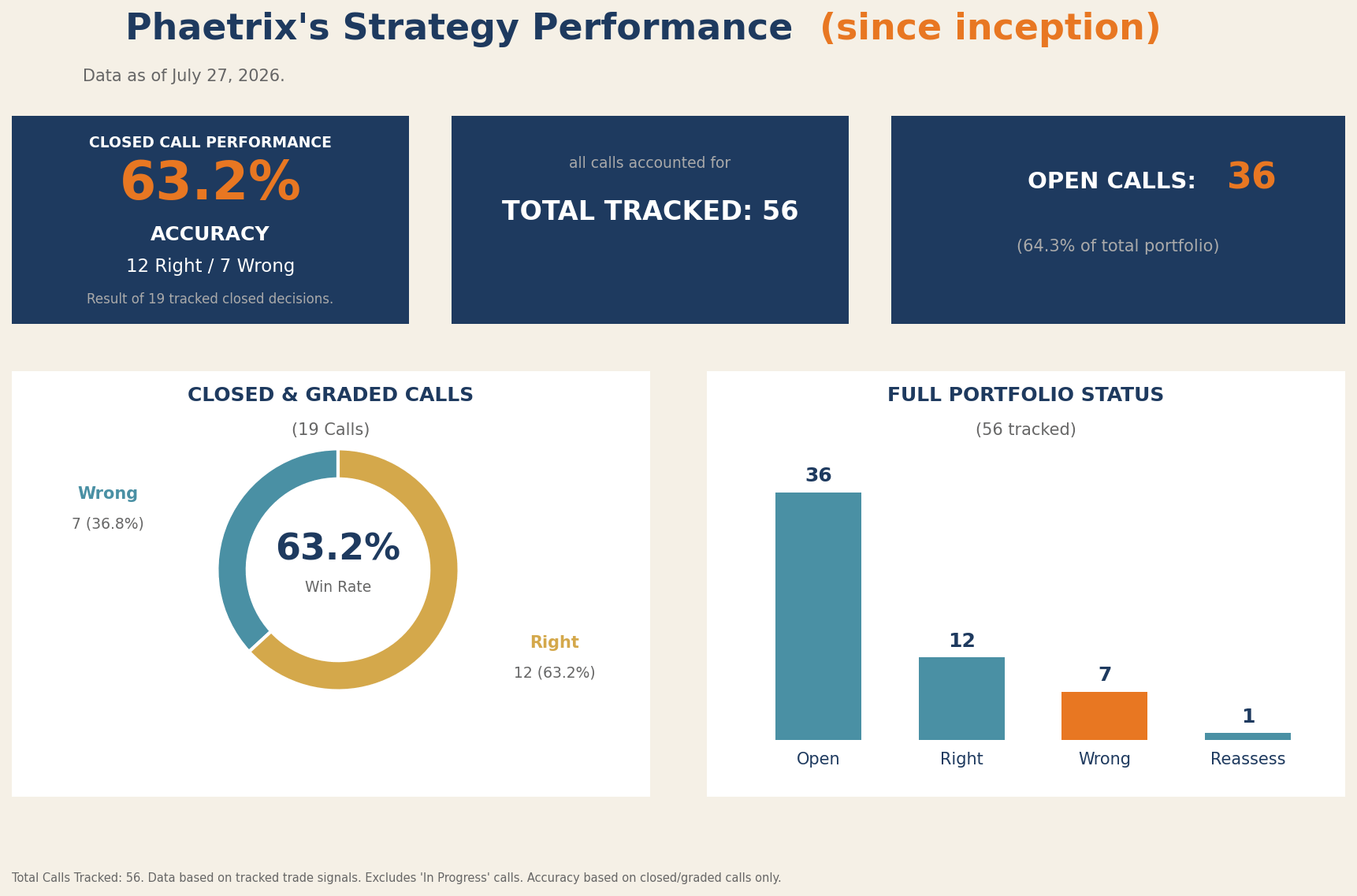
My public Scorecard tracks 56 calls. Of the 19 that have been closed and graded, 12 were right and seven were wrong—a 63.2% accuracy rate as of July 27, 2026.
That is a positive record, but the seven misses still matter. Several were not isolated mistakes; they revealed the same weakness in how I classified different kinds of growth businesses. Publishing this analysis is part of the reason I maintain the Scorecard: not to prove I am always right, but to identify recurring errors and improve the process before I repeat them.
CRWD, GOOGL, and PANW belong here. With CRWD I focused too heavily on valuation and underestimated the durability of recurring cybersecurity demand, the quality of execution, and the stickiness of the business itself. With GOOGL the concerns about elevated capex and free-cash-flow pressure were valid, yet I underweighted the durability of the advertising and cloud cash engine that funds that investment. With PANW I gave too much weight to acquisition and integration risk and too little to platform strength, customer consolidation trends, and the underlying demand for cybersecurity.
A proven compounder must prove durability. When the business continues to grow into its multiple, the market is often willing to keep paying the premium. I treated the valuation discomfort as a stronger signal than the ongoing evidence of compounding.
INTC sits in this category. I focused on the absolute weakness of the business and waited for more complete proof of recovery. The market did not. It began repricing the improving direction well before the turnaround was finished.
A turnaround must prove improving direction. Absolute results can still look imperfect while the trajectory is already shifting enough for the stock to re-rate. Waiting for full repair is a reliable way to miss that move.
CAT requires a special note. Caterpillar is not normally called a growth stock, and that label was part of the analytical mistake. I viewed it through its historical identity as a cyclical industrial. The market increasingly priced a different set of drivers: power generation, data centers, grid investment, and infrastructure demand.
I was thinking about the old sector. The market was pricing the new demand layer. A cyclical company in this position must prove that the new demand is durable. Historical sector classifications can lag the actual earnings drivers, and the old cyclical discount can compress faster than expected once that durability becomes visible.
RBLX and SNOW fall into this group. With RBLX I gave engagement, users, and platform potential too much credit before the company proved it could convert usage into durable earnings. With SNOW I focused on long-term cloud demand while underweighting dilution, stock-based compensation, slowing growth, and the need for cleaner operating leverage.
An emerging platform must prove shareholder economics. Growth is necessary but not sufficient. At some point the growth has to show up in the economics that matter to owners. Giving the narrative full weight while treating the path to cash returns as secondary is how patience turns into a costly habit.
The risks I identified in these names were often real. Valuation was elevated in places. Execution risks existed. Dilution and weak operating leverage were measurable. The error was misjudging which risks the market cared about most at that stage, and which positive developments it would begin pricing before complete proof arrived.
Valuation still matters. It simply becomes useful only after the business has been correctly classified and the relevant evidence for that category has been identified.
The practical adjustment is not to become more aggressive or more cautious. It is to stop asking every growth company to prove the same thing.
A proven compounder must prove durability. A turnaround must prove improving direction. An emerging platform must prove shareholder economics. A cyclical business gaining a new demand layer must prove that the demand can last.
That classification has to come before valuation. Otherwise, a high multiple can look like thesis failure, temporary weakness can hide a genuine inflection, and strong growth can distract from poor economics.
The risks I identified in these seven companies were often real. The mistake was treating those risks as equally important across every stage of the business—and assuming the market would care about them on my timetable.
That is what I need to correct.
Sometimes I was too cautious. Sometimes I was too patient. The recurring error was not valuation itself. It was valuing the wrong evidence at the wrong time.
Phaetrix publishes research, analysis, and market commentary based on my personal investment process.
This site is not financial, investment, tax, or legal advice. I am not acting as your advisor, and nothing here is a recommendation to buy, sell, or hold any security.
The content reflects how I think through decisions — including what I’m watching, what I believe, and what could prove a thesis wrong.
I can be wrong. Setups can fail. Markets can move quickly.
Losses — including permanent loss of capital — are possible.
Past performance, historical analysis, and examples are not guarantees of future results.
I may hold, have held, or trade securities mentioned on this site at any time without notice. Positions and views may change as new information becomes available.
All content is provided for informational and educational purposes only.
You are responsible for your own research, decisions, and outcomes.
If you act on anything presented here, you do so at your own risk.
Invest carefully. Protect capital first.
Comments
Nothing yet. Say the first thing.
Sign in to join the conversation.