
Yields as of July 28, 2026. Source: Charles Schwab Stock Screener, S&P 500 universe.
A 6% dividend yield can be income.
It can also be a warning.
Yield has two parts: the dividend and the stock price.
The company does not have to raise the dividend for the yield to rise.
The price only has to fall.
That means a high-yield screen naturally pulls in companies whose prices have fallen enough to push the percentage higher.
Something happened.
The interesting part is figuring out whether the market went too far or whether the yield is simply compensation for owning the problem.
Safe is the low bar.
I am not satisfied knowing a company can keep paying me.
I want to know whether it can pay me and still become more valuable while it does.
Income investors may disagree with that standard.
Fair enough.
If dependable current income is the objective, accepting slower growth can be a perfectly rational trade.
It is not the trade I am looking for.
I want the cash.
I also want the business left behind after the cash leaves.
PFE — Pfizer — 6.97%
ARE — Alexandria Real Estate — 6.77%
VICI — VICI Properties — 6.73%
GIS — General Mills — 6.66%
KHC — Kraft Heinz — 6.10%
VZ — Verizon — 5.98%
MO — Altria — 5.82%
UPS — United Parcel Service — 5.81%
CMCSA — Comcast — 5.79%
AMCR — Amcor — 5.75%
CCI — Crown Castle — 5.73%
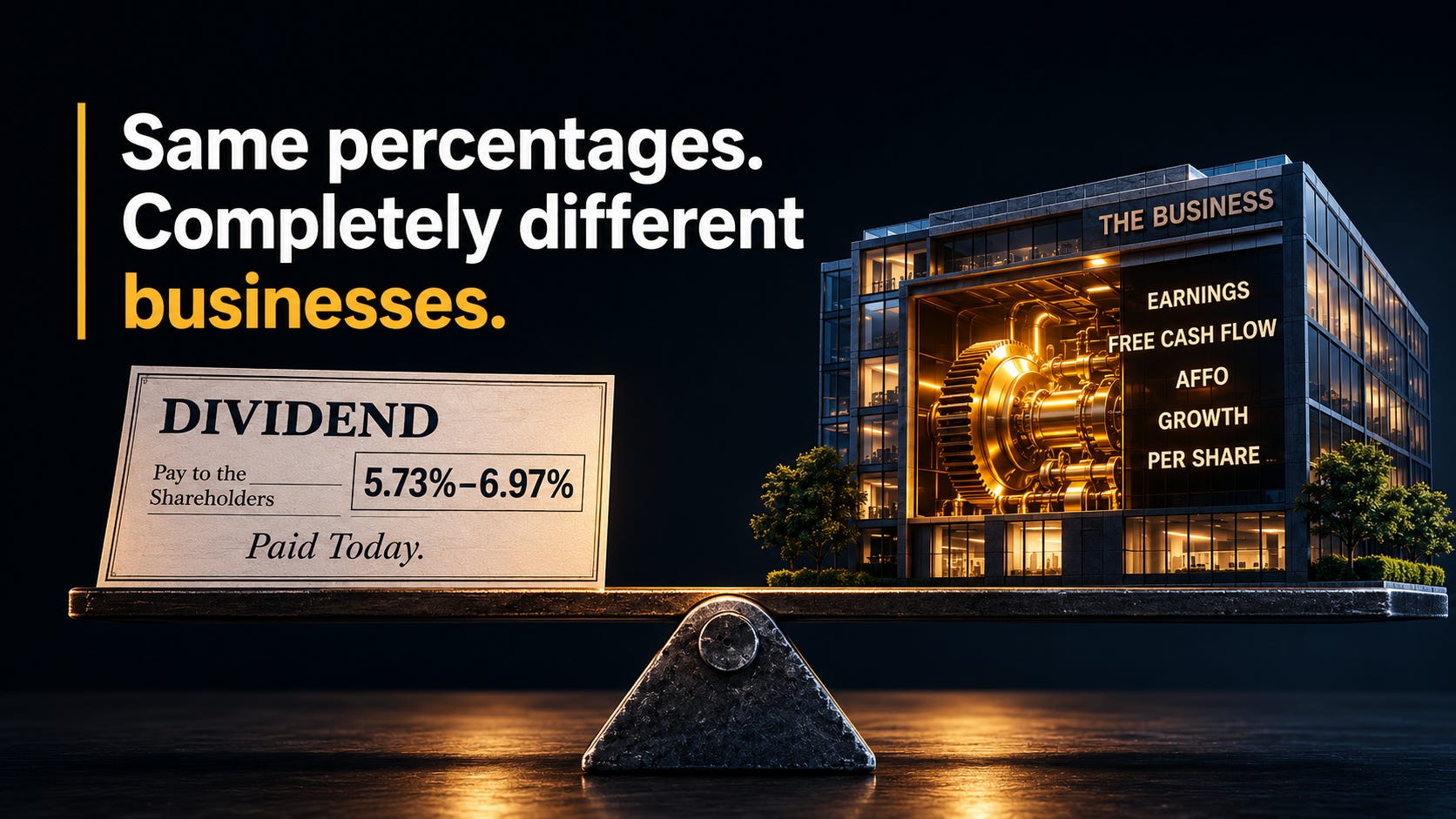
Barely more than one percentage point separates the top from the bottom.
The businesses underneath those percentages could hardly be more different.
Three questions.
Can recurring cash flow fund the dividend across a cycle?
For most operating companies, I am looking at free cash flow after capital spending.
For REITs, AFFO or FFO is the better measure because depreciation makes GAAP earnings a poor proxy for dividend capacity.
The percentages are not intended as one perfectly comparable payout ratio across eleven different businesses.
They answer a narrower question: how much of the cash engine appropriate to that business is already committed to the dividend?
What is left afterward?
A dividend can be safe and still consume so much of the company’s economic output that little remains to increase per-share value.
Is what remains actually producing growth per share?
EPS.
Free cash flow.
AFFO.
Per share.
Not revenue bought with more shares.
Not promised synergies.
Not a cost-cutting plan labeled growth.
And there is one more piece.
For every company, I want to know what would tell me the story has changed.
Pfizer returned $9.8 billion through dividends in 2025.
Operating cash flow was $11.7 billion.
Before capital spending, the dividend consumed roughly 84% of operating cash flow.
At the same time, Pfizer still has to fund the research and business development needed to rebuild the growth engine.
That is the tension.
The company can pay the dividend.
The harder question is how much flexibility remains after paying it while trying to replace the earnings that disappeared with the COVID windfall.
The nearly 7% yield does not solve that problem.
It is one of the reasons I want to understand it.
What would change my view: free cash flow begins growing materially faster than the dividend while new products start replacing the earnings that have been lost.
Until then, I see a large payment attached to a business that still has something to prove.
UPS makes the cash problem harder to ignore.
In the first quarter, operating cash flow was $2.22 billion.
Capital expenditures were $1.03 billion.
That leaves roughly $1.19 billion before other adjustments.
UPS paid $1.35 billion in dividends during the same quarter.
The dividend was larger than the cash left after capex.
One quarter does not define the business.
But it tells me where to look.
UPS still needs the operating recovery.
The dividend cannot substitute for one.
This is where high yield can fool you.
The check arrives while the business problem remains.
What would change my view: trailing free cash flow moves comfortably above the annual dividend while operating margins recover.
I want the coverage restored by the business.
Not merely by spending less.
Dividend investors spend a lot of time worrying about cuts.
I think there is another risk that gets less attention.
Nothing gets cut.
Nothing grows either.
General Mills generated $1.63 billion of free cash flow in fiscal 2026.
It paid about $1.3 billion in dividends.
Roughly 80% of free cash flow went to the payout.
That dividend is not disappearing tomorrow.
The harder part is what happens to the remaining 20%.
Organic sales fell 2% for the year.
Management is now targeting billions in cumulative cost savings.
Cost savings matter.
But they are not demand.
They can defend margins while the business underneath them goes nowhere.
What would change my view: organic sales return to sustainable growth and free cash flow per share rises with them.
If the payout stays near 80% while growth still depends primarily on removing costs, the 6.66% yield is doing most of the work.
Kraft Heinz is almost the opposite.
Cash coverage is not the obvious problem.
Free cash flow reached $3.7 billion in 2025.
The dividend consumed roughly half of that.
Plenty of cash remains.
But organic sales fell.
Adjusted operating income fell.
The company is now spending more on marketing, sales, R&D and product investment in an effort to restore growth.
That makes Kraft Heinz useful for this argument.
The company has cash left after the dividend.
Now it has to prove it can do something productive with it.
A covered dividend attached to stagnant per-share economics is still not what I am looking for.
What would change my view: the additional investment produces organic sales growth first, followed by higher per-share earnings and cash flow.
Until then, the dividend is covered.
The compounding case is not.
Two names on this list have already been through the part income investors fear.
They cut.
Alexandria reduced its quarterly dividend from $1.32 to $0.72 at the end of 2025.
That was a 45% cut.
The reset made the payout much easier to support.
By the first quarter of 2026, the dividend represented roughly 42% of quarterly FFO.
Coverage has been repaired.
Now comes the harder part.
A dividend cut does not automatically improve the underlying property economics.
It simply leaves more cash inside the company.
That cash has to accomplish something.
For Alexandria, leasing, occupancy and development activity eventually have to show up in FFO per share.
What would change my view: sustained FFO-per-share improvement following the reset.
If the dividend is safer two years from now but FFO per share is still going nowhere, the cut bought time.
It did not create a turn.
Crown Castle also reset its dividend.
The current annualized payout is $4.25 per share.
Management’s updated 2026 AFFO guidance is about $4.59.
That still puts the payout around 93% of expected AFFO.
That is not much room.
Second-quarter AFFO per share increased 11%.
That looks like exactly the number that could let me declare the reset worked.
Then I look underneath it.
The increase was driven primarily by lower interest expense and higher interest income following the sale of the fiber and small-cell businesses.
Site-rental revenue is still expected to decline roughly 5% this year.
The per-share number improved.
The tower engine did not suddenly grow 11%.
That distinction matters.
What would change my view: leasing and organic tower economics begin driving AFFO-per-share growth strongly enough to push the payout ratio down without another dividend cut.
Until then, the reset improved sustainability.
I am not convinced it restored compounding capacity.
This is where the clean argument starts getting messy.
That is useful.
Verizon is the name I have the hardest time putting in either pile.
The cash flow is strong.
Free cash flow was $20.1 billion in 2025.
And the operating numbers have improved sharply in 2026.
Verizon added 184,000 postpaid phone customers in the second quarter, its best Consumer second quarter in five years.
It added 348,000 broadband customers.
First-half free cash flow increased 16% to $10.2 billion.
Those are real improvements.
I am still not ready to call it a durable turn.
A year earlier, Consumer postpaid phone net adds were negative.
And even with the recent improvement, mobility and broadband service revenue grew only 2.8% in the second quarter.
That is why Verizon does not clear my bar yet.
The dividend is not the concern.
The growth engine is.
What would change my view: another year of subscriber gains accompanied by accelerating service revenue and higher free cash flow per share.
If customers improve but the economics barely move, the subscriber turnaround has not solved the problem I care about.
Altria is the company that makes this argument uncomfortable.
In 2025, operating cash flow was about $9.29 billion.
Capital expenditures were only $216 million.
That puts free cash flow at roughly $9.1 billion.
Altria paid about $6.96 billion in dividends.
So the dividend consumed roughly 77% of free cash flow. (Altria Investor Relations)
There is not a huge amount left afterward.
And yet the per-share economics have continued to grow.
The mechanism matters.
Cigarette volumes decline.
Pricing and a shrinking share count have helped offset that decline.
The company sells fewer cigarettes and still manages to increase what each remaining share earns.
That is not financial magic.
It is a business extracting more economics from a shrinking base.
It can work.
The question is how long.
What would break it: free cash flow per share stops growing while the payout continues climbing.
The year pricing and buybacks can no longer offset the underlying volume decline is the year this becomes a very different dividend story.
That is not really a dividend question.
It is the business.
Which is the point.
Amcor has too much moving underneath the numbers for me to pretend the answer is obvious.
The Berry acquisition transformed the company.
Adjusted EPS is growing and management expects substantial acquisition synergies.
Then cash flow complicates it.
Management lowered full-year free-cash-flow guidance as higher inventory absorbed more cash.
That is why I am not giving the adjusted EPS number full credit yet.
The dividend is paid in cash.
Eventually the synergies need to become cash too.
What would change my view: the margin and EPS improvement survives while free cash flow recovers toward the earlier guidance range.
Until then, 5.75% could be attractive income.
It could also be compensation for integration risk.
I do not have enough evidence yet.
By this point, my objection to high-yield stocks looks pretty good.
High payouts.
Weak growth.
Dividend resets.
Businesses that still need a turnaround.
Then I get to VICI and Comcast.
Neither fits neatly into that argument.
VICI currently pays $0.45 per quarter, or $1.80 annualized.
Management expects 2026 AFFO of $2.44 to $2.47 per share.
That puts the payout around 73% to 74% of AFFO.
That leaves room.
More importantly, the room is producing something.
First-quarter AFFO per share increased 4.5%.
The dividend has also increased every year since VICI became public.
This is what I wanted to find.
The company is paying me a high yield without distributing everything it earns.
And per-share earning power is still moving forward.
That does not make VICI risk-free.
It does make the 6.73% mean something very different from Pfizer’s 6.97%.
What would break it: VICI keeps issuing capital and buying assets while AFFO per share stops growing.
If the portfolio gets bigger but each share stops owning more earning power, the mechanism is gone.
For now, it is still there.
Comcast is the one that pushes hardest against my bias.
Second-quarter free cash flow was $4.6 billion.
Dividend payments were $1.2 billion.
The dividend consumed only about 26% of free cash flow.
That is not what I expect to see attached to a yield near 6%.
The market’s concern is elsewhere.
Domestic broadband revenue fell 5.5%.
Comcast lost another 166,000 domestic residential customer relationships during the quarter.
At the same time, wireless added a record 448,000 lines, Business Services revenue grew 3.7%, Peacock became profitable, and free cash flow still increased 2.3%.
Now we have an actual argument.
Broadband is deteriorating.
Other businesses are offsetting part of it.
And the dividend is nowhere close to consuming the cash engine.
There is one more complication.
Comcast reduced its share count by 5% during 2025 through buybacks.
Then it paused the repurchase program while working through the separation of its businesses.
Good.
That gives me a clean test.
What I would watch: free cash flow per share after the buybacks slow.
If per-share cash generation continues rising without a 5% annual reduction in shares, Comcast has something stronger than financial engineering supporting it.
If it stalls, I will know how much of the prior per-share growth came from the shrinking denominator.
That is exactly the kind of question I want this screen to produce.
Eleven companies.
Yields ranging from 5.73% to 6.97%.
The screen made them look almost interchangeable.
They are not.
Pfizer and UPS make the yield look like compensation for a problem that still needs fixing.
General Mills and Kraft Heinz show that a dividend can be safe while the business underneath it struggles to compound.
Alexandria and Crown Castle have already cut their payouts.
The cuts repaired coverage.
They still have to prove the retained capital creates growth.
Verizon’s numbers are improving, but I want more than six months before I call it a turn.
Altria continues to make a shrinking underlying category work for the shareholder through pricing and per-share economics.
Amcor has not given me enough cash-flow evidence yet.
Then VICI and Comcast push back on my starting bias.
They are paying high yields without obviously consuming the engine that has to fund the next payment.
That is what I was looking for.
Not the biggest percentage.
A business that can hand me cash today without giving up tomorrow to do it.
Income investors may draw the line somewhere completely different than I do.
How much growth are you willing to give up for a dependable 6% yield?
That is where I expect some disagreement.
If the dividend were cut in half next quarter, would you still want the business at today’s price?
Phaetrix publishes research, analysis, and market commentary based on a personal investment process.
Nothing here is financial, investment, tax, or legal advice. Nothing presented is a recommendation to buy, sell, or hold any security.
The content reflects how decisions are analyzed, including what could prove a thesis wrong.
Markets move quickly. Setups fail. Losses, including permanent loss of capital, are possible.
Past performance and historical examples are not guarantees of future results.
Positions and views may change without notice as new information becomes available.
All content is provided for informational and educational purposes only.
Investors are responsible for their own decisions, research, and risk management.
Protect capital first.
Comments
Nothing yet. Say the first thing.
Sign in to join the conversation.